Achieving a Single Customer View in eCommerce: The 2026 Strategic Playbook

What if your customer data wasn't a static archive but a high-velocity engine capable of making autonomous decisions before you even see the dashboard? You've likely felt the friction of fragmented data across Shopify, Meta, and Klaviyo while CAC continues to climb and real-time LTV remains a moving target. In an era where NVIDIA's Groq 3 LPX is accelerating agentic AI at breakneck speed, achieving a single customer view in eCommerce is no longer a luxury; it's the prerequisite for survival. It is the fuel, the foundation, and the future of your brand's competitive advantage.
We understand the pressure of managing a tech stack where Shopify Scripts are gone and the California Delete Act demands instant compliance. This playbook will show you how to master the architecture of unified customer intelligence to eliminate data silos and fuel high-velocity agentic growth. We are going to break down the technical framework for zero-latency personalization and the automated media buying strategies that define the 2026 market leaders. Prepare to transition from manual oversight to systemic mastery. It is time to build, optimize, and win.
Key Takeaways
- Eliminate the "Data Silo Tax" by unifying fragmented signals to lower your CAC and protect margins against 2026 market volatility.
- Master the three tactical pillars of Identity Resolution, Behavioral Intent, and Transactional History required for achieving a single customer view in eCommerce.
- Transition from passive legacy CDPs to agentic growth systems that autonomously turn customer intelligence into high-velocity revenue.
- Execute a precision 5-step blueprint to audit your current data sources and anchor your customer identity directly into your Shopify ecosystem.
- Leverage managed AI transformation to strip away operational overhead and deploy a professional-grade revenue machine for your brand.
Beyond the Dashboard: Why Disconnected Data is Your Brand’s Greatest Liability
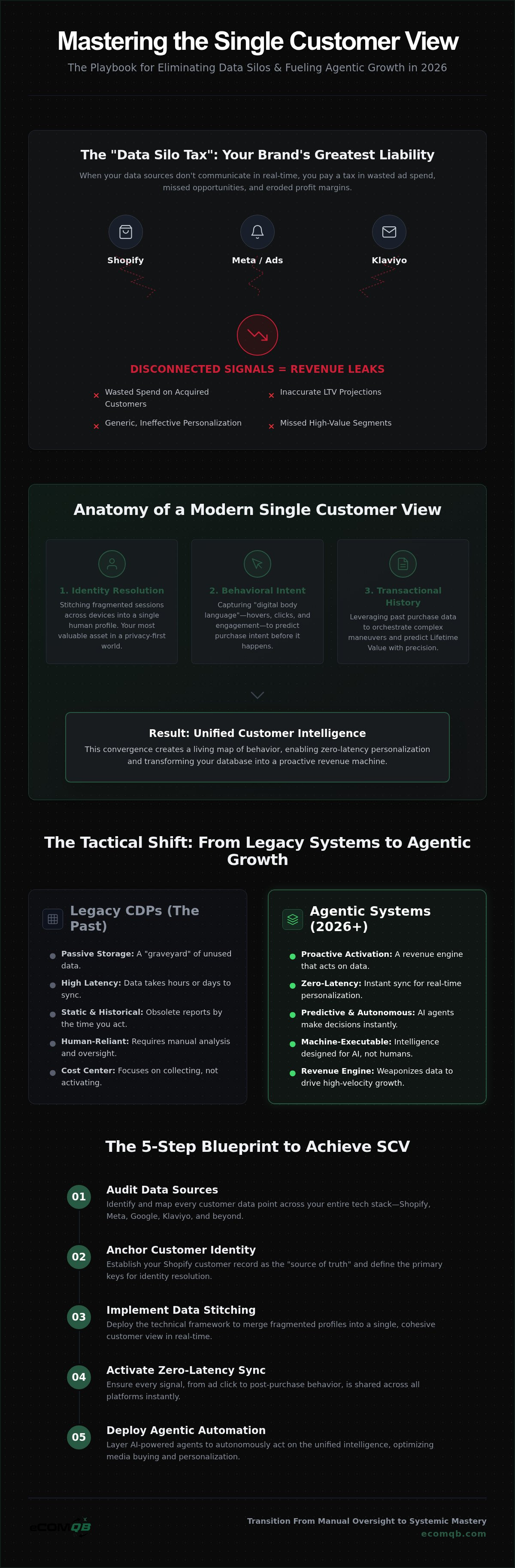
Every disconnected data point in your stack is a silent drain on your capital. We call this the "Data Silo Tax." When your Meta pixel doesn't talk to your Shopify backend in real-time, your media buying is flying blind. You waste spend on customers who already converted. You miss high-value segments that are ready to scale. You depress your LTV before the first shipment even leaves the warehouse. In the 2026 economy, achieving a single customer view in eCommerce is the baseline for high-velocity growth. It is the difference between a brand that reacts and a brand that dominates. Precision is no longer a choice; it is a mandate.
Most brands are drowning in dashboards but starving for execution. They look at historical reports that are already obsolete by the time the meeting starts. We are moving away from human-read charts toward machine-executable intelligence. If your data isn't ready for an AI agent to act upon it instantly, it is a liability. You must identify, isolate, and eliminate these revenue leaks before they compromise your trajectory. Precision is the only path to performance.
The Cost of Legacy Thinking in an AI World
Disconnected signals between Meta and Google create a feedback loop of wasted capital. Ad platforms that don't receive post-purchase data immediately continue targeting existing customers with top-of-funnel creative. This is the "Generic Content Trap." Industry research cited by Signifyd indicates that nearly eight in 10 customers expect a quality, consistent experience across departments, but more than half say those expectations aren't being met. Data latency isn't just a technical glitch. It is a direct tax on your bottom line that erodes your competitive edge and blocks your path to zero-latency personalization.
From Passive Storage to Strategic Mastery
Your CRM is likely a graveyard of unused data points. Storing information is a cost center; activating it is a revenue engine. Strategic mastery requires you to distinguish between "having data" and "possessing actionable intelligence." Achieving a single customer view in eCommerce transforms your database into a field general's map. It provides the clarity needed to orchestrate complex maneuvers, predict behavioral intent, and deploy capital with surgical precision. You must move beyond the "storage" mindset and focus on the "activation" layer. Stop collecting data. Start weaponizing it to fuel your agentic growth systems.
For brands in the education and services sector, achieving this level of integration is made easier with specialized platforms; you can learn more about eTalk.ai to see how they unify CRM, scheduling, and e-commerce into a single system.
The Anatomy of a Modern Single Customer View: Unified Intelligence for 2026
Forget the static spreadsheets of the past decade. In 2026, achieving a single customer view in eCommerce requires a dynamic, real-time identity graph that evolves with every click, swipe, and purchase. It is a living map of human behavior. This architecture is built on three tactical pillars: Identity Resolution, Behavioral Intent, and Transactional History. When these pillars converge, you move beyond basic demographics into the realm of predictive high-value customer modeling. You stop looking at what happened and start engineering what happens next.
Speed is your primary weapon. In a market where hardware like the NVIDIA Groq 3 LPX has redefined the limits of AI inference, "zero-latency" is the only metric that matters. If your data takes hours to sync across platforms, your personalization is already obsolete. You need a system that recognizes a high-value prospect the moment they land on your storefront and adjusts the entire experience to secure the conversion. This is the difference between a passive database and a proactive revenue machine.
The Identity Layer: Resolving the Anonymous Shopper
Your customers don't live in a single tab. They move across devices, browsers, and platforms with fluid speed. Stitching these fragmented sessions into a single human profile is the first step toward strategic mastery. As third-party cookies vanish and regulations like the California Delete Act tighten, your first-party data becomes your most valuable asset. It is the only way to maintain visibility in a privacy-first landscape. Identity resolution is the DNA of eCommerce personalization.
Behavioral Intent: Capturing the Digital Body Language
A customer’s "digital body language" reveals their next move before they make it. We track micro-interactions, such as how long they hover over a specific product image, which SMS links they ignore, and which email triggers they engage with, to predict purchase intent. Integrating these signals into a cohesive narrative allows your brand to meet the customer exactly where they are. This unified intent layer is exactly what fuels AI for Shopify personalization, ensuring every touchpoint is engineered for maximum conversion velocity.
Building this level of intelligence requires precision and technical expertise. If you are ready to audit your current data architecture and deploy a system designed for 8-figure velocity, book a tactical briefing with our team.
Legacy CDPs vs. Agentic Growth Systems: Choosing Your Tactical Architecture
Legacy CDPs are the "dumb" pipes of the previous decade. They collect, store, and display, but they don't act. For most 8-figure brands, these platforms become expensive shelfware because they lack the execution layer. Achieving a single customer view in eCommerce must serve a higher purpose than just populating a dashboard for a weekly meeting. It must fuel a system that moves at the speed of the market. While a CDP provides a map, an Agentic Growth System provides the engine and the driver. It is the difference between having a library and having a strategist.
Stop treating your data stack as a cost center. If your data science requires a team of humans to manually interpret signals before a campaign can launch, you've already lost the game. Strategic mastery in 2026 demands a shift toward fully managed AI stacks. These systems eliminate the operational overhead of DIY data science and turn your unified intelligence into a 24/7 revenue machine. You need data that knows how to sell, not just data that knows how to sit in a cloud warehouse.
The Execution Gap: Why Data Alone Isn't Enough
Insights don't pay the bills; execution does. The primary failure of "insight-only" platforms is the human intervention requirement. When a high-value customer segment is identified, a human still has to build the audience, design the creative, and launch the campaign. This lag is fatal. In contrast, agentic media buying leverages your SCV to scale spend autonomously based on real-time LTV projections. The ROI of automated execution consistently outpaces manual analysis because it captures opportunities in the milliseconds they exist.
Architecture for Velocity
A field general doesn't want the most complex map; they want the one that wins. Your tactical architecture should be lean, punchy, and prioritized for impact. Complexity is the enemy of velocity. By anchoring your data in a system designed for action, you ensure your stack supports agentic email marketing strategies that trigger personalized flows without human oversight. Achieving a single customer view in eCommerce is the prerequisite for this level of autonomy. Choose technology that functions as a tactical partner, not just a storage locker.
The 5-Step Blueprint for Achieving SCV on Shopify
Theory is a luxury; execution is a necessity. To move your brand from fragmented chaos to systemic mastery, you need a repeatable process. Achieving a single customer view in eCommerce on Shopify requires more than just installing an app. It demands a structural overhaul of how data flows through your organization; to support this with professional custom software and enterprise-grade technology, check out Shark Matrix Technologies LLC. This 5-step blueprint is your tactical guide to building a foundation for 8-figure velocity in the 2026 market.
- Step 1: Audit the 'Locker Room'. Identify every disconnected data source leaking your capital. Map the signals coming from Meta, Google, Klaviyo, and your customer service desk to find the gaps where identity is lost.
- Step 2: Establish the Identity Anchor. Use Shopify as your ultimate source of truth. With the deprecation of Shopify Scripts and the mandatory migration to Shopify Functions, your backend must be lean and API-first. Leverage the Shopify 2026-07 API to ensure every customer interaction is anchored to a unique ID.
- Step 3: Deploy the Intelligence Layer. Integrate AI tools to process raw signals into predictive models. This layer turns "last purchase date" into "predicted next purchase window," allowing your brand to move from reactive to proactive.
- Step 4: Activate Agentic Workflows. Turn your unified intelligence into action. This is where your data starts to sell. Connect your SCV to autonomous agents that manage media buying and email triggers without human bottlenecking.
- Step 5: Continuous Optimization. Refine the model based on profit margin KPIs. Stop chasing vanity metrics like ROAS and start optimizing for the true bottom line.
Auditing Your Current Strategic Position
You can't optimize what you don't understand. Mapping the flow of data from the first click to the final retention touchpoint reveals the "Blind Spots" where customer intent vanishes. Most brands lose 30% of their behavioral data between the ad click and the checkout. Identifying these leaks is the first phase of preparing for an eCommerce AI growth system implementation. You are building a map for market domination.
Deployment and Tactical Execution
Speed is the ultimate differentiator. You must set up a zero-latency feedback loop so your marketing agents can adjust bids and creative in real-time. This requires a Shopify storefront built for data velocity, ensuring every micro-interaction is captured and processed instantly. Furthermore, a professional SEO and content strategy for Shopify is essential for capturing high-intent top-funnel data. This organic data feeds your SCV, providing the raw material for your AI agents to scale spend with surgical precision.
Stop managing silos and start leading a unified revenue machine. If you are ready to audit your locker room and deploy a professional-grade architecture, book your tactical briefing today.
Deploying the Revenue Machine: How eComQB Automates the Single Customer View
eComQB doesn't sell tools; we deliver outcomes. Achieving a single customer view in eCommerce is the prerequisite for our Revenue Generating AI Tools, but we don't expect you to build the architecture alone. Most brands are buried under technical debt, fragmented signals, and operational overhead. We strip away that friction. We implement managed AI growth systems that turn your unified data into a high-performance revenue machine. This is how we engineer 8-figure velocity for DTC brands ready to lead the 2026 market.
We move beyond the traditional "data consulting" model. Consulting identifies problems; revenue generation solves them. As your tactical partner, we deploy curated tech stacks that integrate with Shopify's latest API versions and the newest AI inference hardware. Your data stops being a liability and starts being your greatest competitive advantage. We ensure your customer intelligence is machine-executable, giving you the power to dominate your category with surgical precision. Precision, speed, and impact are our core pillars.
Managed AI: The End of Technical Debt
High-performance brands don't waste time on the mechanics of growth. They outsource the technical complexity to experts who live in the mechanics of the digital economy. eComQB functions as your tactical "Field General," orchestrating the next move while your internal team focuses on brand vision and creative strategy. We handle the agentic media buying, the email execution, and the data synthesis. You focus on the win. By eliminating the need for a massive internal data science team, we help you stay lean, agile, and profitable.
Accelerate to Peak Performance
The market moves fast. Every day your data remains siloed is a day your CAC climbs and your LTV stagnates. It's time to reclaim your strategic time and focus on the levers that actually move the needle. We invite you to request a high-stakes diagnostic of your current customer data architecture. Let us show you the gaps in your current system and how to bridge them for maximum impact. The path to category domination starts with a single, unified view of your most valuable asset: your customer. Scale your brand with eComQB's Managed AI Growth System and secure your position at the top of the leaderboard.
Strategic Dominance: The Path to 8-Figure Velocity
The era of fragmented data and manual oversight is over. Success in 2026 belongs to the brands that treat their customer intelligence as a weapon, not a warehouse. You've seen the blueprint. You understand the shift from passive storage to agentic execution. Achieving a single customer view in eCommerce is no longer about having a better dashboard; it's about building a system that acts while your competitors are still analyzing. Precision is the baseline. Speed is the differentiator. Momentum is everything.
eComQB provides the tactical edge you need to win. As Shopify Velocity Experts, we specialize in Managed AI Transformation Services that eliminate technical debt and fuel Agentic Media Buying Execution. We don't just consult. We deploy the engine that drives your brand forward. Stop managing silos and start leading a unified revenue machine. Secure Your Strategic Advantage with eComQB's Managed AI Systems. Your market share is waiting. Take the field and dominate.
Frequently Asked Questions
What is a single customer view in eCommerce?
A single customer view is a unified, real-time profile that aggregates every interaction a shopper has with your brand across all channels. It moves beyond basic contact info to include behavioral intent, transactional history, and cross-device signals. Achieving a single customer view in eCommerce allows your system to recognize a human being instead of just a cookie or a pixel. It serves as the foundation for zero-latency personalization and autonomous growth.
How do you achieve a single customer view on Shopify?
You achieve this by anchoring your identity resolution in Shopify's API-first architecture. Start by mapping all external data sources to a unique Shopify customer ID using the 2026-07 API version. You must migrate legacy scripts to Shopify Functions to ensure data flows without friction. This setup creates a centralized source of truth that feeds your marketing agents, ensuring every email, SMS, and ad reflects the customer's current status and intent.
Why is a single customer view important for AI in eCommerce?
AI is only as effective as the data it consumes. Without a unified view, your AI agents make decisions based on fragmented, incomplete signals, leading to generic outputs and wasted spend. Achieving a single customer view in eCommerce provides the high-fidelity data required for agentic systems to execute tasks like media buying and personalization autonomously. It transforms your AI from a basic chatbot into a strategic revenue generator that understands true LTV.
What is the difference between a CRM and a Single Customer View?
A CRM is a static database designed for human record-keeping; a Single Customer View is a dynamic intelligence layer built for machine execution. CRMs often house basic contact info and manual notes that quickly become obsolete. An SCV integrates real-time behavioral data, cross-channel interactions, and predictive modeling. While your team looks at the CRM to check an order status, your AI uses the SCV to decide which ad to show next.
How long does it take to implement a single customer view architecture?
A professional implementation typically takes eight to twelve weeks depending on the complexity of your tech stack. The process involves auditing your current data silos, establishing an identity anchor, and deploying the intelligence layer. High-velocity brands often choose managed services to bypass the operational overhead of a DIY build. This timeline ensures the architecture is stress-tested and ready to fuel agentic growth workflows without compromising data integrity or privacy compliance.
Can a single customer view help reduce customer acquisition costs (CAC)?
Yes, it reduces CAC by eliminating redundant ad spend on existing customers and identifying high-value lookalike segments with surgical precision. When your media buying agents have access to a unified view, they stop bidding on users who have already converted or those with low predicted LTV. This strategic efficiency allows you to reallocate capital toward prospects with the highest probability of conversion, significantly improving your blended CAC and overall marketing velocity.
What data sources are required for a 360-degree customer view?
It protects margins by shifting your focus from volume-based discounting to high-value personalization. With a unified view, you don't need to send sitewide "20% off" codes to everyone. You can target specific segments with relevant offers based on their unique purchase intent and price sensitivity. This precision reduces margin erosion, increases average order value, and ensures your marketing spend is an investment in profitable growth rather than a desperate hunt for revenue.