Agentic Email Marketing for eCommerce: The 2026 High-Velocity Playbook

Your current email automation is a relic. It relies on rigid, "if-this-then-that" logic that fails the moment customer behavior shifts. In 2026, staying competitive requires more than just triggers. It requires autonomous intelligence. Mastering agentic email marketing for ecommerce is the only way to eliminate manual campaign bottlenecks and stop the engagement decay caused by generic segmentation. You've likely felt the friction of these operational limits as your retention strategy plateaus while complexity scales.
This playbook changes the game. You're about to transform legacy flows into a self-optimizing revenue engine that reasons, adapts, and executes with surgical precision. We're here to help you identify, optimize, and scale your path to 8-figure velocity. This guide breaks down the architecture of agentic systems, how to maintain a flawless brand voice across thousands of touchpoints, and the specific tactical moves needed to win. It's time to move from static sequences to a dynamic, agentic workflow that optimizes itself in real-time.
Key Takeaways
- Pivot from simple generative content to autonomous systems that reason through data and execute high-stakes outcomes.
- Build the reasoning layer for agentic email marketing for ecommerce to turn static retention flows into a self-optimizing revenue engine.
- Master Generative Engine Optimization (GEO) to ensure your brand's cited and prioritized by the AI agents managing consumer data.
- Deploy high-velocity Shopify workflows that integrate agentic landing pages to eliminate manual bottlenecks and scale your operations.
- Leverage a managed "field general" strategy to orchestrate complex AI stacks without sacrificing brand consistency or technical precision.
Defining the Shift: From Generative AI to Agentic Email Marketing
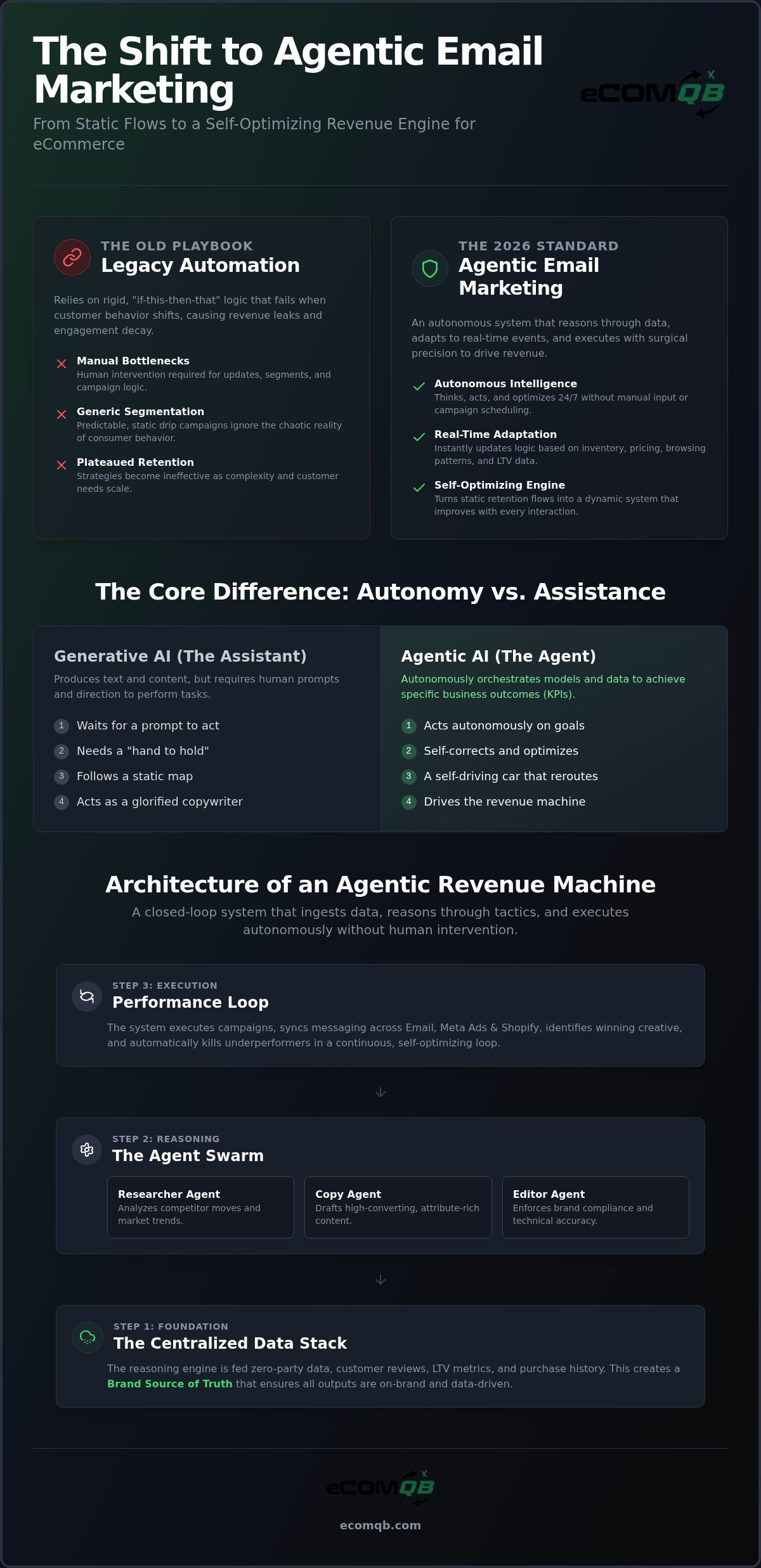
Generative AI was the warm-up. It produced text, but it didn't drive the revenue machine. In 2026, the market has moved beyond the assistant phase. We've entered the era of the agent. While legacy email marketing strategies rely on humans to manually segment lists and schedule blasts, agentic email marketing for ecommerce operates on a level of autonomous reasoning. It doesn't just write a subject line; it analyzes real-time inventory, user intent, and historical LTV data to decide the optimal move. The prompt engineer is obsolete. The agent architect is the new field general.
Static drip campaigns have become massive revenue leaks. They are rigid, predictable, and ignore the chaotic reality of modern consumer behavior. In a high-velocity market, your emails must update their own logic based on stock levels and browsing patterns without a human pulling the lever. This is the 2026 standard: a system that thinks, acts, and optimizes while you focus on high-level strategy. If your system can't pivot mid-flow based on a customer's changing needs, you're leaving money on the table.
The Core Difference: Autonomy vs. Assistance
Generative AI needs a hand to hold. It waits for a prompt. Agentic AI acts. By leveraging Retrieval-Augmented Generation (RAG), these agents pull from your specific brand guidelines, customer reviews, and live product feeds to ensure every output is accurate and on-brand. They don't just follow a sequence; they optimize it. Agentic Email Marketing is the autonomous orchestration of LLMs to achieve specific LTV KPIs. It's the difference between a static map and a self-driving car that reroutes based on live traffic. These systems are evergreen and self-correcting, turning every customer touchpoint into a data-driven opportunity for conversion.
Why 8-Figure Brands Must Pivot Now
The digital environment is shifting under the weight of AI-driven search engines like Perplexity and SearchGPT. These platforms change how consumers discover products, and your email strategy must adapt to this new visibility layer. Brands that rely on legacy automation are facing a terminal risk to their profit margins. Zero-latency content updates are now the standard. If your pricing changes or a SKU sells out, your agentic system updates the logic across every active thread instantly. You can't afford the delay of manual overrides. In a high-stakes market, speed isn't just an advantage; it's the only way to survive. Precision execution at scale is the objective, and agents are the only way to hit the target.
The Architecture of an Agentic Email Revenue Machine
Most brands treat AI as a glorified copywriter. They're missing the point. In 2026, agentic email marketing for ecommerce isn't about generating text; it's about building a closed-loop architecture that reasons through data. This system functions as a high-performance engine that ingests customer reviews, LTV metrics, and brand guidelines to make autonomous decisions. It identifies the gap, selects the tactic, and executes the play without human intervention. This is how you move from reactive blasts to a proactive revenue machine.
The Data Stack: Powering the Reasoning Engine
Your eCommerce AI growth system is the bedrock of this entire operation. Without a centralized data stack, your agents are operating in a vacuum. We feed the reasoning engine zero-party data directly from customer surveys and purchase history. This creates a Brand Source of Truth that ensures every output remains consistent. When the system understands that a specific segment values sustainability over price, it pivots the messaging across the entire lifecycle instantly. It's about precision, not guesswork.
Orchestration: Managing the Agent Swarm
Effective orchestration requires a specialized swarm of agents, each focused on a specific tactical objective. You aren't just running a script; you're managing a digital team. The workflow follows a strict hierarchy:
- The Researcher Agent: Analyzes competitor moves, tracks retention trends, and identifies market shifts.
- The Copy Agent: Drafts high-converting, attribute-rich modules tailored to individual user profiles.
- The Editor Agent: Enforces brand compliance, checks for conversion-centricity, and ensures technical accuracy. To see how to master the technical side of inbox testing, click here.
This swarm doesn't just work in isolation. It syncs email copy with your Meta ads and Shopify PDPs to ensure a frictionless customer journey. The performance loop then takes over, automatically identifying winning creative and killing the underperformers. It's a relentless cycle of improvement that maximizes every dollar spent on retention. If you're ready to stop managing flows and start orchestrating growth, it's time to audit your current AI stack. This level of systemic optimization is the only way to maintain 8-figure velocity in a crowded market.
GEO and Structured Data: The New Standard for Visibility
Traditional SEO focused on keyword density and backlink profiles. GEO prioritizes authority signals and verifiable facts. While legacy email newsletters rely on long-form paragraphs, agentic systems favor structured data that feeds the reasoning engines of LLMs. Schema.org has become the primary language for this exchange. By embedding structured snippets directly into your email templates, you're providing the "source of truth" that agents use to answer user queries. User-generated content (UGC) acts as the fuel for this engine, providing the social proof and diverse language patterns that agents recognize as high-authority signals. It's a move from passive reading to active indexing. To master this technical transition, you can discover Arokia IT LLC and their specialized approach to AI-driven search and GEO.
Optimizing for Conversational Search
Personal AI assistants don't read entire emails; they scan for facts. They're looking for specific product attributes, shipping speeds, and real-world performance data to include in their responses. To win in this environment, you must position your products as the logical conclusion for any AI-driven inquiry. This requires a shift in how you build your content stack. The reality is that SEO and content strategy for Shopify has evolved into a technical data play where visibility is earned through precision. Agentic email marketing for ecommerce ensures that your brand's data is clean, accessible, and ready for retrieval. When an assistant asks for the best solution to a customer's problem, your structured email data ensures your brand is the cited answer. Stop writing for humans alone; start architecting for the agents that guide them.
Implementation: Deploying Agentic Workflows for Shopify
Deploying agentic email marketing for ecommerce on Shopify requires a surgical approach to your data architecture. You can't just bolt an agent onto a broken system. The implementation phase is a tactical rollout designed to eliminate operational friction and maximize retention revenue. It's about moving from manual triggers to an autonomous system that reasons through every customer touchpoint.
Success follows a strict five-step deployment playbook:
- Step 1: Audit existing flows. Identify AI readability issues and data gaps. If your agent can't parse your product catalog or access real-time LTV data, it's flying blind.
- Step 2: Sync with agentic landing pages. Your email traffic shouldn't land on a generic homepage. It needs a destination that adapts to the user intent captured in the inbox.
- Step 3: Integrate email and SMS. Achieve zero-latency retention by responding instantly across the most effective channel based on live user behavior.
- Step 4: Align with acquisition. Connect your email agents to your agentic media buying system to create a unified intelligence loop.
- Step 5: Monitor Revenue Per Word. This is your new diagnostic for AI performance. If your agents are verbose but not converting, the reasoning logic needs a reset.
Dynamic Storefronts and Personalized UX
The era of static "About Us" pages is dead. Intent-based storytelling is the new baseline. By leveraging AI for Shopify personalization, your storefront becomes an extension of your agentic email copy. This 1:1 relevance reduces friction by answering specific customer objections before they ever reach support. Your inbox functions as a concierge service, providing agentic FAQ and support content that drives the purchase decision without human delay.
Scaling to 8-Figures with Managed Workflows
Manual management of these agents is the ultimate growth bottleneck. You don't need another tool; you need an architect. Scaling to 8-figure velocity requires a transition from a traditional content team to an AI operations team. The managed service model ensures you have a field general orchestrating the swarm while you focus on high-level strategy. If you're ready to stop tinkering and start scaling, book a strategic briefing to see how we manage the complexity for you. This isn't just a tech upgrade; it's a total transformation of your revenue engine.
The eComQB Advantage: Managed Agentic Growth Systems
Software is just a tool. Strategy is the weapon. Most brands fail because they mistake the purchase of an AI tool for the execution of an AI strategy. eComQB functions as your Field General, orchestrating the complex workflows required to win in 2026. We don't just sell software; we deliver managed AI transformation for eCommerce brands. By integrating agentic email marketing for ecommerce into a fully managed revenue machine, we remove the technical burden from your team. We curate the technology stack, eliminate operational friction, and focus relentlessly on high-velocity profit margin optimization.
The implementation gap is where most growth plateaus. You shouldn't be managing prompts or debugging API connections. Our team handles the architecture, ensuring that your data ingestion and reasoning layers are perfectly aligned. This is a systemic approach to growth that turns your retention strategy into a self-optimizing engine. We provide the expertise to move from static sequences to dynamic, agentic email marketing workflows that reason through customer data in real-time. We bridge the gap between technical complexity and commercial result.
Your Tactical Partner in AI Transformation
We execute agentic media buying and email as a single, unified offensive. This coordinated approach ensures that the intent captured at the top of the funnel is perfectly mirrored in the inbox. Our "Locker Room" methodology provides the strategic mastery needed by ambitious leaders who refuse to settle for average results. We've helped brands implement zero-latency revenue systems that adapt to market shifts in seconds. This isn't just about efficiency; it's about competitive dominance through technical precision and tactical superiority.
The Path to 8-Figure Velocity
The 2026 landscape is unforgiving to legacy thinkers. Relying on manual campaign management is a terminal risk to your profit margins. As complexity scales, human-led systems inevitably break. We offer a clear path to 8-figure velocity through managed agentic growth. We invite you to a strategic briefing to assess your brand's AI readiness and map out your transformation. Stop managing tools and start leading a machine. Deploy your high-velocity revenue machine with eComQB and take control of your growth trajectory today.
Orchestrate Your Autonomous Revenue Engine
The shift is undeniable. In 2026, legacy automation is a liability that drains your profit margins and slows your momentum. True competitive advantage now belongs to those who move beyond passive generation to active orchestration. You've seen how agentic email marketing for ecommerce transforms rigid flows into a reasoning revenue machine that adapts in real-time. By mastering structured data and deploying autonomous agent swarms, you eliminate the manual bottlenecks that stall 8-figure growth.
We specialize in managed AI transformation for 8-figure brands. As Shopify Plus Strategic Partners and experts in Agentic Media Buying and Email, we provide the field general strategy you need to win. It's time to stop managing tools and start leading a self-optimizing system. This is your opportunity to exit the cycle of manual overrides and enter the era of high-velocity precision.
Scale your brand with eComQB’s Managed AI Growth Systems. The future of commerce is agentic. Take the field and claim your victory today.
Frequently Asked Questions
What is the difference between automated email and agentic email marketing?
Automated email follows rigid, pre-defined triggers that can't adapt to shifting consumer intent. In contrast, agentic email marketing for ecommerce uses autonomous reasoning to decide the next move based on real-time data. It doesn't just send a message; it evaluates inventory, browsing behavior, and historical LTV to orchestrate the most profitable outcome. You move from managing static sequences to leading a dynamic, self-optimizing engine that executes without manual intervention.
How does agentic email marketing improve eCommerce ROAS?
Agentic systems improve your bottom line by maximizing the revenue potential of every customer in your database. By delivering hyper-personalized content that reasons through a user's specific objections, these systems drive higher conversion rates and repeat purchases. This increase in retention efficiency directly offsets rising acquisition costs on Meta and Google. The objective is high-velocity profit margin optimization through precision execution and zero-latency updates across the entire customer lifecycle.
Can agentic systems maintain my brands unique voice at scale?
Absolutely. We use Retrieval-Augmented Generation (RAG) to anchor every agentic output in your specific Brand Source of Truth. This ensures that the system pulls from your established guidelines, previous high-performing campaigns, and unique value propositions. Your voice isn't just imitated; it's reinforced through a reasoning layer that understands the nuances of your brand's identity. This level of consistency is impossible to maintain manually across thousands of individual customer journeys.
What is Generative Engine Optimization (GEO) and why does it matter for email?
Generative Engine Optimization is the process of making your brand's data accessible and authoritative for AI search engines and personal assistants. It matters for email because these agents scan your structured data to answer user queries and make recommendations. By using attribute-dense data modules instead of long-form text, you ensure your products are cited as the logical solution. It's the new standard for visibility in a world where AI agents are the gatekeepers.
How do I integrate agentic workflows into my existing Shopify store?
Integration begins with a comprehensive audit of your Shopify data architecture to identify gaps in AI readability. You then deploy a curated AI technology stack that syncs your storefront with your email and SMS workflows. This allows agents to pull real-time inventory levels and customer purchase history directly from your backend. The goal is to create a unified growth system where your email agents and Shopify storefront operate as a single, high-performance machine.
Does agentic email marketing replace my current marketing team?
No, it empowers your team to focus on high-level strategy rather than manual execution. Your staff transitions from being content creators and segment managers to becoming agent architects and field generals. They oversee the orchestration of the AI swarm and make the high-stakes decisions that guide the machine. This shift eliminates the operational bottlenecks that typically stall growth, allowing your human talent to focus on innovation and brand strategy.
What data do I need to provide to an agentic email system?
You need to feed the system high-quality zero-party data, customer reviews, and comprehensive LTV metrics. This data provides the context necessary for the reasoning layer to make informed decisions. Additionally, providing clear brand guidelines and historical performance data helps the agents understand what works for your specific audience. The more granular the data, the more precise the agent's execution will be. Clean, structured data is the fuel for your revenue engine.
How long does it take to see results from agentic growth systems?
You'll see an immediate reduction in operational friction and manual workload within the first few weeks of deployment. Revenue results typically follow as the performance loop identifies winning creative angles and begins to scale them autonomously. Because the system is self-optimizing, the efficiency of your agentic email marketing for ecommerce increases over time. The focus is on building a sustainable, high-velocity growth system that compounds its own success through continuous data-driven refinement.