Agentic Marketing for eCommerce: Engineering 8-Figure Velocity in 2026

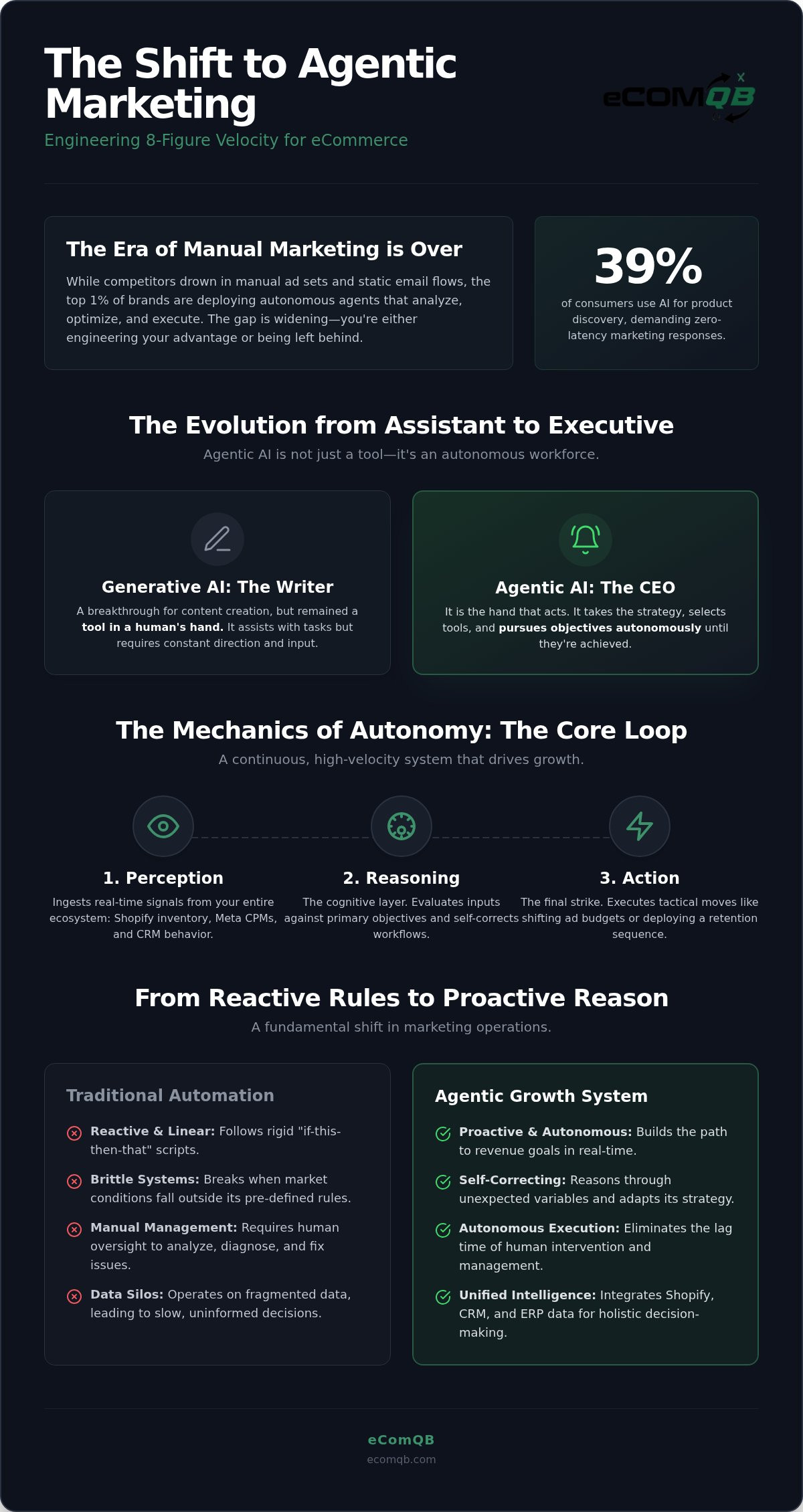
The era of the manual marketing stack is dead. While your competitors are still drowning in Meta ad sets and manual email flows, the top 1% of brands have already transitioned to agentic marketing for ecommerce. It's no longer about using AI as a basic writing tool. It's about deploying autonomous agents that analyze, optimize, and execute. With 39% of consumers already using AI for product discovery as of July 2026, the gap between the leaders and the laggards is widening at a terminal velocity. You're either engineering your advantage or you're being left behind.
You've likely felt the friction of plateauing ROAS and the crushing weight of operational overhead. It's a common struggle for ambitious leaders who want to scale but find themselves trapped by data silos and manual execution. This guide will show you how to break through that ceiling by engineering an autonomous growth system that drives predictable 8-figure revenue. We'll explore the strategic shift from checkout to discovery, the transparency requirements of the EU AI Act, and the exact playbook for building a self-optimizing brand that runs on pure velocity.
Key Takeaways
- Shift from reactive automation to proactive autonomy by mastering the core loop of perception, reasoning, and action.
- Unify your Shopify and CRM data silos into a single, actionable intelligence engine that executes growth tactics in real-time.
- Outpace the competition with agentic marketing for ecommerce, replacing manual bidding with autonomous budget reallocation across major ad platforms.
- Re-engineer your retention strategy by replacing static email flows with dynamic, agent-led triggers that adapt to every customer touchpoint.
- Scale to 8-figures with precision by leveraging a fully managed agentic growth system designed to eliminate operational friction.
Beyond Automation: What is Agentic Marketing for eCommerce?
Agentic marketing for ecommerce represents the shift from tools that assist to systems that execute. For years, brands relied on basic automation: rigid scripts that triggered an email when a cart was abandoned or adjusted a bid when a threshold was hit. That was the era of "if-this-then-that" logic. It was linear, limited, and reactive. In 2026, the standard has evolved. True agentic systems don't just follow a path; they build it. They function as an intelligent agent that perceives the market, reasons through data, and acts to secure a specific revenue goal.
This is the triadic imperative of modern growth: analyze, optimize, and execute. An agentic system doesn't wait for a weekly report to suggest a change. It identifies a drop in conversion, diagnoses the friction point, and implements a fix in real-time. It moves your brand from passive assistance to autonomous action. You aren't just buying software. You're deploying a high-performance workforce that never sleeps, never tires, and never misses a tactical opening. It's the difference between having a map and having a driver who knows every shortcut in the city. For those in specialized niches like healthcare, finding a knowledgeable partner is just as critical, and Future Marketing para Saúde provides the expert digital marketing and visual identity services needed to navigate that specific landscape.
The Evolution from Generative to Agentic
The 2026 Growth Landscape
The primary driver behind this shift is the brutal reality of rising CAC. On platforms like Meta and Google, the margin for error has vanished. Brands can no longer afford the lag time of manual management. The demand for zero-latency marketing responses is absolute. If your system takes four hours to adjust a budget or swap a creative, you've already lost the auction. This is why eCommerce AI growth systems are no longer a luxury for scaling brands. They are the foundational architecture for anyone serious about engineering 8-figure velocity. You either own the machine, or you're crushed by it.
The Mechanics of Autonomy: How AI Agents Execute Growth
The engine of agentic marketing for ecommerce is built on a continuous, high-velocity loop: Perception, Reasoning, and Action. This isn't a linear sequence of events. It's a living system. Perception involves the ingestion of real-time signals from your entire ecosystem. It monitors Shopify inventory levels, Meta CPMs, and CRM behavior simultaneously. Reasoning is the cognitive layer where the agent evaluates these inputs against your primary objectives. Action is the final strike; the autonomous execution of a tactical move, such as shifting budget to a high-performing SKU or pausing an ad that's hitting fatigue.
To achieve 8-figure velocity, your agents must live inside your data silos. They don't just sit on top of Shopify; they integrate deeply with your CRM and ERP. This interoperability ensures that every decision is backed by the full weight of your historical and real-time data. When an agent sees a customer segment's LTV dropping, it doesn't wait for a human to notice the trend. It reasons through the cause and acts immediately to deploy a retention sequence. It bridges the gap between raw data and realized profit.
Strategic precision requires absolute control. Every autonomous system needs guardrails to ensure brand voice and budget safety. You define the mission parameters; the agent executes the strategy. These boundaries keep the machine focused on ROI while preventing the overspending common in unmanaged AI. If you're ready to see how these systems function in a live environment, you can book a call to audit your current stack and identify your biggest leverage points.
Reasoning vs. Rules-Based Logic
Traditional automation is brittle. If a market condition changes, a rules-based system breaks because it cannot account for variables outside its script. Agentic reasoning is the bridge between data and revenue. It allows the system to self-correct workflows without manual oversight. When an unexpected inventory drop occurs, the agent doesn't just stop. It reasons through the next best move, such as pivoting ad spend to a secondary collection or launching a pre-order campaign. It identifies, adapts, and wins.
The Agentic Tech Stack
Scaling requires a curated AI technology stack built on open APIs for seamless workflow automation. Data readiness is the non-negotiable prerequisite for performance. If your data is fragmented or messy, your agents will be ineffective. Integrating AI transformation for eCommerce brands into legacy systems is the first step toward total autonomy. This is how you move from fragmented tools to a unified growth machine that runs with surgical precision.
Agentic Media Buying vs. Traditional Ad Management
Traditional ad management is a legacy bottleneck. It relies on human eyes, manual bidding, and the dreaded "weekly report" that provides a post-mortem of money already wasted. In the high-stakes environment of 2026, waiting seven days to pivot is a death sentence for your margins. Agentic marketing for ecommerce eliminates this lag by replacing reactive management with proactive, autonomous execution. While a human buyer is still analyzing yesterday's ROAS, an agent has already reallocated budget across Meta and Google based on real-time shifts in consumer intent and platform volatility.
The core advantage is precision. Traditional media buying often relies on broad strokes and gut feelings. Agents operate on granular data points, identifying micro-trends before they become visible in a standard dashboard. This level of oversight is critical for closing the "visibility gap" where brands often lose track of early-stage customer discovery. By executing at zero latency, these systems reduce customer acquisition costs (CAC) through hyper-precise targeting that a human team simply cannot replicate. You aren't just buying ads; you're deploying a tactical strike force that optimizes every dollar in the moment it's spent.
Execution at this scale requires a shift in mindset. You are moving from a world of "managing campaigns" to a world of "managing outcomes." The agent handles the mechanics of the auction while you focus on the high-level strategy. This eliminates the friction of manual execution and allows your brand to maintain 8-figure velocity without the need for a massive, bloated media team. It's about lean, high-impact growth driven by machine intelligence.
Autonomous Meta and Google Execution
The "human delay" is the single greatest threat to your scaling efforts. Humans sleep, eat, and second-guess. Agents do not. They identify winning creative clusters in minutes, scaling the winners and killing the losers with cold, mathematical certainty. This is the science of agentic media buying for high-velocity brands. It ensures your capital is always flowing toward the highest probability of return, regardless of the time of day or the platform. By removing human hesitation, you capture opportunities that your competitors miss.
Dynamic Creative Optimization
Modern agents function as autonomous creative directors. They don't just test two or three images; they can orchestrate and analyze 1,000+ variants simultaneously to find the perfect match for every audience segment. This systemic optimization extends beyond the ad itself. These agents align specific ad triggers with agentic landing pages, ensuring a seamless, high-converting journey from the first click to the final purchase. This level of synchronization is the only way to overcome the performance gap often found in unmanaged AI traffic. It's a closed-loop system designed for peak performance.
Building the Agentic Retention Stack: Email and SMS
Retention is the battlefield where 8-figure profit margins are secured or surrendered. Most brands are still tethered to static, linear email flows that feel dated the moment they're built. In 2026, the consumer expectation has shifted toward radical relevance. Traditional "scheduled blasts" are being replaced by agentic marketing for ecommerce, moving the needle from broad segments to individual intent. Your retention stack shouldn't just follow a script; it should reason through customer behavior to deliver the right message at the exact moment of highest impact.
Agents manage your SMS and email cadence with a level of precision that manual teams cannot match. They monitor real-time signals: dwell time on a product page, past purchase frequency, and even sentiment in support tickets. Instead of a generic "we miss you" text, the system executes a tactical outreach based on predicted needs. This prevents the primary driver of churn: irrelevant noise. By managing the frequency and content of every touchpoint, agents maximize lifetime value (LTV) while protecting the integrity of your brand's relationship with the customer.
Scaling to 1,000,000 customers requires a system that can handle one-to-one personalization at total volume. You can't hire enough copywriters to speak to every individual, but you can deploy an agentic system that does. This is the only way to maintain a high-performance growth trajectory without bloating your operational overhead. If you're ready to deploy a self-optimizing retention machine, you can book a call with our tactical team to start engineering your stack.
Zero-Latency Revenue Strategies
Capturing intent requires speed. When a customer shows interest, agentic email marketing responds in milliseconds. These systems don't just wait for a cart abandonment; they use predictive restock agents to anticipate when a customer is running low on a consumable product. They also protect your margins through intelligent discount management. Instead of offering a blanket 20% off, the agent only triggers a discount if its reasoning engine determines it's necessary to close the sale. It preserves profit while securing the conversion.
The Science of Personalization
True personalization is about navigation, not just name tags. By utilizing AI for Shopify personalization, agents act as personal shoppers for every visitor. They guide the customer to the perfect SKU, reducing the friction of discovery and driving repeat purchases. This intelligence extends to the storefront itself. Agents can dynamically adjust agentic landing pages to mirror the specific ad trigger that brought the user there. You aren't just showing products; you're engineering a custom storefront for every single click. This is how agentic marketing for ecommerce builds the foundation for 8-figure velocity.
Deploying the eComQB Revenue Machine: Your Path to Scaling
Engineering 8-figure velocity isn't a DIY project. While off-the-shelf software promises autonomy, it often delivers more operational friction. You don't need more tools; you need a system that works. The eComQB advantage lies in our fully managed agentic growth systems. We don't just hand you a login; we deploy a curated AI technology stack that is architected for your specific SKU profile and customer journey. This is agentic marketing for ecommerce built for the high-stakes environment of 2026. We handle the technical heavy lifting so you can focus on decisive leadership.
Our approach is defined by the "Field General" philosophy. It combines strategy, execution, and technical mastery into a single, cohesive growth engine. Most brands fail because they try to stitch together disparate AI tools that don't communicate. We eliminate that risk by providing a unified system that manages the entire revenue loop. You get the benefits of AI transformation for eCommerce brands without the burden of increasing your internal head count. It's about lean, high-performance scaling that prioritizes results over activity.
The Managed AI Blueprint
The transition from a legacy brand to an agentic powerhouse follows a precise roadmap. It begins with a comprehensive audit of your current data readiness and technical infrastructure. We identify the friction points where manual execution is leaking profit. From there, we move into the implementation phase, deploying our Revenue Generating AI Tools to take over media buying and retention loops. Staying legacy is the greatest risk to your profit margins in 2026. The market moves too fast for human-only teams to compete. Our blueprint ensures you are always positioned for peak performance.
- Audit: Identify data silos and revenue leaks.
- Architect: Deploy a curated AI technology stack.
- Execute: Shift to autonomous media buying and retention.
- Scale: Drive 8-figure velocity with zero operational overhead.
Next Steps for High-Growth Brands
The first step toward mastery is an honest assessment of your current stack. If your team is still spending hours on manual bidding or static email flows, you are already falling behind the 39% of consumers who use AI for discovery. You must decide if you want to manage tools or manage outcomes. The transition to an agentic-first marketing organization is the only way to secure a predictable growth trajectory. You can't win tomorrow's game with yesterday's playbook. It's time to stop reacting and start orchestrating. Engineer your high-velocity growth with eComQB and take command of your market position.
The window for early-mover advantage is closing. As protocols like OpenAI's ACP and Google's UCP become the standard, the brands with the most mature agentic systems will capture the majority of the market. Don't wait for the competition to force your hand. Establish your autonomous growth system now and build the 8-figure brand your vision demands. The machine is ready. The playbook is written. The next move is yours.
Command the Future of eCommerce Growth
The shift from passive tools to autonomous systems is no longer a strategic option; it's a competitive necessity. By mastering agentic marketing for ecommerce, you transition from managing manual tasks to orchestrating high-velocity results. We've explored how these agents eliminate the human delay in media buying and transform retention from static flows into dynamic, behavioral-led revenue loops. The infrastructure for 8-figure scaling is now available to those willing to lead rather than follow.
eComQB provides the tactical expertise in Meta and Google execution required to dominate the 2026 landscape. We deliver curated AI technology stacks and managed 8-figure growth systems that eliminate operational overhead while driving surgical precision across every touchpoint. This is your opportunity to stop fighting the algorithm and start owning the machine. You possess the vision; we provide the engine to realize it at scale.
The era of manual execution is over. It's time to secure your competitive advantage and engineer a brand that operates with total autonomy. Deploy your autonomous revenue machine with eComQB. The future of your growth is waiting for your command.
Frequently Asked Questions
What is the difference between marketing automation and agentic marketing?
Automation follows a script; agentic marketing for ecommerce builds the script. Traditional automation is rigid, linear, and reactive, relying on "if-this-then-that" logic. Agentic systems are fluid, autonomous, and proactive. They utilize an intelligent reasoning engine to perceive market shifts, evaluate data, and execute tactics without human intervention. You aren't just triggering an email; you're deploying a system that decides the best path to your goal.
Can AI agents manage my Meta and Google ad spend autonomously?
Yes, agents manage ad spend with zero-latency precision. They identify winning creative clusters, reallocate budgets, and pause failing ads 24/7. This eliminates the "human delay" that often drains profit margins during high-volatility periods. You set the mission parameters and budget guardrails. The agent then functions as a tactical strike force, optimizing every dollar in the moment it enters the auction.
Do I need a technical team to implement agentic marketing for my Shopify store?
No, you don't need an internal technical team when partnering with eComQB. We provide a managed service model that eliminates operational overhead. Our team deploys the curated AI technology stack and handles the deep integration into your Shopify and CRM data silos. You maintain your role as the strategic leader while we orchestrate the technical mechanics and engineering required for 8-figure scaling.
How does agentic marketing improve eCommerce customer acquisition costs (CAC)?
Agentic marketing for ecommerce reduces CAC through hyper-precise targeting and real-time execution. Agents close the "visibility gap" by identifying micro-trends before they become expensive for human buyers. They analyze thousands of data points to find the highest probability of return. By cutting waste and scaling winners instantly, the system drives down the cost of every new customer acquired.
Will agentic marketing work with my existing email and SMS platforms?
Yes, these systems integrate with your existing tech stack through open APIs. We bridge your CRM data silos to turn static, dated flows into agent-led retention loops. The agents use your current infrastructure to deliver behavioral triggers that maximize LTV and minimize churn. It's about upgrading your existing engine with a more sophisticated, autonomous driver that reasons through every customer touchpoint.
How long does it take to see results from an agentic growth system?
Tactical improvements are often visible within the first 72 hours as agents eliminate obvious waste and optimize bidding. True 8-figure velocity builds over a 30 to 90 day window as the system ingests more data and refines its reasoning. It's a process of rapid improvement, systemic optimization, and sustainable scaling. You'll see the friction of manual execution vanish almost immediately.
Is agentic marketing safe for my brand voice and reputation?
Absolute safety is maintained through strict mission guardrails. You define the brand voice, budget limits, and strategic boundaries before the system goes live. The agent operates exclusively within these parameters, ensuring every message and ad remains consistent with your leadership. You maintain total control over the high-level strategy while the machine handles the complex, high-speed execution.
What are the best agentic marketing tools for eCommerce in 2026?
The most effective tools are curated AI technology stacks rather than fragmented, off-the-shelf software. Successful brands avoid the "software sprawl" of trying to manage multiple disconnected AI tools. Systems like eComQB's Revenue Generating AI Tools offer a unified approach that integrates strategy, execution, and technical mastery. This "Field General" approach is the only way to maintain a competitive advantage in a high-velocity market.