Agentic Media Buying: The 2026 Strategic Playbook for High-Velocity Brands

The era of passive automation is dead. If you're still relying on the black-box promises of Advantage+ or PMax, you aren't scaling; you're surrendering. True growth in 2026 requires a shift from static rules to agentic media buying, where autonomous systems negotiate, execute, and optimize with surgical precision. While your competitors struggle with rising CAC and opaque algorithms, high-velocity brands are deploying agents that reason, plan, and win.
You've felt the friction of manual management and the frustration of diminishing returns in saturated markets. It's a ceiling for ambitious leaders who know their data should be working harder. This playbook will show you how to reclaim your strategic edge by transitioning from manual bidding to fully autonomous ad negotiation. We'll break down the specific frameworks, from Meta's Ads Model Context Protocol to PubMatic’s AgenticOS, that allow you to scale without adding headcount. You are about to discover how to achieve zero-latency response times and secure 30% lower effective CPMs through a system built for peak performance and relentless results.
Key Takeaways
- Shift your strategy from rigid automation to goal-oriented autonomy by deploying systems that execute strategic intent.
- Master the mechanics of agentic media buying to secure lower CPMs through direct, intent-based negotiation between Brand Agents and Seller Agents.
- Distinguish brand-centric agentic systems from platform-centric tools like PMax to reclaim control over your growth trajectory.
- Prepare your infrastructure for autonomous scaling by sanitizing data clean rooms and establishing precise strategic guardrails for AI agents.
- Leverage a managed AI transformation partner to handle technical execution while you focus on high-level market dominance.
What is Agentic Media Buying? Beyond the Black Box
Standard automation is a map; agentic media buying is the driver. For years, high-growth brands have settled for "automated" systems that follow rigid, pre-defined rules. If the cost per click hits a certain threshold, the system lowers the bid. This is reactive, predictable, and increasingly ineffective in the hyper-competitive markets of 2026. Agentic systems represent a fundamental shift from rule-following to goal-pursuing. These agents don't just execute commands; they act on strategic intent. They reason through complex variables, plan multi-step maneuvers, and negotiate with a level of precision that human buyers simply cannot match in real-time.
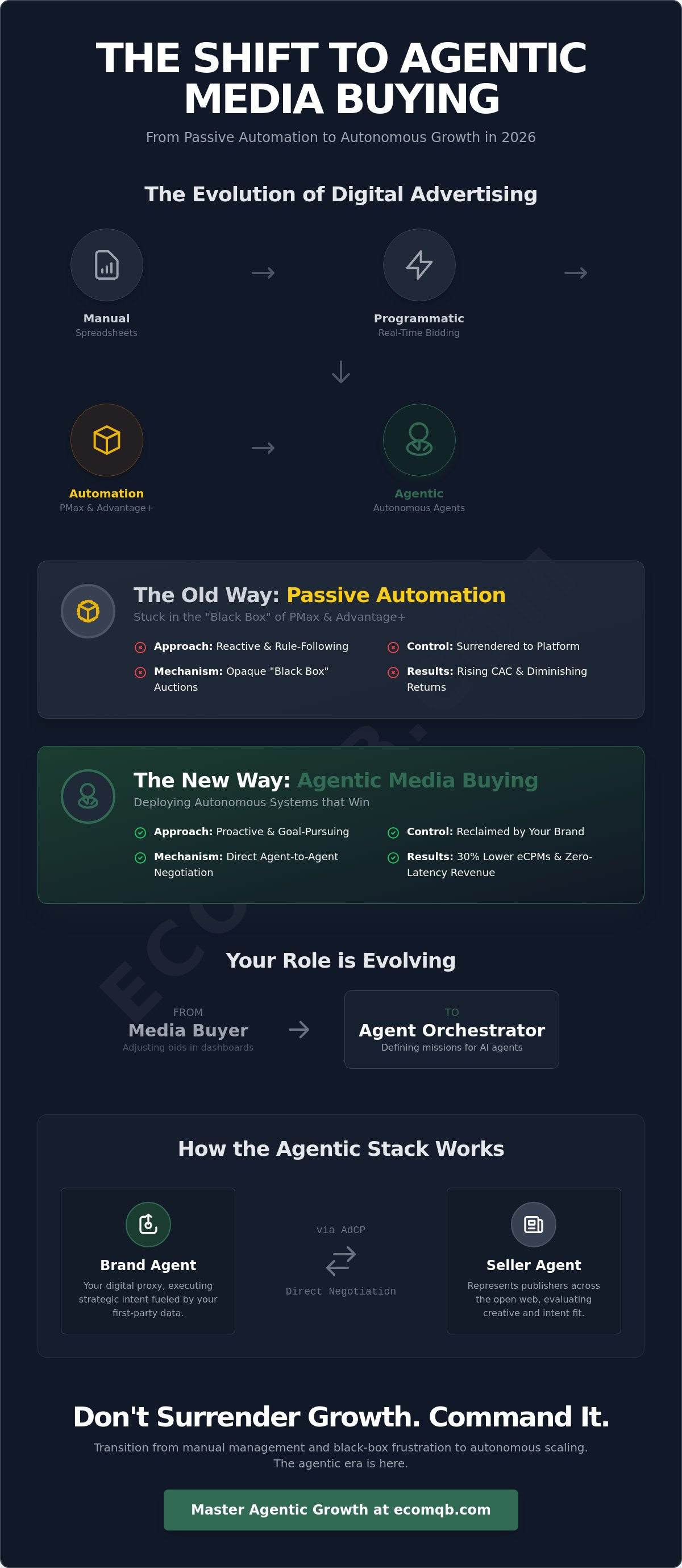
The role of the leader is changing. You are no longer a media buyer stuck in the weeds of campaign adjustments. You are an Agent Orchestrator. Your job is to define the mission, set the parameters, and deploy a managed growth system that scales without adding headcount. This shift unlocks what we call Zero-Latency Revenue. In a landscape where market shifts happen in milliseconds, waiting for a human to review a dashboard is a tactical failure. Autonomous execution ensures that your brand captures every profitable opportunity the moment it appears. You aren't just running ads; you're commanding a digital sales force that never sleeps, never blinks, and never misses a signal.
The Evolution from Programmatic to Agentic
The trajectory of digital advertising has been a steady march toward total autonomy. We moved from manual spreadsheets to programmatic auctions, and then to the automated "black boxes" of the early 2020s. While Real-time bidding (RTB) revolutionized the speed of the transaction, it still required human intervention to define the specific tactics. Legacy systems are leaking revenue because they rely on human-in-the-loop approvals. In the time it takes a manager to log into a dashboard, a profitable pocket of inventory has already vanished. Agentic systems use LLMs to bridge this gap, translating high-level brand strategy into machine-executable tactics instantly. They analyze, adapt, and win before your competitors even see the trend.
Why 2026 is the Turning Point for DTC Brands
DTC brands are hitting a wall. Meta and Google have optimized their native algorithms to serve their own interests, creating a "black box" environment that lacks transparency. These walled gardens offer convenience but demand a surrender of control. Agentic media buying allows you to bypass these limitations by deploying proprietary agents that operate on your behalf, not the platform's. They find the intent, negotiate the price, and secure the placement across the entire open web. The Agentic Era is the final move in the AI transformation of eCommerce.
The Mechanics of Agent-to-Agent Advertising
The engine of 2026 isn't a dashboard. It's a dialogue. In the world of agentic media buying, your Brand Agent functions as a digital proxy. It enters the marketplace with a mandate, not just a budget. It communicates directly with Seller Agents representing publishers across the open web. This interaction bypasses the traditional, clunky auction house. Instead of shouting a price in a crowded room, your agent conducts a private, high-speed negotiation. It evaluates creative fit. It assesses user intent. It secures the win.
As noted in the UN report on AI in Advertising, this move toward autonomous systems requires a new level of transparency and integrity. For high-velocity brands, this means using first-party data as the primary fuel. Your data isn't just a list; it's the intelligence that allows your agent to identify your ideal customer with surgical precision. This is the foundation for meaningful eCommerce ROAS improvement. Your data provides the context. Your agent provides the execution. The result is a system that learns, adapts, and scales.
The Role of AdCP and Interoperability
Think of AdCP (Agentic Advertising Communication Protocol) as the universal translator for the digital economy. It allows agents from different ecosystems to speak the same language. This protocol breaks down the artificial walls between Meta, Google, and the Open Web. Your strategy is no longer confined to a single platform's logic. To close the loop, you must deploy Agentic Landing Pages. These pages adapt in real-time to the specific intent captured during the negotiation phase. If you're ready to see how this fits your specific brand, you can speak with a specialist today to audit your current stack.
From Bidding to Negotiation: A Paradigm Shift
Static bids are relics of a slower era. Dynamic negotiation is the new standard. In milliseconds, agents evaluate context, creative relevance, and conversion probability. They don't just ask "how much?" They ask "is this the right moment for this specific user?" This level of sophistication is a core component of a high-performance eCommerce AI growth system. It turns media buying into a strategic advantage rather than a line-item expense. You aren't just buying impressions; you're securing outcomes.
Agentic Media Buying vs. Meta Advantage+ and Google PMax
The most common objection from performance marketers is predictable: "Isn't this just PMax with a new name?" The answer is a definitive no. While Meta Advantage+ and Google PMax utilize machine learning to automate placements, they are platform-centric tools. Their primary objective is to maximize the platform's revenue by filling their own inventory. Agentic media buying is brand-centric. It places a fiduciary agent between your budget and the ad exchange. This agent doesn't care about Google's quarterly earnings; it only cares about your bottom line. It negotiates for the highest intent at the lowest possible cost, often bypassing the expensive, low-quality inventory that native algorithms use to "pad" their spend.
The difference lies in who owns the intelligence. Native automation keeps the data inside a walled garden, leaving you with a black box of results. Agentic systems ensure you maintain total data ownership. Your agents learn from every interaction, building a proprietary intelligence layer that stays with your brand. As detailed in The State of Agentic Advertising, the industry is reaching a tipping point where transparency is no longer optional. Brands that rely on native tools are effectively subsidizing the platform's learning at the expense of their own margins. Agents flip the script, using your data to protect your profit and drive aggressive, sustainable growth.
The Illusion of Control in Native Automation
Meta and Google have mastered the art of the "easy button," but that convenience comes with a heavy price. Native algorithms frequently prioritize their own surplus inventory over your brand profit. This leads to the "Black Box" problem: you see the spend, but you can't see the specific logic behind a campaign failure. You are left guessing while the algorithm continues to burn through your capital. Reclaim your strategic control from the algorithms by deploying systems that answer to you, not the platform. Stop being a passenger in your own growth strategy and start commanding the vehicle.
Why Agentic Systems are the 'Field General' of Your Tech Stack
Think of your agent as the field general of your entire marketing ecosystem. Unlike single-channel silos, agents are cross-channel orchestrators. They possess the autonomy to pull budget from an underperforming Meta campaign and reallocate it to a high-converting segment on the open web in real-time. This isn't just optimization; it's tactical maneuverability at scale. This level of coordination is the cornerstone of a successful AI transformation for eCommerce brands. By removing the friction of human-in-the-loop delays, you ensure that your capital is always flowing toward the highest potential return.
The Implementation Playbook: Deploying Your Agentic Stack
Strategy without execution is a liability. To move from the theoretical promise of agentic media buying to 8-figure velocity, you need a precise deployment roadmap. This isn't about toggling a few settings in a dashboard; it's about engineering a managed growth system that operates with autonomous precision. You must sanitize your data, define your guardrails, and deploy your agents with the mindset of a field general. The goal is a zero-latency response to market shifts that leaves slower competitors in the dust.
The transition to an agentic stack follows a rigorous five-step sequence:
- Step 1: Data Sanitization. Agents require high-fidelity inputs. You must establish a "Clean Room" environment where your first-party data is scrubbed, organized, and ready for agentic ingestion.
- Step 2: Strategic Guardrails. You don't give an agent a blank check. You set the rules of engagement. Define your target ROAS, maximum CPA ceilings, and brand safety parameters.
- Step 3: Agent Orchestration. Select your curated technology stack. This involves integrating authorized bridges like Meta’s Ads Model Context Protocol to allow agents to execute tasks directly within ad managers.
- Step 4: Human-in-the-Loop Feedback. Automation does not mean abdication. You must monitor for strategic alignment, ensuring the agents' tactical maneuvers reflect your high-level brand mission.
- Step 5: Scaling to Velocity. Move from isolated testing to full-scale execution. Once the system proves its logic, you remove the bottlenecks and allow the agents to pursue 8-figure revenue targets.
Preparing Your Shopify Store for Agentic Ingestion
Your Shopify store is the destination, but it must also function as a data beacon. Deep pixel integration and server-side tracking are non-negotiable requirements. Without them, your agents are flying blind. To complete the conversion loop, you must also deploy Agentic Landing Pages. These pages don't just sit there; they dynamically adjust their layout and messaging based on the specific negotiation the agent conducted in the marketplace. This level of precision should extend into your retention efforts by linking your media buying to agentic email marketing. When your acquisition and retention agents speak the same language, you create a frictionless path to purchase. If your current infrastructure feels fragmented, you should book a call with our team to audit your readiness for autonomous scaling.
The New Role of the Growth Lead
The era of the "button pusher" is over. In the 2026 landscape, the Growth Lead is a strategy designer. You aren't manually adjusting bids; you are writing the "Agent Prompts" that dictate high-performance media buying behavior. This requires a shift from campaign optimization to systemic optimization. You are no longer managing ads. You are managing a workforce of autonomous agents. Your value lies in your ability to orchestrate these tools to win the high-stakes game of digital commerce.
Managed AI: The eComQB Approach to Agentic Growth
Attempting to build an in-house agentic stack is a strategic trap. It is an operational nightmare that consumes time, capital, and focus. Most brands get buried under the weight of technical debt before they see a single dollar of return. High-velocity leadership requires a different approach. You don't need more developers; you need a tactical partner who understands the mechanics of growth. eComQB provides the Revenue Generating AI Tools that turn agentic media buying into a turnkey advantage. We manage the complexity. You own the results.
Think of us as your field general in the digital theater. We don't just provide software; we provide a fully managed execution layer. Our team integrates directly with your existing data structures to ensure seamless interoperability. We handle the authorized bridges, the protocol updates, and the real-time troubleshooting. This allows your growth lead to shift from a button-pusher to a strategy designer. We deploy the agents, monitor the guardrails, and execute the maneuvers that drive 8-figure velocity. You define the mission. We ensure the agents execute it to perfection.
Our workflows are engineered to identify, negotiate, and capture revenue with zero latency. We've seen brands cut their operational overhead significantly by offloading the management of these autonomous systems to specialists. You stay focused on high-level brand strategy while we handle the systemic optimization. This isn't just about running ads; it's about engineering a growth system that scales without adding headcount or friction.
Curated AI Stacks vs. Off-the-Shelf Tools
Off-the-shelf AI tools are built for the masses. They are generic, rigid, and often lead to mediocrity. If you use the same tools as everyone else, you get the same results as everyone else. eComQB takes a different path. We curate a custom AI stack tailored specifically to your Shopify footprint. We strip away the tech bloat and focus on the levers that actually move the needle. This managed approach ensures your system remains lean, fast, and lethal. We eliminate the noise. We prioritize impact. We deliver results.
Your Next Move: Strategic Mastery in the AI Era
Legacy systems are a choice. Velocity is a result. In the 2026 landscape, the gap between the leaders and the laggards is widening every day. You can continue to fight against rising CAC and opaque algorithms, or you can choose to dominate. Starting your AI transformation doesn't require a total overhaul of your current operations. It requires a strategic pivot toward autonomy. Deploy your agentic growth system with eComQB and stop playing defense. It's time to take the field and claim your edge.
Secure Your Future in the Agentic Era
The window for early adoption is closing. To win in 2026, you must move beyond the limitations of platform-native tools and embrace the precision of agentic media buying. This shift isn't just about efficiency; it's about strategic survival. By deploying autonomous agents that negotiate on your behalf, you reclaim your data, protect your margins, and respond to market shifts with zero latency. You've seen the roadmap. You understand the mechanics. Now, it's time to execute with the confidence of a leader who knows exactly how to orchestrate the next move.
At eComQB, we specialize in engineering 8-figure growth velocity for elite DTC brands through managed AI transformation. We don't believe in one-size-fits-all solutions. Instead, we provide curated high-performance technology stacks that integrate seamlessly with your specific operations. We manage the technical complexities so you can focus on high-level strategy and market dominance. Stop fighting the black-box algorithms and start commanding a system built for your success.
Secure Your Competitive Edge: Deploy Agentic Media Buying with eComQB. The high-stakes game of digital commerce rewards the bold and the precise. Take the field today and lead your brand to its next peak performance milestone.
Frequently Asked Questions
What is the difference between automated and agentic media buying?
Automated systems follow static, pre-defined rules like lowering a bid when a specific cost threshold is met. Agentic media buying utilizes autonomous agents that reason, plan, and negotiate to achieve high-level goals. While automation reacts to historical data, agents act on strategic intent to secure the best possible outcomes in real-time.
Does agentic media buying work with Shopify?
Yes, it is a critical component for scaling modern Shopify stores. It requires deep pixel integration and server-side tracking to provide the high-fidelity commerce data agents need to make informed decisions. This allows for a seamless connection between your media spend and your storefront performance.
Will agentic AI replace my media buying agency?
It replaces manual execution, not strategic leadership. Your agency's role shifts from tactical button-pushing to high-level strategic orchestration. They become the designers of the mission and the guardians of the guardrails while the AI handles the high-speed negotiation and execution in the marketplace.
How does agentic media buying improve ROAS?
Agents avoid the low-quality, "filler" inventory that native platform algorithms often use to exhaust your budget. By negotiating for high-intent placements and evaluating context in milliseconds, they ensure your capital is only deployed where there is a high probability of conversion. This precision directly protects your profit margins.
Is agentic media buying safe for brand identity?
Brand safety is a core feature of the system. You define the strategic guardrails and the rules of engagement that the agents must follow. They operate strictly within these human-defined boundaries, ensuring that every ad placement and negotiation aligns with your brand's specific identity and values.
What data do I need to start with agentic advertising?
You need high-fidelity first-party data and a sanitized data environment. Establishing a "Clean Room" and robust server-side tracking ensures your agents have the necessary inputs to identify your ideal customers. Without clean data, the agents cannot execute with the precision required for high-velocity growth.
How much does it cost to implement an agentic media buying system?
Implementation costs vary based on the complexity of your technology stack and the scale of your operations. It should be viewed as a strategic investment in your growth infrastructure rather than a simple service fee. You should consult with a tactical partner to receive a custom audit and scoping for your brand.
Can agentic systems manage both Meta and Google ads simultaneously?
Yes, agents function as cross-channel orchestrators that eliminate single-channel silos. They possess the autonomy to pull budget from an underperforming Meta campaign and reallocate it to a high-converting Google segment instantly. This ensures your marketing capital is always flowing toward the highest potential return across the entire ecosystem.