AI Dynamic Merchandising for eCommerce: The 2026 High-Velocity Playbook

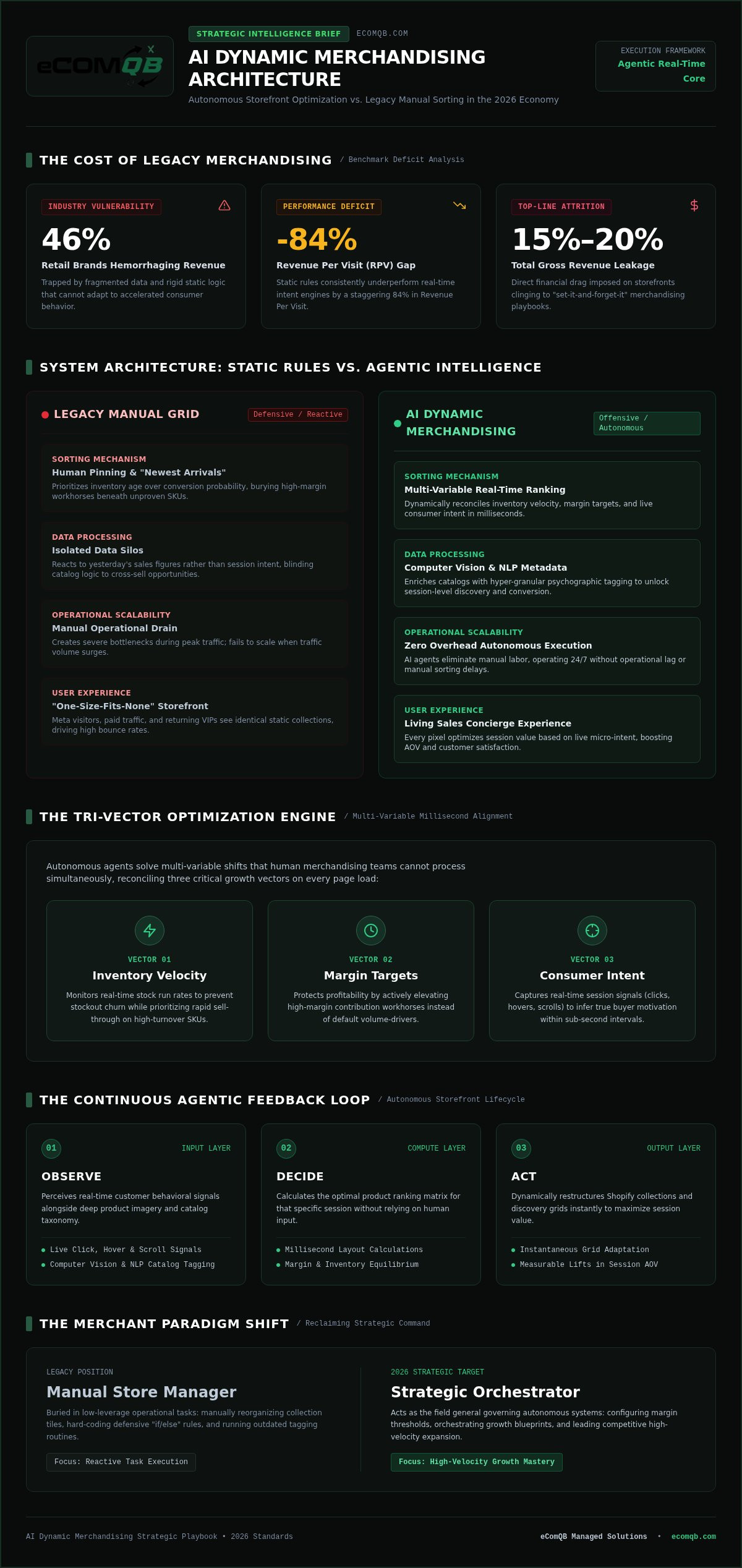
Nearly 46% of retail brands are currently hemorrhaging revenue because they rely on fragmented data and static rules that underperform real-time intent engines by a staggering 84% in Revenue Per Visit. If you're still manually pinning bestsellers or setting basic "if/else" logic, you're not just wasting time; you're conceding your market share to competitors who move faster. The era of the manual merchant is over. High-performance brands have pivoted to AI dynamic merchandising for eCommerce to transform their storefronts into autonomous, profit-maximizing engines. This isn't about sorting products. It's about deploying agentic systems that reconcile inventory velocity, margin targets, and consumer intent in milliseconds.
You already know that manual product sorting is a massive operational drain that fails to scale during peak traffic. It's a bottleneck that creates irrelevant discovery experiences and drives bounce rates higher. This playbook will show you how to master the transition from rigid product grids to agentic, revenue-generating storefronts that optimize every click in real-time. We'll break down the 2026 standards for machine-readable catalogs, inventory-aware sorting, and the managed systems that deliver measurable lifts in AOV with zero operational overhead. It's time to stop managing grids and start orchestrating growth.
Key Takeaways
- Transition from manual sorting to autonomous agentic systems that observe, decide, and act in real-time.
- Replace defensive "if-then" rules with AI dynamic merchandising for eCommerce to drive offensive, intent-based storefront optimization.
- Enrich your Shopify catalog with automated tagging and psychographic metadata to capture session-level intent and boost conversion.
- Audit your tech stack for data leaks and deploy a managed agentic layer to execute a high-velocity growth blueprint.
- Implement managed growth systems to eliminate operational overhead and maintain a decisive competitive advantage in the 2026 economy.
The Death of Static Merchandising: Why Manual Playbooks Fail in 2026
In the high-velocity market of 2026, speed is the only currency that matters. If your merchandising strategy relies on a human manually choosing which products to feature on a Tuesday morning, you've already lost the game. The sheer volume of data generated by modern shoppers moves too fast for human-led sorting. Static grids are no longer just inefficient. They are a legacy liability. By ignoring real-time intent, you're effectively showing a "one-size-fits-none" storefront to your most valuable traffic. This friction results in a performance gap where static rules underperform real-time intent engines by 84% in Revenue Per Visit (RPV). That is not a marginal difference; it is a total collapse in competitive efficiency.
Relying on "set-it-and-forget-it" rules is a direct tax on your growth. Industry data confirms that brands clinging to rigid merchandising playbooks are hemorrhaging between 15% and 20% of their top-line revenue. Manual tagging creates isolated data silos, effectively blinding your system to obvious cross-sell opportunities. When your data doesn't talk, your customers don't buy. AI dynamic merchandising for eCommerce solves this by replacing slow, subjective human input with precise, data-driven execution. It's the difference between a static billboard and a living, breathing sales concierge.
The High Cost of Legacy Logic
Traditional rule-based systems are defensive. They react to yesterday's sales data rather than today's browser intent. The common "Newest Arrivals" sort order is a prime example of a tactical error. It prioritizes inventory age over conversion probability, burying your high-margin workhorses under unproven SKUs. Modern algorithmic recommender systems have evolved to handle multi-variable shifts that human brains simply cannot process. If the top row of your Shopify collection looks the same for a first-time visitor from Meta as it does for a returning VIP, you have a massive revenue leak. You are failing to optimize session value. High-performance brands use AI dynamic merchandising for eCommerce to ensure every pixel on the screen earns its keep.
From Store Manager to Strategic Orchestrator
The role of the merchandiser is being redefined in real-time. You are no longer the person moving tiles in a grid. You are the field general orchestrating a sophisticated machine. High-performance brands are effectively firing their manual merchandisers and replacing them with autonomous AI agents. These agents don't sleep, don't guess, and don't miss signals. They analyze, optimize, and execute without hesitation. This transition allows your leadership team to reclaim strategic time. Implementing an AI transformation for eCommerce brands shifts your focus from "doing" the work to "managing" the system. You move from tactical execution to strategic mastery, focusing on the vision while the AI handles the mechanics of growth.
The Mechanics of Agentic Intelligence: Automated Product Tagging and Sorting
Agentic merchandising is the next evolution of storefront management. It isn't a passive tool or a simple recommendation widget. It is an autonomous operative. These systems observe real-time behavior, decide on the optimal layout, and act to maximize session value without human intervention. This is the core of agentic AI in retail merchandising. It eliminates the lag between data collection and tactical execution. By deploying AI dynamic merchandising for eCommerce, you move from a reactive posture to a proactive, revenue-generating offensive.
The foundation of this system is a continuous feedback loop. Computer vision and Natural Language Processing (NLP) analyze product imagery and descriptions to create hyper-granular metadata. This isn't just about color or size. It's about intent. Every click, hover, and scroll refreshes product rankings every millisecond. The storefront evolves as the customer browses. If you want to capture the full potential of your traffic, you need a system that thinks as fast as your customers do.
The Science of Automated Product Tagging
Traditional tagging is slow and subjective. AI extracts attributes that humans miss, such as specific textures, subtle occasions, or the overall "vibe" of a collection. This level of precision is critical for your 8-figure revenue machine. Clean, granular data is the fuel. Without it, your algorithms are guessing. High-performance brands use this data to bridge the gap between discovery and purchase. This automated tagging also plays a decisive role in strengthening your SEO and content strategy for Shopify, ensuring that your products are visible to the right agents and humans alike.
Agentic Sorting: The 24/7 Tactical Briefing
Stop sorting by "Best Selling." That is a trailing indicator that ignores future potential. Agentic systems sort by "Predicted Conversion." They balance inventory levels with high-converting products to protect your margins and prevent stockouts on key sizes. These agents perform real-time adjustments based on external signals. If a specific style starts trending on TikTok, your storefront re-orders itself instantly to meet the demand. It is a 24/7 tactical briefing that ensures your best-performing assets are always in the lead. If you're ready to deploy these systems and stop leaving revenue on the table, you should book a tactical briefing with our team today.
AI Personalization vs. Traditional Rule-Based Systems
Rule-based systems are inherently defensive. They rely on pre-defined assumptions, rigid logic, and historical data that is often irrelevant by the time it's applied. In contrast, AI dynamic merchandising for eCommerce is an offensive strategy. It doesn't wait for a customer to fall into a broad demographic bucket. Instead, it hunts for conversion by analyzing real-time intent. The shift toward dynamic merchandising and adaptive commerce marks the end of the "If-This-Then-That" era. Modern storefronts must act as orchestration brains, adjusting digital shelves and promotions based on live signals rather than stale profiles.
In 2026, the advantage lies in session-based personalization. While legacy systems struggle with declining cookie reliability and privacy regulations, agentic AI focuses on anonymous real-time intent. It observes how a user interacts with your site right now. This precision directly impacts your bottom line by lowering Customer Acquisition Cost (CAC). When you implement AI for Shopify personalization, you ensure that every paid click lands on a storefront specifically optimized for that individual session's goal.
The Rule-Based Ceiling
Human-defined segments are simply too broad. You can't manually account for the infinite variables of consumer behavior. Managing 500 or more manual merchandising rules isn't a strategy; it's a maintenance nightmare. These complex rule sets eventually conflict, leading to broken site experiences and "boring" storefronts that fail to excite the shopper. Static rules create friction. Friction kills brand affinity. High-performance brands recognize that manual rules have a hard ceiling that prevents true 8-figure velocity.
Agentic Edge: The Precision Advantage
AI agents identify micro-segments that are invisible to the human eye. They deliver dynamic content with surgical precision. If a user clicks an ad for a specific "vibe" or aesthetic, the entire storefront hero and collection order should pivot to match that intent instantly. This level of synchronization is why agentic merchandising is the inevitable partner to agentic media buying. When your ads and your storefront share the same intelligence layer, you create a seamless, high-velocity conversion path. The result is a decisive competitive edge:
- Real-time adaptation to ad-click context.
- Elimination of manual segment management.
- Instant identification of high-intent micro-behaviors.
Engineering High-Velocity Revenue: A Blueprint for Implementation
Implementation is where vision meets reality. You cannot scale an 8-figure brand on a foundation of broken data and manual workflows. To dominate in 2026, you must treat your storefront as a high-precision instrument. Deploying AI dynamic merchandising for eCommerce requires a systematic approach that eliminates friction and maximizes session value. It is about building a system that moves as fast as your customers do.
The process starts with a foundational cleanup. Step 1: Audit your current tech stack for data leaks and latency. If your customer data is trapped in silos, your AI agents are working in the dark. Step 2: Deploy an agentic tagging layer to enrich your Shopify product catalog. This ensures every SKU is readable, searchable, and ready for real-time promotion. Step 3: Integrate this intelligence with agentic email marketing to maintain full-funnel continuity. Finally, Step 4: Shift from slow, manual A/B testing to continuous AI optimization. The market moves too fast for 14-day tests; you need a system that learns and iterates in seconds.
The Storefront Velocity Audit
Identify the friction points where users drop off due to poor discovery. If a user has to hunt for a product, you have already lost the session. We measure "Time to First Interaction" as a key merchandising KPI to track how quickly a user engages with a relevant product. Velocity is the speed from landing to checkout. Every second of delay is a direct hit to your profit margin and brand authority.
Integrating the Full-Stack Growth System
Merchandising cannot exist in a silo from your Meta and Google ads. When your storefront intelligence is disconnected from your media buying, you create a disjointed experience that confuses the shopper. High-performance brands aim for a "Zero-Latency" experience from the initial ad click to the product recommendation. Leveraging The eCommerce AI Growth System allows you to bridge this gap, ensuring your entire stack works as a unified offensive unit. This integration ensures that the "vibe" promised in the ad is the exactly what the user sees on the collection page.
Ready to stop guessing and start executing? Book a tactical implementation call to audit your storefront velocity today.
The eComQB Managed Solution: Merchandising as a Competitive Weapon
Execution is the ultimate differentiator. While the market is flooded with self-serve apps and basic recommendation widgets, high-performance brands know that a tool is only as good as the strategy behind it. eComQB does not sell point solutions. We implement managed growth systems. In the hyper-competitive landscape of 2026, the complexity of AI dynamic merchandising for eCommerce has surpassed the capacity of most internal teams. You don't need another subscription; you need a tactical partner to orchestrate your entire stack for maximum profit.
Our curated AI technology stacks are designed to remove the operational burden from your leadership team. We handle the technical heavy lifting, from agentic tagging to real-time sorting algorithms. Most importantly, we ensure your on-site experience is never disconnected from your top-of-funnel efforts. By syncing your merchandising with our Meta and Google advertising execution, we create a unified offensive front. This managed approach is the only way to maintain a decisive edge as the digital economy moves toward total automation.
The Field General Advantage
We function as your field general in the theater of eCommerce. We manage the intricate complexities of AI transformation so you can remain focused on the overarching brand vision. Our agentic workflows automate the high-performance execution of your store, making decisions in milliseconds that would take a human merchant weeks to analyze. This is continuous optimization in its purest form. Your storefront analyzes, adapts, and improves while you sleep. We provide the playbook; you reap the results. For brands that also need to coordinate physical retail teams, you can learn more about FieldPie to see how they streamline field-based merchandising and audits.
Your Path to 8-Figure Velocity
The ROI of a fully managed AI growth system is incomparable to the performance of a fragmented tech stack. Fragmented systems leak data, create latency, and confuse customers. A managed system provides the precision and momentum required for 8-figure scaling. It is the difference between a collection of parts and a high-performance engine. We start by identifying the specific levers in your business that will drive the most immediate lift in session value.
The transition from a static grid to a revenue-generating powerhouse begins with a comprehensive audit. We analyze your data flow, identify friction points, and map out your trajectory toward peak performance. Stop settling for legacy results in a high-velocity world. Deploy your high-performance growth system with eComQB and secure your market position today.
Secure Your Decisive Competitive Advantage
The window for manual storefront management has closed. In 2026, the brands that dominate are those that treat every pixel as a tactical asset. You have seen how legacy grids leak revenue and how autonomous agentic systems reclaim it. By implementing AI dynamic merchandising for eCommerce, you move from a reactive posture to a high-velocity offensive. This is about more than just sorting products; it is about building a profit-maximizing engine that never sleeps.
Success requires absolute precision. It requires the seamless integration of agentic media buying with real-time storefront intelligence. It requires a system that learns, adapts, and executes without human delay. As Shopify high-performance specialists, eComQB provides the managed AI growth systems you need to eliminate technical complexity and focus on your vision. Don't let your competition set the pace or dictate the terms of the game. It is time to lead.
Take the next step in your growth trajectory. Scale your brand to 8-figure velocity with eComQB's managed AI systems. The future of commerce belongs to the fast and the bold. Your move.
Frequently Asked Questions
What is the difference between automated and agentic merchandising?
Automated merchandising follows pre-set "if-this-then-that" rules defined by humans. Agentic merchandising uses autonomous AI agents that observe live storefront data, decide on the optimal layout, and act in real-time. It moves beyond rigid logic to behavioral intelligence. While automation is reactive and defensive, agentic systems are proactive and offensive. They continuously optimize for session value without manual input, representing the core of a high-velocity growth strategy.
Does AI dynamic merchandising work with Shopify and Shopify Plus?
Yes, eComQB specializes in implementing AI dynamic merchandising for eCommerce specifically for Shopify and Shopify Plus brands. Our systems are engineered to handle the high-traffic demands of 8-figure storefronts. We leverage the Shopify API to deploy agentic landing pages and dynamic collections that scale with your brand. This focus ensures that your technical stack remains lean, fast, and fully optimized for conversion without the bloat of disparate third-party apps.
How does automated product tagging improve my store's SEO?
Automated product tagging enriches your catalog with hyper-granular metadata that traditional manual methods miss. By extracting attributes like texture, occasion, and aesthetic "vibe," you provide search engines and AI shopping agents with structured data for precise indexing. This improves visibility in both traditional SERPs and generative search engines. It turns your product feed into a machine-readable asset that achieves higher AI-referred revenue and superior organic discovery across the digital economy.
Will AI merchandising mess up my brand's curated aesthetic?
Agentic systems protect and enhance your brand's curated aesthetic by ensuring relevance at the individual session level. Instead of showing a generic grid, the AI identifies the specific intent or "vibe" that brought the user to your store. It then re-orders products to match that expectation perfectly. You maintain control over the visual guardrails while the AI handles the tactical placement. The result is a storefront that feels deeply personal, strategically aligned, and visually consistent.
How much revenue lift can I expect from AI personalization?
Brands implementing real-time AI personalization generate 40% more revenue on average compared to those using static, rule-based systems. Research indicates that dynamic product recommendations can boost cross-sell revenue by up to 300%. These aren't just marginal gains; they are transformative shifts in your unit economics. By deploying AI dynamic merchandising for eCommerce, you optimize every click and maximize the Revenue Per Visit (RPV) across your entire catalog to secure a competitive advantage.
Do I need a data science team to implement an AI growth system?
You don't need an internal data science team to deploy these systems. eComQB provides a fully managed solution that includes AI stack curation, implementation, and ongoing governance. We function as your tactical partner, handling the technical complexities and algorithm tuning so your team can focus on brand vision. Our managed growth systems deliver advanced technological advantages with zero operational overhead, ensuring you stay focused on high-level strategy and vision.
How does agentic merchandising integrate with my Meta and Google ads?
Agentic merchandising creates a "zero-latency" path from your Meta and Google advertising execution to the final checkout. When a user clicks an ad, the AI agent instantly recognizes the context and intent behind that click. It then adjusts the landing page or collection grid to mirror the promise made in the creative. This synchronization ensures full-funnel continuity, reduces bounce rates, and significantly lowers your Customer Acquisition Cost (CAC) by maximizing session relevance.