AI for Shopify Personalization: Engineering High-Velocity Revenue in 2026

If your 2026 growth strategy still relies on static widgets, you aren't personalizing. You're just cluttering the UI. Research shows that 78% of consumers now abandon brands that fail to deliver relevant experiences within the first two touchpoints. The old playbook of manual rule-setting and app bloat is a liability to your site speed. To dominate the market, you must deploy advanced AI for Shopify personalization that functions as an autonomous revenue engine. It's time to stop managing tools and start leading a system that thinks, adapts, and converts.
You've likely felt the friction of a tech stack that requires constant oversight and delivers robotic results. We're here to eliminate that drag. This article provides the blueprint to transition from basic recommendations to agentic systems designed for 8-figure growth. You'll learn to engineer zero-latency experiences, automate complex merchandising, and master a tech stack that requires zero manual intervention. We're moving past the noise to focus on the precision, speed, and strategy required for peak performance.
Key Takeaways
- Stop the revenue leakage caused by legacy widgets and understand why static systems erode brand trust in a high-performance environment.
- Shift from basic LLMs to autonomous action agents using AI for Shopify personalization to achieve scalable, 8-figure growth.
- Audit your tech stack to eliminate app bloat and replace disconnected tools with a unified, managed AI growth system.
- Follow the 2026 playbook to deploy, optimize, and scale zero-latency experiences through high-velocity data diagnostics.
- Leverage managed AI transformation to secure a competitive advantage, drive results, and maintain decisive leadership.
Beyond the Widget: Why Legacy Shopify Personalization is Failing Your Brand
Static widgets are the participation trophies of modern eCommerce. They're table stakes, not a strategy. If your storefront still relies on a basic "Frequently Bought Together" strip to drive growth, you're leaving 8-figure revenue on the table. Legacy systems are reactive. They wait for a click and then offer a generic response. In 2026, this passivity is a death sentence for your margins. High-velocity brands don't just display products; they orchestrate journeys. You need a system that leads, not one that follows.
The shift toward advanced AI for Shopify personalization is about moving from decoration to decision-making. Most merchants are trapped in a cycle of revenue leakage because their recommendations feel robotic and disconnected. When a customer sees irrelevant items, brand trust erodes instantly. Data shows that 78% of consumers abandon brands that fail to personalize the experience within the first two touchpoints. You're not just losing a single sale; you're losing a lifetime of value because your tech stack couldn't keep up with the shopper's intent.
The High Cost of Static Rules
Manual rule-setting is the ultimate bottleneck. You can't hard-code your way to global scale. If your team is spending hours setting "if-this-then-that" logic for every SKU, you've already lost the game. This manual approach creates a friction-heavy experience that can't adapt to real-time shifts in consumer behavior. It lacks the sophistication of a modern recommender system that learns and evolves autonomously. "Dumb" apps slow down your site speed and clutter your UI without providing a measurable ROI. Performance requires precision, and manual rules are too blunt an instrument for the high-velocity 2026 digital economy.
Widget Fatigue and the Modern Shopper
Shoppers have evolved. They've developed a blind spot for generic widgets that look the same on every site. They no longer want to be "sold to" by a static script; they expect to be understood by an intelligent system. This is where the psychological shift happens. Personalization must act as a tactical field general that anticipates needs before the customer even articulates them. At eComQB, we identify the specific revenue gaps in legacy stacks where generic logic is failing. We replace reactive accessories with proactive intelligence. The goal is a seamless, zero-latency experience that feels intuitive rather than invasive. If your personalization doesn't feel like a concierge service, it's just noise.
The Anatomy of Agentic AI for Shopify Personalization
Deploying AI for Shopify personalization in 2026 requires a fundamental shift in your technical architecture. You aren't just installing another app; you're commissioning a digital workforce. Agentic AI is an autonomous system that perceives, thinks, and acts to achieve specific revenue goals. While legacy tools wait for a user to trigger a rule, an agentic system proactively scans the environment to identify growth opportunities. It doesn't just suggest products. It executes your entire revenue strategy at the individual level.
This architecture represents a massive leap beyond standard Large Language Models. We're moving from text generation to "Action Agents." These systems don't just predict the next word; they predict the next profitable move. In the broader context of AI Personalization, the goal is total synchronization between user intent and brand response. This is about moving from static A/B testing to a state of continuous self-correction. If a strategy isn't yielding a 10% to 30% revenue increase, the agent pivots in real-time. It's tactical, precise, and relentless.
From Recommendation Engines to Revenue Agents
Modern agents are the next inevitable evolution of your AI eCommerce technology stack. They function as a cross-channel command center, ensuring your message is consistent across storefronts, email, and SMS. Predictive modeling allows these agents to anticipate customer needs before the first click even occurs. They detect intent, calculate probability, and trigger action without human intervention. This isn't just about showing an upsell; it's about engineering a high-velocity journey. If you're ready to move beyond basic apps, you can book a strategic briefing to see how these agents perform in your environment.
First-Party Data: The Fuel for Agentic Systems
Data silos are the primary enemy of 8-figure scaling. An agentic system is only as effective as the data it consumes. By eliminating the walls between Shopify, Klaviyo, and Meta, you create a unified customer profile that evolves in real-time. Every interaction becomes a data point that sharpens the agent's precision. You stop guessing and start executing based on hard evidence. Agentic Personalization is the autonomous execution of a brand’s strategic playbook. It ensures that every touchpoint is optimized for maximum LTV and zero friction. You build the strategy; the agent wins the game.
This reliance on high-fidelity data is what separates elite performers from the rest of the market. For instance, DermaQuip.com enables aesthetic professionals to move beyond guesswork by using advanced imaging to analyze skin health, providing the same kind of evidence-based foundation that an agentic AI system provides for eCommerce growth.
Evaluating the Stack: App Widgets vs. Managed AI Growth Systems
Most Shopify merchants are drowning in a sea of disconnected plugins. They've built a Frankenstein’s monster of "best-of-breed" apps that don't speak to each other. This is the App Bloat trap. It's a performance killer that drags down site speed and complicates your data layer. Real AI for Shopify personalization isn't about adding another icon to your sidebar. It's about systemic integration. If your tech stack requires a full-time manager just to keep the manual rules straight, you aren't scaling; you're just surviving.
Eight-figure brands approach technology differently. They don't DIY their transformation because they understand the stakes. They recognize that at 100k+ SKUs or 1M+ monthly visitors, a $29/month widget will buckle under the pressure. Total Cost of Ownership (TCO) is the metric that matters. It isn't just the monthly subscription fee. It's the hundreds of human hours spent tweaking rules, fixing conflicts, and reconciling data. A managed growth system replaces manual overhead with autonomous execution. You need a stack that scales as fast as your ambitions.
The Performance Comparison Framework
Speed is the primary currency of the digital economy. Lightweight agentic layers outperform heavy, script-based apps every time. These systems must integrate seamlessly with your broader infrastructure, including agentic landing pages eCommerce, to maintain a unified customer journey. When evaluating your stack, use these three tactical levers:
- Site Speed: Assess the impact on Time to Interactive (TTI) and Largest Contentful Paint (LCP). "Dumb" widgets often bloat the DOM and kill conversion rates.
- Integration Depth: Ensure data flows bi-directionally between your storefront and marketing automation platforms. Siloed data is useless data.
- Revenue Attribution: Demand holistic growth metrics that reflect true incremental lift. Moving beyond last-click attribution is the only way to measure the true impact of AI for Shopify personalization.
The Case for Managed AI Transformation
The "App Store" approach is a series of isolated skirmishes. The "Field General" approach is a coordinated campaign. Managed AI transformation removes the operational burden from your internal team, allowing you to focus on high-level strategy. You stop playing tech support and start playing offense. At eComQB, we don't just provide tools; we engineer the entire environment for peak performance. Our systems are fully managed, ensuring that your technology evolves as fast as the market does. Audit your stack. Consolidate your tools. Dominate your category.
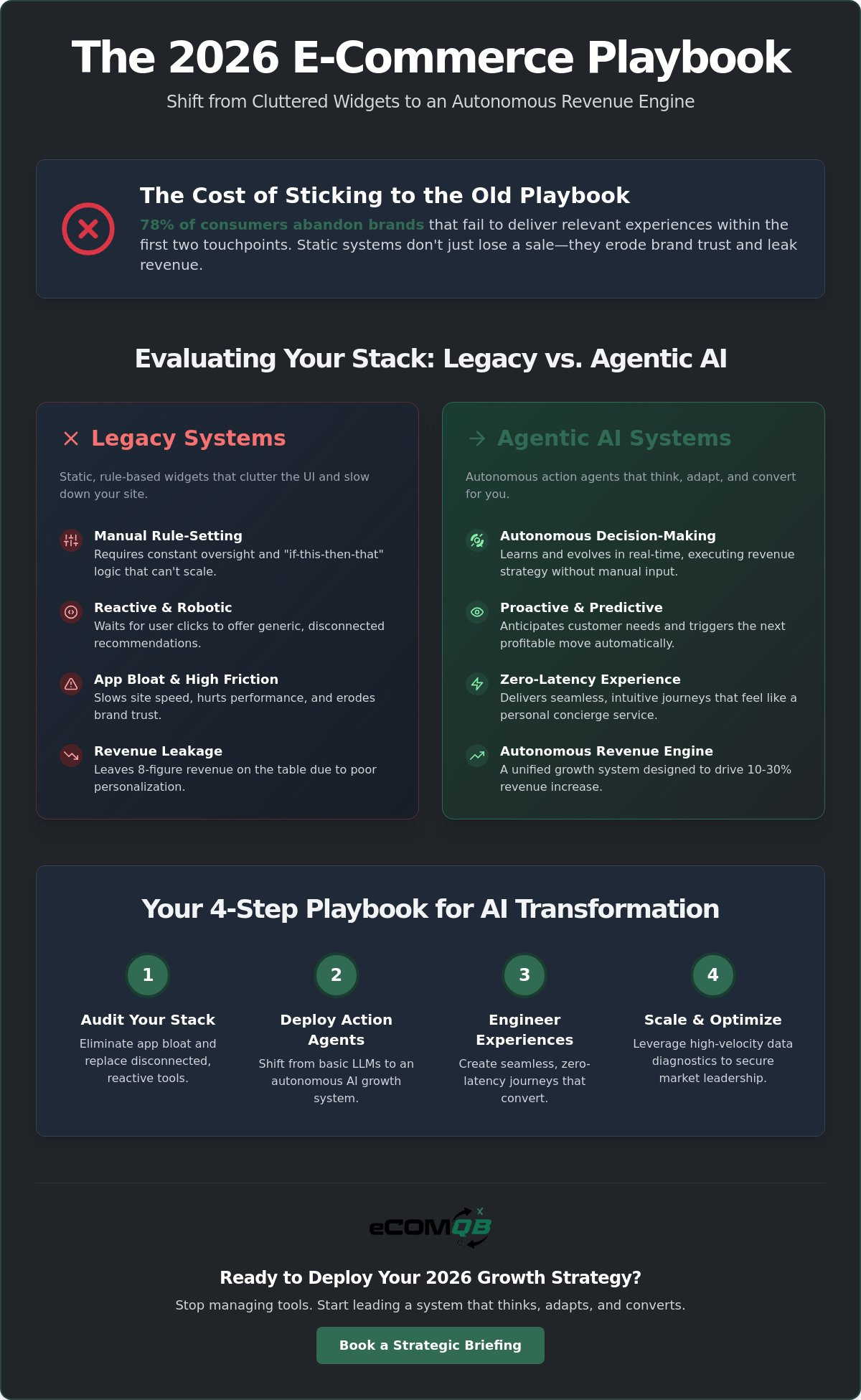
The 2026 Playbook: Deploying Zero-Latency Personalization
Execution separates the market leaders from the pretenders. You have the strategy; now you need the tactical playbook. Deploying AI for Shopify personalization is not a one-off event. It is a systematic rollout designed for speed, precision, and dominance. We don't guess. We engineer. To achieve 8-figure growth, your deployment must follow a rigorous, high-velocity sequence that eliminates friction and maximizes intent.
Success in the 2026 digital economy requires a five-step offensive:
- Step 1: Audit CRO Performance. Start by identifying the leaks in your current funnel using a high-velocity Shopify conversion rate optimization checklist.
- Step 2: Data Consolidation. Aggregrate your first-party data from Shopify, Meta, and Klaviyo into a single diagnostic engine.
- Step 3: Agentic Deployment. Activate autonomous workflows that dynamically generate storefront content and landing pages based on real-time user behavior.
- Step 4: Cross-Channel Synchronization. Ensure your email, SMS, and paid media agents are speaking the same language to provide a unified experience.
- Step 5: Systemic Optimization. Partner with a tactical expert to monitor performance and adjust the playbook as the market shifts.
If you are ready to stop managing tools and start driving revenue, you can book a performance briefing today.
Mapping the Customer Journey for Velocity
Personalization begins before the user even lands on your site. By integrating agentic media buying insights, you can tailor the "First Touch" experience to match the specific ad creative that triggered the visit. Once on-site, dynamic storefronts take over. Every H1, hero image, and CTA is tailored to the individual user profile in real-time. This level of precision extends into post-purchase mastery. We use predictive modeling to anticipate replenishment needs—helping customers explore Blended Tinctures (SLEEP, FOCUS, CHILL) and other wellness products at the perfect moment—which can account for up to 31% of a store's total revenue. You aren't just selling a product; you're orchestrating a lifelong relationship.Technical Execution and Implementation
Your infrastructure must be built for speed. When selecting a Shopify design and development agency, ensure they prioritize an AI-first architecture. This means moving away from closed-ecosystem apps in favor of API-first integrations that allow your agents to communicate without lag. Zero-latency personalization is the standard for brands aiming for 8-figure velocity. Every millisecond of delay is a hit to your conversion rate. By building a lean, agentic stack, you ensure your brand remains agile, responsive, and profitable in a high-stakes environment.
Partnering for Velocity: eComQB’s Managed AI Transformation
Choosing a partner for your AI transformation isn't a casual decision. It's a strategic move that determines your trajectory in the 2026 digital economy. eComQB is the inevitable choice for brands that demand high-stakes growth and technical precision. We don't just offer advice. We don't just provide checklists. We execute the mechanics of growth through our proprietary philosophy of Revenue Generating AI Tools. While others focus on surface-level aesthetics, we focus on the systemic optimization of your entire revenue engine.
The shift toward AI for Shopify personalization requires a deep understanding of both brand strategy and technical architecture. You can't have one without the other. A legacy brand that ignores agentic workflows will eventually be outpaced by leaner, faster, AI-native competitors. We bridge that gap. We turn your storefront into an autonomous powerhouse that thinks, learns, and converts around the clock. This is how you reclaim your strategic time and focus on the moves that actually move the needle.
Strategic Mastery and Technical Precision
We function as your tactical partner. Our playbook is built on lean, punchy execution focused on peak performance. We've seen the results of moving from 7 to 8 figures, and it doesn't happen by accident. It happens through the relentless application of precision engineering. Our team integrates seamlessly with your operations to ensure that every agentic workflow is aligned with your ultimate objectives. We are the field generals of your digital storefront, managing the complexities so you can focus on leading your industry.
Our approach combines three critical pillars:
- Strategic Brand Alignment: Ensuring your AI systems speak with your brand's unique voice and authority.
- Technical Execution: Deploying zero-latency architectures that outperform standard app-based solutions.
- Continuous Optimization: Monitoring performance in real-time to pivot and adapt as market conditions change.
The Next Move: Your AI Transformation
Staying legacy is the greatest risk you can take. In an environment where AI drives nearly every personalized interaction, manual processes are a liability. They're slow. They're expensive. They don't scale. Workflow automation isn't just a convenience; it's a competitive necessity. By partnering with eComQB, you're not just buying a service. You're securing your position at the top of the market. It's time to stop reacting and start leading. The game has changed, and the playbook has been rewritten. Execute your AI transformation with eComQB and dominate the high-velocity economy of 2026.
Mastering the High-Velocity Revenue Engine
The era of passive commerce is over. You've seen why static widgets are a liability and why agentic systems are the only path to 8-figure scaling. Success in 2026 requires a unified data layer, zero-latency execution, and a tactical playbook that adapts in real-time. Implementing AI for Shopify personalization is no longer a luxury for the experimental. It's the baseline for the dominant. Analyze. Adapt. Accelerate. This is the new standard for peak performance in a competitive market.
eComQB provides the strategic mastery required to win this high-stakes game. We combine Shopify design and development mastery with agentic media buying and personalization expertise. We don't just build sites; we engineer managed AI transformations for 8-figure brands. It's time to stop playing defense and start orchestrating your next move. The field is set, and the technology is ready. You have the vision. We have the execution. Let's build the inevitable solution together and secure your competitive advantage.
Deploy your high-performance AI growth system with eComQB. Your next growth phase starts now.
Frequently Asked Questions
How does AI for Shopify personalization improve my profit margins?
AI for Shopify personalization increases profit margins by identifying and executing high-probability upsell opportunities without human intervention. By automating the decision-making process, you reduce the operational overhead associated with manual merchandising. This precision ensures that your marketing spend is directed toward the most profitable segments, maximizing Lifetime Value while minimizing wasted ad spend. You're effectively replacing a room full of analysts with a single, high-velocity revenue engine.
Will adding AI personalization apps slow down my Shopify store?
Legacy widgets often bloat the DOM and increase Time to Interactive, but modern agentic systems are designed for zero-latency performance. We utilize lightweight, server-side execution to ensure that personalization occurs before the page even loads for the user. This approach eliminates the flicker associated with client-side scripts and maintains peak site speed. Speed is a conversion lever, and our architecture ensures that intelligence never comes at the cost of performance.
What is the difference between standard upsell apps and agentic personalization?
Standard upsell apps rely on static, rules-based logic that requires constant manual adjustment to remain relevant. Agentic personalization is an autonomous system that perceives user intent and acts independently to achieve specific revenue objectives. While an app might show a generic product, an agent orchestrates a complete, tailored journey across every touchpoint. It’s the difference between a simple vending machine and a high-level strategic partner.
How much data do I need before AI personalization becomes effective?
Agentic systems become effective immediately by leveraging your existing first-party data from Shopify, Klaviyo, and Meta. While machine learning models sharpen with volume, modern AI can identify patterns and intent signals from the very first session. You don't need millions of visitors to see a lift; you need a system that can synthesize the data you already have. The goal is to turn existing traffic into higher-velocity revenue through better precision.
Can eComQB manage the entire AI transformation for my Shopify brand?
Yes, eComQB provides a fully managed AI transformation that covers everything from initial strategy to technical execution. We function as your tactical field general, deploying Revenue Generating AI Tools and managing the ongoing optimization of your growth systems. Our team handles the design, development, and data orchestration, allowing your leadership to focus on high-level strategy. We don't just consult on the technology; we own the results.
Is agentic personalization compatible with Shopify Plus?
Agentic personalization is specifically engineered to thrive within the Shopify Plus ecosystem, utilizing advanced APIs and Shopify Functions for deep integration. The enterprise-level infrastructure of Plus provides the stability and data access required for high-velocity agentic workflows. We leverage these native capabilities to build customized, zero-latency experiences that standard apps cannot replicate. It’s the inevitable choice for brands aiming for 8-figure scale and beyond.
How does AI personalization integrate with Meta and Google advertising?
Advanced AI for Shopify personalization creates a closed-loop feedback system with your Meta and Google advertising channels. By feeding on-site intent data back into your ad platforms, your media buying agents can target high-value prospects with extreme precision. This synchronization ensures that the message a customer sees in an ad is perfectly mirrored in the landing page experience. You're no longer running isolated campaigns; you're executing a unified, cross-channel offensive.
What are the first steps to upgrading from legacy personalization tools?
The first step is a comprehensive audit of your existing tech stack to identify app bloat and revenue leakage. Once the bottlenecks are identified, we consolidate your siloed data into a unified diagnostic engine to fuel your new agentic workflows. This transition moves your brand from a reactive posture to a proactive, high-velocity growth strategy. It’s a tactical shift that replaces disconnected tools with a single, high-performance revenue system.