AI Personalization vs Traditional eCommerce Tools: Engineering 8-Figure Velocity in 2026

Your current tech stack isn't a growth engine; it's a ceiling. Most eCommerce leaders are currently suffocating under the weight of expensive legacy systems that require constant manual oversight. When you weigh ai personalization vs traditional ecommerce tools, the difference isn't just a simple feature set. It's the gap between a static storefront and a high-velocity revenue machine. You likely feel the frustration of spending 20 hours a week on manual segmentation only to watch your customer acquisition costs climb. It's a relentless grind that yields diminishing returns, drains your team, and eats your margins alive.
We're here to change the game. This guide breaks down why rules-based tools are capping your growth and how agentic AI systems transform every touchpoint into a predictive conversion lever. You'll learn to eliminate tech stack bloat, automate your revenue growth, and deliver zero-latency experiences that scale. We're providing the strategic playbook to engineer 8-figure velocity. It's time to stop managing traffic and start engineering outcomes. Let's move.
Key Takeaways
- Break the "If-This-Then-That" trap that causes legacy systems to leak revenue through manual friction and data latency.
- Master agentic workflows that predict and capture customer intent before the first click to drive relentless conversion.
- Evaluate the definitive ROI of ai personalization vs traditional ecommerce tools to see how precision targeting slashes acquisition costs.
- Audit your current tech stack to identify revenue leakers and unify your data for high-performance AI execution.
- Deploy a managed growth system to engineer 8-figure velocity while stripping away the operational complexity of technical scaling.
Why Rules-Based Personalization is Leaking 7-Figure Revenue
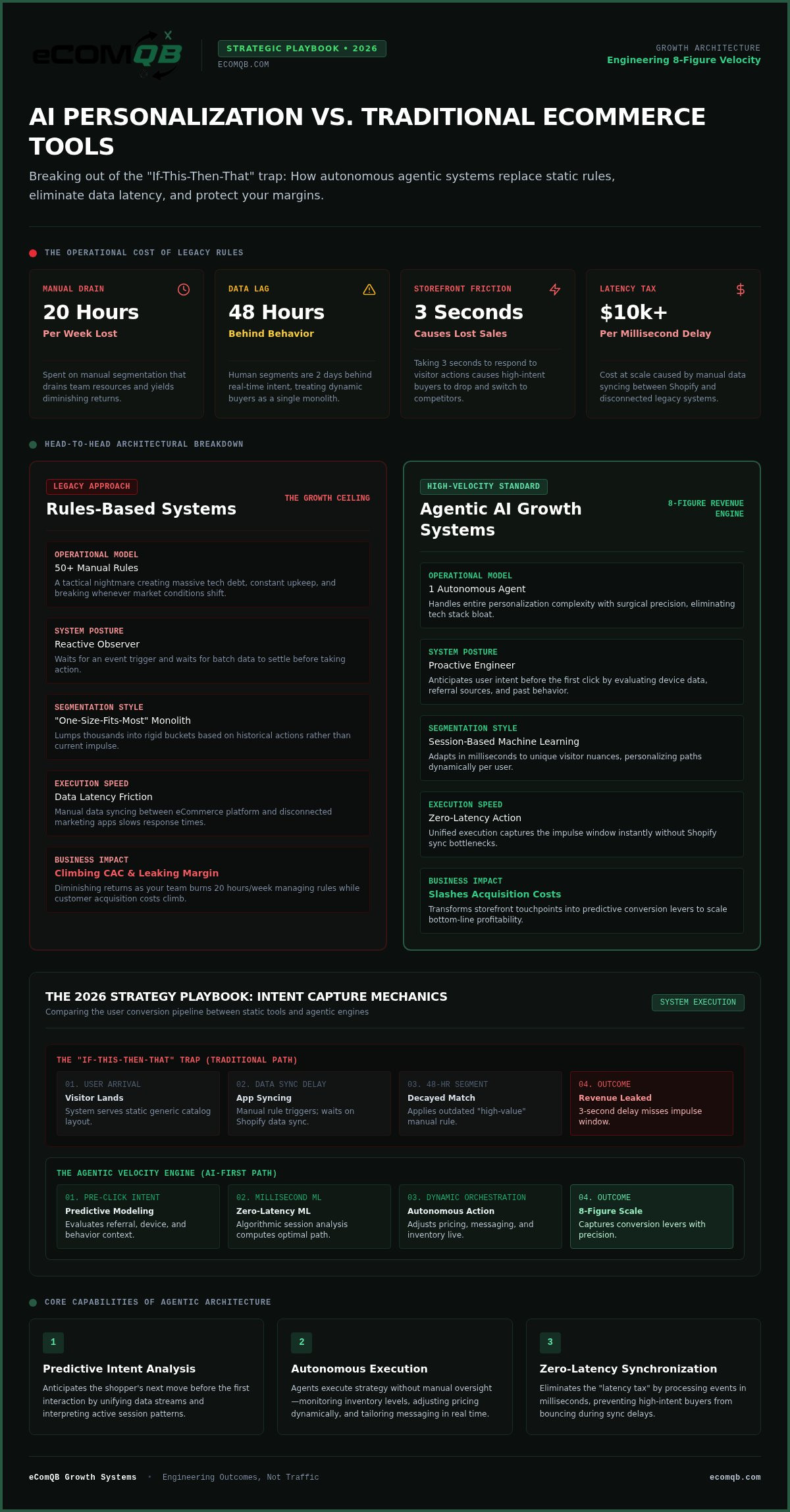
Legacy tools are bleeding your bottom line. They rely on rigid logic that cannot keep pace with the modern buyer. When comparing ai personalization vs traditional ecommerce tools, the core issue is agility. Traditional tools are reactive observers that wait for data to settle. AI systems are proactive engineers that shape the journey in real time. Managing 50 manual rules is a tactical nightmare that creates massive tech debt. One autonomous agent handles the entire complexity with surgical precision. You don't need more rules; you need better intelligence.
The "If-This-Then-That" trap is the silent killer of eCommerce growth. It forces your team to play a perpetual game of catch-up. You build a rule, the market shifts, and your rule becomes a liability. This manual approach is static, sluggish, and outdated. It prevents you from achieving the momentum required for 8-figure scaling. In the high-stakes game of 2026, relying on yesterday's logic ensures you lose tomorrow's revenue. High-performance brands are moving away from these bottlenecks to embrace autonomous systems that prioritize speed and accuracy.
The Limits of Manual Segmentation
Human-defined segments are fundamentally flawed because they are always 48 hours behind real-time behavior. By the time you have manually grouped "high-value shoppers," their intent has already shifted. This "One-Size-Fits-Most" approach is why your current tech stack is likely leaking revenue. It treats thousands of unique individuals as a single monolith. This lack of granularity destroys your competitive advantage and inflates your customer acquisition costs.
Unlike basic logic, algorithmic recommender systems utilize session-based machine learning to adapt instantly. They analyze, predict, and execute within milliseconds. Traditional email and SMS flows often fail because they rely on these decaying segments. They send the right message to the wrong person at the wrong time. Strategic leaders recognize that manual segmentation is a ceiling on growth. It is time to audit your segments and identify where your traffic is falling through the cracks.
The Latency Tax on Modern Brands
Zero-latency is not a luxury. It is a requirement for 8-figure velocity. Every millisecond of delay between data collection and action costs $10k+ at scale. Traditional apps create friction during manual data syncing between Shopify and your legacy stack. This gap kills conversion rates. It creates a disjointed experience that frustrates high-intent buyers and drives them to competitors who offer a seamless path to purchase.
Static storefronts fail to capture the impulse window of high-intent buyers. They offer yesterday's products to today's shoppers. When your site takes three seconds to respond to a user's behavior, you have already lost the sale. Speed wins. Delay loses. Precision scales. By eliminating the latency tax, you transform your storefront into a high-velocity engine that captures revenue in real time. This is how you win the game in 2026.
The Architecture of Agentic Personalization in 2026
AI in 2026 isn't a bolt-on feature. It is the foundational layer of your growth system. When evaluating ai personalization vs traditional ecommerce tools, the distinction lies in agency. Traditional tools wait for a trigger; agentic systems create the opportunity. They don't just observe; they engineer. This architectural shift moves your brand from a static catalog to a living, breathing revenue engine. You're no longer just showing products. You're orchestrating intent.
Predictive intent is the core of this new framework. It allows your system to anticipate the next move before the user even clicks. By the time a visitor lands, the system has already processed their referral source, device data, and past behavior to build a custom path. This synergy between AI for Shopify personalization and backend automation ensures that every interaction is optimized for maximum velocity. It's about moving from a reactive posture to a proactive strategy that dominates the market.
From Reactive Tools to Autonomous Agents
Agentic software executes strategy. It doesn't just follow a rigid list of instructions. These agents monitor inventory levels, adjust pricing dynamically, and tailor messaging in real-time. They operate with a bird’s-eye view of your entire operation to ensure peak performance. This level of systemic optimization is supported by McKinsey research on personalization ROI, which highlights how leaders generate 40% more revenue by moving faster than their peers. A curated AI stack ensures you maintain 8-figure momentum without increasing operational overhead.
Agentic Landing Pages: The New Conversion Standard
The static homepage is a relic of the past. In 2026, every visitor deserves a unique, dynamically generated storefront designed specifically for their needs. Agentic landing pages eliminate the conversion-killing mismatch between your Meta ad copy and the on-site experience by instantly reconfiguring layouts to match the user's psychological triggers. You can adapt the 'Hook, Story, Offer' framework in milliseconds to align with specific buyer personas.
This precision transforms cold traffic into loyal customers at a rate traditional tools cannot match. It ensures that your marketing spend is never wasted on a generic experience. If you want to see how these systems integrate with your current scaling goals, schedule a strategic briefing to map out your transition. It is time to stop guessing and start engineering your conversion rates.
AI Personalization vs Traditional Tools: The ROI Comparison
ROI isn't just about spreadsheets. It's about speed. When you weigh ai personalization vs traditional ecommerce tools, the winner is clear. Traditional tools are cost centers. They demand constant manual tuning and deliver diminishing returns. Agentic AI systems are profit engines. They scale your brand without adding a single person to your payroll. You're moving from a model of high-overhead maintenance to one of autonomous revenue generation. This is the shift that separates the market leaders from the also-rans in 2026.
Efficiency is the engine of growth. Manual flow management is a 40-hour-a-month drain on your leadership team. Agentic systems reclaim that time. They handle the technical complexity while you focus on the ultimate objective. You're not just cutting costs; you're increasing your team's tactical capacity. This is how you win the game. By automating the mechanical aspects of growth, you free up your resources to focus on high-level strategy and brand innovation.
CAC Reduction Through Precision
Traditional tools waste 30% of ad spend on cold segments. They rely on broad audience data that is often outdated before the campaign even launches. High-performance brands don't settle for "close enough." They use agentic media buying to align every dollar with high-intent behavior. These agents optimize Meta and Google bids in real time based on how a user interacts with your site. This precision targeting slashes acquisition costs and gives you an unfair advantage in a crowded market. You stop paying for impressions and start paying for outcomes.
Compounding LTV with Agentic Retention
Retention is where the real profit lives. Stop sending generic "Blast" emails that customers ignore. In 2026, you need "Pulse" messaging that reacts to the individual. Agentic email marketing is the only way to scale this level of intimacy. It transforms your retention strategy from a routine task into a zero-latency revenue driver. AI-driven real-time personalization ensures that every message resonates with the recipient's current needs. When customers feel truly understood, their lifetime value expands exponentially. This compounding effect is the secret to engineering 8-figure velocity.
Strategic Blueprint: Transitioning to an AI-First Growth System
Transitioning to an AI-first model is a strategic overhaul, not a software update. When you evaluate ai personalization vs traditional ecommerce tools, the first step is identifying the static bottlenecks currently capping your growth. Legacy stacks often hide revenue leakers within fragmented data silos. You need a unified data architecture to fuel high-performance AI execution. Without this foundation, even the most advanced tools will underperform. Precision requires a clean slate. You must audit, unify, and execute.
The shift from 'AI-assisted' to 'Agentic-led' workflows marks the difference between a tool and a system. A tool follows a command; a system achieves an objective. This transition allows your brand to operate with a level of precision that manual management cannot replicate. By removing human friction from the conversion path, you engineer a high-velocity engine designed for 8-figure scaling. It is about moving from a state of constant maintenance to a state of autonomous expansion.
Phase 1: The AI Diagnostic
High-stakes growth starts with a cold, hard look at your metrics. You must identify the three hidden data gaps currently killing your profit margins: attribution lag, segment decay, and cross-channel friction. Mapping customer journeys reveals 'abandonment' triggers that traditional tools simply cannot see. We assess your Shopify storefront's readiness for agentic integration to ensure your foundation is ready for 8-figure scaling. This is about identifying weaknesses before they become liabilities. You can't fix what you haven't diagnosed.
Phase 2: Deploying Agentic Workflows
Once the diagnostic is complete, move into rapid execution. Integrate agentic email and SMS to drive immediate revenue recovery without human intervention. Set up dynamic landing pages for your top-performing Meta campaigns. This ensures every click lands on a page optimized for that specific user's intent. Training the AI on your brand voice is critical to maintain consistent strategic mastery across every touchpoint. You're moving from 'AI-assisted' tasks to 'Agentic-led' workflows that operate with zero-latency. This is how you engineer velocity.
Success in 2026 requires a partner that truly understands AI transformation for eCommerce. You need a field general who handles the technical complexity while you stay focused on the objective. This phased approach provides the ultimate conversion lever for ambitious brands. It strips away the operational fluff and replaces it with a lean, punchy revenue engine. Stop managing the complexity and start engineering the outcomes. If you're ready to identify your revenue leakers and deploy a high-velocity system, book a strategic briefing with our team today.
Deploying the eComQB AI Growth System for Unfair Advantage
Most brands fail at AI because they treat it as a DIY project. They buy a subscription, install a plugin, and expect miracles without the underlying infrastructure or strategic oversight. This is where the debate between ai personalization vs traditional ecommerce tools becomes a matter of execution. Traditional tools leave the heavy lifting on your shoulders. eComQB removes that weight. We provide the managed technology stack and the tactical mastery to ensure your brand hits peak performance without the operational bloat. We don't just hand you a tool; we deploy a system.
Our curated AI stack is not a generic collection of apps. It is a precision-engineered engine. We don't just use AI; we engineer it into the DNA of your business to drive relentless growth. This moves your brand beyond the limitations of standard SaaS platforms and into a realm of systemic optimization. We function as your tactical growth partner, bridging the gap between high-level consulting and technical execution. The final objective is clear: engineering 8-figure velocity and maintaining a dominant market position.
The eComQB Playbook: Strategic Mastery in Action
Our Field Generals manage your AI transformation end-to-end. We handle the technical complexities of data unification and agentic integration so you can focus on the objective. This involves a high-stakes synergy of Shopify development and revenue-generating AI tools. We take command of your Meta and Google advertising execution, ensuring every ad dollar is backed by predictive intent data. It's a comprehensive approach that turns your storefront into a high-velocity revenue machine. We win by out-thinking and out-executing the competition at every touchpoint.
Your Next Move: Securing the Growth Trajectory
Waiting for the right time is a tactical failure in 2026. The digital economy moves too fast for hesitation. The competitive advantage of being an early adopter of agentic systems is the difference between leading the market and fighting for scraps. You need a system that learns, adapts, and converts while your competitors are still stuck in manual flows. This is your opportunity to secure an unfair advantage and scale with precision. It's time to stop managing the friction and start engineering the momentum.
Success requires a specific playbook and specialized leadership. If you're ready to see the true potential of your brand, you need a tailored briefing on your AI potential. We strip away the corporate fluff and focus on the levers that actually move the needle. Don't let legacy tools cap your growth for another quarter. Take the field with a partner that understands the mechanics of 8-figure velocity. Let's execute.
Dominate the Digital Economy with Agentic Velocity
The shift from managing traffic to engineering outcomes is the definitive line between stagnation and 8-figure growth. By moving beyond the limitations of rules-based logic, you unlock a level of precision that slashes acquisition costs and compounds your lifetime value. The choice between ai personalization vs traditional ecommerce tools is ultimately a choice between a static ceiling and an autonomous revenue engine. You've seen the blueprint. Now it's time to execute the play with precision and intent.
We handle the technical complexity so you can focus on the objective. As Managed AI Growth Systems specialists and Agentic Media Buying Experts, we function as your tactical partner in the field. Our team of Shopify High-Performance Specialists is ready to audit your stack and deploy a system built for speed. Secure Your 8-Figure Velocity: Book Your AI Transformation Briefing today. The future belongs to the leaders who act with speed. Let's win.
Strategic Briefing: Frequently Asked Questions
What is the main difference between AI personalization and traditional rules-based tools?
The primary difference is the shift from static triggers to predictive intent. Traditional tools rely on "If-This-Then-That" logic, which is rigid and reactive. AI personalization uses machine learning to anticipate buyer needs before they click. When weighing ai personalization vs traditional ecommerce tools, the core advantage is the ability to adapt in real time. You move from a system that follows a script to an agent that executes a strategy.
Can AI personalization work with my existing Shopify store?
AI personalization integrates seamlessly with high-performance Shopify environments. We specialize in Shopify website design and development to ensure your storefront is ready for agentic workflows. By leveraging Shopify Plus API capabilities, our systems execute real-time updates to pricing, product recommendations, and messaging. You don't need to migrate your platform. You simply need to upgrade the intelligence driving your existing storefront to engineer high-velocity revenue growth.
How does agentic media buying improve my ROAS?
Agentic media buying improves ROAS by aligning your Meta and Google bids with actual on-site intent. Traditional media buying relies on broad segments that often decay before your campaign scales. Our AI agents monitor real-time behavior to identify high-intent shoppers, allowing for surgical bid adjustments. This precision eliminates wasted ad spend on cold traffic. You stop paying for impressions and start paying for conversion outcomes that drive bottom-line profit.
Do I need a large data science team to implement AI personalization?
You don't need a data science team because eComQB provides a fully managed AI technology stack. We function as your tactical partner, handling the technical execution while you focus on the objective. Ambitious leaders often hesitate because they fear the operational overhead of complex systems. Our model strips away that complexity. We deploy the experts and the infrastructure required to scale your brand to 8-figure velocity without increasing your payroll.
What are agentic landing pages and why are they superior to static ones?
Agentic landing pages are dynamic storefronts that reconfigure themselves based on a visitor's specific intent and referral source. Static pages offer a one-size-fits-all experience that creates a mismatch between your ad copy and the site content. This friction kills conversion rates. Agentic pages adapt the "Hook, Story, Offer" framework in milliseconds to match the user's psychological triggers. This level of precision is the ultimate lever for transforming cold traffic into revenue.
How long does it take to see a return on investment with an AI growth system?
Return on investment usually manifests in two stages. You often see immediate revenue recovery through the deployment of agentic email and SMS workflows that capture abandoned intent. The broader ROI from system-wide optimization typically scales over several months as the AI models refine their predictive accuracy. By eliminating manual segmentation and the latency tax, you reclaim hours of team time and start seeing compounding growth in your profit margins.
Is AI personalization better for customer acquisition or retention?
It is equally powerful for both, but the strategic application differs. For acquisition, it slashes CAC by ensuring your paid traffic lands on a hyper-relevant experience. For retention, it expands LTV by moving away from generic "blast" messaging to "pulse" communication that reacts to individual behavior. This dual-threat capability is why the debate between ai personalization vs traditional ecommerce tools is so critical for brands aiming for 8-figure velocity.
What is the 'latency tax' in eCommerce personalization?
The latency tax is the measurable loss of revenue caused by the delay between data collection and action. Traditional tools are often 48 hours behind real-time behavior, meaning they show products a customer has already bought or ignored. This delay creates friction and destroys the impulse window for high-intent buyers. Eliminating this tax requires zero-latency systems that process and act on data in milliseconds to capture every revenue opportunity.