AI Transformation for eCommerce Brands: The 2026 Strategic Playbook

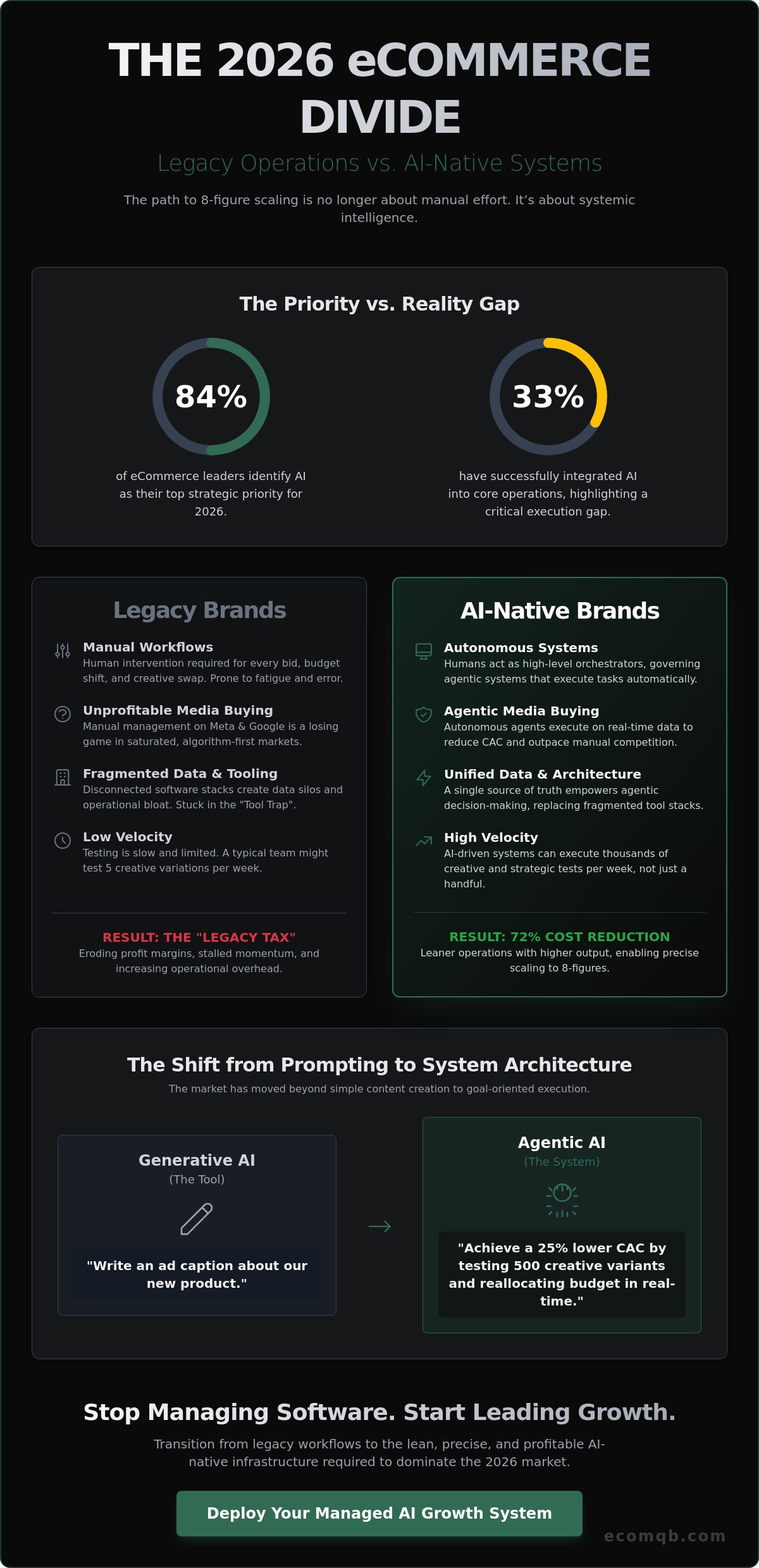
While 84% of eCommerce leaders identify AI as their top strategic priority for 2026, only 33% have successfully integrated it into their core operations according to Cubeo AI. Most brands are still stuck in the "tool phase," layering disconnected software over broken processes while manual media buying on Meta and Google becomes increasingly unprofitable. You recognize that the current model is unsustainable. Saturated ad markets, operational bloat, and fragmented data silos are draining your margins and stalling your momentum. A true AI transformation for eCommerce brands requires a shift from passive tools to active, agentic systems.
You're ready to stop managing software and start leading a high-performance growth engine. This strategic playbook provides the roadmap to master agentic systems that automate scaling and eliminate manual bottlenecks. You'll learn how to deploy autonomous media buying to reduce CAC, streamline your operations for higher output, and build a system-driven revenue model. We will break down the transition from legacy manual workflows to the lean, precise, and profitable infrastructure required to dominate the 2026 market.
Key Takeaways
- Identify the critical divide between legacy operations and AI-native systems to protect your profit margins from rising acquisition costs.
- Execute a true AI transformation for eCommerce brands by replacing fragmented software stacks with integrated, autonomous growth systems.
- Deploy agentic media buying and dynamic creative workflows that outpace manual competition through constant, high-velocity testing.
- Build a unified data infrastructure that serves as a single source of truth for agentic decision-making and real-time scaling.
- Scale to 8-figures with precision by adopting a managed AI growth framework that eliminates operational bloat and maximizes output.
The Shift to AI-Native: Why Legacy eCommerce Brands are Fading in 2026
The eCommerce landscape has fractured into two distinct camps. On one side, AI-native brands operate with surgical precision, autonomous speed, and relentless momentum. On the other, legacy brands cling to manual workflows, watching their margins erode in real-time. By mid-2026, the divide is no longer a matter of tactical preference. It's a matter of operational survival. If you aren't building an agentic growth system, you're essentially subsidizing your competitors' market share.
Legacy brands are currently paying a heavy price for their hesitation. Saturated ad markets on Meta and Google have made manual media buying a losing game. When every bid adjustment, budget shift, and creative swap requires human intervention, you simply can't move fast enough to win. This operational bloat creates a "Legacy Tax" that crushes profitability. While traditional retailers struggle with overhead, leaders pursuing a comprehensive AI transformation eCommerce brands are seeing 72% cost reductions according to Cubeo AI data from early 2026.
The velocity gap is the most lethal threat. While a traditional team might test five creative variations a week, an AI-driven competitor executes thousands. They've moved beyond the "human-plus-tools" phase. They've embraced a sophisticated model of AI in digital marketing where humans act as high-level orchestrators of autonomous systems. This isn't about working harder. It's about out-executing the entire market through systemic intelligence and superior data ingestion.
The Death of the Manual Growth Model
Relying on manual media buying and content creation is now a high-risk bottleneck. Humans are slow, expensive, and prone to fatigue. In an algorithm-first economy, human-only strategies are obsolete because they can't process signals at the speed of the platform. Disconnected tech stacks further compound this issue. Every minute your team spends moving data between SaaS tools is a minute lost to a competitor whose systems talk to each other automatically. Manual management isn't just inefficient; it's a liability that prevents real-time decision making.
Defining the AI-Native Advantage
The 2026 eCommerce leader wins on three specific pillars: precision, speed, and scale. AI-native brands don't wait for weekly reporting cycles to pivot. They execute on real-time data. This allows them to scale to 8-figure revenue without doubling their headcount or increasing their operational complexity. By leveraging agentic systems, these brands maintain leaner operations with significantly higher output. They've replaced the friction of manual management with the momentum of autonomous, system-driven growth.
Defining True AI Transformation: Moving Beyond Fragmented Tooling
Most eCommerce leaders are falling into the "Tool Trap." They buy ten different AI apps, add ten more subscriptions to their balance sheet, and wonder why their team is busier than ever. This isn't transformation. It's bloat. True AI transformation eCommerce brands achieve isn't found in a list of features; it's found in the systemic integration of autonomous agents into the brand's core. You don't need more tools. You need a unified architecture.
The winning move in 2026 is orchestration over adoption. It's the science of making disparate AI systems talk to each other without human intervention. Instead of your team manually moving data from a customer service bot to an email marketing platform, your systems should sync automatically. By executing essential AI use cases like dynamic product management and order intelligence, you move from reactive management to proactive system governance. You stop puting out fires and start refining the engine. Implementing a managed AI growth system ensures these technologies work in harmony rather than creating new silos.
The Difference Between Generative AI and Agentic AI
Generative AI creates content. Agentic AI executes business objectives. In 2026, the "Agent" is the standard. These systems don't just write a caption; they use tools, analyze performance metrics, and make tactical decisions to optimize your bottom line. You're moving from prompt engineering to system architecture. It's a shift from asking a machine to "make this" to telling a machine to "achieve this." This evolution allows you to focus on high-level strategy while the agents handle the heavy lifting of execution.
The Three Layers of an AI-Transformed Brand
To dominate the market, your brand must be built on three specific layers of intelligence:
- The Data Layer: Your foundation must be clean, unified, and accessible in real-time. AI cannot optimize what it cannot see. This layer eliminates data silos and provides a single source of truth for every autonomous agent.
- The Agentic Layer: This is the engine room. It consists of autonomous workflows for marketing, sales, and retention. These agents manage your bids, segment your lists, and trigger SMS flows based on live behavior.
- The Experience Layer: This is what the customer sees. It involves dynamic, personalized storefronts and landing pages that adapt to every user. Every interaction feels individualized because the system learns and responds in milliseconds.
When these three layers align, you've achieved a complete AI transformation eCommerce brands need to scale. You're no longer managing a collection of apps. You're governing a high-performance system designed for predictable, autonomous growth.
The Agentic Advantage: How Autonomous Workflows Outperform Manual Growth
Manual growth is a bottleneck. In the high-stakes environment of 2026, relying on human operators to adjust bids or swap creatives is like bringing a knife to a drone strike. Leading an AI transformation eCommerce brands can actually sustain requires moving beyond "tools" and into the era of autonomous agents. These systems don't just assist your team; they execute the mission. They identify patterns, deploy resources, and optimize outcomes with a speed that human-led teams simply cannot match.
The "Field General" perspective is the new standard for leadership. You provide the strategic objective. The agentic layer handles the tactical execution. This shift eliminates the latency between data discovery and action. While your competitors are still analyzing last week's spreadsheets, your autonomous workflows are already pivoting to capture new pockets of demand. It's about precision, momentum, and unrelenting scale.
Agentic Media Buying for Shopify Brands
Legacy media buying is dead. The "Bidding War" of the early 2020s has been replaced by algorithmic warfare. Autonomous agents now manage budget allocation across Meta and Google in real-time, shifting capital to the most efficient path to conversion without human oversight. This isn't just about efficiency; it's about survival. By identifying high-value audiences that manual targeting misses, agentic systems are helping brands bridge the revenue gap. According to the Stord 2026 report, early adopters of AI-driven personalization generate 40% higher revenue compared to non-adopters.
- Dynamic Creative Optimization: Testing 1,000+ variations while your team sleeps to find the winning hook.
- Zero-Latency Retention: AI agents managing email and SMS flows based on real-time behavior, not static schedules.
- Predictable Scaling: Shifting budgets to top-performing assets in milliseconds to maximize ROAS.
Automated Content and SEO Velocity
Organic growth used to be slow. Not anymore. AI-enhanced SEO services now allow brands to scale visibility by adapting to search algorithm shifts in real-time. You can now maintain content marketing at 10x speed without sacrificing the brand voice that defines your identity. The new standard is the Agentic Landing Page. These are storefronts that don't just sit there; they actively adapt layout and copy to match the specific intent of every visitor. This level of personalization is exactly why 84% of eCommerce businesses now rank AI as their top strategic priority for the year.
The 2026 Roadmap: Executing a High-Velocity AI Transformation
Transformation isn't a slow crawl. It's a strategic sprint. You need a playbook that moves at the speed of the digital economy. Execution requires a clinical approach to your existing infrastructure. To achieve a successful AI transformation eCommerce brands must follow a specific sequence: Audit, Infrastructure, Deployment, and Governance. This isn't about minor tweaks. It's about re-engineering your growth engine for maximum velocity. It's about moving from manual friction to autonomous momentum.
The roadmap begins with identifying the highest-friction bottlenecks in your current system. Most brands are "leaking" revenue through manual delays and fragmented data. You need a single source of truth for AI ingestion. Without a unified data layer, your agents are flying blind. Once the foundation is set, you deploy agentic workflows that handle the tactical heavy lifting while your leadership team focuses on high-level strategy. This is how you win in 2026.
Phase 1: Diagnostic and Data Readiness
Start with a 48-hour audit. You must identify exactly where your tech stack is leaking revenue. Most brands discover their biggest bottlenecks in manual reporting and disconnected SaaS tools. If you are currently seeing performance dips, your first move should be Fixing Declining Revenue with AI Diagnostics. Once the leaks are identified, clean your data pipes. AI is only as powerful as its input. Consolidate your customer, inventory, and marketing data into a real-time accessible layer. This is the fuel for your agentic systems.
Phase 2: Deploying the Agentic Stack
Don't adopt everything at once. Select a curated AI stack that fits your specific brand niche. Start with Agentic Media Buying for immediate ROI. This system takes over the tactical execution on Meta and Google, allowing you to scale budgets based on real-time performance signals. Simultaneously, build your "Zero-Latency" loops. These are agentic email and SMS flows that respond to user behavior in milliseconds. You aren't just sending campaigns; you are orchestrating individualized customer journeys that adapt as the user interacts with your storefront.
Governance is the final piece of the playbook. Your team must shift from "doers" to "system managers." They no longer pull the manual levers; they set the parameters. They monitor the feedback loops. They refine the strategic objectives. This transition allows your brand to scale to 8-figures without adding operational bloat. You are building a system that learns, adapts, and wins. Ready to lead the shift? Partner with us for AI transformation for eCommerce brands and secure your competitive advantage today.
eComQB: Deploying Managed AI Growth Systems for 8-Figure Scaling
Scaling to 8 figures in the 2026 economy isn't a DIY project. It is a high-stakes operation that demands precision, speed, and technical mastery. Most leaders fail the AI transformation eCommerce brands require because they attempt to build the infrastructure while simultaneously running the business. This leads to fragmented systems, exhausted teams, and missed targets. eComQB eliminates the friction. We provide a managed growth system that turns AI from a confusing cost center into a relentless profit engine.
Our "Field General" partnership model is built for the ambitious leader. We don't just hand you a list of apps. We build, manage, and optimize the entire system. You own the results; we own the execution. This allows you to maintain a bird’s-eye view of your brand's trajectory while our autonomous agents handle the tactical heavy lifting. It's a partnership based on performance, not promises. By shifting from manual management to system governance, you position your brand to capture a share of the AI-enabled eCommerce market, which Envive projects will reach $22.6 billion by 2032.
The Managed AI Transformation Service
We deliver an end-to-end implementation of curated AI technology stacks designed for your specific niche. This goes beyond simple software installation. We execute agentic media buying that outperforms traditional agencies by making real-time, data-driven adjustments across Meta and Google. Our team ensures Shopify excellence by building storefronts and landing pages designed for velocity and machine-readability. In an era where data quality is a competitive moat—especially for technical distributors like Electron Optics Instruments, LLC—we ensure your product catalog is clean, accurate, and ready for autonomous discovery.
Your Tactical Advantage in 2026
Brands that partner with eComQB scale faster with significantly less overhead. We focus on a triadic framework: Strategy, Execution, and Optimization. This approach ensures that every revenue-generating AI tool in your stack is pulling its weight. While 71% of stores are still experimenting with basic AI, our partners are already seeing the 40% revenue increases reported by early adopters of deep personalization. We move quickly from identifying a strategic need to presenting a path toward optimization. Don't let operational bloat hold you back. Secure your position at the top of the market. Deploy Your Managed AI Growth System Today and win the 2026 game.
Secure Your Competitive Advantage in the Agentic Era
The window for experimentation is closing. By August 2026, the divide between legacy operations and AI-native growth will be insurmountable. You've seen the roadmap. You understand that a successful AI transformation eCommerce brands need is about systemic orchestration, not just tool adoption. It's about moving from manual bottlenecks to agentic systems that operate with surgical precision. Success in this new landscape requires a shift in leadership. You must stop being a manager of tools and start being an architect of growth systems. For entrepreneurs looking to sharpen their strategic edge, Thrive Collective Publishing: Books, Journals, and Guides offers the coaching and training materials needed to lead this evolution.
We specialize in 8-figure Shopify scaling through managed AI stacks that eliminate operational overhead. Our team of agentic media buying experts ensures your capital is deployed with maximum efficiency while you focus on high-level strategy. Analyze, deploy, and dominate. The game has changed. The playbook is clear. Now, it's time to execute. Scale Your Brand with a Managed AI Growth System and lead the shift. The future of eCommerce belongs to the leaders who act with speed and certainty. Your move.
Frequently Asked Questions
What is the difference between AI tools and an AI growth system?
AI tools are fragmented point solutions that often create more manual work through disconnected data. An AI growth system is a unified, agentic architecture where autonomous workflows talk to each other to execute high-level business objectives. You shift from managing a tech stack to governing an integrated performance engine.
How long does a full eCommerce AI transformation typically take?
A high-velocity AI transformation eCommerce brands execute usually follows a 90-day trajectory. The diagnostic phase takes 48 hours to identify bottlenecks; data infrastructure is unified within the first 30 days; and full agentic deployment is stabilized by the end of the third month. This timeline ensures rapid ROI without disrupting your ongoing operations.
Will AI transformation replace my existing marketing team?
AI transformation doesn't eliminate your team; it elevates them. Your marketers move from the manual labor of bid adjustments and spreadsheet analysis to high-level strategic orchestration. They stop pulling tactical levers and start setting the mission parameters for the agentic systems that handle the execution.
Can AI transformation help reduce my Customer Acquisition Cost (CAC)?
It reduces CAC by eliminating the latency between data discovery and action. Agentic media buying identifies high-value audience pockets that manual targeting misses and reallocates budget in milliseconds to the most efficient conversion paths. This precision prevents wasted spend on underperforming assets while maximizing your top-performing creative.
Is AI transformation only for large enterprise eCommerce brands?
No, it's a strategic necessity for any brand aiming for 8-figure scaling. While enterprise players have the capital, mid-market brands have the agility to implement a full AI transformation eCommerce brands need to outmaneuver legacy giants. It is about operational efficiency and competitive speed rather than company size.
How does agentic media buying differ from standard automated bidding?
Standard automated bidding is a reactive feature restricted to a single platform. Agentic media buying is a proactive, cross-platform system that makes independent decisions about budget, creative swaps, and audience targeting. It functions like a digital media buyer that never sleeps and processes millions of signals simultaneously to optimize ROAS.
What are agentic landing pages and why do I need them?
Agentic landing pages are dynamic storefronts that reconstruct themselves based on the visitor’s real-time intent. You need them because static pages lose conversions by offering a generic experience. These pages adapt copy, imagery, and offers in milliseconds to match the specific needs of the individual shopper.
How do I ensure my brand voice is maintained during AI transformation?
Brand voice is maintained through a codified Master Persona training layer. Your specific brand DNA, lexicon, and tone are embedded into the system's core before any agentic deployment occurs. Your team then acts as the final governance layer to ensure every autonomous output aligns perfectly with your strategic identity.