How AI Should Actually Fit Into Your eCommerce Growth Strategy

Most eCommerce teams have already decided they need AI. What they have not decided, or at least not clearly, is where it belongs.
That gap creates a predictable mess. Brands buy tools before fixing the growth engine, automate copy before fixing the offer, and layer AI on top of disconnected channels that still do not share data, goals, or timing. The result is more activity, more dashboards, and very little profitable growth.
A strong AI eCommerce growth strategy starts from a simpler idea: AI is not the strategy. It is an operating layer inside the systems that already drive acquisition, conversion, and retention. When those systems are sound, AI helps them move faster, test more, and waste less. When those systems are weak, AI just helps you get the wrong answer at scale.
The wrong way to use AI in eCommerce
The biggest mistake is treating AI like a shortcut. It is easy to believe that smarter automation will fix rising CAC, low conversion, weak repeat purchase, or inconsistent creative performance. It will not. Those are growth problems first.
The second mistake is buying AI in fragments. One tool for paid media. Another for on-site chat. Another for email copy. Another for segmentation. If none of them sit inside a connected eCommerce AI strategy, they create more fragmentation, not less.
That usually shows up in a few common patterns:
Tool-first thinking: buying software before auditing acquisition, conversion, and retention
Automation without structure: expecting AI to fix weak offers, broken tracking, or poor creative strategy
Channel silos: running AI in ads, site, and lifecycle without shared customer logic
Short-term hacks
Disconnected reporting
Fancy outputs, weak margin
If AI sits on top of a fragmented business, it becomes noise. If it sits inside a well-built growth system, it becomes force multiplication.
The right AI eCommerce growth strategy framework
The right way to think about AI for eCommerce brands is operational, not theoretical. Start with the three systems that already determine growth: acquisition, conversion, and retention. Then ask where AI can improve speed, precision, relevance, and decision quality inside each one.
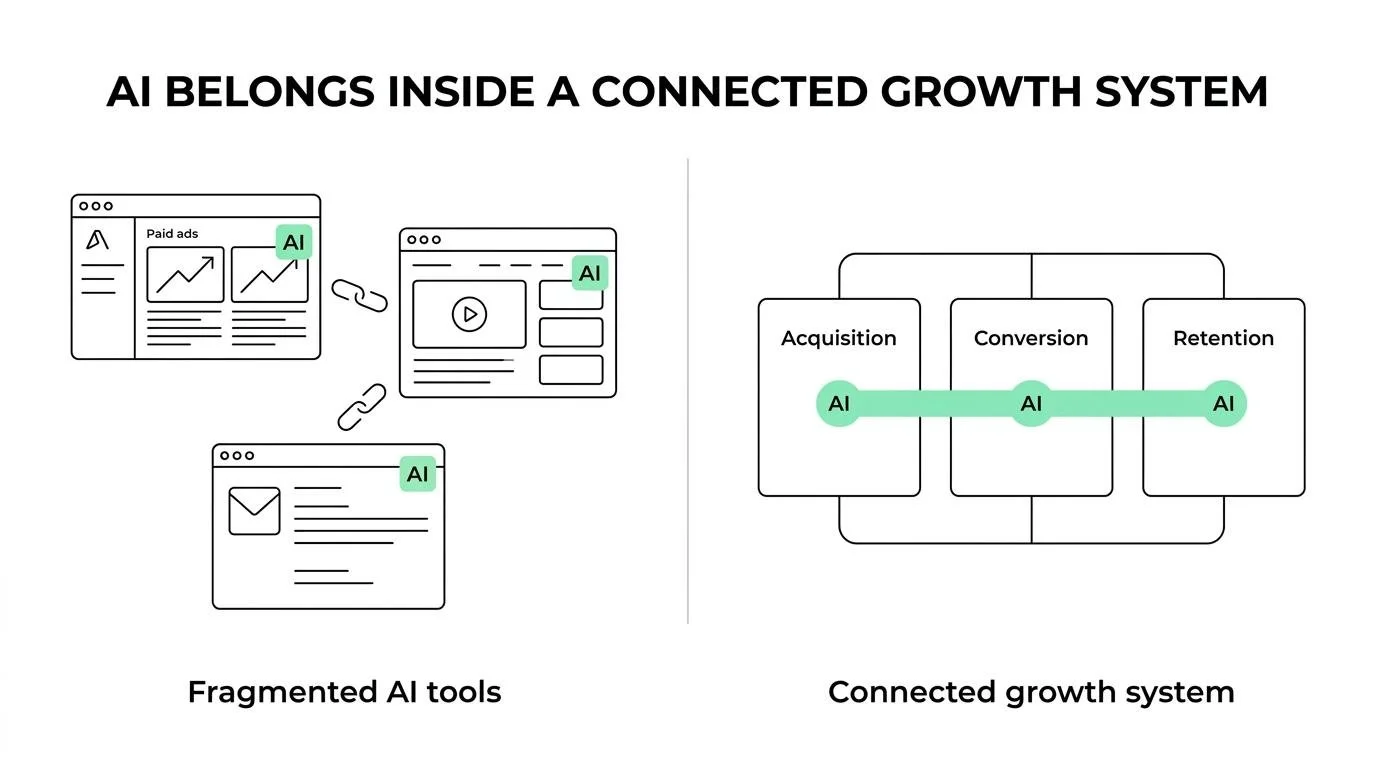
That shift matters because it changes the goal. You are not trying to create more AI activity. You are trying to improve business performance across the full customer path, from first click to repeat purchase.
Acquisition
AI works best in media buying, creative iteration, SEO, AI visibility, and audience signal analysis. It should improve traffic quality, CAC efficiency, and testing velocity. But human ownership still matters in positioning, offer strategy, and channel mix.
Conversion
AI is most valuable in personalization, conversational AI, landing page adaptation, and cart logic. It should improve conversion rate, average order value, and revenue per session. But human ownership is still needed for merchandising logic, UX priorities, and promo rules.
Retention
AI fits best in email and SMS orchestration, timing optimization, replenishment, churn signal detection, and subscription flows. It should improve repeat purchase rate, lifetime value, and churn reduction. But human ownership still matters in lifecycle strategy, margin guardrails, and brand voice.
Where AI fits in acquisition
Acquisition is where many brands first test AI, usually through media platforms and creative tools. That makes sense, but it often stays too shallow. Good acquisition work is not just automated bidding. It is a connected system of audience signals, creative testing, landing page continuity, and message match.
AI for paid media and creative iteration
Agentic AI for eCommerce can support campaign optimisation in ways that matter commercially. It can surface budget shifts faster, test more creative combinations, identify fatigue earlier, and increase the speed of media decisions. Generative workflows can also help teams turn one winning angle into multiple ad variants, hooks, formats, and UGC scripts.
Used properly, that gives operators more shots on goal without adding the same amount of manual labour.
A few high-impact acquisition use cases stand out:
Faster creative iteration
Better budget reallocation
Audience signal clustering
Reduced testing lag
Improved traffic efficiency
AI visibility and search discovery
AI visibility is becoming part of acquisition whether brands are ready or not. Search is no longer just about ranking product and collection pages in classic results. Brands now need structured product data, clear entity signals, useful category content, and language that helps AI surfaces interpret relevance.
That means AI visibility-first SEO is less about pumping out more articles and more about making your catalogue, site structure, and commercial pages easier for search engines and AI assistants to interpret. If your products do not show up in Google AI Overviews, ChatGPT-style shopping prompts, or merchant-rich search experiences, you lose demand before the click ever happens.
AI-assisted social selling
On social, AI can help qualify comments, suggest replies, score intent, and route high-intent interactions into DMs or assisted selling flows. It can also support content selection by identifying which formats, claims, and creators are moving traffic that converts, not just traffic that watches.
This is where acquisition starts to connect with conversion. The ad does not need more AI. The system needs tighter continuity from message to landing page to purchase intent.
Where AI fits in conversion
Conversion is where many brands can get the fastest payback from AI, because small lifts in site performance compound across all paid and organic traffic.
AI personalization and site relevance
AI personalization works best when it responds to real behaviour, not broad assumptions. A visitor coming from a bundle ad should not land on the same generic experience as a visitor coming from a brand search. Someone browsing refill products should not see the same product sequence as a first-time shopper.
AI can help adjust what visitors see based on source, category interest, cart activity, and product affinity. That can shape homepage modules, collection sorting, recommendation blocks, offer visibility, and product education.
Conversational AI and adaptive shopping support
Conversational AI can also improve conversion when it is built as sales support, not as a novelty widget. Strong implementations answer product questions, recommend the right SKU, handle hesitation around sizing or fit, and move shoppers toward checkout without sounding robotic.
There is also a strong use case for adaptive landing pages. If traffic source, product interest, or visitor type changes, page structure and message order can shift with it. AI-detected discounting can support this by identifying when a shopper needs urgency, when they need education, and when a discount would only erode margin.
Brands with strong traffic volume can go even further with anonymous profile detection. If a shopper is not logged in but shows repeat behaviour, the system can infer intent patterns and recover more abandoned carts or browse sessions with better follow-up logic.
AOV growth through recommendation logic
One of the most practical conversion use cases is AI-driven cross-sell and cart expansion. That is not just “related products” on a PDP. It is context-aware recommendation logic based on cart composition, order history, category behaviour, and offer economics.
The goal is simple: increase average order value without damaging conversion rate.
Where AI fits in retention
Retention is where AI often produces the cleanest profit because the economics are already better. You are working with owned channels, known customer behaviour, and margin-friendly repeat purchase opportunities.
Agentic email and SMS for repeat purchase
Agentic Email and SMS should not mean setting every flow to auto and hoping the machine figures it out. It should mean giving the lifecycle system better timing, better segmentation, and better next-message logic.
AI-driven timing optimization can identify when a customer is most likely to open, click, reorder, or lapse. That can improve send timing, replenishment reminders, win-back offers, and subscription prompts. It can also help decide what not to send, which matters just as much when list fatigue starts eating into response.
Personalized offers and subscription growth
Retention gets stronger when AI personalization is tied to customer value and behaviour. A first-time buyer may need education and trust signals. A second-order customer may need a bundle suggestion. A subscriber at risk may need cadence flexibility rather than a discount.
This is where strong operators use AI in acquisition, conversion, and retention as one connected system. The ad promise, the site experience, and the post-purchase messaging should all reflect the same commercial logic.
The strongest retention applications usually include:
Replenishment timing: prompting reorders based on actual consumption patterns
Churn reduction: detecting weak engagement before the customer fully lapses
Offer selection: adjusting incentives by margin, order history, and subscription status
Behavioural automation
Repeat purchase prediction
Customer experience still matters
AI can also support retention through support triage, self-serve order help, and post-purchase assistance. When a customer gets the right answer faster, trust rises. When support automation creates confusion, retention drops.
That is why oversight matters just as much here as it does in paid media.
What AI should never replace in eCommerce growth
There is a line AI should not cross. It can speed up execution, suggest actions, and improve relevance. It should not own the commercial brain of the business.
Brand strategy, offer strategy, customer insight, growth system design, measurement, and accountability still need human ownership. Those are the areas that determine whether the business is pursuing the right market with the right message and the right economics.
“AI can recommend.
Operators still need to
decide.”
The non-negotiables are clear:
Brand strategy: what the brand stands for and how it wins
Offer strategy: pricing, bundles, promos, and margin logic
Customer insight: what buyers care about, resist, and respond to
Growth system design: how acquisition, conversion, and retention connect
Measurement and accountability: what gets tracked, judged, and changed
AI can recommend. Operators still need to decide.
What a real AI-enabled growth system looks like
A real AI-enabled growth strategy does not look like a pile of tools.
It looks like connected acquisition, conversion, and retention systems sharing data, rules, and commercial priorities. Paid traffic learns from customer value. The site reflects traffic intent. Lifecycle messaging reflects on-site behaviour. Customer service feeds back into retention logic. Reporting tracks profit, not just clicks and opens.
That is where an operator-led partner becomes useful. eComQB approaches AI for eCommerce brands as an embedded growth layer, not a bolt-on experiment. The aim is better business performance across the full engine, with AI deployed intentionally inside the places that already move revenue.
How to start integrating AI the right way
Start with an audit, not a shopping list. Look at acquisition, conversion, and retention as separate systems first, then look at where they break when stitched together. Weak event tracking, poor offer logic, disconnected audiences, and bad message continuity are usually more expensive than the absence of AI.
Once those gaps are clear, choose AI based on the problem in front of you. If creative testing is slow, fix that. If site relevance is weak, work on AI personalization and recommendation logic. If repeat purchase is flat, focus on lifecycle timing and replenishment.
A practical rollout often looks like this:
Audit the current growth engine and baseline the key metrics.
Pick one use case in acquisition, one in conversion, or one in retention.
Add rules, review steps, and clear owners before automating.
Measure impact across CAC, CVR, AOV, repeat rate, and contribution margin.
Brands that scale best with AI are not the ones using the most tools. They are the ones using AI in the right places.
If you want more on this topic, it helps to read the broader view on why most eCommerce brands are using AI backwards, the practical side of AI Visibility for eCommerce Brands, and a retention-specific breakdown of how to use AI in Email and SMS to increase repeat purchase and subscription growth. You can also review the main services, case studies, or return to the homepage if the next step is figuring out where AI should sit inside your own growth system.