Meta Ads Optimization for Shopify: The 2026 High-Performance Playbook
The era of manual bidding is dead. Brands still clinging to granular audience targeting are effectively funding their competitors' growth. You've felt the revenue ceiling. You've watched your customer acquisition costs climb toward the industry average of $38.99 while data signals vanish. To win, you must optimize meta ads for shopify using a high-fidelity data ecosystem. It's a high-stakes environment where precision is your only protection.
We know the frustration of a stalled trajectory. You need a system that delivers predictable, automated, and scalable results. This guide provides the definitive 2026 playbook to master Meta’s algorithmic power. You'll synchronize Meta’s v26.0 Graph API with Shopify’s backend for 8-figure scaling velocity. We're moving beyond basic setups to focus on agentic media buying and systemic optimization. This briefing covers the shift to Advantage+ Shopping Campaigns, the implementation of one-click Conversions API, and the creative-led strategies required to dominate the $7.4 trillion e-commerce landscape. It's time to build, scale, and dominate.
Key Takeaways
- Abandon legacy manual interest targeting in favor of Meta’s algorithmic Broad targeting to maintain a competitive advantage in the 2026 landscape.
- Secure your data feedback loop by implementing a high-fidelity signal through Meta’s Conversions API (CAPI) to combat privacy-driven signal loss.
- Adopt an agentic media buying workflow where AI-driven creative testing dictates your audience reach and drives peak performance.
- Master the tactical "Audit-Fix-Scale" methodology to prune budget-leaking "Zombie" ad sets and effectively optimize meta ads for shopify at scale.
- Bridge the gap to 8-figure revenue by replacing manual bottlenecks with automated AI growth systems designed for rapid, predictable velocity.
Why Legacy Meta Ads Strategies Fail in the 2026 Shopify Ecosystem
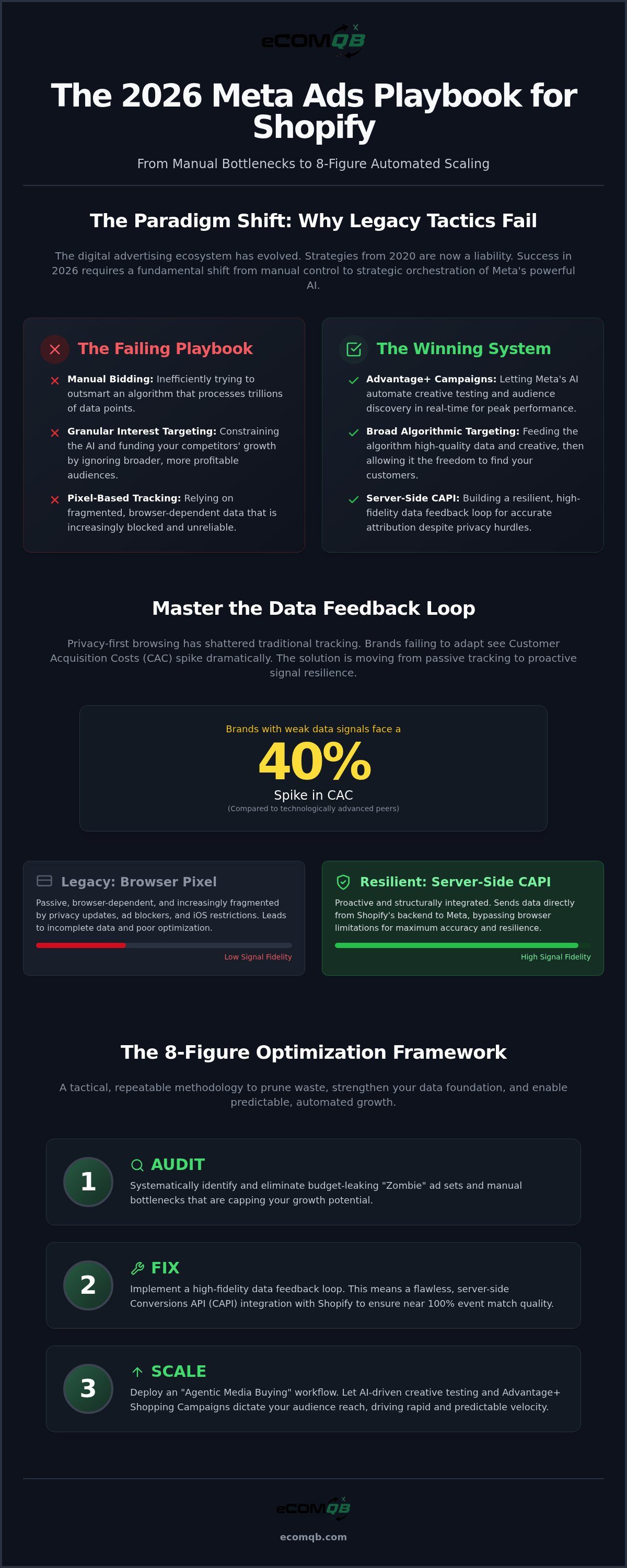
The 2020 playbook is a liability. If you're still micro-managing interest groups or obsessing over manual bid caps, you're losing revenue every hour. Modern success requires a definitive shift from tactical "hacks" to strategic account architecture. Meta's Lattice system now processes trillions of data points simultaneously to predict user behavior with terrifying accuracy. It doesn't want your narrow constraints. It wants your high-fidelity data. To effectively optimize meta ads for shopify, you must transition from a manual controller to a strategic orchestrator.
Legacy strategies focused on campaign-level tweaks. Today, the platform rewards account-level cohesion. The digital advertising ecosystem has evolved into an AI-first environment where the algorithm identifies patterns invisible to the human eye. Brands that refuse to relinquish granular control face stagnant growth and deteriorating margins. This is no longer a game of clever targeting tricks; it's a game of systemic dominance.
The Algorithmic Shift: From Levers to Logic
Meta now requires freedom to find your customers. Advantage+ Shopping Campaigns (ASC) have become the mandatory baseline for high-growth Shopify brands. These systems leverage machine learning to automate creative testing and audience discovery in real time. Your Shopify store structure, its product categories, site speed, and conversion history, now serves as a primary signal for the algorithm. When you optimize meta ads for shopify, the focus shifts from finding the audience to feeding the machine. A clean, high-performing Shopify storefront is no longer just a destination. It's a critical component of your ad delivery logic.
The Signal Loss Crisis and the 2026 Solution
Privacy-first browsing and browser-level tracking preventions have shattered traditional pixel-based attribution. We've moved beyond simple "tracking" into the era of "signal resilience." This isn't just about knowing who clicked. It's about providing Meta with enough server-side data to model conversions accurately despite privacy hurdles. Brands failing to adapt this high-fidelity approach are seeing customer acquisition costs (CAC) spike by 40% compared to their technologically advanced peers.
- Tracking: Passive, browser-dependent, and increasingly fragmented.
- Signal Resilience: Proactive, server-side, and structurally integrated.
The 2026 solution relies on a deep technical integration between Shopify’s backend and Meta’s Marketing API v26.0. This ensures that every purchase, add-to-cart, and view-content event is captured and communicated with absolute precision. Without this foundation, your scaling efforts will inevitably hit a ceiling. You must build for resilience, scale with confidence, and dominate the market through superior data engineering. To establish the foundation for this growth, Cornerstone Marketing Solutions helps brands build a robust online presence that supports high-level technical scaling.
Mastering the Data Feedback Loop: CAPI and Shopify Audiences
Data is the lifeblood of the algorithm. If your signals are weak, your performance will be erratic. In the current landscape, the traditional Meta Pixel is no longer sufficient for brands that want to scale. You must establish a high-fidelity data feedback loop to optimize meta ads for shopify with precision. This requires a shift from browser-side tracking to a robust server-side architecture that bypasses the limitations of modern web browsers.
The regulatory environment around consumer protection and data privacy has made third-party data less reliable. As of 2026, server-side tracking has become the global standard for attribution accuracy. Without it, you're effectively flying blind, losing critical conversion data to privacy-first browsing habits and iOS restrictions. High-velocity brands use this data resilience to outspend and out-maneuver competitors who are still guessing at their ROI.
Implementing Server-Side CAPI for Shopify
The Conversions API (CAPI) acts as the direct server-side bridge between Shopify sales and Meta optimization. Meta’s Marketing API v26.0, released in July 2026, has streamlined this process with one-click setups, but high-performance brands go deeper. You must ensure 100% event match quality by passing unique external IDs, hashed emails, and phone numbers directly from your Shopify backend. Effective deduplication is critical; your system must reconcile browser and server events to prevent double-counting conversions. This precision is the cornerstone of any strategy designed to optimize meta ads for shopify at an 8-figure scale.
Advanced Audience Seeding Strategies
The algorithm is only as good as its starting point. Use Shopify Audiences to feed Meta’s Lattice system high-intent seed data from the start. By exporting Lifetime Value (LTV) data from Shopify, you can create high-value Lookalikes that target your most profitable customer segments. This is where agentic media buying comes into play, automating the refinement of these audiences based on real-time purchase signals. This integration allows you to bypass iOS restrictions by relying on first-party data that you own and control. If your current setup feels like it's hit a ceiling, it's time to audit your data infrastructure for hidden leaks.
Creative Velocity: Deploying Agentic Media Buying Workflows
Creative is no longer just an asset; it is the definitive targeting lever. In 2026, the algorithm identifies your ideal buyer based on the resonance of your visuals, the strength of your hooks, and the technical metadata of your ads. If you fail to optimize meta ads for shopify through a creative-first lens, you're essentially bidding blind. With e-commerce CPMs ranging from $10.42 to over $15.00, every impression must be a strategic strike. You must transition from a production mindset to an iteration mindset to maintain scaling velocity.
High-performance brands prioritize their iteration rate over their production rate. Production is simply the volume of content created. Iteration is the speed at which you translate data into improved assets. By feeding Shopify sales data directly back into your creative briefs, you ensure every new asset is engineered for conversion. This creates a closed-loop system where performance dictates production. To see how professional production can enhance your brand's visual identity, you can discover The Photography Co and their high-impact studio services. Build, test, and refine.
The Agentic Creative Workflow
The manual creative process is a catastrophic bottleneck for 8-figure brands. Modern workflows leverage AI to analyze thousands of Shopify customer reviews to identify high-converting hooks and specific customer pain points. You can then deploy 50+ creative variations simultaneously without manual oversight, allowing the Meta algorithm to find the winning combinations. We implement a strict 3-day rule for all new assets. If an asset hasn't hit its performance benchmarks within 72 hours, it is pruned immediately. This aggressive methodology ensures your budget only fuels the highest-performing assets. Analyze, iterate, and dominate.
Dynamic Creative Optimization (DCO) at Scale
Your Shopify product feed is the engine for predictable scale. Meta Catalog Sales ads, powered by high-fidelity feed data, allow for real-time personalization at the individual user level. By using custom creative overlays, you can tailor messaging for different customer segments, ranging from first-time browsers, to active shoppers, to repeat high-LTV purchasers. True AI for Shopify personalization begins in the ad feed, where dynamic elements adjust to match user intent. This level of technical sophistication is necessary to optimize meta ads for shopify while maintaining a competitive edge in the global digital economy. Precision is the only path to 8-figure velocity.
The 8-Figure Optimization Playbook: A Step-by-Step Framework
Scaling to 8 figures isn't a matter of luck. It's a matter of engineering. Most brands hit a revenue ceiling because they lack a systematic protocol for expansion. To effectively optimize meta ads for shopify, you must transition from a reactive manager to a proactive architect. We utilize a rigorous "Audit-Fix-Scale" methodology to ensure your account remains lean, aggressive, and profitable. This framework identifies budget leaks, prunes inefficiency, and accelerates winners with surgical precision.
A primary bottleneck for scaling is the presence of "Zombie" ad sets. These are legacy campaigns that continue to consume spend but have lost their algorithmic resonance. They leak budget, skew data, and suppress your overall account performance. In the 2026 landscape, horizontal scaling through new creative and vertical scaling through increased budget must work in tandem. Integrating eCommerce AI growth systems allows you to automate these decisions, removing human hesitation from the equation. This level of structural clarity is how we optimize meta ads for shopify at the highest level.
Phase 1: The Account Structure Audit
Success begins with consolidation. You must maximize Meta’s "Power Five" principles by reducing campaign fragmentation. When you have too many ad sets, you create internal bidding wars. This overlap drives up your CPMs and confuses the algorithm. Your Shopify checkout is the final hurdle. If your storefront isn't optimized for high-velocity conversion, your ad spend is wasted. Audit your funnel. Consolidate your spend. Command your market.
Phase 2: The Scaling Protocol
Scaling requires discipline. We follow the 20% rule: never increase a campaign budget by more than 20% within a 48-hour window. This prevents the algorithm from re-entering the volatile learning phase. Automated rules are non-negotiable; they act as your field guards to protect profit margins during market fluctuations. While Advantage+ Shopping Campaigns (ASC) are the default for scale, manual campaigns remain essential for specific, high-intent product launches. If you're ready to move beyond manual bidding and secure your growth, it’s time to book a tactical briefing with our team.
Engineering Predictable Scale: The eComQB Managed Growth System
Manual media buying is a structural bottleneck. It introduces latency, fatigue, and human error into your growth trajectory. For brands targeting 8-figure velocity, the objective isn't just to manage ads. It's to engineer a self-optimizing revenue engine. eComQB moves beyond the traditional agency model by implementing managed AI growth systems that automate the complexities of the 2026 digital economy. To effectively optimize meta ads for shopify, you need a system that integrates every lever of growth, from paid performance to SEO and content strategy for Shopify.
Our approach centers on AI transformation. We deploy Revenue Generating AI Tools that synchronize with Meta’s v26.0 Graph API and Shopify’s backend in real time. This isn't just about software; it's about a strategic partnership that replaces manual friction with algorithmic precision. We don't just run ads. We build high-performance storefronts and agentic media buying workflows that dominate the market. While competitors suggest upgrading your software plan to fix a broken strategy, we rebuild your strategy from the data up.
The Managed AI Transformation
Curated AI tech stacks eliminate the operational overhead that kills scaling momentum. Our agentic media buying systems maintain 24/7 optimization, adjusting bids and creative weights while your competitors sleep. This level of automation allows your leadership team to focus on high-level strategy and product innovation while we handle the technical execution. We move your brand from reactive tweaks to proactive systemic dominance. Precision is our baseline. Velocity is our objective.
Next Steps: Securing Your Competitive Advantage
The cost of staying legacy is catastrophic. In an AI-driven market, those who rely on manual bidding are effectively funding the growth of their more advanced competitors. You must audit your current Meta performance for 2026 readiness today. Stagnant revenue is a signal that your current architecture has reached its limit. It's time to transition to a managed growth system designed for the next era of e-commerce. Don't wait for your margins to erode further. Secure your position at the top of the market. The next move is yours. Book your tactical briefing with eComQB to see how we optimize meta ads for shopify for 8-figure brands.
Execute Your Move to 8-Figure Dominance
The 2026 marketplace rewards the precise and punishes the hesitant. You've seen the framework: shift from manual levers to algorithmic logic, secure your signal resilience with CAPI, and deploy creative velocity via agentic media buying. To effectively optimize meta ads for shopify, you must move beyond the role of an ad manager and become a strategic architect of revenue. Legacy methods are a liability. True scale requires a synchronized data ecosystem where Meta’s AI works in tandem with high-converting Shopify development.
We specialize in building managed AI growth systems for brands ready for elite scaling. Our expertise in agentic media buying ensures your brand maintains a permanent competitive advantage in a volatile digital economy. The revenue ceiling is a choice, not a constraint. Break through the noise. Secure your trajectory. Book your high-performance growth call with eComQB and let’s engineer your next phase of growth. Your future market share is waiting.
Frequently Asked Questions
How much should I spend on Meta Ads for a new Shopify store in 2026?
Your initial investment must provide enough data for Meta’s algorithm to exit the learning phase. This requires a minimum of 50 conversion events per ad set every seven days. Given current e-commerce CPAs ranging from $29.99 to $38.99, you should allocate at least $250 per day per campaign. Precision in your starting budget prevents the algorithm from stalling and ensures you gather enough signal to identify winning products quickly.
Is Advantage+ Shopping Campaigns (ASC) better than manual targeting?
Advantage+ Shopping Campaigns are the definitive baseline for high-velocity scaling in the current landscape. ASC leverages the Lattice system to automate audience discovery, which typically outperforms manual interest targeting in broad environments. However, the most effective strategy is to optimize meta ads for shopify by using ASC for your primary scaling engine while maintaining manual campaigns for surgical product launches or specific high-intent customer segments. Balance freedom with strategic control.
How do I fix the "Learning Limited" status on my Meta ad sets?
The "Learning Limited" status indicates your ad set isn't generating the necessary 50 weekly conversions to stabilize performance. To fix this, you must consolidate fragmented ad sets to increase data density per campaign. If your budget is a constraint, move your optimization event higher up the funnel, perhaps from "Purchase" to "Add to Cart." Alternatively, broaden your audience targeting to give the algorithm more opportunities to find your ideal buyers.
What is the ideal ROAS for a Shopify brand scaling to 8 figures?
ROAS is a vanity metric if it isn't viewed through the lens of contribution margin. Brands targeting 8-figure velocity often prioritize Profit on Ad Spend (POAS) and Customer Lifetime Value (LTV) over top-line ROAS. While a 3.0x ROAS is a common industry benchmark, scaling aggressively often requires accepting a lower initial return to capture market share. High-performance leaders focus on the Marketing Efficiency Ratio (MER) to ensure total business profitability.
How often should I refresh creative assets for Meta Ads?
You must refresh creative assets based on performance decay rather than a fixed schedule. High-spend accounts typically require new hooks or visual iterations every 7 to 14 days to combat ad fatigue. We recommend a high iteration rate where you constantly test small variations of winning assets. This ensures your creative laboratory is always providing fresh signals to the algorithm, maintaining your scaling momentum and preventing stagnant conversion rates.
Can I optimize Meta Ads without the Shopify Conversions API?
Attempting to optimize meta ads for shopify without the Conversions API (CAPI) is a strategic failure in 2026. Browser-based pixels are increasingly fragmented due to privacy-first browsing and iOS restrictions. CAPI establishes a high-fidelity, server-side link that ensures Meta receives 100% of your conversion data directly from Shopify. Without this technical foundation, your attribution will be inaccurate, your targeting will be inefficient, and your scaling efforts will hit a hard ceiling.
How does eComQB differ from a traditional Meta Ads agency?
Traditional agencies rely on manual media buying and outdated reporting, while eComQB implements fully managed AI growth systems. We function as a tactical partner that deploys Revenue Generating AI Tools and agentic workflows to automate scaling mechanics. Our approach integrates specialized Shopify development with agentic media buying to eliminate operational overhead. We don't just manage campaigns; we engineer your entire revenue trajectory using a curated technology stack designed for 8-figure velocity.
What is agentic media buying and how does it improve Shopify sales?
Agentic media buying is an AI-driven methodology where autonomous systems handle the real-time execution of bidding, creative testing, and budget allocation. Unlike basic automation, agentic systems use deep Shopify data integration to make complex decisions based on your specific profit margins. This ensures 24/7 optimization and allows your brand to respond to market shifts instantly. It transforms your advertising into a self-correcting engine that drives predictable revenue growth and superior competitive advantage.