Modern Content Management: CMS for Scaling

Your current CMS isn't a library. It's a bottleneck that bleeds your conversion rate every hour you wait for a developer to push a simple update. You've felt the friction of campaigns stalling while tech debt anchors your site speed and destroys your search rankings. Effective eCommerce website content management should be a strategic asset, not an obstacle that forces you to choose between brand consistency and speed to market.
We're here to bridge that gap. This guide shows you how to transform your content from passive storage into an agentic revenue engine that scales with your ambition. You'll master the tactical shift required to deploy at pace, personalize at scale, and dominate the digital landscape. We will explore the mechanics of rapid deployment, the power of seamless AI personalization, and the framework for capturing measurable ROI through organic visibility. It's time to stop managing data and start orchestrating growth.
Key Takeaways
- Stop the revenue leak by identifying how legacy systems stall growth and why your content must act as an active sales engine.
- Discover the strategic framework for agentic eCommerce website content management that automates execution, optimization, and deployment.
- Compare headless and integrated architectures to build a 2026 tech stack that prioritizes speed, precision, and competitive advantage.
- Deploy a high-performance playbook to audit operational bottlenecks and install workflows that turn content updates into immediate market moves.
- Partner for an AI transformation that provides the technical mastery of a field general without the friction of internal tech debt.
Beyond the Storefront: Why Legacy Content Management Kills Growth
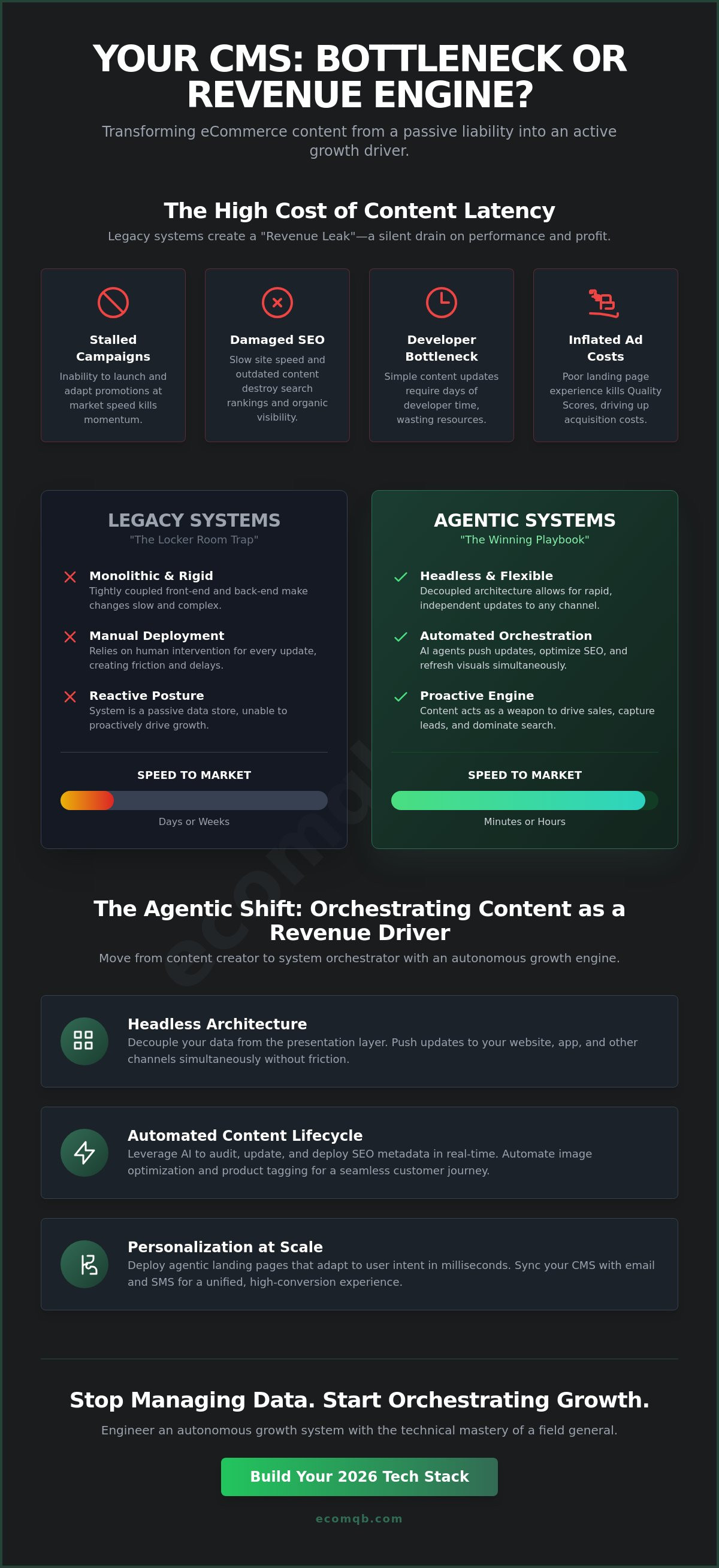
In the high-stakes environment of digital commerce, your back-end infrastructure is either an accelerator or an anchor. Most brands treat their Content Management System (CMS) as a digital filing cabinet. This is a fatal strategic error. Modern eCommerce website content management is a dynamic revenue engine designed for speed, precision, and conversion. When your system is passive, it creates a massive "Revenue Leak." This isn't just a technical glitch. It's a failure to capitalize on market momentum. Every hour your team spends wrestling with a rigid interface is an hour your competitors are stealing your market share.
This friction extends directly to your paid media performance. If your CMS is a bottleneck, your Meta and Google ads suffer. Slow page loads or mismatched landing page content kill your Quality Scores and drive up your customer acquisition costs. You end up paying a clumsiness tax on every click. Strategic mastery requires a shift from passive storage to active orchestration. You need a system that doesn't just hold data but weaponizes it to drive sales, capture leads, and dominate search results.
The High Cost of Content Latency
Speed is the ultimate currency. Delayed product launches erode your competitive advantage and leave money on the table. When it takes days instead of minutes to update a storefront, you lose the ability to react to real-time trends. This content latency is a hidden drain on your most valuable resources. Your elite talent shouldn't be trapped in a cycle of manual site updates. They should be focused on high-level eCommerce brand strategy. Quantifying the loss is simple. If your speed to market isn't a primary KPI, you're already falling behind the growth curve.
Legacy vs. Modern: A Tactical Comparison
Monolithic platforms are the "Locker Room" trap of the digital age. They're heavy, rigid, and slow. These systems were built for a simpler time, and they lack the flexibility required for 2026's agentic commerce. Modern stacks are engineered for performance. They prioritize rapid improvement and systemic optimization. If your current tech stack requires a developer for every minor change, it's leaking revenue. High-performance brands utilize Shopify website design and development to build lean, punchy storefronts that move at the speed of the digital economy. It's about moving from a defensive posture to a relentless offensive drive.
The Agentic Shift: Orchestrating Content as a Revenue Driver
Legacy systems are built for maintenance. Modern systems are built for dominance. Content is no longer a static asset to be stored; it's a strategic weapon to be deployed. In the 2026 market, the brands winning the game aren't just using AI to write product descriptions. They're using agentic systems to orchestrate the entire content lifecycle. For editorial teams seeking this level of automation, editivo.ai offers a platform to streamline creation and management. This is the evolution of eCommerce website content management. It moves the needle from human-led manual labor to system-led strategic execution. It is fast, precise, and relentless.
Traditional workflows are too slow to compete. They rely on human intervention at every step, creating friction and delay. Agentic content management removes these bottlenecks. By implementing a headless commerce architecture, you decouple your data from your presentation layer. This allows AI agents to push updates, optimize SEO, and refresh visuals across every channel simultaneously. You aren't just building a site. You're engineering an autonomous growth engine that works while you sleep.
Automating the Content Lifecycle
Dominance in search requires more than just keywords. It requires velocity. AI visibility and SEO services now leverage agentic tools to audit, update, and deploy metadata in real-time. These systems handle dynamic asset optimization, ensuring every image is served in the perfect format for the user's device without manual resizing. Automated tagging and categorization create seamless customer journeys. Your products find the customer, not the other way around. This level of precision is only possible when you move from being a content creator to a system orchestrator.
Personalization at Scale
The "one-size-fits-all" storefront is dead. High-performance brands now utilize agentic landing pages that adapt to user intent in milliseconds. If a visitor arrives from a specific Meta ad, the entire storefront experience should reflect that specific journey. This isn't just about changing a headline. It's about full-scale AI personalization experiences that sync your CMS with your agentic email and SMS marketing. Every touchpoint becomes a data-driven move designed to maximize LTV. When your systems talk to each other, your revenue scales.
If your team is still manually updating banners or tweaking product pages, you're losing ground to more agile competitors. It's time to consider a full AI transformation that turns your content into a relentless revenue driver.
Evaluating the 2026 Stack: Headless, Integrated, and Agentic Architectures
Choosing your tech stack isn't a technical debate. It's a strategic decision about your market velocity. Your eCommerce website content management choice determines whether you lead the pack or chase the tail. In 2026, the landscape is divided between integrated powerhouses and headless flexibility. Both have their place, but neither works without an "Agentic Layer." This is the intelligence tier that sits atop your architecture to automate execution, optimization, and deployment. It turns your stack from a static foundation into a proactive growth engine.
The decision lever isn't a list of features. It's your velocity requirement. An API-first mindset is no longer optional for brands aiming for the top tier. It's the only way to future-proof your operations against shifting consumer behavior and emerging AI chat platforms. Whether you opt for a hosted SaaS model or a decoupled headless build, your architecture must allow for rapid improvement and competitive advantage. If your system can't talk to other tools via robust APIs, you're building a digital dead end.
Shopify Excellence: The Integrated Powerhouse
Shopify remains the gold standard for high-performance eCommerce because it prioritizes speed and reliability. With revenue growing 24% year-over-year at the end of 2024, the platform has doubled down on AI-native commerce. Features like Sidekick and agentic storefronts allow brands to scale without the massive technical debt of custom builds. You can achieve elite results by layering agentic landing pages and storefronts onto this proven foundation. For those ready to push the limits, The High-Performance Growth System for Shopify provides the playbook for engineering 8-figure velocity in the current market.
Headless and Hybrid: When to Make the Move
The "Velocity Threshold" is the moment your current system starts costing you more in missed opportunities than it saves in subscription fees. This often happens when you need deep customization across multiple channels that a standard integrated theme can't support. Headless commerce is gaining popularity, advancing at a 19.6% compound annual growth rate. It offers total frontend freedom, but it comes with increased operational complexity. You must manage this complexity without drowning in overhead. This is where a managed AI growth system becomes essential. It provides the technical mastery required for complex migrations while keeping your team focused on brand strategy and revenue generation.
Operational Velocity: The Playbook for High-Performance Content Workflows
Execution is the ultimate separator. Most brands have a strategy; few have velocity. You've already identified the technical debt and selected your 2026 stack. Now, you need a playbook to turn that infrastructure into a relentless revenue driver. High-performance eCommerce website content management isn't about having a pretty dashboard. It's about building a system that executes at the speed of your ambition. If your team is still manually updating product pages or waiting on dev tickets, you're playing a defensive game. It's time to go on the offensive.
- Step 1: Audit the Bottlenecks. Map every manual touchpoint in your current workflow. Identify where content stalls and where revenue leaks occur due to latency.
- Step 2: Deploy Agentic Workflows. Replace repetitive management tasks with AI that executes. This includes automated tagging, real-time SEO updates, and dynamic asset deployment.
- Step 3: Synchronize with Media Buying. Your CMS shouldn't exist in a silo. Feed your content data directly into your Meta and Google advertising execution to ensure perfect alignment between ad and landing page.
- Step 4: Implement AI Diagnostics. Use real-time monitoring to identify declining revenue or conversion friction. Fix these issues in minutes, not days.
- Step 5: Optimize for Margin. Shift your focus from vanity metrics like traffic to hard profit margins. Use your data to double down on the products and content that actually move the needle.
Synchronizing Content and Media Buying
Your content strategy and your media buying strategy must be a single, unified motion. Agentic media buying feeds off real-time data from your CMS. When you update a product story or launch a new collection, your ad creative should reflect that change instantly. This level of synchronization reduces your customer acquisition cost (CAC) by ensuring a seamless, high-intent journey from click to checkout. It creates a powerful feedback loop. Ad performance data informs your content strategy, and your content strategy fuels better Meta advertising execution. You stop guessing and start winning based on data-driven insights.
Reclaiming Strategic Time
Automation isn't just about speed. It's about reclaiming your team's cognitive bandwidth. When you move from manual bidding and content entry to strategic mastery, you empower your talent to focus on high-leverage creative tasks. This is the "Field General" approach to eCommerce growth. You orchestrate the system while the technology handles the tactical execution. By implementing a full AI transformation, you strip away the operational fluff and focus on systemic optimization. Your team stops being content creators and starts being system orchestrators.
Stop letting manual workflows anchor your growth. It is time to audit your current system and install a high-performance engine. Book a tactical briefing today to see how we can accelerate your operational velocity.
Engineering Your Growth System: The eComQB Advantage
Strategic mastery isn't about working harder. It's about engineering a system that works for you. At eComQB, we function as your tactical partner for full scale AI transformation. We don't just give you tools. We install a high-performance engine that handles your eCommerce website content management with surgical precision—the same standard of excellence required by industry leaders like EAP® Abutments for their patented dental solutions. While legacy consulting models charge for billable hours and vague deliverables, we focus on systemic optimization and revenue velocity. You get the technical depth of an elite engineering team without the operational overhead of managing one.
Our Fully Managed model is built for leaders who demand rapid improvement. We strip away the complexity of modern tech stacks and replace it with a lean, punchy execution layer. This is the eComQB advantage. We identify the critical levers for success, automate the friction points, and drive your brand toward 8-figure territory. You stop fighting your tech stack and start winning with it.
Managed AI Transformation
Our discovery process doesn't waste time on surface-level metrics. We dive deep into your data gaps and profit margins to find where your revenue is leaking. Once identified, we deploy the AI Transformation for eCommerce Brands roadmap. This isn't a months-long implementation cycle. We move from legacy architectures to agentic systems in weeks. We prioritize speed, precision, and competitive advantage to ensure you never miss a market move. Our goal is to turn your content into a relentless revenue driver that scales effortlessly.
Your High-Performance Playbook
In an AI-first world, the gap between the leaders and the laggards is widening. Securing your advantage requires more than just better software. It requires a field general who understands the mechanics of growth. The eComQB commitment is simple: revenue, results, and rapid improvement. We don't just manage your site; we orchestrate your growth. We take the technical burden off your plate so you can focus on high-level strategy and creative vision. It is time to reclaim your competitive edge. Secure your tactical briefing today and let's map out your path to 8-figure velocity.
Command Your Market: The Path to Systemic Dominance
Content isn't just data; it is the fuel for your revenue engine. You've seen why legacy bottlenecks kill growth and how agentic shifts redefine the competitive landscape. Mastering modern eCommerce website content management requires more than just better software. It demands a strategic move away from manual maintenance toward autonomous execution. You must decouple your talent from repetitive tasks to focus on high-leverage brand strategy.
We deliver curated AI technology stacks engineered for 8-figure velocity and fully managed growth systems that eliminate your operational overhead. With proven results in agentic media buying and systemic optimization, we ensure your brand operates at peak performance. It is time to stop managing tech debt and start orchestrating growth. Your competitors are already looking for the next advantage; don't let them find it first.
Secure Your Strategic AI Transformation Briefing
Your next move defines your trajectory. Let's build the engine that takes you there.
Frequently Asked Questions
What is the best CMS for a scaling Shopify brand in 2026?
Shopify Plus remains the standard for brands demanding high-performance results and systemic reliability. Its 24% revenue growth at the end of 2024 proves its continued dominance in the hosted segment. The most effective strategy in 2026 is layering agentic tools over Shopify's core to handle complex automation without the technical debt of a full custom build. This combination provides the speed and precision needed to scale to 8 figures.
How does agentic content management differ from traditional AI tools?
Traditional AI tools act as assistants that require human prompting and manual intervention for every action. Agentic content management functions as an autonomous execution layer that identifies strategic needs and takes action. It manages the content lifecycle from initial audit to final deployment without constant oversight. You move from being a manual editor to a system orchestrator who oversees a high-velocity revenue engine.
Will switching to a headless CMS actually increase my conversion rate?
A headless CMS increases conversion rates by eliminating the technical friction and load-time lag that kill user intent. The headless market is currently growing at a 19.6% compound annual growth rate because it allows for total frontend freedom and superior site speed. While the architecture is the foundation, the ability to deliver instant, personalized experiences across every touchpoint is what actually drives the revenue lift.
How do I integrate my content strategy with my Meta and Google ad spend?
Integration requires a unified data layer where your CMS communicates directly with your advertising execution systems. By utilizing agentic media buying, your Meta and Google ads can pull real-time product data and content updates directly from your storefront. This ensures your creative is always fresh and your landing pages perfectly match the user's entry intent. It creates a seamless loop between your marketing message and the purchase experience.
Can AI content management maintain my brand’s unique voice?
Modern AI transformation ensures your brand voice remains consistent by training agentic systems on your specific strategic playbook and tone profile. These tools follow the precise linguistic and emotional registers you define rather than using generic outputs. This level of eCommerce website content management allows you to scale production without diluting the unique identity that built your brand's authority in the first place.
What are the first steps to fixing a slow content management workflow?
Start by conducting a rigorous audit of your content bottlenecks and revenue leakage points to identify where manual updates stall growth. Every manual task that takes longer than five minutes should be targeted for immediate automation. Deploying agentic workflows to handle repetitive management tasks is the fastest way to reclaim strategic time. You must prioritize operational velocity to maintain a competitive advantage in the 2026 digital economy.
How does eCommerce content management impact long-term customer LTV?
Effective eCommerce website content management drives LTV by providing the infrastructure for seamless AI personalization experiences. When your content adapts to individual user behavior in real-time, you create deeper engagement and higher repeat purchase rates. It transforms your site from a static storefront into a dynamic environment that anticipates customer needs. Consistent, relevant communication is the most effective lever for building long-term brand loyalty.