Shopify Conversion Rate Optimization: The 2026 High-Velocity Checklist

The era of manual best practices is dead. If you are still tweaking button colors while your ROAS bleeds out, you are playing a game that ended three years ago. In 2026, Shopify conversion rate optimization is no longer a design exercise. It is a high-stakes battle of systemic precision. You see the traffic hitting your site, but fragmented tech stacks and lagging load times are leaking revenue at every touchpoint. Precision, momentum, and results are the only metrics that matter now.
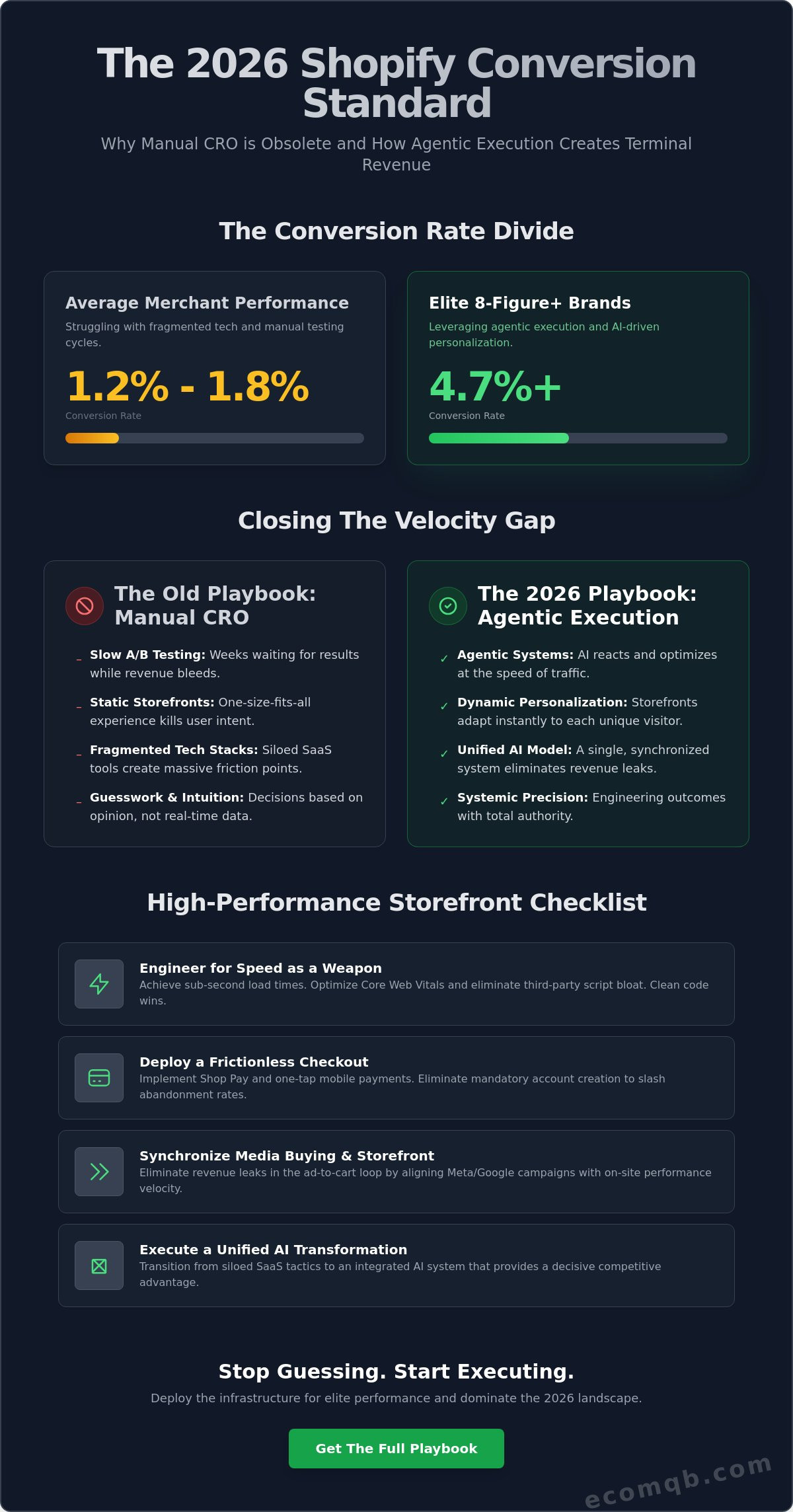
You know that the average merchant is currently struggling with a conversion rate between 1.2% and 1.8%. Meanwhile, the elite 8-figure brands are pushing past the 4.7% threshold by leveraging agentic execution layers. It is frustrating to watch your margins shrink while manual A/B testing fails to keep pace with the market. We are here to change that trajectory. This checklist provides the tactical playbook to audit your storefront against the global standard, ensuring your brand stays ahead of the June 30th Shopify Scripts shutdown and the shift toward agentic commerce.
We will show you how to deploy revenue generating AI tools and agentic landing pages that turn volatile traffic into terminal revenue. This briefing covers the essential migration to Shopify Functions, the integration of AI personalization experiences, and the architectural shifts required to dominate the 2026 landscape. It is time to stop guessing and start executing with total authority.
Key Takeaways
- Bridge the velocity gap by replacing legacy manual testing with agentic execution systems that react at the speed of modern traffic.
- Audit your technical infrastructure to ensure your theme and checkout logic don't bottleneck high-performance growth.
- Accelerate Shopify conversion rate optimization by deploying agentic landing pages that transform visitor intent into terminal revenue.
- Synchronize your Meta and Google media buying with storefront performance to eliminate revenue leaks in the ad-to-cart loop.
- Transition from siloed SaaS tactics to a unified AI transformation model to secure a decisive competitive advantage.
The 2026 Conversion Standard: Why Manual CRO is Obsolete
The market has shifted. Traditional Conversion rate optimization (CRO) was once a game of patience, spreadsheets, and incremental gains. In 2026, that approach is a liability. We now operate in a "Velocity Gap." This is the chasm between legacy brands stuck in manual testing cycles and high-performance leaders deploying agentic systems. If you're still waiting two weeks for a manual A/B test to reach statistical significance, you've already lost the sale. Your competitors aren't just moving faster; they're playing a different game entirely.
Precision is the new currency. The 2026 benchmark for Shopify stores has hardened. Current data shows the average conversion rate sits between 1.2% and 1.8%, but these numbers are no longer a baseline for growth. They're a signal of systemic decay. For ambitious leaders, 2% is the new floor for failure. To join the top 10% of merchants who command conversion rates of 4.7% or higher, you must stop guessing and start engineering. Shopify conversion rate optimization in this era requires a shift from human intuition to agentic execution. You need systems that analyze, adapt, and accelerate in real time.
The Death of the Static Storefront
A static layout is a profit killer. Every visitor arrives with a unique intent, a specific history, and a distinct set of friction points. Serving the same "one-size-fits-all" experience to every user is a strategic failure that drains your margins. The cost of latency in this zero-patience economy is absolute. Modern architectures must be dynamic and user-aware. High-velocity brands use agentic landing pages and storefronts to reconfigure themselves instantly based on real-time data. This isn't just design; it's tactical dominance.
Calculating Your Revenue Leakage
Standard conversion formulas only tell half the story. To win, you must track Profit Velocity. This metric measures the speed at which traffic converts into liquid capital. Most brands have massive friction points where 80% of their traffic drops, usually at the intersection of fragmented tech and slow mobile experiences. You must identify these leaks with surgical precision. Revenue Leakage is the delta between your current performance and your AI-optimized potential. If you aren't closing that gap, you're subsidizing your competitors' growth. Stop settling for legacy standards and start deploying the infrastructure required for elite performance.
The High-Performance Storefront: A Technical Precision Checklist
Infrastructure is the foundation of your revenue engine. If your theme is bloated, your growth is capped. High-performance Shopify conversion rate optimization starts with a ruthless audit of your technical stack. You aren't just building a website; you're engineering a high-velocity conversion machine. Every millisecond of latency is a friction point that pushes your customers toward a competitor. Precision is the difference between a storefront that survives and one that dominates. Identify, isolate, and eliminate technical debt before it drains your budget.
Speed as a Competitive Advantage
Speed is not an IT metric. It is a financial one. In the 2026 economy, sub-second load times are the standard for 8-figure scaling. You must optimize Core Web Vitals for conversion, ensuring that Largest Contentful Paint happens before the user has a chance to bounce. This requires a lean, punchy approach to code. Every unnecessary app or tracking pixel is a tax on your conversion rate. Clean code wins. Minimize your third-party script bloat to ensure the path to the "Yes" is fast, fluid, and decisive.
The Frictionless Checkout Blueprint
Your Shopify checkout is a weapon. Use it. It remains the world's most optimized conversion engine because it prioritizes speed and trust. To maximize this, you must deploy Shop Pay and one-tap mobile payments immediately. Removing mandatory account creation is a non-negotiable move to slash abandonment rates. Leaders are now leveraging AI transformation for eCommerce brands to predict and prevent checkout exits before they happen. This proactive approach captures the untapped potential of CRO that most merchants leave on the table.
We live in a thumb-driven economy. Your storefront must be mobile-only in its design philosophy. Zero-friction navigation means reducing the clicks to "Add to Cart" to the absolute minimum. If a user has to search for your product or navigate a complex menu, you've failed the velocity test. Simplify your hierarchy. Direct your traffic. Every field you remove from the checkout form is a win for Shopify conversion rate optimization. Scaling to elite levels requires more than just a fast theme; it requires a strategic partner to audit your technical infrastructure and unlock hidden revenue.
Beyond Static Pages: Deploying Agentic Personalization
Static pages are a legacy burden. If your storefront treats a first-time visitor from a Meta ad the same way it treats a loyal repeat customer, you're bleeding revenue. Shopify conversion rate optimization in 2026 has evolved beyond simple layout tweaks. It's now about agentic personalization. This isn't a feature you toggle on; it's a tactical advantage that transforms your storefront into a living sales agent. The market has no mercy for the slow or the generic.
We are moving from "Recommended Products" to "Intent-Based Discovery." Legacy systems look at what others bought. Agentic systems look at what this specific user is doing right now. They analyze scroll depth, hover time, and navigation patterns to surface the exact solution the customer needs. This precision doesn't just increase conversion. It drives Average Order Value (AOV) by presenting high-margin bundles that actually make sense for the individual's specific context. You aren't just selling a product; you're engineering a solution in real time.
The End of One-Size-Fits-All Marketing
The "one-size-fits-all" model is a drain on your profit margins. Agentic systems now rewrite headlines in real-time based on the specific ad source or keyword that brought the user to the site. If they clicked an ad for "performance," they see a headline about durability. If they clicked for "aesthetics," the hero image shifts to match their demographic profile instantly. To master this level of precision, you need a unified framework like The eCommerce AI Growth System. This automates the personalization layer so your team can focus on high-level strategy while the machine handles the execution.
Trust Engineering in 2026
Trust is engineered, not earned. In a crowded market, generic reviews aren't enough. You need dynamic social proof that updates based on real-time inventory and localized purchasing trends. When a visitor sees that five people in their city just purchased the same item, the psychological momentum is undeniable. This creates a sense of urgency that static text can never replicate.
Agentic chat takes this further by solving objections before they lead to bounces. These aren't clunky chatbots. They are sophisticated AI agents that understand product specs, shipping nuances, and customer pain points. They provide the final nudge required to secure the "Yes." This is the science of psychological precision. It turns a browsing session into a terminal revenue event. By integrating these AI Personalization experiences, you ensure your Shopify conversion rate optimization strategy is proactive, adaptive, and unapologetically focused on peak performance.
The Post-Click Playbook: Synchronizing Media Buying with Storefront Velocity
Your ads are the scouts. Your store is the closer. If these two layers aren't synchronized, you're burning capital on every click. Most brands treat Shopify conversion rate optimization as an isolated on-page task, but this is a strategic error. Elite growth requires a seamless "Ad-to-Cart" loop where every Meta and Google impression is a data point for the storefront to absorb. High-velocity stores don't just wait for traffic; they orchestrate it through Agentic Media Buying. You must align your offensive strategy with your defensive infrastructure to win the game of margins.
The objective is simple: reduce Customer Acquisition Cost (CAC) by ensuring total message match. When a user clicks an ad, they expect a specific outcome. If your landing page fails to deliver that promise instantly, the bounce is inevitable. By synchronizing your targeting with your storefront architecture, you create a frictionless path to purchase. This isn't just about design; it's about tactical alignment. Every dollar spent on Meta Advertising Execution must be backed by a storefront that knows exactly how to handle that specific audience intent.
Precision Targeting for High Conversion
Precision is no longer about broad interests. It's about predictive intent. AI transformation allows you to identify high-intent audiences before they even click your creative. This creates a powerful feedback loop. Your storefront data informs the ad platform exactly which users are converting, allowing the machine to sharpen its aim with surgical accuracy. Scaling to 8-figures is only possible when your ad creative and landing page architecture are perfectly aligned. You must analyze, synchronize, and execute with total confidence.
Closing the Retention Gap
The first sale is just the beginning of the campaign. To dominate your niche, you must close the retention gap. Legacy abandoned cart sequences are too slow and too generic for the 2026 consumer. You need a Zero-Latency revenue strategy. By integrating Agentic email and SMS, you recover "lost" conversions in real-time. These systems don't just send reminders; they solve objections and offer personalized incentives tailored to the user's behavior. This is how you maximize LTV and turn a single conversion into a lifelong customer relationship.
Stop letting fragmented tech stacks leak your revenue. If your media buying isn't talking to your storefront, you're playing a losing hand. It's time to deploy a unified system that captures every ounce of intent and turns it into terminal revenue. Synchronize your media buying with a high-velocity storefront and book your strategic briefing today to secure your competitive advantage.
Managed Growth: Moving from CRO Tactics to AI Systems
Tactics are for survivors. Systems are for winners. Most brands fail because they treat Shopify conversion rate optimization as a series of disconnected DIY projects. They buy a heatmapping tool, install an A/B testing app, and configure a basic chatbot, then wonder why their ROAS remains stagnant. Founders and marketing directors don't have the bandwidth to be full-time data analysts. You need an execution partner that manages the technical complexities while you focus on the high-level vision. The "Managed" model wins because it replaces fragmented tools with a unified execution layer.
Software alone is never the solution. Without a strategic playbook, even the most expensive SaaS platform is just another line item on your P&L. A fully managed AI transformation for Shopify brands replaces guesswork with high-velocity precision. We deploy curated technology stacks that work in total harmony, ensuring your storefront, media buying, and retention layers are perfectly synchronized. This approach eliminates the operational overhead of manual configuration. It allows you to scale with speed, precision, and confidence without bloating your internal headcount.
The Field General Approach to Scaling
eComQB functions as your tactical growth partner. We don't just provide a checklist; we execute the mission. Our roadmap starts with a surgical diagnostic audit to identify every revenue leak in your current technical stack. From there, we deploy Revenue Generating AI Tools designed to push your brand toward 8-figure velocity. We focus on the ultimate objective: net profit. A higher conversion percentage is meaningless if it doesn't translate into terminal revenue. By optimizing the entire ecosystem, we ensure every impression and every click contributes to your bottom line.
Your Tactical Move
Stop tinkering with button colors and header fonts. These are minor distractions that prevent you from achieving real growth. The digital economy in 2026 has no mercy for the hesitant. You have a clear choice: lead the market with agentic systems or get left behind by competitors who have already automated their growth. It's time to move beyond legacy Shopify conversion rate optimization and embrace a unified growth engine. The game has changed, and the old playbook is obsolete. Request a high-performance growth audit and secure your competitive advantage with eComQB today. The next move is yours. Execute with authority.
Execute the 8-Figure Playbook
The window for manual experimentation has closed. Dominating the 2026 market requires a shift from reactive tweaks to proactive systems. You've seen the roadmap. Success now depends on technical precision, agentic personalization, and strategic synchronization. This is how you bridge the gap between stagnant growth and 8-figure momentum. High-performance Shopify conversion rate optimization is no longer a luxury; it is the baseline for survival in a machine-driven economy.
We specialize in 8-figure Shopify scaling by deploying curated AI technology stacks and managed agentic media buying execution. You don't need more tools; you need a tactical partner to orchestrate your next move. Stop managing tech debt and start capturing terminal revenue. The path to peak performance is clear. It's time to lead your category with a system designed to win every click. Scale your Shopify brand with a managed AI growth system and secure your future today. Your growth trajectory starts now.
Frequently Asked Questions
What is a good Shopify conversion rate in 2026?
A good conversion rate in 2026 is generally between 2.5% and 3.5%. While the average Shopify store sits between 1.2% and 1.8%, elite brands in the top 10% are achieving 4.7% or higher. Your target should be to move past the 2% floor by implementing high-velocity systems that eliminate friction and match visitor intent with surgical precision.
How do I start Shopify conversion rate optimization without a developer?
You can begin Shopify conversion rate optimization by adopting a lightweight, high-performance theme like Dawn to ensure a clean code foundation. Utilize Shopify's native AI assistant, Sidekick, to generate reports and identify immediate workflow improvements. Focus on high-impact, low-code moves like enabling Shop Pay and simplifying your navigation menus to reduce the total clicks required to reach the checkout.
Does Shopify's native AI help with CRO?
Shopify's native AI features are powerful entry points for optimization. Tools like SimGym allow you to run an AI Store Simulation to test changes with virtual shoppers before going live. Sidekick functions as a tactical assistant that can help you edit themes or generate insights from your data. These tools provide the foundational metrics needed to scale toward more advanced agentic systems.
How much does a professional Shopify CRO audit cost?
The investment required for a professional audit varies based on your store's technical complexity and current revenue volume. Rather than looking for a flat fee, you should evaluate the potential ROI of identifying revenue leaks in your funnel. High-growth brands typically view an audit as a strategic diagnostic tool that pays for itself by capturing the delta between current performance and AI-optimized potential.
Can AI personalization actually improve my ROAS?
AI personalization is a direct lever for increasing ROAS by ensuring total message match between your ads and your storefront. When your landing pages dynamically update headlines and imagery to match the specific demographic of the visitor, bounce rates drop and conversion velocity increases. This synchronization ensures that your Meta and Google ad spend is never wasted on a generic user experience.
What are the best Shopify apps for conversion rate optimization?
The best apps in 2026 are those that integrate with the Storefront API version 2026-04 without adding third-party script bloat. Prioritize tools that facilitate agentic personalization and one-tap mobile payments. You should look for solutions that offer agentic chat for objection handling and dynamic social proof that updates in real-time based on your current inventory levels and localized purchasing trends.
How long does it take to see results from a CRO strategy?
You will see immediate results from technical infrastructure improvements, such as optimizing load times and mobile speed. Behavioral changes and AI-driven personalization layers typically require enough traffic volume to reach statistical significance. Most high-performance brands observe a measurable lift in conversion velocity and average order value within 14 to 30 days of deploying a unified agentic execution layer.
Is mobile speed more important than desktop for Shopify stores?
Mobile speed is the primary battlefield for Shopify merchants. Current data shows mobile conversion rates average 1.2% compared to 2.8% on desktop, yet the majority of social traffic arrives via mobile devices. Closing this gap is the fastest way to scale. You must prioritize a mobile-only design philosophy that ensures your storefront is fast, fluid, and optimized for the thumb-driven economy.