The eCommerce Marketing ROI Optimization Checklist: Engineering 8-Figure Velocity

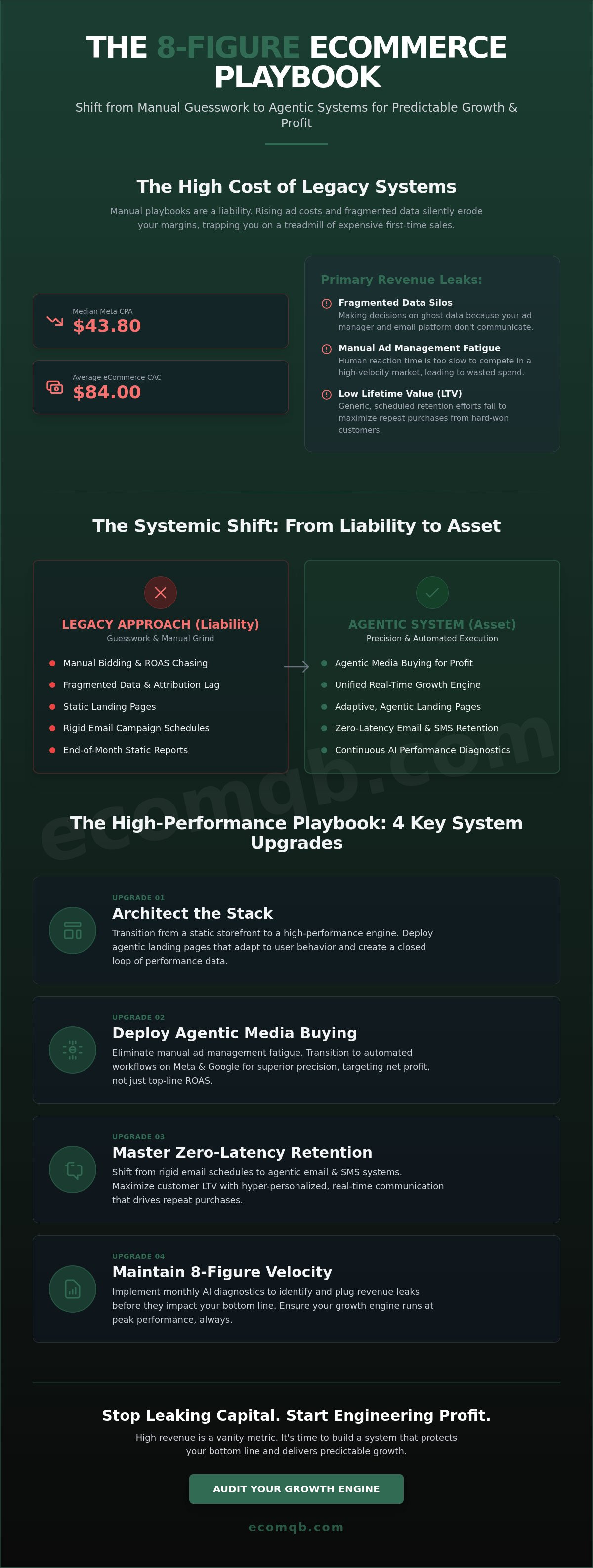
Scaling to eight figures isn't a marketing challenge. It's a systems engineering problem. In a market where Meta CPAs have climbed to a median of $43.80 and average eCommerce CAC sits as high as $84, your manual playbooks are leaking capital. You're likely exhausted by fragmented Shopify data and the relentless grind of manual ad management. It's time to pivot. True eCommerce marketing ROI optimization requires a shift from human-led guesswork to agentic systems that prioritize precision, speed, and profit.
You've seen the margins tighten despite your best efforts to scale. We agree that high revenue is a vanity metric if your bottom line isn't protected. This checklist is designed to stop the bleeding and maximize your margins through tactical, automated systems. We'll show you how to deploy agentic media buying, navigate 2026 privacy regulations, and gain total visibility into your customer lifetime value. This is your blueprint for predictable growth, surgical execution, and 8-figure velocity.
Key Takeaways
- Stop treating growth as a math problem and start engineering it as a system to solve for eCommerce marketing ROI optimization.
- Upgrade your digital infrastructure from a standard storefront to a high-performance engine using agentic landing pages that adapt to user behavior in real-time.
- Eliminate manual ad management fatigue by transitioning to agentic media buying workflows on Meta and Google for superior, automated precision.
- Shift from rigid email schedules to zero-latency retention systems that leverage agentic email and SMS to maximize customer lifetime value.
- Maintain 8-figure velocity by implementing monthly AI diagnostics that identify and plug revenue leaks before they impact your bottom line.
The ROI Audit: Identifying Revenue Leaks in Your 2026 Strategy
Legacy brands fail because they treat numbers as static history. They view eCommerce marketing ROI optimization as a simple math problem to be solved at the end of the month. High-performance leaders know better. In an 8-figure environment, ROI is a systemic engineering process. It's about the velocity of capital and the precision of your growth engine. If your attribution is lagging or your data is fragmented, you aren't scaling; you're just spending faster.
To master your Return on Marketing Investment (ROMI), you must first neutralize the three silent killers of profit. Attribution lag forces you to make decisions on ghost data. High Customer Acquisition Costs (CAC), which now averages between $68 and $84 for many merchants, eat your margins before you ship a single unit. Finally, low Lifetime Value (LTV) ensures you're trapped on a treadmill of expensive first-time sales. Solving these isn't about working harder. It's about auditing the system.
- Audit your attribution model: Identify cross-channel blind spots where Meta and Google both claim credit for the same conversion.
- Calculate Contribution Margin: Move beyond top-line ROAS. You need to know your net profit after ad spend, COGS, and shipping are stripped away.
Phase 1: The Diagnostic Audit
Start with the cold reality of your bank account. Review your Meta and Google ad spend against actual net profit, not the inflated numbers in your ad manager. You'll likely find that 20% of your products drive 80% of your returns while carrying the lowest margins. These are anchors on your growth. Use your Shopify data to pinpoint the exact millisecond a prospect drops off in your funnel. Is it the loading speed? The checkout friction? Find the leak and plug it immediately.
The Cost of Legacy Thinking
Manual bidding is a liability in a high-velocity market. When Meta CPMs average $11.54 and competition is fierce, human reaction time is too slow to catch profitable pockets of traffic. Fragmented data silos are equally dangerous. When your email platform doesn't talk to your ad manager, you're bidding on customers you've already won. The remedy is a unified eCommerce AI growth system. This approach replaces manual guesswork with agentic precision, ensuring every dollar of your eCommerce marketing ROI optimization strategy is deployed with clinical intent.
Architecting the Stack: Infrastructure for High-Velocity Growth
A standard storefront is a static brochure. For 8-figure velocity, your infrastructure must function as a high-performance engine. If your tech stack doesn't support eCommerce marketing ROI optimization, you're effectively racing a supercar with a clogged fuel line. High-velocity growth requires a seamless transition from basic web hosting to an integrated growth system where data flows without friction. You need a foundation that doesn't just host products but actively engineers conversions.
The first priority is deploying agentic landing pages. Unlike traditional static templates, these assets adapt to user behavior in real-time. They recognize the acquisition source, understand the intent, and pivot the messaging to match the visitor's psychological state. When your landing pages work in tandem with AI personalization experiences, you boost Average Order Value (AOV) by serving the right offer at the exact moment of peak interest. This isn't just about design. It's about ensuring your backend data flows directly into your media buying agents to create a closed loop of performance data.
The Shopify Optimization Playbook
Shopify excellence is the baseline for 2026. Start by auditing your site speed and mobile responsiveness. With mobile commerce accounting for over 60% of retail sales in key markets, a half-second delay is a revenue leak. Next, audit your app stack. Redundant, revenue-draining subscriptions slow down your liquid code and fragment your data. Replace bloated third-party apps with agentic workflows for inventory and order management. This streamlines your operations and ensures your eCommerce marketing ROI optimization efforts aren't undermined by operational overhead. If you're ready to modernize your infrastructure, it may be time to audit your current growth engine with a tactical partner.
AI Personalization: The New Standard
Static marketing is dead. Modern consumers expect hyper-personalization, and AI is the only way to deliver it at scale. Use agentic systems to serve dynamic content based on whether a user arrived from a TikTok ad or a Google Search query. This level of relevance continues into the post-purchase experience, where automated systems trigger immediate, high-margin upsells based on purchase history. We've moved beyond the era of static brand decks. High-performance brands now treat eCommerce brand strategy as a managed AI system. This shift ensures your brand identity isn't just a PDF on a hard drive but a living part of your automated sales process.
Agentic Media Buying: Beyond Manual ROAS Optimization
Manual media buying is a legacy bottleneck. In a digital economy where Meta CPMs average $11.54 and Google Search CPCs hit $2.69, human reaction time is simply too slow to compete. You cannot win a high-frequency auction with manual bid adjustments and gut-feeling targeting. To achieve true eCommerce marketing ROI optimization, you must deploy agentic media buying as the field general of your advertising strategy. This isn't just automation; it's a systemic shift toward autonomous decision-making that prioritizes margin over vanity metrics.
The transition starts by moving away from manual bidding and embracing agentic workflows on Meta and Google. These systems process millions of data points per second, identifying profitable pockets of traffic that human buyers overlook. You must also implement Dynamic Creative Optimization (DCO) to test thousands of variants simultaneously. This allows the system to find the perfect match between creative and consumer intent without manual intervention. To protect your bottom line, set strict kill-switches for underperforming ad sets. If an asset doesn't hit its contribution margin target within a specific window, the system cuts it immediately. No emotion. No hesitation. No wasted capital.
- Transition to agentic workflows: Move from manual bid caps to autonomous systems that adjust in real-time.
- Implement DCO: Test thousands of headline, image, and video combinations to find winning iterations fast.
- Deploy margin-based kill-switches: Automate the termination of ad sets that fail to meet strict profitability thresholds.
Mastering the Meta and Google Algorithms
The goal isn't just to reach people; it's to reach high-intent audiences before your competitors do. Agentic systems use predictive modeling to identify users likely to convert, often before they even search for your product. This precision is how you combat the rising eCommerce CAC, which currently fluctuates between $68 and $84. By automating your budget scaling based on real-time net profit rather than platform ROAS, you ensure every dollar spent is an investment in growth, not just a donation to the ad platforms. This tactical approach reduces acquisition friction and accelerates your path to 8-figure velocity.
Creative at Scale
Your media buying engine is only as effective as the fuel you feed it. In 2026, winning creative isn't just about aesthetics; it's about volume and data. Audit your creative pipeline for speed and throughput. You need a system that produces, tests, and iterates at a pace manual teams can't match. Use AI visibility tools to track which specific visual elements, like a certain color palette or a 3-second hook, are actually driving the conversion. Focus your resources on the winning assets that fuel the agentic media buying engine, ensuring your eCommerce marketing ROI optimization remains sharp, focused, and relentlessly profitable.
Retention Mastery: Maximizing LTV with Zero-Latency Systems
The first sale is nothing but an entry fee. In a landscape where average eCommerce CAC ranges from $68 to $84, breaking even on the first transaction is a victory; profiting on it is a miracle. True eCommerce marketing ROI optimization happens after the initial checkout. You don't build an 8-figure brand on a treadmill of one-off buyers. You build it on a foundation of high-velocity retention. This requires zero-latency systems that respond to customer behavior in milliseconds, not days. If your post-purchase strategy is static, you're leaving your most certain revenue on the table.
- Deploy agentic email and SMS: Move away from rigid, scheduled blasts and implement strategies that trigger based on real-time user behavior.
- Predictive Churn Prevention: Utilize AI to identify "at-risk" customers by tracking declining engagement patterns, allowing for surgical intervention before they vanish.
- Autonomous Loyalty Management: Implement a tiered loyalty system managed by AI agents that personalizes rewards and incentives based on individual spending habits.
Agentic Email and SMS Playbook
Legacy email marketing is a drain on your operational focus. Sending the same generic newsletter to your entire list is a surrender to mediocrity. You must audit your existing flows for engagement dead zones where customer momentum stalls and interest fades. The solution is agentic email marketing, which personalizes every touchpoint based on live data streams. This isn't just about inserting a first name. It's about shifting the narrative, product recommendations, and offer urgency based on browsing history and predicted intent. Maximize your SMS revenue by allowing AI to determine the exact millisecond a message should land for peak conversion. If you're ready to stop the churn, it's time to deploy a zero-latency retention system today.
The LTV Multiplier
Precision in acquisition requires absolute visibility into retention. You must calculate the Lifetime Value (LTV) of customers specifically by their acquisition channel. If Meta delivers high-volume but low-retention buyers while Google Search delivers high-LTV loyalists, your budget must shift to reflect that reality. Reinvest the profits from your high-value segments back into your agentic media buying engine to create a self-funding growth loop. Trust is built through speed and relevance. Focus on zero-latency responses to customer inquiries and behavior. When a customer feels seen and heard instantly, their loyalty is secured. This is the final lever in eCommerce marketing ROI optimization that transforms a standard shop into an 8-figure powerhouse.
The Field General’s Playbook: Scaling to 8-Figures and Beyond
Transitioning from a manual shop to an AI-managed growth system is the ultimate strategic pivot. You've moved beyond the chaos of fragmented data and the exhaustion of manual ad management. You've audited the leaks. You've architected the stack. Now, you must lead with the precision of a field general. True eCommerce marketing ROI optimization is not a one-time event; it is a continuous state of high-velocity improvement. It requires a relentless focus on the mechanical levers of growth and the courage to replace human intuition with agentic certainty.
The final phase of this checklist ensures your momentum never stalls. To maintain 8-figure velocity, you must move from working in the business to engineering the system that runs it. This involves shifting your attention to high-level strategic outcomes while allowing your technology stack to handle the tactical execution. Precision is power. Speed is profit. Systems are the solution.
- Schedule monthly AI diagnostics: Regularly scan your entire ecosystem to identify new revenue opportunities and emerging margin threats.
- Re-evaluate brand strategy: Ensure your brand identity and creative direction align with the rapid pace of high-velocity scaling.
- Partner with a tactical expert: Don't let technical complexity slow your growth. Partner with specialists who manage the mechanics of agentic systems.
Engineering Your Growth Trajectory
Your path to 8-figures follows a logical, aggressive sequence. First, you must eliminate manual bottlenecks in your marketing execution. If a human has to click a button for a sale to happen, you have a bottleneck. Second, deploy a curated AI technology stack that provides total visibility into your contribution margins and customer behavior. Finally, hand over the burden of manual bidding to agentic media buying systems. This frees your leadership team to focus on market expansion, product innovation, and high-level strategy. This three-step engineering process is the only way to achieve sustainable eCommerce marketing ROI optimization in a competitive digital economy.
Winning the High-Stakes Game
The game has changed. Success no longer belongs to those who work the hardest, but to those who build the most efficient systems. Shift your focus from tactical tasks to strategic outcomes. Every move you make should be designed to increase the velocity of your capital and the strength of your competitive advantage. Embrace the AI transformation as your primary weapon for market dominance. The era of guessing is over. It is time to take decisive action and secure your position at the top of the market. You have the checklist. You have the blueprint. Now, deploy your AI Growth System with eComQB and engineer your 8-figure future.
Take the High Ground: Master the Mechanics of 8-Figure Growth
Legacy tactics are anchors. You've audited the leaks, architected the stack, and deployed the field general of agentic media buying. The path to 8-figure velocity is now a matter of execution. You know that eCommerce marketing ROI optimization isn't about working harder; it's about building a system that works faster than the competition. It is about precision, speed, and mastery.
By integrating specialized Shopify development with a high-performance AI transformation strategy, you move from a reactive shop to a proactive powerhouse. You've secured the playbook. Now, you must choose to lead. Don't let technical complexity or manual fatigue hold your brand back from its true potential. The digital economy moves with zero latency. Your growth engine should do the same. It's time to stop managing tasks and start engineering outcomes.
Scale Your Brand with eComQB's Managed AI Growth System
You have the tools. You have the strategy. The next move is yours. Victory is a choice.
Frequently Asked Questions
What is the most effective way to optimize eCommerce marketing ROI in 2026?
The most effective strategy is to replace manual oversight with autonomous, agentic growth systems that solve for the entire funnel. True eCommerce marketing ROI optimization requires a shift from static reporting to real-time, algorithmic decision-making. You must unify your Shopify data with your media buying agents to eliminate latency and human error. This systemic approach ensures every dollar is deployed where it generates the highest contribution margin.
How does agentic media buying differ from traditional automated bidding?
Agentic media buying functions as an autonomous field general rather than a simple set of rules. Traditional automated bidding often reacts to historical data within rigid, pre-defined parameters. Agentic systems use predictive modeling to identify high-intent audiences and adjust creative, bidding, and budget allocation in real-time. They operate with a level of speed and precision that manual teams cannot match in high-frequency ad auctions.
Can AI really help improve my eCommerce profit margins?
AI improves profit margins by identifying and neutralizing revenue leaks across your entire operation. It automates high-frequency tasks like bid adjustments and inventory management; this significantly reduces operational overhead. By deploying AI personalization experiences, you also drive higher Average Order Values and better retention. This combination of lower costs and higher revenue per customer creates a decisive advantage in a high-CAC market.
What are the first steps in an AI transformation for a Shopify brand?
The first step is a comprehensive audit of your data infrastructure and current funnel efficiency. You need to ensure your Shopify backend is optimized for speed and that your app stack isn't creating fragmented data silos. Once the foundation is clean, you can begin deploying agentic landing pages and media buying workflows. This structured approach ensures your AI tools have the high-quality data they need to perform.
How do I calculate the true ROI of my marketing spend including operational costs?
Calculate your true ROI by focusing on Contribution Margin rather than top-line ROAS. You must subtract your Cost of Goods Sold (COGS), shipping fees, ad spend, and operational overhead from your total revenue. This provides a clinical view of the actual profit generated by each marketing dollar. eCommerce marketing ROI optimization is impossible without this level of visibility into your net profitability.
Why is LTV more important than ROAS for long-term eCommerce scaling?
ROAS is a short-term vanity metric that often ignores the true cost of acquisition. LTV is the ultimate growth lever because it represents the total value a customer brings over their entire relationship with your brand. High-performance scaling requires reinvesting the profits from high-LTV customers back into acquisition. This creates a self-funding growth loop that is far more sustainable than chasing one-off sales on a treadmill of rising ad costs.
What is a 'zero-latency' revenue strategy and why do I need it?
A zero-latency revenue strategy is a system that responds to customer behavior in milliseconds. You need it because modern consumers expect immediate relevance and instant gratification. By using agentic email and SMS, you can trigger personalized offers and support the moment a prospect shows intent. This speed eliminates engagement dead zones and captures revenue that would otherwise be lost to friction or delay.