10 DTC Growth Hacks to Scale in 2026

The average DTC brand retains just 28.2% of customers for a second purchase, according to Ringly.io’s June 2026 research. That’s a reminder that more acquisition activity doesn’t automatically create profitable growth. The best direct to consumer growth hacks aren’t isolated tricks. They’re measured experiments that improve the customer journey.
If your tactics feel scattered across channels, a new campaign, landing page, or email flow can create activity without showing whether it strengthens revenue, margins, or customer value. With limited time and resources, testing everything at once isn’t a strategy.
This guide covers practical tactics, ways to prioritize them using customer and business data, and how to measure what moves the numbers that matter. You’ll find 10 experiments across acquisition, conversion, and retention, plus a process for deciding what to scale, refine, or stop. Build a more focused growth engine, learn faster, and make every test earn its place.
Key Takeaways
- Treat direct to consumer growth hacks as focused experiments with a clear hypothesis and success measure, not shortcuts that guarantee results.
- Test creative variations, intent-led content, and focused landing pages to attract qualified traffic and keep the message consistent from discovery to destination.
- Improve one customer journey at a time with clearer product information, less friction, or more relevant personalization.
- Use lifecycle email and SMS to support repeat purchases, matching each message to customer needs and channel consent.
- Prioritize experiments by customer relevance, evidence, effort, and potential business impact. Document what you learn before scaling.
What Direct-to-Consumer Growth Hacks Actually Mean for a DTC Brand
A growth hack isn’t a guaranteed shortcut or a clever tactic detached from the business. It’s a focused, measurable experiment designed to solve a customer problem or improve a business outcome. The Direct-to-consumer (DTC) business model gives brands a direct relationship with customers, but growth still depends on how well each part of that relationship works.
Useful direct to consumer growth hacks span the full customer journey: acquisition brings qualified shoppers in, conversion helps them decide, and retention gives them reasons to return. Learning connects those stages. A test that reveals why shoppers abandon a product page can inform a storefront update, campaign message, or lifecycle email.
The right test depends on your customers, product, margins, and growth stage. A new brand may need to learn which audience responds to its message. A brand with steady traffic may focus on product-page clarity, while a business with repeat customers may test relevant post-purchase communication. Treat each tactic as part of a larger system, not a universal formula.
A growth experiment has a defined customer problem, a testable hypothesis, and a primary metric. Unmeasured marketing activity has none. That distinction keeps teams focused on evidence instead of motion.
How to tell a useful growth experiment from a short-lived trick
Start with one customer problem, one hypothesis, and one primary metric. For example: “Shoppers can’t tell which size fits, so adding clearer fit guidance should increase add-to-cart rate.” The hypothesis connects a customer need to a business signal. If a tactic has no plausible path to customer value or business performance, it’s a distraction. A temporary spike after changing a channel or promotion isn’t proof of durable growth. Check whether the effect persists and whether the economics still make sense.
Which metrics should guide a DTC growth test?
Choose a metric that matches the experiment. Conversion rate can show whether a storefront change helps more visitors purchase. Customer acquisition cost (CAC) helps assess the cost of acquiring customers. Repeat purchase rate tracks whether customers return, while contribution margin shows what remains after variable costs. Revenue alone can hide trade-offs: discounting may lift sales while reducing margin, and returns or fulfillment costs can change the value of those orders.
Set a baseline before launching. Record the relevant metric over a representative period, along with conditions that could affect it, such as traffic source, promotion, or product mix. Then compare like with like. Without a reference point, a result can look like a win simply because the audience or offer changed. Document the result and the learning, including when a test doesn’t move the primary metric. That insight can shape a sharper next experiment.
Use Acquisition Growth Hacks to Earn More Qualified DTC Traffic
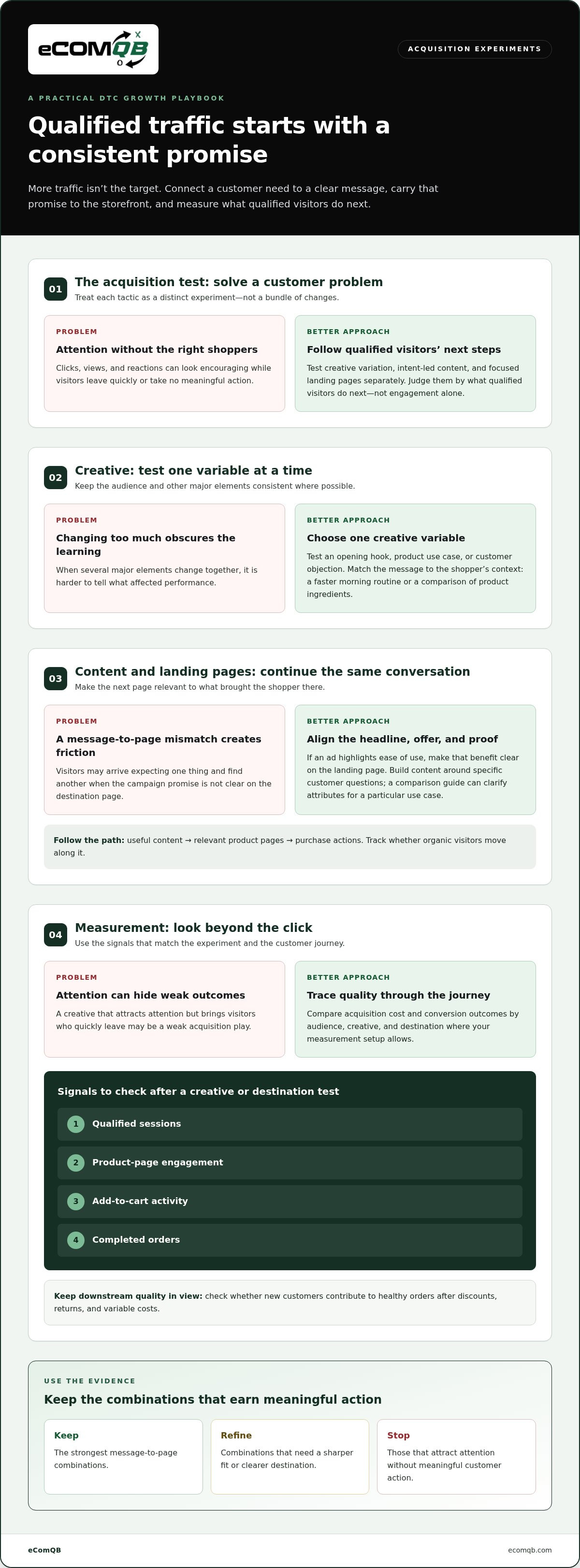
More traffic isn’t the target. More of the right shoppers is. Strong acquisition tests connect a customer need to a clear message, then carry that promise from the first impression to the storefront. Test creative variation, intent-led content, and focused landing pages as distinct experiments. Judge each by what qualified visitors do next, not by clicks or engagement alone.
Test sharper creative and audience-message fit
Choose one creative variable to test, such as the opening hook, product use case, or customer objection addressed. Keep the audience and other major elements consistent where possible, so the result helps explain what changed performance. A shopper looking for a faster morning routine needs a different message from someone comparing product ingredients. Match the creative to that context, then send each audience to a page that continues the same conversation.
Track more than views, clicks, and reactions. Compare qualified sessions, product-page engagement, add-to-cart activity, and completed orders. A creative that attracts attention but brings visitors who quickly leave may be a weak acquisition play. The agentic media buying playbook offers a deeper look at coordinating channel strategy, creative, and testing.
Capture existing demand with useful content and landing pages
Build content around specific questions customers ask while researching or choosing a product. A comparison guide, for example, can clarify which product attributes matter for a particular use case. Each page should help shoppers make a decision, not simply repeat broad category keywords. Track whether organic visitors move from that content to relevant product pages and purchase actions.
Focused landing pages give a campaign or search result a relevant destination. Align the headline, offer, and supporting proof with the source message. If an ad highlights ease of use, the landing page should make that benefit clear and help shoppers evaluate it. A mismatch creates friction: visitors arrive expecting one thing and find another. For organic visibility, a Shopify SEO and content strategy can connect useful search content with the storefront.
Keep downstream quality in view. Compare acquisition cost and conversion outcomes by audience, creative, and destination where your measurement setup allows. Check whether new customers contribute to healthy orders after discounts, returns, and variable costs. Keep the strongest message-to-page combinations; refine or stop those that attract attention without meaningful customer action. That’s how direct to consumer growth hacks become a disciplined acquisition system instead of disconnected campaigns.
For help coordinating paid media, search content, and storefront destinations, discuss a connected growth strategy.
Improve DTC Conversion with a More Relevant Storefront Experience
Once qualified shoppers arrive, the storefront has to carry the buying conversation forward. Three useful conversion tests focus on what shoppers need to understand, where they encounter friction, and which next step is most relevant. Avoid changing the entire site at once. A broad redesign makes it difficult to identify what influenced the result. A focused test on one journey, such as a product page through checkout, gives you a clearer signal.
A conversion test needs a defined audience and outcome, or you can’t tell whether the experience solved the right problem. Match the test to a specific shopper need, then choose a primary metric that reflects progress toward purchase.
| Test | Hypothesis | Evaluation metric |
|---|---|---|
| Clarify product information | Making a key benefit, specification, or shipping detail easier to find will help shoppers decide. | Add-to-cart rate and checkout completion |
| Reduce purchase friction | Simplifying a step in the buying journey will help more shoppers continue. | Step-to-step checkout progression |
| Personalize the experience | Relevant recommendations or page content will help a defined audience find a suitable next step. | Product selection and purchase rate |
Make product pages answer the buyer's real questions
Audit the page from the shopper’s perspective. Are the product’s benefits and specifications clear? Do images show the details needed to evaluate it? Can visitors find shipping information and answers to common concerns before checkout? Prioritize questions that could block a decision, then test the clarity or placement of one information element at a time. Avoid rewriting every section and replacing imagery together, since that makes it harder to isolate what helped.
Measure meaningful actions through checkout, not page engagement alone. A longer visit or more clicks may show interest, but doesn’t establish that shoppers understood the offer or completed a purchase. Follow the journey from product-page interaction to cart, checkout, and order completion. If the updated page helps shoppers add products but not finish checkout, the remaining obstacle may be later in the flow.
Use personalization to make the next step more relevant
Personalization can tailor product recommendations or landing-page content to customer signals, such as the page a shopper arrived from or the category they’re exploring. Keep the experience useful and explainable. A recommendation should fit the shopper’s context, not feel like a random detour. Compare the personalized journey with a clear baseline and evaluate purchase behavior, not just recommendation clicks. The Shopify personalization playbook explores these experiences in more depth.
These direct to consumer growth hacks work best when each test has a defined audience, a clear hypothesis, and an outcome tied to buying behavior. Start with one product or journey, learn from the result, then decide what deserves a broader rollout.
Turn DTC Customer Retention into a Repeatable Growth Lever
Acquisition brings new customers into the business. Retention gives satisfied buyers a relevant reason to return, complementing acquisition and supporting steadier customer relationships. It isn’t an automatic revenue lift: repeat purchases depend on the product, customer experience, timing, and whether the next message is genuinely useful. Treat retention as a system to test, not a result to assume.
Start by mapping customer moments when communication can help. A first-order welcome can set expectations. Product education can help customers get more value from a purchase. Replenishment reminders may suit products customers use up, while re-engagement messages can reconnect with buyers who haven’t returned. Segment by behavior or lifecycle stage instead of sending every message to every customer.
Build lifecycle messages around customer moments
Email and SMS serve different contexts. Email can support richer education, product guidance, and thoughtful recommendations. SMS is better reserved for concise, timely updates that customers have consented to receive. Choose the channel based on the message and customer preference, not simply because it’s available. Measure engagement alongside repeat orders and revenue contribution so opens or clicks don’t stand in for commercial impact.
Give each message a clear purpose and relevant audience. A post-purchase email might answer a common product-use question, while a replenishment prompt should reach customers for whom repeat ordering makes sense. Review frequency and overlap across channels too. Multiple messages about the same offer can create noise instead of value. Keep consent and channel relevance central to the plan.
Use customer insight to strengthen the next purchase
Ask for feedback after purchase and look for recurring friction: confusion about product use, unmet expectations, or questions the product page didn’t answer. Feed those patterns into retention messaging and product improvements. Cohort analysis adds another layer: compare customers who first purchased in different periods or through different offers, then observe whether they return. That helps distinguish a one-time promotion spike from a repeatable retention pattern.
Interpret the signals together. A campaign may earn strong engagement but few repeat orders, pointing to a gap between message and customer need. A cohort may return without responding to a discount, suggesting the product experience or education deserves closer attention. Document the audience, message, channel, and result, then use what you learn to refine the next test. The agentic email marketing playbook explores how lifecycle strategy can connect customer signals with relevant communication.
These direct to consumer growth hacks make retention a deliberate part of the growth engine, alongside acquisition and the storefront experience. Coordinate email and SMS with customer behavior, feedback, and business goals rather than treating each campaign as a standalone send.
Discuss your growth priorities and how to coordinate retention with your broader eCommerce growth strategy.
Prioritize DTC Growth Hacks and Scale What the Data Supports
A strong testing process keeps the team focused on the constraint that matters most. Don’t launch unrelated tactics across acquisition, storefront, and retention at the same time. Diagnose the bottleneck, choose a test that addresses it, then use the result to set the next move. This turns direct to consumer growth hacks into a repeatable operating rhythm, not a backlog of disconnected ideas.
Rank candidate tests against four factors: customer relevance, supporting evidence, implementation effort, and potential business impact. A test that addresses a frequent customer question and can be measured with existing data may deserve priority over a complex change built on a weak assumption. The goal isn’t to chase the easiest win or the boldest idea. It’s to place the next bet where customer need and business value meet.
Choose the next experiment without overloading the team
Start with one diagnosed bottleneck, such as qualified traffic failing to progress from a product page or first-time buyers not returning. Before launch, record the hypothesis, target audience, primary success metric, baseline, and review point. Define the audience carefully: a change that helps new visitors may not help returning customers. A shared experiment log keeps decisions, results, and learnings visible across marketing, storefront, and retention teams, including when a test is inconclusive.
Keep the test narrow enough to interpret. If you change the offer, audience, page, and message together, you may not know which change affected the result. Set a review point that gives the team a fair opportunity to observe the intended behavior. Note business context, such as a promotion or product availability, that could influence the comparison.
Decide what to scale, refine, or stop
At review, compare results with the original baseline and the outcome you set before launch. If the result points in the right direction but the evidence is mixed, refine the test or repeat it under comparable conditions. If it fails to address the customer problem or weakens the business outcome, stop and record the learning. Expand a tactic only when the result supports the intended audience and outcome, not because one metric rose in isolation.
Scaling also means checking whether the tactic holds across the relevant customer journey. An acquisition message may attract the right shoppers but need a matching storefront experience; a retention message may earn engagement without encouraging another order. Look for connected signals, then roll out deliberately and keep monitoring performance. A shared record helps separate durable patterns from one-off results and gives the next experiment stronger evidence to start with.
When the work spans strategy, media, storefront experience, and retention, coordinated execution keeps tests aligned around the same customer and business priorities. eComQB connects eCommerce strategy with AI transformation, digital advertising execution, email and SMS marketing, personalization, and Shopify development through managed growth systems.
Ready to turn your test priorities into a coordinated growth plan? Book a growth strategy call.
Make Your Next Growth Move Count
Your next advantage may come from connecting the work, not adding another tactic. Give teams a shared view of the customer problem, the experiment in motion, and the evidence needed to decide what happens next. That discipline helps turn direct to consumer growth hacks into a coherent way to learn and allocate effort.
When coordinating that work requires strategic or technical support, eComQB brings managed eCommerce growth systems together with execution across advertising, AI transformation, email and SMS, personalization, and Shopify development. The aim is to connect customer acquisition, storefront experience, and retention around your business priorities, without treating any single tactic as a guaranteed win.
Choose the growth constraint you most need to address, then map a practical next step with a team that connects the moving parts. Book a growth strategy call to discuss coordinated execution. A sharper plan starts with one deliberate move. Make it count.
Frequently Asked Questions
What are direct-to-consumer growth hacks?
Direct-to-consumer growth hacks are targeted tactics or experiments intended to improve how a brand attracts, converts, or retains customers. The useful ones address a real business constraint rather than chase novelty. For example, a brand might test a referral prompt after a positive customer interaction, then assess whether referred shoppers become customers and return. The tactic is valuable only if customer response supports the business case.
Which growth hacks work best for a DTC brand?
The best tactic depends on where the brand is losing momentum. If visitors arrive but don’t purchase, examine product information, the offer, and the checkout journey. If customers buy once and disappear, investigate their post-purchase experience and reasons for not returning. If qualified traffic is limited, test relevant content or creative. Start with evidence from customer questions, site behavior, and order patterns, then choose a tactic tied to that specific gap.
How can a DTC brand grow without relying only on paid ads?
Build additional routes to discovery and purchase, such as useful search content, creator collaborations, customer referrals, and a recognizable brand community. A product-focused guide can answer a comparison question, while a referral prompt can invite satisfied customers to introduce someone with the same need. Track which sources bring visitors who engage and purchase. Diversifying channels takes sustained effort, but can reduce dependence on a single traffic source.
How do you measure whether a DTC growth hack is working?
Match measurement to the behavior the tactic is meant to change, and look beyond the first click or order. A referral test could track referred visits, first purchases, and later repeat behavior; a content test could track qualified organic visits and assisted purchases. Use consistent attribution rules and compare similar audiences or time periods. Where possible, use a holdout or controlled comparison to distinguish incremental impact from sales that might have happened anyway.
Are growth hacks sustainable for eCommerce brands?
They can be sustainable when they strengthen customer value or improve a repeatable business process. A useful product education sequence may keep helping new buyers, while a temporary discount could produce a short-lived lift without improving loyalty or margins. Review whether a tactic still works as the audience, offer, or channel changes. Keep the underlying customer insight, even if the original execution eventually needs to evolve.
Should a DTC brand use AI for growth experiments?
AI can help teams organize customer feedback, identify recurring themes, generate creative variations, or tailor product discovery. Use it to accelerate analysis and execution, not replace judgment about what customers need. For instance, AI may group support questions that point to unclear product information; a team can then validate the pattern and test a page update. Human review remains essential for accuracy, brand fit, and a relevant customer experience.
How many growth experiments should a DTC brand run at once?
There’s no universal number. Run only as many as the team can implement, measure, and interpret without muddying the results. A small team may focus on one high-priority test, while a larger team can run separate experiments across distinct audiences or journeys if the results won’t overlap. If multiple changes affect the same shoppers or metric, sequence them or isolate the groups so the learning stays actionable.
Ready to connect acquisition, storefront improvements, and retention into a focused growth plan? Book a growth strategy call with eComQB.