Omnichannel eCommerce Strategy: Build a Connected Customer Experience

Adding channels won’t fix a fragmented customer journey. A strong omnichannel eCommerce strategy connects the moments customers already move between, from marketing and storefront to service and retail, without adding unnecessary operational complexity.
If your teams work from scattered data or disconnected systems, it’s difficult to see how customers move from discovery to purchase or which improvements deserve priority. The answer isn’t to integrate everything at once. Focus on the journeys that matter most, then connect the channels, information, and workflows that support them.
This guide shows you how to build a practical omnichannel eCommerce strategy around customer needs and clear business objectives. You’ll learn how to prioritize channels and integrations, strengthen your data foundation, and define ownership and measurement so your team can improve with confidence.
We’ll cover the key decisions, from storefront and marketing alignment to personalization and performance tracking, then turn them into an actionable roadmap. The goal is a more consistent customer experience and a more coordinated growth system for your business.
Key Takeaways
- Build around customer needs and friction points, not the latest channel trend or preferred software.
- Use a clear framework to map journeys, set outcomes, assign ownership, connect systems, and test.
- Compare phased integration, unified commerce, and composable setups to choose an omnichannel eCommerce strategy that fits your operating needs.
- Start your roadmap with a baseline and one priority journey, then track workflow progress and business outcomes.
- Coordinate storefront development, personalization, paid media, and lifecycle messaging around shared goals and measurement.
What an Omnichannel eCommerce Strategy Connects, and Why It Matters
An omnichannel eCommerce strategy connects customer-facing channels with the information and operations needed to make each interaction feel like part of one journey. The aim isn’t to be everywhere. It’s to make the touchpoints you choose work together, so customers can move between them without losing context, clarity, or support.
Multichannel means a business uses multiple channels; omnichannel means those channels coordinate to provide continuity for the customer. A brand may sell through a website, social platforms, and a physical store, yet still leave shoppers to repeat questions, search again for product information, or navigate disconnected processes to resolve an issue. Channel presence creates access. Integration connects the experience.
This coordination can include shared product information, consistent promotions, customer service context, and clear handoffs between teams. The right mix depends on how customers shop and what the business can operate well. An overview of omnichannel retail strategy describes examples such as click and collect, but no single model or technology platform is right for every brand.
Omnichannel vs. multichannel: what changes for the customer?
Consider a shopper who discovers a product in a social post, visits the online storefront to compare details, and completes a purchase later. Afterward, they contact support with a question about the order. In a disconnected setup, the support team may lack relevant context, leaving the shopper to explain the journey again. With coordinated touchpoints, product and order information can help the team provide a more informed response.
The practical test is continuity, not channel count. Can customers find consistent information, understand the next step, and get help without restarting? A focused experience across a few relevant touchpoints can serve customers better than a sprawling channel mix that teams struggle to maintain.
Which customer and business outcomes should the strategy improve?
Separate customer outcomes from internal outcomes. For customers, priorities might include easier product discovery, consistent information, a simpler path to purchase, or support that understands the issue. Translate each priority into an observable measure, such as purchase journey completion, repeated support requests, or customer retention. Choose measures that reflect the specific journey you’re improving.
Internally, a connected approach should make ownership and performance easier to understand. Define who manages each handoff, where customer or campaign data is recorded, and how results are reported. That clarity helps reveal friction, such as a marketing promise that the storefront doesn’t reinforce or a service question that no team clearly owns.
Keep the scorecard balanced. A smoother journey matters, but so do commercial and service objectives such as conversion, repeat purchase, and support resolution. Establish a baseline before making changes, then compare results over a defined period. Outcomes depend on data quality, workflow design, and execution. Integration alone doesn’t guarantee improvement.
The strategic shift is from managing channels as separate destinations to designing connected customer journeys. That gives the team a clearer basis for deciding what to align, what to measure, and where to focus next.
How to Design the Connected Omnichannel eCommerce Operating Model
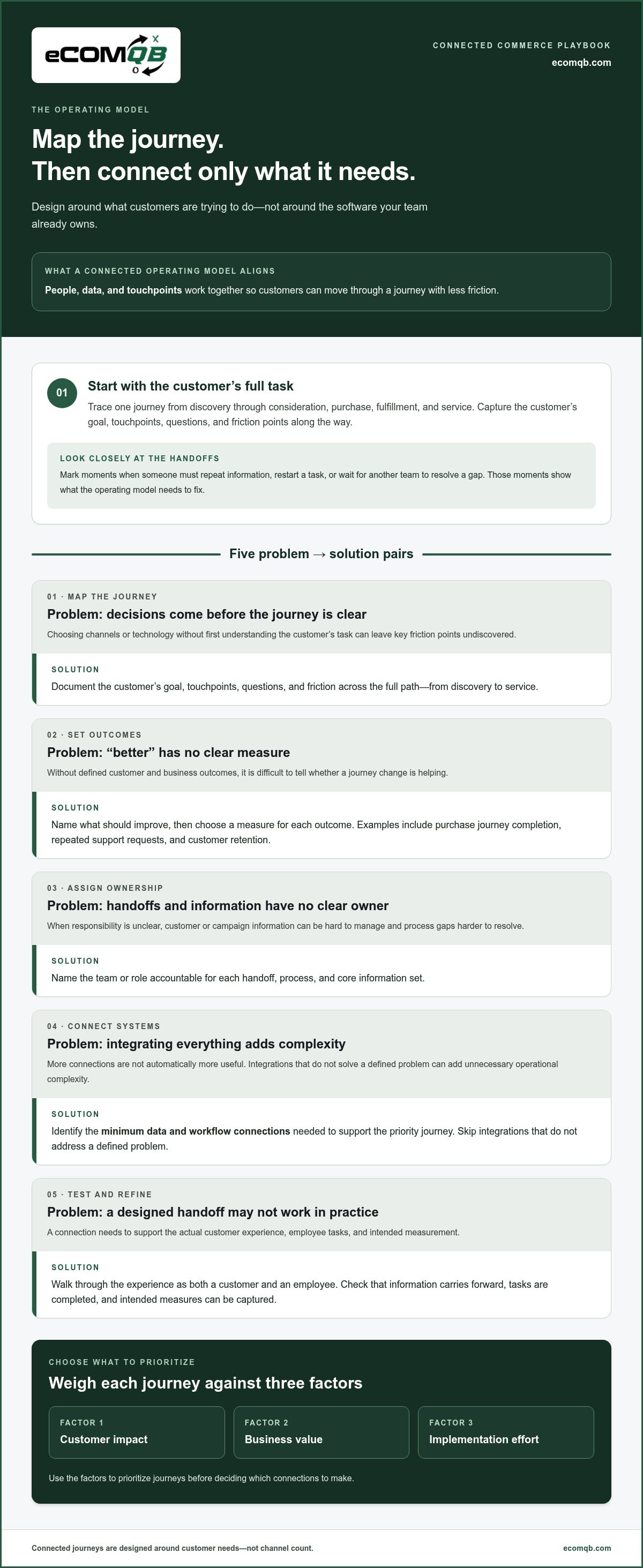
Build the operating model around what customers are trying to do, not around the software your team already owns. An omnichannel eCommerce strategy becomes practical when it defines the journey, its intended outcomes, the people responsible, the information that must move, and how the team will test each handoff.
An omnichannel operating model aligns people, data, and touchpoints so customers can move through a journey with less friction. That requires clear decisions about process as well as technology. IBM’s guidance on omnichannel customer experience also emphasizes connected channels and coordinated data as foundations for consistency.
Map the journey before selecting channels or technology
Trace one customer task from discovery through consideration, purchase, fulfillment, and service. Record the touchpoints customers use and what they need at each stage. Mark any handoff where someone must repeat information, restart a task, or wait for another team to resolve a gap. Those moments show what the operating model needs to fix before a platform decision can help.
Use this sequence to turn the journey map into a working design:
- Map the journey. Document the customer’s goal, touchpoints, questions, and friction points across the full path.
- Set outcomes. Define what should improve for the customer and the business, then choose a measure for each outcome.
- Assign ownership. Name the team or role accountable for each handoff, process, and core information set.
- Connect systems. Identify the minimum data and workflow connections needed to support the priority journey. Skip integrations that don’t solve a defined problem.
- Test and refine. Walk through the experience as a customer and as an employee. Check that information carries forward, tasks are completed, and the intended measures can be captured.
Prioritize journeys by weighing customer impact, business value, and implementation effort. A journey with repeated service friction and a clear owner may be a stronger first move than an ambitious project that depends on several unresolved integrations.
Set channel roles, data ownership, and team responsibilities
Give each channel a defined job. Social content may introduce products, the storefront may support comparison and purchase, and email or SMS may carry relevant lifecycle messages. Roles can overlap, but repeating identical activity everywhere can create noise and blur accountability.
Then assign owners for customer records, product information, orders, and service processes. Define which system is authoritative for each, how changes are shared, and what employees need to see at a handoff. Keep customer, order, product, and service details consistent so a change in one touchpoint doesn’t create conflicting information elsewhere.
AI can support personalization or coordinated marketing, but it works best within a deliberate operating model. Treat AI transformation for eCommerce brands as a capability aligned with defined journeys, data rules, and human ownership, not as a substitute for them. If you’re shaping strategy and implementation together, discuss your eCommerce growth priorities with eComQB.
Choose an Omnichannel eCommerce Approach Without Overbuilding
Your architecture should serve the journeys you’ve prioritized, not dictate them. A phased integration can connect a few critical workflows while leaving the wider stack in place. A unified commerce platform can bring more capabilities into a coordinated environment. A composable setup connects specialized systems, giving teams flexibility but also more integration decisions to manage. None is universally best. The right fit depends on your goals, data access, process ownership, and capacity to manage change.
Use this comparison to frame the trade-offs before committing to a direction:
| Approach | Best fit | Operating implications | Integration needs | Trade-offs |
|---|---|---|---|---|
| Phased integration | Teams targeting a specific journey or handoff first | Change is focused and incremental | Connect only the systems and data the priority journey requires | Legacy gaps may remain; improvements can require further phases |
| Unified commerce platform | Brands seeking to reduce fragmented workflows across core commerce activity | More work can be coordinated within a shared environment | Migration, configuration, and connections to remaining systems still need planning | Can simplify some workflows, but may constrain specialized requirements |
| Composable setup | Teams that prioritize flexibility and distinct capabilities | Requires clear technical and operational ownership across components | Interfaces and data flows between selected systems need deliberate design | Supports tailored choices, but adds integration and governance demands |
When does a phased integration make the most sense?
Choose a phased approach when one customer journey has a clear pain point and can be improved without replacing the whole stack. A pilot might connect storefront activity with relevant service context while leaving other workflows unchanged. Before starting, confirm that teams can access the needed data, someone owns the process, and the integration can be supported. Define success measures and boundaries in advance, then use the pilot results to decide what to expand.
When should a brand consider a more unified or composable setup?
A unified platform may suit a brand whose teams repeatedly manage fragmented workflows across core commerce functions. A composable model may fit when distinct capabilities matter more than consolidation and the business can manage the connections. In either case, compare the operating effort as carefully as the feature set. A coordinated eCommerce AI growth system can also align personalization and marketing capabilities with broader business goals, rather than adding tools without a defined role.
Pressure-test each option against the same questions: Which priority journey improves? What data must move? Who will own the workflow? Can the team measure and maintain the change? An omnichannel eCommerce strategy should connect priority journeys before expanding channel count. Start with the smallest approach that can deliver a meaningful, measurable improvement, then scale when evidence and operating capacity support the next move.
Build a Practical Omnichannel eCommerce Roadmap and Scorecard
Turn the operating model into a controlled rollout. A useful roadmap moves from a baseline to one priority journey, then connects the workflow, tests it, and expands only when the evidence supports the next step. This keeps the work focused and helps teams identify whether the bottleneck is customer experience, process, data, or measurement.
- Baseline. Record current journey performance, workflow completion, data quality, and known friction. Note the source and limitations of each measure.
- Prioritize one journey. Select a customer path with a clear need, business objective, and accountable owner.
- Connect the workflow. Make the minimum process and system changes needed to support the journey, with ownership defined for each handoff.
- Test. Review customer experience and operational performance against the baseline on an agreed date.
- Expand. Keep, revise, or scale the change based on results and the team’s capacity to sustain it.
Which metrics show whether channels work together?
Pair journey-level measures with channel performance. A channel report can show visits, clicks, or purchases, but it won’t necessarily reveal whether a customer moved smoothly between touchpoints. Track leading indicators such as successful handoff completion, consistency of order or customer records, and whether a service team receives the context needed to respond. Then compare those signals with business outcomes such as conversion, repeat purchase, retention, or service resolution.
Give every KPI four controls: an accountable owner, a review cadence, a named data source, and a decision rule. For example, an owner might review handoff completion at a regular team meeting and investigate if it falls below an agreed threshold. Set thresholds from your own baseline rather than borrowing arbitrary targets. Define attribution limits, too. A customer who saw multiple channels before purchasing doesn’t, by that fact alone, prove each channel caused the sale.
How should teams test, learn, and scale the roadmap?
Keep the first test bounded. Name the use case and owner, document the baseline, and set the review date before launch. Alongside performance, capture customer feedback, staff friction, and data quality issues. These signals help explain why a result changed and whether the workflow is reliable enough to extend. Assess coordinated lifecycle touchpoints, including agentic email marketing, as part of the journey, not only by message-level engagement.
Use this readiness checklist to find the first operational bottleneck:
- Is the customer journey and its intended outcome clearly defined?
- Can the team access the data needed to complete and measure the handoff?
- Does each workflow step have an accountable owner?
- Are the baseline, data source, review cadence, and decision rule documented?
- Can the team capture customer feedback and operational issues during the test?
A disciplined scorecard turns an omnichannel eCommerce strategy into decisions, not just dashboards. If you’re ready to align the roadmap with execution, plan your eCommerce growth roadmap with eComQB.
Turn Your Omnichannel eCommerce Strategy into Coordinated Execution
Strategy creates value when it changes how teams work together. Move from priorities to delivery by aligning goals, selecting important journeys, assigning clear owners, and reviewing performance against agreed measures. The aim is one coordinated system, not a collection of disconnected projects. Storefront development, personalization, paid media, and lifecycle messaging should each support a defined customer need and business objective.
- Align goals: Connect customer needs to commercial and service objectives.
- Prioritize journeys: Focus teams on the customer paths with the clearest opportunity.
- Assign owners: Make responsibility for workflows, data, and handoffs explicit.
- Measure: Review journey experience and business outcomes together, then refine the plan.
AI can help make experiences and workflows more relevant, but it needs direction. Use it as an enabler within defined data practices, customer goals, and review processes. Keep people accountable for decisions that affect the experience, and assess AI-supported activity against the same measures as other parts of the system.
What should an implementation partner bring to the strategy?
A useful partner connects strategic priorities to technical and marketing execution, so the customer journey guides what gets built and activated. Shopify development can support the storefront experience, while paid media and lifecycle programs can align discovery, purchase, and follow-up around consistent goals. The work should have clear owners, defined handoffs, and a way to assess whether each component supports the selected journey.
This connection matters because a storefront change can affect campaign landing experiences, while personalization and lifecycle messaging rely on relevant context. Strategic consulting paired with implementation helps teams coordinate those moving parts, surface dependencies, and keep execution focused on the intended customer outcome.
What should happen in the first strategy session?
Bring the information that makes decisions concrete: priority customer journeys, each channel’s current role, known workflow friction, and the performance measures you already review. Add an outline of technology dependencies and the teams responsible for key handoffs. Gaps are useful signals, too. They show where discovery, ownership, or measurement needs attention before a larger build.
Use the session to agree on the first journey to address, the outcome it should support, the owner, and the next decision point. Keep the plan grounded in what your team can execute and measure. That creates a clear bridge from strategy to action without expanding scope before the first workflow is understood.
eComQB brings eCommerce strategy and implementation together across Shopify development, AI-driven personalization, Meta and Google advertising, and agentic email and SMS. If you’re ready to align those capabilities around your priority customer journeys, book a strategy call with eComQB.
Make Your Next Move Count
The strongest omnichannel eCommerce strategy isn’t a finished diagram. It’s a working discipline: teams notice friction, make a focused change, and use what they learn to choose the next move. Keep that cycle active as customer needs and business priorities evolve. Progress comes from deliberate execution, not from connecting every possible touchpoint at once.
Your next step can be simple. Choose one customer journey that matters, identify the decision slowing progress, and bring the people closest to that work into the conversation. A clear starting point gives strategy momentum and turns complexity into a manageable set of actions.
eComQB combines strategic thinking with implementation support to help eCommerce brands shape coordinated growth systems, including managed AI capabilities designed to support work without adding operational overhead. Map your next growth move with eComQB and turn your priorities into a practical path forward.
Build with focus, learn from the journey, and keep moving. A more connected customer experience starts with the next decision you make.
Frequently Asked Questions
What is an omnichannel eCommerce strategy?
An omnichannel eCommerce strategy coordinates the channels and business processes a customer encounters so the experience carries useful context forward. That context might include the product a shopper viewed, the offer they received, or an existing service issue. The goal isn’t identical interactions everywhere. It’s a coherent experience in which each touchpoint has a clear role and gives customers a sensible next step.
How do you develop an omnichannel retail strategy?
Start by choosing a customer task worth improving, such as comparing product options or getting help after an online purchase. Gather the teams involved and map what currently happens, including where information is missing or work gets repeated. Agree on the desired customer outcome and a way to observe it. Then decide which process or system change to test first, with an owner responsible for reviewing the results.
What is the difference between omnichannel and multichannel eCommerce?
Multichannel eCommerce means customers can engage or transact through more than one channel; omnichannel eCommerce emphasizes how those channels work together. A multichannel setup can still serve customers effectively, and having multiple channels doesn’t automatically create a connected experience. The useful distinction is whether information and processes support movement between touchpoints. For example, a campaign and storefront can operate separately or share consistent product details and messaging.
Which channels should an eCommerce brand include in its omnichannel strategy?
Include channels that serve a real customer need and that your team can support consistently. For one brand, that may mean a storefront, social discovery, and email or SMS. Another may need paid search or a service touchpoint to complete its customers’ journeys. Review customer questions, shopping behavior, and channel performance before expanding. A channel earns its place by contributing to a defined journey, not simply by being popular.
Does an omnichannel eCommerce strategy require replacing existing platforms?
No. A brand can often begin by improving how existing platforms share relevant information or support a specific workflow. First identify what the current setup can do, where data can be accessed, and which handoff creates the greatest friction. Consider replacement when a platform prevents a priority journey from functioning or creates ongoing constraints that outweigh the disruption of change. The decision should follow business needs, not a preference for new technology.
How do you measure whether an omnichannel strategy is working?
Measure both the customer journey and the channels contributing to it. Track a business outcome such as conversion or repeat purchase alongside signals like completed handoffs, consistent customer records, and service resolution. Set a baseline, identify the data source, and agree who reviews each measure and when. If several channels influence a purchase, report attribution limits clearly. A channel’s presence in the journey doesn’t prove it caused the outcome.
Can AI support an omnichannel eCommerce strategy?
Yes. AI can support tasks such as tailoring product experiences or coordinating lifecycle messages, provided it uses relevant data and serves a clear customer purpose. For example, a brand might use AI personalization to adapt storefront content to a shopper’s interests, then review whether the experience is useful and appropriate. Keep people accountable for oversight, data quality, and decisions. AI can strengthen a designed operating model, but it can’t replace one.