Data-Driven eCommerce Brand Strategy: Turn Customer Signals into Better Product Decisions

Your next strong product decision may already be visible in your data, but disconnected sales, customer, and marketing signals can hide it. A data-driven eCommerce brand strategy doesn’t mean letting dashboards make the call. It means turning customer behavior, sales patterns, and campaign feedback into evidence your team can use to decide what to offer, how to position it, and what to test next.
A burst of sales can look like lasting demand, while a flood of opinions can push the roadmap in the wrong direction. Without a repeatable way to validate ideas, product and positioning decisions default to instinct. The result can be investment in offers or messages that don’t address a durable customer need.
This article lays out a practical process for bringing signals together, distinguishing meaningful patterns from short-term noise, and testing product and brand decisions before you commit. You’ll learn how to connect customer evidence to commercial outcomes and where AI can help organize analysis without replacing strategic judgment. The goal is a sharper playbook: prioritize with confidence, learn from each test, and carry a clear strategy through your marketing and storefront.
Key Takeaways
- Build a stronger evidence base by connecting Shopify transactions and customer feedback with on-site behavior and marketing signals.
- Use a data-driven eCommerce brand strategy to compare product and positioning opportunities across demand, brand fit, margin potential, feasibility, and evidence strength.
- Turn uncertainty into a focused test: define the customer problem, form a hypothesis, choose a credible experiment, review results, and decide what to do next.
- Treat prioritization scores as decision aids, not forecasts. Combine measurable signals with customer empathy and strategic judgment.
- Connect validated insights to execution across Shopify, AI personalization, advertising, and content, with people accountable for the strategic calls.
What data-driven eCommerce brand strategy means for product decisions
A data-driven eCommerce brand strategy uses customer evidence and commercial results to guide product and positioning choices, then measures whether those choices create better outcomes for customers and the business. Data sharpens the decision, but doesn’t make it for you. Teams still need customer empathy, a distinct point of view, and the judgment to recognize which opportunities fit the brand.
That distinction matters. The wider E-commerce ecosystem includes customer interactions, technology, and commercial activity across digital channels. Brand strategy turns relevant signals from that activity into choices about what the brand should offer and stand for. It’s different from adjusting an ad or monitoring a daily report, though those activities can surface useful evidence.
Which brand and product decisions should data inform?
Start with strategic choices that shape what customers can buy and why they should choose you. For each choice, name the customer problem or opportunity first, then identify the evidence that can inform the decision.
- Audience priorities: Which customers show a recurring need your brand can serve distinctively?
- Product concepts: What unmet need appears in product reviews, support conversations, or repeated customer requests?
- Assortment choices: Which products deserve more attention, and where do customer interest and commercial performance tell different stories?
- Messaging: Which product benefits do customers value, describe in their own words, and respond to across channels?
- Experience improvements: Where do customers hesitate, struggle to find relevant products, or abandon a purchase journey?
These questions guide long-term product and positioning decisions. Routine reporting and campaign adjustments serve a different purpose: they help teams monitor and optimize activity already underway. An ad’s click-through rate might point to a message worth investigating, but it can’t establish product-market fit on its own.
Why more data does not automatically mean better strategy
More dashboards can create more confusion. Shopify transactions, customer feedback, support themes, and advertising results each tell part of the story, but disconnected views make it hard to see how those signals relate. A rise in product-page visits, for example, could indicate interest. Without purchase behavior or customer context, it doesn’t explain what’s driving that interest or what to build next.
Give each metric a decision to serve. Impressions and follower counts can show reach, but they’re weak strategic evidence if the team hasn’t defined what action they inform. Stronger analysis connects a signal to a question, a customer need, and a possible next move.
Then add qualitative context. A conversion pattern may show where shoppers drop off; customer comments can reveal whether the issue is unclear sizing, weak product information, or a mismatch between expectations and the offer. Quantitative patterns show what is happening. Customer context helps explain why. Together, they give the team a disciplined basis for product choices without mistaking activity for demand.
Build a reliable eCommerce evidence base before choosing what to develop
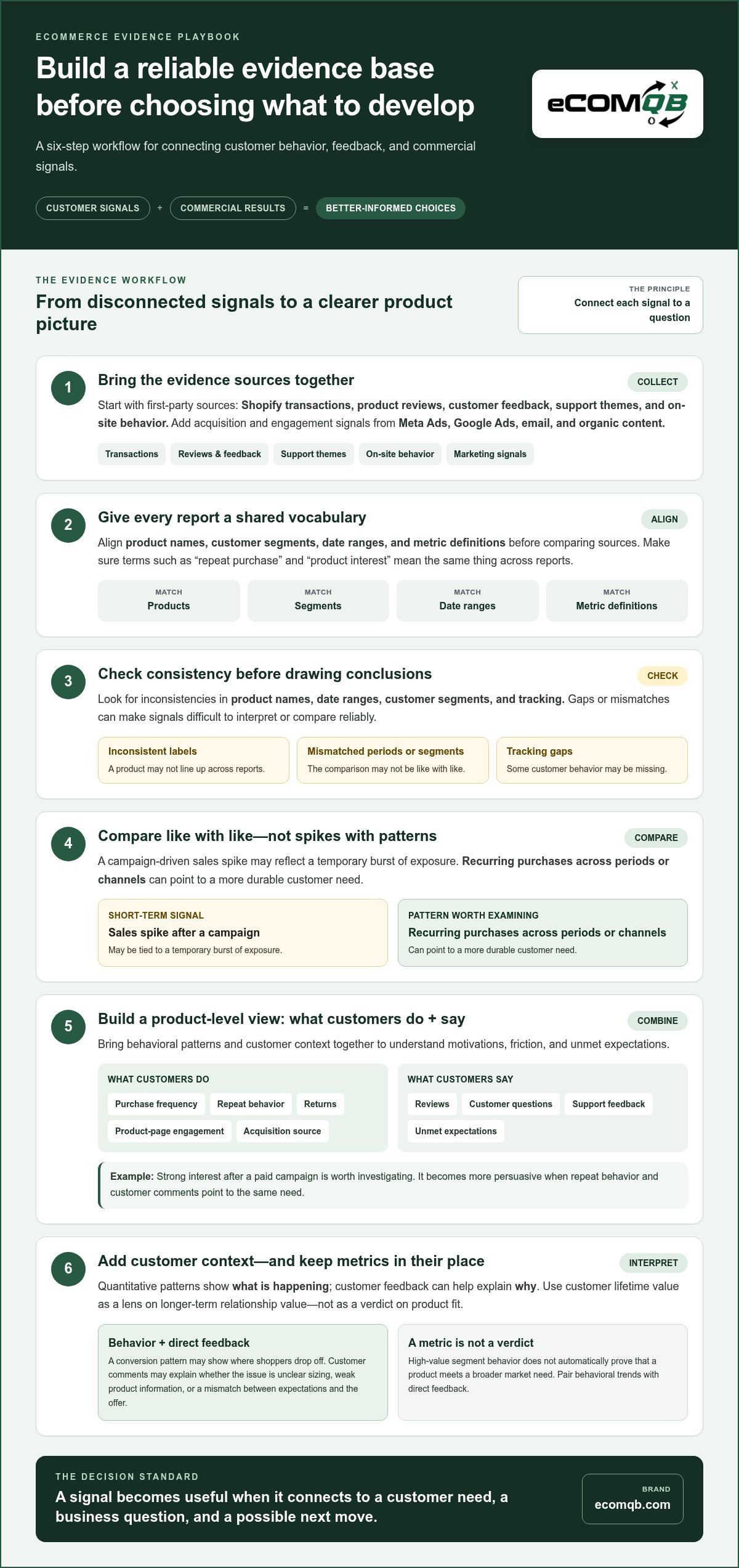
Before comparing product ideas, establish what your evidence can actually tell you. Start with first-party sources: Shopify transactions, product reviews, customer feedback, support themes, and on-site behavior. Then add acquisition and engagement signals from Meta Ads, Google Ads, email, and organic content. These sources offer different views of the customer journey. Compare them only after defining consistent segments and product-level measures.
Set a shared vocabulary first. Align product names, customer segments, date ranges, and metric definitions so that “repeat purchase” or “product interest” means the same thing across reports. Then compare like with like: a campaign-driven sales spike may reflect a temporary burst of exposure, while recurring purchases across periods or channels can point to a more durable customer need. A broader data-driven decision-making approach in e-commerce also depends on connecting signals to a specific business question, not simply collecting more of them.
What customer and product signals belong in the analysis?
Build a product-level view that combines what customers do with what they say. Track purchase frequency, repeat behavior, returns, reviews, and customer questions alongside product-page engagement and acquisition source. For example, strong interest after a paid campaign is worth investigating. It becomes more persuasive when repeat behavior and customer comments point to the same need.
Use customer lifetime value as a lens, not a verdict on product fit. It can help reveal the longer-term value of a customer relationship, but a high-value segment’s behavior doesn’t automatically prove that a particular product meets a broader market need. Pair behavioral trends with direct feedback to understand motivations, friction, and unmet expectations.
How to assess data quality and interpret gaps
Before drawing a conclusion, check for inconsistent product names, date ranges, customer segments, and tracking definitions. Look for missing records and biased samples, too. Customers who leave reviews may not represent all buyers, and a campaign audience may differ from your wider customer base. Record these limits beside the finding so the team knows how far it can reasonably generalize.
Evidence limits: This dataset reflects the customers, channels, products, tracking coverage, and time period captured, so missing activity, inconsistent definitions, or an unrepresentative sample can limit what it supports.
Keep a simple evidence log for each potential product decision: the customer segment, product measure, signal source, time period, and known gaps. This makes it easier to distinguish a short-lived campaign effect from a pattern that persists across customer groups or channels. For a broader view of how AI can support connected data and decision systems, explore the AI transformation playbook for eCommerce brands. A well-structured evidence base can then inform a conversation about your eCommerce strategy.
Prioritize product and positioning bets with a clear comparison framework
Once the evidence is assembled, put each product or positioning opportunity through the same decision filter. A scorecard makes trade-offs visible and keeps the loudest opinion from winning by default. Set the criteria before reviewing concepts, then use a simple 1-to-5 scale: low, mixed, or strong support. The scores help your team compare options. They are prioritization aids, not precise forecasts or guarantees of future performance.
How to rank product opportunities without false precision
Define what each score means before anyone rates a concept. For example, strong demand should require repeated customer signals, not a single campaign spike. Record the evidence beside every rating, and label internal assumptions separately. This makes the logic auditable: the team can see whether a high score reflects observed customer behavior, a strategic judgment, or a belief that still needs testing.
Customer demand
Are there repeated, relevant signals that customers want this solution?
Brand fit
Does the opportunity reinforce what the brand wants to be known for?
Margin potential
Is there a plausible path to sustainable commercial value after product and selling costs?
Feasibility
Can the team credibly develop, present, and support the offer?
Evidence strength
Are the supporting signals consistent, relevant, and based on a useful sample?
Don’t let a total score hide a critical trade-off. Imagine customer interest is strong, but feasibility is low because the concept requires capabilities the business can’t yet support. That doesn’t automatically mean reject it. Identify what makes execution difficult, then decide whether to simplify the concept, build capability, or test demand before committing further. If customer appeal is weak and brand fit is also poor, a high score elsewhere may not justify the bet.
Behavioral evidence can also shape how an existing offer is presented. A Shopify personalization strategy can use relevant customer signals to tailor experiences, but personalization should reinforce a deliberate product and brand choice, not obscure an unclear one.
When to test, refine, or reject a product hypothesis
Advance a concept when customer relevance is supported by credible evidence and there’s a plausible path to execution. Refine it when the underlying customer problem is clear but the proposed product or message remains uncertain. Pause or reject it when the evidence conflicts with strategic fit, or when the case depends mainly on assumptions. Make the next move explicit so the scorecard drives action, not just discussion.
Use the framework consistently across product and positioning bets, then revisit ratings when new evidence arrives. A score is a snapshot of what the team knows now, not a permanent verdict. This discipline helps a data-driven eCommerce brand strategy stay responsive without chasing every short-lived signal. It gives teams a repeatable way to focus resources, test uncertainty, and make sharper choices.
Validate a data-driven eCommerce strategy through focused experiments
A promising idea is still a hypothesis. Before investing in a larger product or experience change, run the smallest credible test that can reduce uncertainty. Use a repeatable loop to turn the result into a clear next move:
- State the customer problem. Describe who faces it and what they’re trying to accomplish.
- Define a hypothesis. Specify what change you expect to help, and why.
- Select a test. Match the method to the uncertainty, from customer interviews to a focused landing page or controlled experience test.
- Review the results. Compare observed behavior and feedback with your predefined success measures.
- Decide. Scale, revise, retest, or stop based on what the evidence supports.
Design tests that answer one strategic question
Keep the test narrow. If you’re unsure whether customers understand a product’s value, test the message before changing the product itself. Define the audience, offer, timeframe, primary measure, and decision rule before collecting results. For example, decide in advance what customer response would justify refining the concept. Don’t change the success criteria after results arrive just to support a preferred outcome.
Choose the test based on the uncertainty. Interviews can probe motivations; a landing page can help assess interest in a clearly described offer; a controlled experience test can compare alternatives under more consistent conditions. If organic discovery is part of the question, SEO and content strategy for Shopify can help you explore demand through content. Keep the conclusion proportional to the evidence: uncontrolled comparisons and small samples can suggest a pattern, but they don’t establish causation.
Turn experiment results into the next decision
Close every test with a written record: what you changed, who saw it, what happened, what the test couldn’t establish, and what the result means for product or positioning. A positive signal may warrant a broader test, not an immediate full rollout. Mixed results can show that the problem is real but the proposed solution needs work. Weak or conflicting evidence may justify pausing.
Make the decision against the rule you set before launch. Scale when the result supports the hypothesis and the path to execution is credible. Revise when feedback points to a specific gap. Retest when the signal is promising but uncertain. Stop when the evidence fails to support the customer need or strategic rationale. This discipline keeps a data-driven eCommerce brand strategy moving through deliberate learning, not reactive swings.
Each test should leave the team with a sharper question, a clearer decision, and a documented rationale. Discuss your eCommerce growth strategy to connect customer insight with focused testing and execution.
Connect data-driven brand strategy to eComQB execution
A product insight creates value only when it changes what the customer experiences. Connect evidence to a coordinated plan: what to prioritize, how the storefront should support it, and which marketing activity should bring the right customers into the journey. A data-driven eCommerce brand strategy works best when recommendations and implementation stay connected, with clear ownership for each decision and a consistent way to assess results.
What an integrated strategy-to-execution system should connect
Start with the customer insight, then trace its implications across the business. A recurring product question might inform product priorities, a clearer Shopify product page, and content that answers the question before a shopper arrives. Relevant advertising can then reach the audience most likely to care. Each action should serve the same customer need rather than operate as an isolated channel task.
Measurement needs the same coordination. Align definitions for the audience, product, conversion event, and time period across storefront analytics, advertising, email, and content reporting. Otherwise, teams can interpret the same customer journey in conflicting ways. AI workflows can help organize feedback, surface patterns, and support personalization or campaign activation. People must still judge whether a pattern matters, whether it fits the brand, and what decision to make.
That’s where strategy and execution need to work as one system. eComQB combines strategic consulting with technology implementation, connecting recommendations to Shopify development, AI personalization, Meta and Google advertising, and SEO and content marketing. The aim is practical alignment: translate customer evidence into priorities, build the relevant experience, and measure signals that inform the next move. AI supports the process; human owners remain accountable for strategic choices and how the brand shows up.
Prepare for a focused strategy conversation
You don’t need to bring every dashboard. Bring the decision that needs evidence next, plus the information that helps make it concrete:
- Priority products: the offers or concepts you’re considering.
- Customer questions: recurring feedback, objections, support themes, or unmet needs.
- Current measures: the metrics your team uses to assess product and marketing performance.
- Known limitations: gaps in tracking, inconsistent definitions, or segments that may not represent all customers.
Use the discussion to clarify the strategic question, identify which systems and signals can inform it, and agree on execution priorities. A focused conversation can bring the moving parts into view without pretending that data removes uncertainty. Book a strategy call with eComQB to discuss your strategy, systems, and next steps.
Make your next strategic move count
Your next advantage won’t come from collecting more signals. It will come from choosing one important decision, aligning your team around the evidence, and turning what you learn into action. That’s how a data-driven eCommerce brand strategy becomes a practical growth discipline, not another report on the shelf.
eComQB pairs strategic consulting with technology implementation and execution, connecting customer insight to AI personalization, Meta and Google advertising, Shopify development, and SEO. The priority is not to activate every capability at once. It’s to identify the move that matters now, then build a clear path from decision to delivery.
Bring the customer opportunity or product decision your team is wrestling with. Together, you can map the evidence, clarify the strategic choice, and define a focused next step. Book a strategy call with eComQB and put your next insight to work. Your strongest next move starts with a sharper question.
Frequently Asked Questions
What data should an eCommerce brand use to guide product development?
Use data that helps explain both customer behavior and the business case for a product. Beyond orders and product reviews, examine search terms customers use on your site, questions asked before purchase, return reasons, and which product attributes shoppers compare. Add relevant costs and inventory constraints where available. For example, repeated questions about compatibility may point to a product information gap rather than demand for a new product feature.
How can a small eCommerce business build a data-driven brand strategy?
A small business can start with a focused question instead of investing in a complex analytics setup. Choose one product decision, gather the customer and sales evidence already available, and document what’s missing. A simple shared spreadsheet can track the signal, source, date, customer group, and proposed action. This gives a lean team a repeatable decision record and helps its data-driven eCommerce brand strategy grow as its evidence base improves.
How do you separate a real product trend from short-term sales noise?
Check whether the apparent lift has a clear explanation, such as a promotion, seasonal event, influencer mention, or change in ad spend. Compare the product’s performance with its own baseline and with relevant products that weren’t exposed to the same change. Look for continued interest after the event ends. If the pattern appears only during one unusual window, treat it as a clue to investigate, not a trend to build around.
Can customer feedback predict whether a new product will succeed?
Customer feedback can reveal unmet needs and sharpen a product concept, but stated interest alone can’t reliably establish future purchasing behavior. People may like an idea without choosing it when faced with a real offer. Use feedback to identify the problem, then test a concrete version of the proposed solution, such as a prototype, sample, or clearly described product page. Compare what customers say with the actions they take.
How often should an eCommerce brand revisit its product strategy?
Revisit product strategy on a regular planning cycle and whenever a meaningful trigger changes the decision. Triggers might include a shift in customer questions, repeated return reasons, a new competitor offer, or a change in product costs. Avoid rewriting the roadmap after every daily fluctuation. A scheduled review keeps priorities current, while trigger-based reviews help the team respond when new evidence could materially alter a product or positioning choice.
Does data-driven brand strategy replace creativity or customer intuition?
No. Creativity and intuition help teams imagine new offers, messages, and experiences; evidence helps them decide which ideas deserve investment and how to improve them. In a data-driven eCommerce brand strategy, treat intuition as a source of hypotheses, not something to suppress or accept without scrutiny. A distinctive concept may not have a long history of data behind it. Test its customer relevance while protecting the brand’s original point of view.