Customer Retention Strategies for Subscription Boxes: A Practical Growth Playbook

Ringly.io reports that 44% of subscription-box cancellations happen within a customer’s first 90 days. That’s a short window to show that every delivery is worth renewing. If customers fade after a few boxes, another promotional discount may buy time without building loyalty. Effective customer retention strategies for subscription boxes start earlier, with a coordinated experience that gives subscribers a reason to stay.
Retention depends on more than a strong first order. Customers need relevant experiences, timely communication, and enough flexibility to keep the subscription working for them. The challenge is spotting when interest drops and responding before a cancellation becomes final.
This playbook shows you how to build a retention system from first order through renewal. You’ll pinpoint high-risk moments, match lifecycle messaging and personalization to customer preferences, and measure performance against renewals, churn, and customer value. You’ll also learn to use cancellation insights to improve the experience instead of relying on discounts to carry the whole strategy. The goal is a growth system that turns customer behavior into clear next steps.
Key Takeaways
- Diagnose why subscribers leave before choosing a retention tactic. Recurring billing alone doesn’t create lasting customer value.
- Map the subscriber lifecycle to spot friction, then refine onboarding so customers understand what to expect and why the box fits them.
- Match the response to the cause: convenience, relevance, flexibility, or communication may call for different interventions.
- Track churn, renewals, cohort retention, and customer lifetime value using comparable subscriber groups and time periods.
- Strong customer retention strategies for subscription boxes connect customer data, lifecycle messaging, personalization, and storefront experience into one growth system.
Why customer retention strategies for subscription boxes must start with churn diagnosis
Retention means a subscriber continues their membership and receives value across successive billing cycles. It isn’t simply a second purchase. A one-time reorder may show product interest, but it doesn’t tell you whether the customer intends to stay subscribed. The Subscription box model can create a recurring customer relationship, but recurring billing alone can’t sustain one.
A charge can process while a subscriber feels disconnected, confused, or ready to leave. A cancelled subscription doesn’t always mean the customer chose to go, either. Separate voluntary cancellations from involuntary churn, such as failed payments, so your response fits the cause. Subscriber churn is the loss of active subscribers over a defined period; retention is the share who remain active. Track the two together, but don’t treat them as interchangeable.
That distinction is the starting point for customer retention strategies for subscription boxes. Diagnose the pattern before choosing an intervention. Otherwise, you risk using discounts to address a payment problem, or payment reminders to address a product experience that no longer feels relevant.
Which subscription-box churn signals should teams diagnose first?
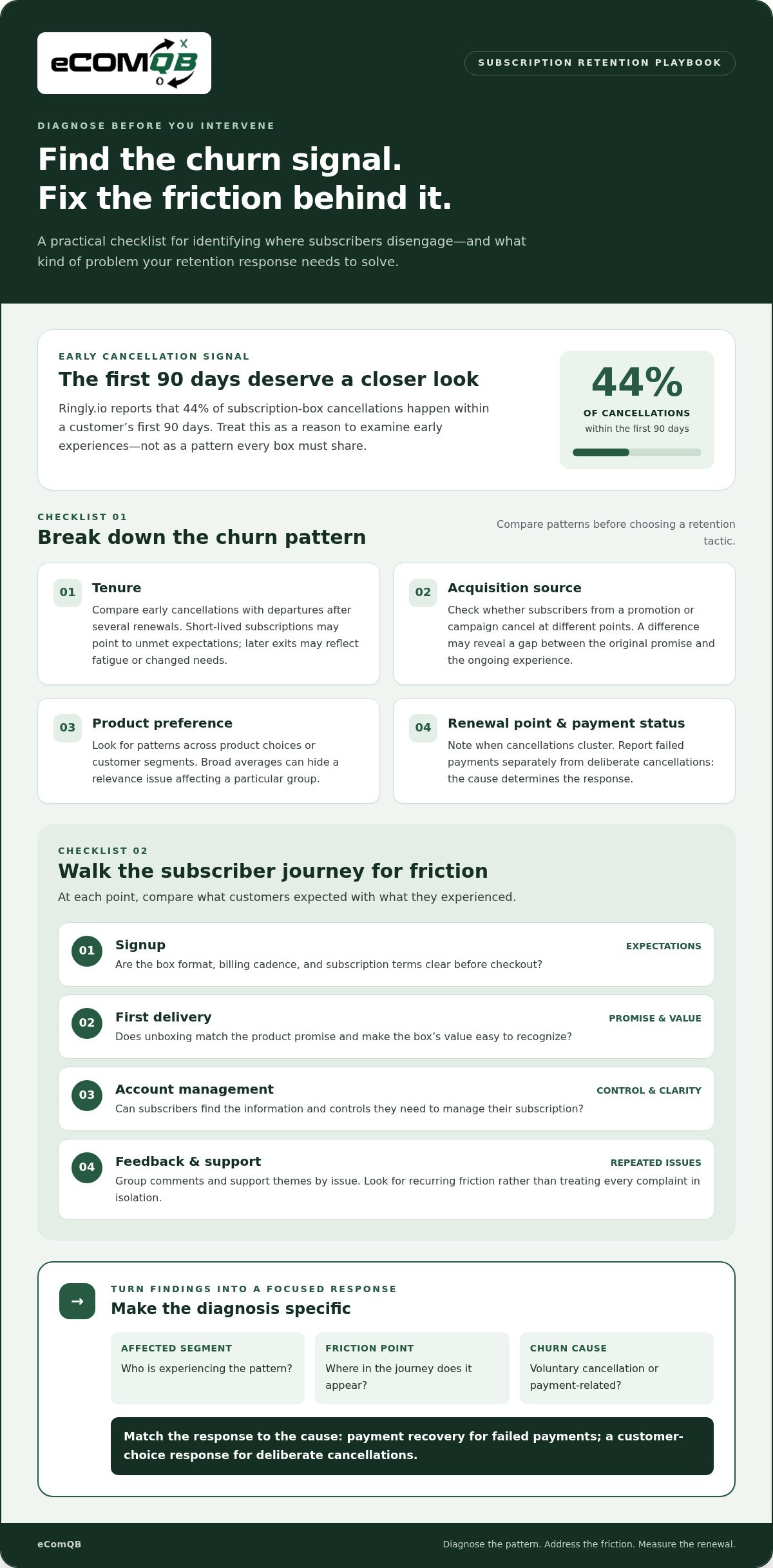
Break cancellations down by tenure, acquisition source, product preference, and renewal point. These views can show whether customers leave after the first delivery, after a particular billing cycle, or following a specific campaign. Ringly.io reports that 44% of subscription-box cancellations happen within the first 90 days. Use that as a reason to examine early experiences, not as an assumption that every box follows the same churn pattern.
- Tenure: Compare early cancellations with departures after several renewals. A short-lived subscription may point to unmet expectations; a later exit may reflect fatigue or changed needs.
- Acquisition source: Check whether subscribers from a promotion or campaign cancel at different points from other customers. A difference may signal a mismatch between the promise that attracted them and the ongoing experience.
- Product preference: Look for cancellation patterns across product choices or customer segments. A broad average can hide a relevance issue affecting a particular group.
- Renewal point and payment status: Note when cancellations cluster, and report failed payments separately from deliberate cancellations. One calls for a customer-choice response; the other calls for payment recovery.
How can a box experience create avoidable retention friction?
Review the complete subscriber path, from signup through first delivery and each renewal. At every step, compare what customers were led to expect with what they experienced. Check whether cadence, box contents, billing details, and account controls are easy to understand. Even small points of confusion can weaken confidence before a customer decides whether the next delivery is worthwhile.
- Signup: Are the box format, billing cadence, and subscription terms clear before checkout?
- First delivery: Does the unboxing experience match the product promise and make the box’s value easy to recognize?
- Account management: Can subscribers find the information and controls they need to manage their subscription?
- Feedback and support: Group customer comments and support themes by issue. Look for repeated friction rather than treating each complaint in isolation.
Turn those findings into a prioritized diagnosis: identify the affected segment, the point where friction appears, and whether the churn is voluntary or payment-related. That gives your next retention move a clear target.
How to build customer retention strategies across the subscription-box lifecycle
Once you’ve identified where subscribers disengage, turn that insight into a lifecycle plan. Strong customer retention strategies for subscription boxes aren’t a stack of disconnected emails. They’re a sequence of relevant actions, each tied to a customer stage, a friction point, and a clear next step.
Build the system in order. This keeps your team focused on solving the right problem before adding more campaigns.
- Map the stages. Outline the journey from signup and first delivery to repeat renewals, pauses, and cancellation. Mark the moments when customers need information or a useful prompt.
- Identify friction. Pair behavior with feedback. For example, if subscribers don’t engage with box content before renewal, investigate whether the contents feel relevant or whether the value is unclear.
- Select interventions. Choose an action that addresses the observed barrier. Use onboarding to clarify expectations, tailored content to reinforce relevance, or a timely reminder to make the next account step clear.
- Test and refine. Set a specific goal for each message or experience, then compare engagement and renewal behavior across comparable groups. Keep what supports the goal, revise what misses, and avoid changing several elements at once.
What should a subscription-box onboarding sequence accomplish?
Onboarding should confirm that the subscriber made a good choice and explain what happens next. Reinforce the reason they joined, set clear expectations for delivery cadence and billing, and show where to manage their account. Then use early signals, such as product details they explore or preferences they share, to shape a useful follow-up. If someone engages with a particular product category, connect that interest to the subscription experience instead of sending another generic welcome message.
How should renewal and between-box messages support retention?
Give each communication a job. A renewal message can make the upcoming charge and available account choices easy to understand. Between-box messages can help subscribers get more value from what they receive, explain a relevant feature, or invite them to update preferences. Use email or SMS based on permission, subscriber preference, and the purpose of the message. More sends don’t automatically create more engagement. The right content helps the customer take a meaningful next action.
Coordinate triggers with the subscription calendar so a message arrives when it can help, not simply because a campaign is scheduled. For deeper guidance on building responsive lifecycle flows, explore this agentic email marketing playbook. If your team needs to connect customer signals with messaging execution, discuss a lifecycle growth system tailored to your eCommerce goals.
How to compare subscription-box retention tactics before investing
A retention tactic is effective only when it addresses the reason a subscriber is considering leaving. Match the intervention to the diagnosed friction, then weigh its likely value against the cost, complexity, and customer experience trade-offs. A convenience fix won’t solve an irrelevant assortment. A discount may delay a cancellation without making the next box more appealing.
Use four decision filters: convenience removes effort, relevance improves perceived fit, flexibility gives subscribers more control, and communication clarifies what happens next. The best customer retention strategies for subscription boxes don’t apply every lever to every customer. They target the barrier and define a metric that can show whether the fix helped.
When should a brand offer flexibility instead of a discount?
Let customer feedback point to the friction. A subscriber who has too much product may benefit from skipping a cycle; someone who needs a temporary break may prefer a pause. A swap can address an assortment mismatch, while a plan change may better fit a different cadence or budget. Treat discounts as a deliberate test, not the automatic response to every cancellation signal.
How can personalized retention outperform generic campaigns?
Use signals customers have shared, along with relevant prior engagement. A message about a category they’ve shown interest in is more useful than a broad incentive sent to everyone. Keep personalization explainable, respectful of customer permissions, and tied to a clear next action. For ideas on shaping tailored storefront experiences, explore AI personalization for Shopify.
Compare options before committing resources. The table below connects common tactics to a likely use case, a trade-off to consider, and a practical measurement point. Choose metrics that fit your goal, and compare them with a suitable baseline.
| Tactic | Best-fit problem | Trade-off | Metric to monitor |
|---|---|---|---|
| Convenience improvements | Account tasks or subscription management feel difficult | Requires a clear, usable account experience | Completion of relevant account actions |
| Personalized content | Messages or product details feel generic | Depends on relevant data and appropriate permissions | Engagement with the targeted content |
| Pause or skip | Temporary timing or subscription fatigue | May defer a renewal rather than secure it immediately | Return to an active subscription |
| Swap or plan change | Assortment, cadence, or plan fit is off | Can add operational and choice complexity | Renewal after the change |
| Discount | Price is a stated cancellation concern | Can reduce margin and condition customers to wait for offers | Renewal and value after the offer |
Run a focused test: define the audience, the friction, and the outcome before launch. Track whether subscribers renew, return, or continue engaging, and consider the margin impact alongside retention. If you need to connect personalization, messaging, and customer signals into a coordinated approach, explore a managed eCommerce growth system.
How to measure and optimize customer retention strategies for subscription boxes
Good retention work needs a scorecard, not a collection of disconnected campaign metrics. Track whether subscribers renew, when they leave, and how their ongoing value changes. Define each measure before comparing results. For example, decide whether churn includes only deliberate cancellations or also failed payments, and report those causes separately. Consistent definitions make performance easier to interpret and give teams a reliable basis for action.
A retention metric only means something when its subscriber cohort and measurement window are clearly defined. A renewal rate for customers who joined in one month may not be comparable with a blended rate across every subscriber. Keep the audience, denominator, and time period visible in every report.
Which subscription retention metrics belong on a practical scorecard?
Start with a compact set of measures that connect subscriber behavior to business value. Set the rules once, document them, and use the same calculation over time. Customer retention strategies for subscription boxes become easier to optimize when the scorecard shows both the outcome and where the journey changes.
- Churn rate: Subscribers lost during a defined period divided by active subscribers at the period’s start. Separate voluntary cancellations from failed-payment churn.
- Renewal rate: Subscribers who renew among those eligible to renew in that window. Define how you handle pauses, skips, and payment recovery so the denominator stays consistent.
- Cohort retention: The share of a signup group still active at each renewal point. This exposes when drop-off concentrates, rather than blending new and long-standing subscribers together.
- Customer lifetime value: Estimate the value generated across a customer relationship using a consistent revenue or margin basis. Read it alongside acquisition activity and retention trends, not as a standalone win.
How should teams run useful retention experiments?
Write down the customer problem first, then state the behavior you expect to change. If subscribers appear uncertain before renewal, for example, test whether a clearer renewal message improves completed renewals. Where feasible, compare a group receiving the intervention with a similar group that doesn’t. Keep the audience, timing, and offer consistent enough to make the comparison useful.
Change one meaningful element at a time when practical. If you alter the message, audience, and incentive together, you won’t know which change influenced the result. Also account for timing: a cohort nearing renewal isn’t directly comparable with one early in its subscription. Avoid claiming causation from a small or uneven comparison. Treat results as evidence with limits, not proof beyond what the test supports.
Log each experiment in a simple record: the diagnosed problem, audience, intervention, measurement window, result, limitations, and next decision. Decide whether to keep, refine, or stop the tactic. That discipline turns campaign activity into a learning loop and helps teams allocate effort to changes tied to renewal and customer value. If you want to strengthen the measurement and execution behind your retention program, book a conversation about your eCommerce growth system.
Turn subscription-box retention into a managed eCommerce growth system
Retention gains stall when customer data sits in one system, messages run from another, and the storefront experience tells a different story. A managed growth system connects those moving parts. Customer retention strategies for subscription boxes work best when each customer signal can inform a relevant experience, and each experience can be measured against subscriber behavior.
Think of the system as a loop: collect meaningful customer signals, use them to shape the next interaction, then review the response. If a subscriber updates a preference, for example, that information should inform relevant messaging and the experience they see on the storefront. The aim isn’t to add more technology or campaigns. It’s to make each part support the same customer journey.
What does coordinated retention execution look like?
Start by connecting customer signals to a clear action. Lifecycle messages should reflect subscriber behavior, the product experience, and the point in the renewal cycle. Email and SMS execution can work alongside personalization, while measurement shows whether the combined experience supports the intended customer action.
- Signals: Bring useful preference and engagement data into a shared view of the customer.
- Experience: Align relevant storefront content and lifecycle communication with those signals.
- Learning: Review performance across the customer journey, then refine the workflow based on what the data shows.
Managed workflows can also reduce disconnected handoffs and repetitive manual tasks. That gives teams a clearer operating rhythm for planning, launching, and improving retention activity, while keeping customer relevance at the center.
When should a subscription brand bring in a growth partner?
Start with the bottleneck. If your team can’t identify where customers disengage, prioritize diagnosis and strategy. If the plan is clear but campaigns aren’t getting executed consistently, the gap may be capacity. If customer signals don’t flow between the storefront and marketing activity, technical integration may need attention.
eComQB supports eCommerce brands with AI transformation, agentic email and SMS marketing, AI-driven personalization, and Shopify development. These services connect strategic direction with marketing execution and the digital experience. For a wider view of how these capabilities fit together, explore the eCommerce AI growth system.
Name the constraint, identify the customer signals and systems involved, and decide what a better operating process must accomplish. Bring those priorities into a conversation about a tailored retention growth plan. Discuss your retention growth priorities.
Make retention your next growth priority
The next advantage comes from turning retention into an operating discipline, not a campaign you revisit only when renewals soften. Choose one subscriber group, one experience to improve, and one outcome to guide the next decision. That focus gives your team a practical starting point for building customer retention strategies for subscription boxes that can evolve with customer needs.
When the path forward calls for broader execution, eComQB brings together managed AI-powered eCommerce growth systems, agentic email and SMS marketing, AI-driven personalization, and Shopify development. The aim is to align strategy, technology, and customer experience around your growth priorities.
Book a growth strategy call to explore a plan shaped around your retention goals. Your next step can be clear, measurable, and built to move your business forward.
Frequently Asked Questions
What are the most effective customer retention strategies for subscription boxes?
The most effective strategies address a specific subscriber need and make the next step easier. For example, a box with interchangeable items could let customers update a preference before the next renewal, while a hobby-focused box could send a short guide that helps subscribers use what they received. Track the response among customers who experienced the change, then check whether the improvement holds beyond a single billing cycle.
How can subscription boxes reduce customer churn?
Subscription boxes can reduce churn by removing avoidable reasons to leave and resolving payment issues before a subscription lapses. Review cancellation feedback alongside account activity to spot issues such as repeated preference changes or confusion about upcoming charges. If failed payments are a factor, evaluate the payment recovery process separately from cancellation messaging. That separation helps teams address the right problem without sending an unwanted retention offer to a customer who simply needs to update payment details.
Should subscription-box brands offer discounts to prevent cancellations?
Use discounts selectively, and judge them by more than immediate save rates. A discount may help a subscriber who says price is the obstacle, but it can unnecessarily reduce margin for someone who needs a different cadence or assortment. Compare the offer with a non-discount option, such as a plan adjustment, and monitor what happens after the incentive ends. If the customer cancels at the next renewal, the discount likely postponed the decision rather than improving fit.
How often should a subscription box send retention emails or text messages?
Set message timing around useful customer moments, not a fixed quota of sends. A subscriber might need a welcome message after signup, a practical product tip after delivery, and a clear notice before an account decision is due. Use the channel that suits the message and the subscriber’s stated preference. Review unsubscribes and complaints alongside clicks and renewals; strong engagement on one message doesn’t justify a cadence that customers find intrusive.
Which metrics should subscription-box businesses track for customer retention?
Track churn, renewals, cohort retention, and customer lifetime value, but keep their definitions stable. Add a practical diagnostic measure, such as the share of cancellation feedback tied to a recurring issue, to help explain movement in the headline metrics. Break results out by tenure or acquisition source when the sample is large and consistent enough to be useful. A small, uneven group can point to a question worth investigating, but not a firm conclusion.
Can personalization improve subscription-box retention?
Personalization can strengthen retention when it makes a customer’s next interaction more useful. For example, a subscriber who has selected a particular interest could receive content related to that preference rather than a general product roundup. Keep the experience transparent and based on information customers have shared or permitted the brand to use. Then evaluate whether the tailored interaction improves a meaningful action, such as product engagement or renewal, for the intended audience.