Agentic Email Marketing for eCommerce: Engineering the 2026 Revenue Machine

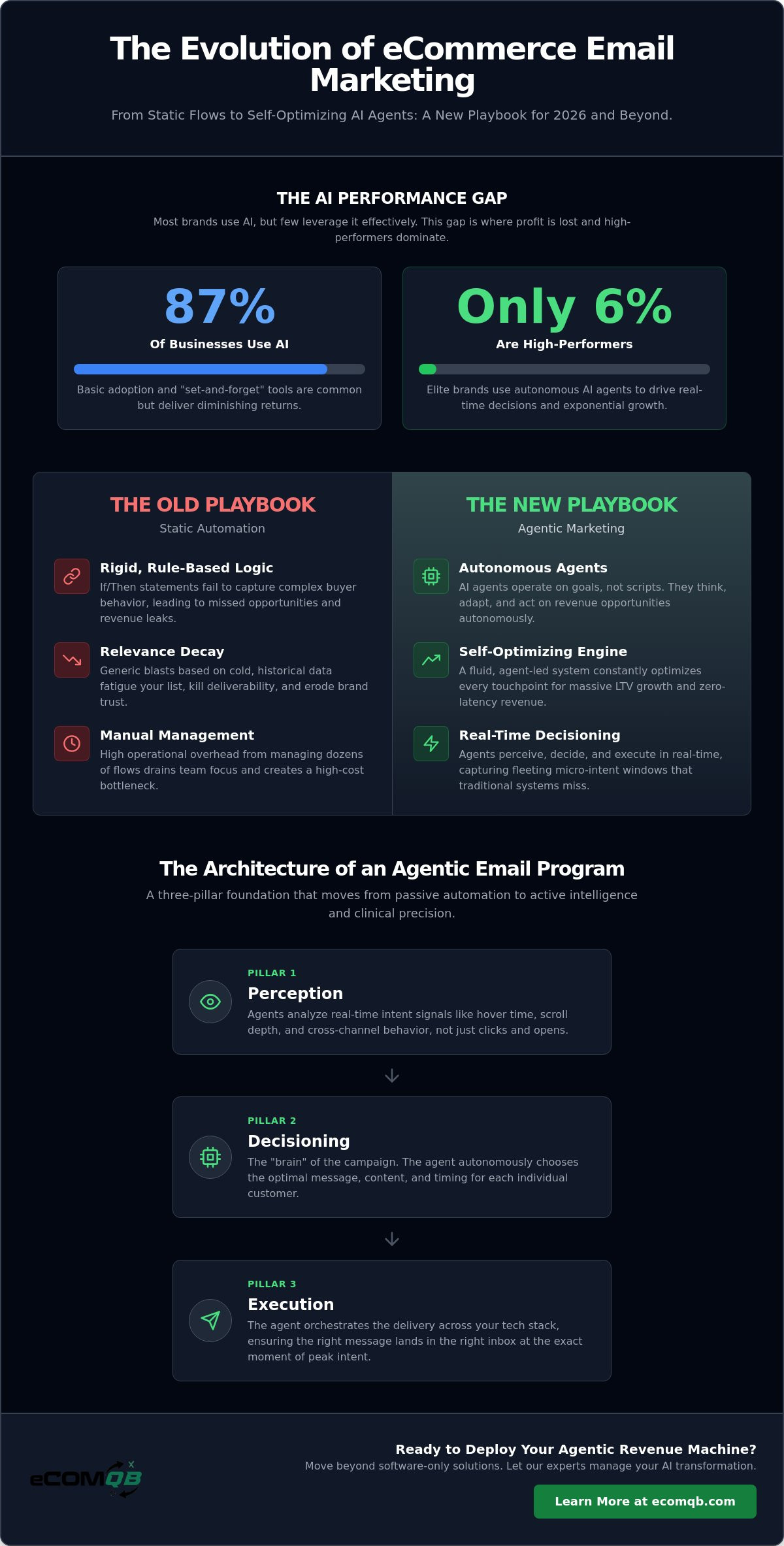
Your current email flows are leaking profit every second they remain static. While 87% of businesses have integrated some form of AI, only 6% are actually high performers using it to dominate their niche. Most eCommerce brands are trapped by rigid rules, manual management, and relevance decay that fatigues their lists. The era of "set it and forget it" is dead. To break through your current revenue plateau, you must transition to agentic email marketing for ecommerce. This isn't just another software update. It's a strategic shift toward autonomous systems that think, adapt, and execute at the speed of your customers.
You know that manual campaign management is a high-cost bottleneck that limits your scale. We agree that the traditional playbook is failing to capture the full potential of your data. This guide will show you how to engineer a 2026 revenue machine using AI agents that deliver zero-latency revenue and massive LTV growth. We'll explore the mechanics of fully managed retention systems that optimize every touchpoint without adding a single person to your headcount. Get ready to move from static flows to a self-optimizing profit engine that identifies, targets, and converts with clinical precision.
Key Takeaways
- Stop the revenue leaks caused by static flows. Learn why "set and forget" automation fails to capture shifting buyer intent and kills deliverability.
- Transition to agentic email marketing for ecommerce. Replace rigid rules with autonomous agents that perceive, decide, and execute in real-time.
- Build a high-performance architecture using Unified Customer Profiles. Create a seamless bridge between your AI agents and your Shopify store data.
- Follow a strategic roadmap to audit inefficiencies and deploy pilot agents. Focus on high-impact lifecycle stages to drive zero-latency revenue and exponential LTV.
- Move beyond software-only solutions. Partner with experts to manage your AI transformation and scale your retention systems without increasing headcount.
Beyond Flows: Why Traditional eCommerce Email Automation is Leaking Revenue
Traditional email automation is no longer a strategic asset; it's a structural liability. For years, 8-figure brands have relied on "set-and-forget" flows, operating under the delusion that a static abandoned cart sequence or a standard welcome series is sufficient. It isn't. Static flows are built on historical data that grows cold within minutes. They fail to capture the fluid, high-velocity intent of the modern buyer. When your system relies on rigid rules, you aren't marketing; you're guessing. This gap between customer expectation and brand execution is where your revenue disappears.
The shift to agentic email marketing for ecommerce represents a fundamental move from human-led campaign calendars to autonomous revenue generation. Humans are slow. We sleep. We deliberate. Agents, however, identify, analyze, and act on revenue opportunities in real-time. If your current tech stack is anchored in manual segmentation, you are leaking profit through every untriggered intent signal. You are playing a high-stakes game with a low-resolution playbook.
The Limits of Rule-Based Logic
Rule-based logic is a relic of a slower era. Simple If/Then statements are too binary to map the complexity of 2026 consumer behavior. A customer doesn't just "abandon a cart"; they research, compare, and hesitate across multiple devices and sessions. Manual A/B testing is a tactical failure in this environment. By the time you identify a "winner," the market has already moved, and the data is obsolete. Managing 50 or more individual flows creates massive operational overhead that drains your team's focus. You need precision, momentum, and results, not more manual labor.
The Relevance Decay Problem
Relevance decay is the silent killer of your brand's deliverability. When you blast generic "win-back" sequences to disengaged users, you aren't recovering them; you're accelerating list churn. Gmail and Yahoo now enforce strict engagement standards that punish irrelevant senders. Sending a "Best Sellers" email to a VIP customer who only buys specific, high-ticket niche items is a signal of incompetence. It tells the customer you don't know them. The cost of missing real-time intent signals is high. Every irrelevant email sent is a withdrawal from your brand's trust bank and a direct hit to your long-term value. You cannot scale a brand on 2018 tactics in a 2026 economy.
What is Agentic Email Marketing? The Shift from Rules to Autonomous Decisioning
Agentic email marketing for ecommerce is the definitive departure from passive automation toward active intelligence. It's the difference between a pre-programmed robot and a tactical partner. Traditional systems follow a script. Agents follow a goal. This technology uses autonomous AI agents to decide who receives a message, what the content should be, and exactly when it should land in the inbox. It doesn't ask for permission; it executes based on live data. This is the cornerstone of a managed AI growth system that prioritizes performance over process.
To master this shift, you must understand the hierarchy of your AI stack. Decisioning agents focus on the "what" and "why," while orchestration agents handle the "how" across your various tools. Together, they form a three-pillar foundation: Perception, Decisioning, and Execution. This structure ensures that your marketing isn't just fast; it's precise. It's about moving from a rigid campaign calendar to a fluid, agent-led revenue engine that never misses a beat.
Perception: Reading Real-Time Intent
Modern agents go far beyond tracking simple clicks or opens. They analyze hover time, scroll depth, and cross-channel signals to build a high-fidelity map of customer interest. By utilizing vector databases, these agents understand the semantic "why" behind every action. They identify micro-intent windows, those fleeting moments where a user is most likely to convert, which traditional platforms completely miss. It's about seeing the field before the play even starts and reacting before the opportunity vanishes.
Decisioning: The Brain of the Campaign
Once an agent perceives intent, it enters the decisioning phase. It chooses the optimal angle for the individual. Does this customer need social proof, a scarcity trigger, or educational content? The agent decides in milliseconds. It also manages dynamic frequency capping. This ensures you don't burn out your list by over-saturating a user who isn't ready to buy. If you're interested in evaluating your technical readiness for this level of autonomy, you need to look at your data infrastructure today.
This intelligence extends to autonomous budget and channel allocation. The agent determines whether a message should go via SMS or Email based on the highest probability of zero-latency revenue. It's a self-correcting loop that maximizes every touchpoint. You aren't just sending emails; you're deploying a fleet of digital experts to manage your customer relationships. This isn't just a new tool. It's a total reimagining of your revenue machine for the 2026 economy.
The Architecture of an Agentic Email Program: Data, MCPs, and Feedback Loops
High-performance agents require a foundation of absolute data integrity. You cannot engineer an 8-figure revenue machine using fragmented silos or stale spreadsheets. Unified Customer Profiles (UCPs) are the prerequisite for any system aiming for strategic mastery. These profiles provide the ground truth. They aggregate every touchpoint, purchase, and preference into a single, actionable record. Without this unified layer, your AI is flying blind; with it, your agent possesses the tactical clarity needed to dominate the inbox.
The Model Context Protocol (MCP) serves as the critical bridge in this architecture. It connects your autonomous agents directly to your Shopify store, providing them with "eyes" into your operational reality. Through MCP, an agent queries live inventory levels, tracks real-time order statuses, and analyzes historical customer behavior. This transforms the agent from a simple messaging tool into a tactical operator with full situational awareness. It enables zero-latency revenue by reducing the gap between a data signal and a personalized email send to mere milliseconds.
Building the Agentic-Ready Data Layer
Fragmented data stacks are more than just an inconvenience; they are revenue leaks. They amplify bad AI decisions by providing incomplete context. To succeed with agentic email marketing for ecommerce, you must implement a real-time event stream. This stream allows for agentic perception, capturing intent as it happens. Identity resolution is equally non-negotiable. You must track the customer journey across every device to ensure your agents maintain a coherent strategy. If your data is broken, your revenue machine will stall before it starts.
The Feedback Loop Mechanism
Agents operate with programmatic control, moving beyond the limitations of manual tagging. They autonomously update subscriber tags based on engagement or the lack thereof. If a user ignores three consecutive "social proof" angles, the agent doesn't just try a fourth. It adjusts its playbook. It analyzes the "no-click" data to refine its future strategy, switching perhaps to a direct utility or scarcity approach. The feedback loop is a self-correcting revenue mechanism that ensures your strategy improves with every interaction. This constant refinement creates a compounding effect on your LTV. You aren't just sending emails; you're running a system that learns how to win. It's about precision, momentum, and results.
Transitioning to Agentic Workflows: A Strategic Execution Roadmap
Execution is the only differentiator. You've seen the architecture; now you need the deployment sequence. Transitioning to agentic email marketing for ecommerce requires a phased approach that prioritizes immediate profit over theoretical perfection. You don't rebuild your entire system in a vacuum. You audit, pilot, integrate, and scale. This is how you move from a stagnant automation stack to a high-velocity revenue engine that adapts in real-time. It's about precision, momentum, and results.
Your first move is a tactical audit. You must identify the specific "cracks" where your current welcome sequence stops converting. Most brands suffer from a massive delta between their current LTV and the performance of category leaders. You need to bridge this gap by evaluating your infrastructure for compatibility. This includes ensuring your Shopify design can support agentic landing pages that dynamically adjust based on the email's intent signal. If your storefront is static, your email performance will be capped.
Phase 1: The Tactical Audit
Success starts with identifying the friction points. We look for revenue leaks in your existing flows where intent signals are ignored. Are you sending the same follow-up to a casual browser as you are to a high-intent cart abandoner? If so, you're losing money every hour. We analyze your store's technical readiness, ensuring your data layer is clean, accessible, and structured for autonomous perception. This isn't just about finding problems; it's about preparing the field for a strategic takeover. You need to know exactly where the leaks are before you can plug them with AI.
Phase 2: Connecting the Growth System
An agentic email program doesn't exist in isolation. It is a vital component of a larger, managed ecosystem. By feeding email engagement data back into your Meta and Google ad algorithms, you create a self-reinforcing loop. This integration with your agentic media buying strategy significantly lowers your CAC. It increases the efficiency of your retargeting spend by ensuring your ads and emails speak the same language. Using AI for Shopify personalization, you deliver a seamless store-to-inbox experience that eliminates friction and accelerates the purchase decision.
Once your pilot agent, typically focused on a high-impact stage like Post-Purchase, proves its ROAS, you scale. You expand autonomy across the full customer lifecycle. You move from manual oversight to strategic leadership. If you're ready to stop managing flows and start engineering growth, book a call to audit your retention roadmap. The 2026 revenue machine doesn't build itself; it requires a tactical partner who understands the mechanics of scale.
Deploying the Agentic Revenue Machine with eComQB
Software alone is not a strategy. In the high-stakes environment of 2026, simply purchasing a tool and expecting exponential growth is a tactical error. True competitive advantage comes from managed AI transformation. This is where agentic email marketing for ecommerce moves from a technical concept to a dominant revenue driver. At eComQB, we don't just provide access to technology; we provide strategic mastery. We function as your tactical partner, ensuring that your autonomous systems are aligned with your brand's specific growth trajectory. This is about precision, momentum, and results.
The ultimate objective is to reclaim your strategic time. While our agents execute high-stakes growth maneuvers in the background, you are free to lead. We move your focus away from the operational weeds and toward the big picture. This shift is reflected in your metrics. We are moving the needle from vanity indicators like "Open Rates" to the only KPI that matters: Profit Margin Optimization. By engineering a system that prioritizes high-margin conversions and zero-latency revenue, we ensure your brand doesn't just grow; it scales with clinical efficiency.
The Field General Advantage
We understand the technical complexities of vector databases, MCP integrations, and real-time event streams so you don't have to. Our "Revenue Generating AI Tools" are curated specifically for 8-figure velocity. We act as the field general for your digital operations, overseeing the mechanics of growth while remaining focused on the ultimate objective. You get the power of a fully managed eCommerce growth system without the overhead of a massive internal team. We identify the levers, pull the triggers, and deliver the results. It's a specialized playbook designed for winners.
Next Steps for High-Velocity Brands
The window for early adoption is closing. Brands that continue to rely on human-led campaign calendars will be outpaced by those utilizing autonomous execution. You have a choice: stay trapped in the cycle of manual flow management or start leading a revenue machine. At eComQB, we integrate your core eCommerce brand strategy with agentic execution to create a seamless, self-optimizing ecosystem. We handle the AI transformation so you can handle the scale. The path to 2026 dominance starts with a single decisive move.
Schedule your AI Transformation Briefing with eComQB to see how we can engineer your brand's next phase of growth. Stop guessing and start executing with the precision of a market leader.
Command the Future of eCommerce Revenue
The window for maintaining a competitive edge with legacy automation is closing. You've seen how static flows leak revenue and why autonomous decisioning is the only path to zero-latency growth. Mastering agentic email marketing for ecommerce isn't just about adopting new tech. It's about shifting your entire strategy toward peak performance. By integrating unified data with real-time feedback loops, you transform your retention system into a self-optimizing profit engine that never sleeps.
Scaling an 8-figure brand requires more than just tools. It requires tactical mastery and specialized execution. eComQB provides the field general advantage through fully managed AI growth systems, proven agentic media buying, and specialized Shopify development for agentic landing pages. We handle the technical complexities so you can focus on leading your brand to its ultimate objective. Stop managing stagnant flows. Start engineering a machine that wins.
Deploy your Agentic Revenue Machine with eComQB
The 2026 economy rewards the decisive. Your next move determines your trajectory. Let's get to work.
Frequently Asked Questions
Is agentic email marketing just another name for AI-generated copy?
No, it's a fundamental shift from content generation to autonomous execution. While these systems can write copy, their primary value lies in decisioning. An agent decides who receives a message, which tactical angle to use, and when to trigger the send. You're moving from a basic writing tool to a digital operator that manages your entire revenue strategy.
How does an AI agent decide when to send an email vs. an SMS?
Agents analyze real-time engagement data and historical channel preferences to calculate the highest probability of conversion. If a user consistently ignores emails but clicks SMS links, the agent prioritizes the mobile channel. This dynamic allocation ensures you don't waste touchpoints. It's about maximizing every interaction for zero-latency revenue without burning out your list.
Can agentic email marketing work with my existing Shopify store?
Yes, agentic systems integrate directly with your Shopify store through Model Context Protocol and secure APIs. This connection allows agents to see inventory levels, order history, and customer behavior in real-time. You don't need to rebuild your store. You simply layer the agentic intelligence over your existing data to start engineering your 2026 revenue machine.
What is the difference between a traditional drip campaign and an agentic workflow?
Traditional drip campaigns follow a rigid, linear script that ignores shifting buyer intent. Agentic workflows are non-linear and goal-oriented. An agent perceives a signal, decides on the best move, and executes. It doesn't wait for a pre-set three-day delay if the intent is hot. It adapts the playbook in milliseconds to capture the conversion.
How do agents maintain my brand voice without human supervision?
Agents utilize vectorized brand guidelines and semantic guardrails to stay within your specific tone profile. By training on your historical content and strategic playbook, the agent understands the nuances of your voice. It doesn't guess. It operates within a defined framework to ensure consistency across thousands of unique touchpoints without requiring manual oversight.
What kind of data infrastructure do I need to start with agentic marketing?
You need a clean, unified data layer to succeed with agentic email marketing for ecommerce. This requires Unified Customer Profiles and a real-time event stream that captures user actions as they happen. Without this high-fidelity data, the agent lacks the perception needed to make accurate decisions. Your infrastructure must be built for situational awareness, not just storage.
How does agentic email marketing affect my deliverability and sender reputation?
It significantly improves your reputation by eliminating the "blast" mentality that causes list fatigue. Agents only send messages when there's a high probability of relevance. This aligns with the strict engagement standards enforced by Gmail and Yahoo. By increasing engagement rates and reducing unsubscribes, you protect your domain's health while maximizing profit margins.
Can agentic AI help reduce my Customer Acquisition Cost (CAC)?
Yes, agentic AI lowers CAC by making your retargeting and retention systems far more efficient. When your email agents feed engagement data back to your media buying agents, your ad spend becomes laser-focused. You stop overpaying to acquire customers who would have converted through a well-timed, autonomous email. It's a self-reinforcing loop that drives down costs and scales LTV.