Managed AI for Enterprise eCommerce: Engineering 8-Figure Velocity in 2026

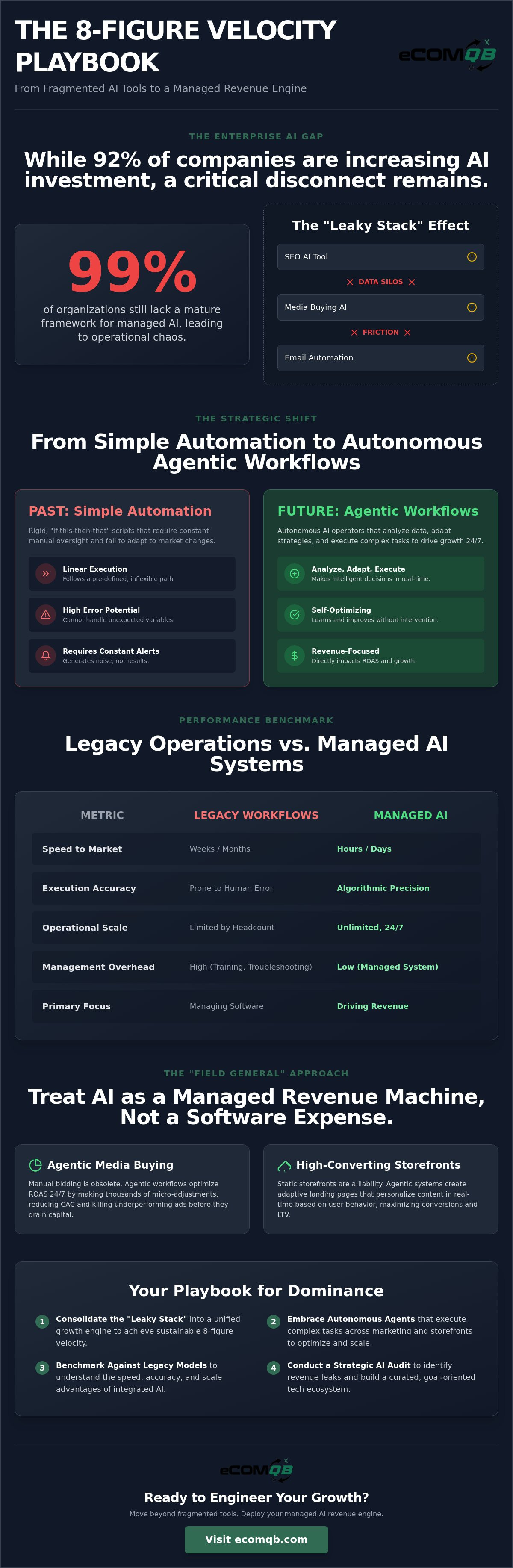
While 92% of companies are aggressively increasing their AI investments, a staggering 99% of organizations still lack a mature framework for managed AI for enterprise ecommerce. You likely feel this friction every day. Managing a disjointed stack of AI tools creates more operational overhead than it solves. It leaves your data fragmented, your team exhausted, and your speed to market stalled. You aren't looking for more software to manage; you're looking for a decisive competitive advantage that delivers results.
It's time to transition from fragmented tools to a system built for scale. Mastering this shift is the only way to engineer 8-figure velocity in a market that moves at the speed of light. This guide provides the strategic playbook for moving past simple AI assistants toward fully automated, agentic workflows. We will explore how to consolidate your tech stack, eliminate legacy friction, and build a predictable engine for revenue growth. Learn to orchestrate a system that optimizes, executes, and scales with total precision.
Key Takeaways
- Move beyond the "Leaky Stack" by consolidating fragmented tools into a unified growth engine. Learn why managed AI for enterprise ecommerce is the only path to sustainable 8-figure velocity.
- Transition from simple automation to autonomous agentic workflows. Discover how AI operators execute complex tasks across your storefront and marketing channels to optimize, execute, and dominate.
- Benchmark your operations against legacy models. Understand why traditional manual workflows fail to match the speed, accuracy, and scale of integrated AI systems.
- Identify revenue leaks through a strategic AI audit. Build a curated ecosystem of tools tailored to your specific enterprise goals and operational requirements.
- Leverage a field general approach to strategic growth. Position your brand for dominance by treating AI as a managed revenue machine rather than a software expense.
Beyond the Hype: Why Enterprise eCommerce Requires Managed AI Systems
The digital economy doesn't reward participation. It rewards dominance. As we move into 2026, the shift to managed AI for enterprise ecommerce is the pivot from buying software to deploying a revenue engine. Most organizations are currently trapped in the "Leaky Stack" phase. They have a collection of fragmented, disconnected tools that fail to communicate. This creates friction, silos data, and leaves millions in potential revenue on the table. Legacy enterprise systems were never designed for the speed of autonomous processing.
Operational velocity is the only metric that matters. While your competitors struggle with the steep learning curves of self-serve platforms, a managed growth system provides immediate, high-performance execution. This isn't about simple automation or basic chatbots. It's about aggressive scaling. It's about a revenue-first mentality that prioritizes results, precision, and momentum over manual process. You don't need more tools to manage; you need a system that manages the work for you.
The Failure of the Fragmented Tool Approach
Tool sprawl is the silent killer of enterprise agility. When you stack disparate AI solutions for SEO, email marketing, and media buying, you create a massive layer of management complexity. Your team ends up spending more time troubleshooting integrations than driving growth. The hidden costs of training in-house staff on a rapidly shifting AI landscape are immense. These resources are better spent on high-level strategy rather than technical maintenance. Managed AI is a strategic partnership that eliminates operational friction.
Managed AI as a Competitive Moat
In 2026, your competitive moat isn't just your product catalog. It's your proprietary AI playbook. A managed system ensures total data integrity between your Shopify storefront and your enterprise ERP, creating a seamless flow of intelligence. This foundation powers agentic commerce systems that handle autonomous decision-making at a scale no human team can match. Strategic mastery requires a field general approach. You need a partner who understands the technical terrain but remains focused on the ultimate objective: total market dominance. This managed approach is designed to be lean, fast, and relentless.
The Architecture of Velocity: Curated Tech Stacks and Agentic Workflows
Velocity isn't a happy accident. It's an engineered outcome. To hit 8-figure milestones in 2026, your infrastructure must be leaner, faster, and smarter than the competition. This requires a transition from a collection of "cool tools" to a curated technology stack. Managed AI for enterprise ecommerce ensures that every component of your ecosystem integrates seamlessly with Shopify and your backend ERP. You don't need more data points. You need a system that translates data into decisive action without human intervention.
The core of this architecture is the shift from automation to autonomy. Standard "if-this-then-that" workflows are too rigid for the modern market. Agentic workflows move beyond these limitations by functioning as autonomous operators. These systems don't just follow a script. They analyze, adapt, and execute. While 84% of organizations are currently piloting AI tools, only 12% have deployed the autonomous systems required for true market dominance. Precision wins. Speed scales. Results follow.
Agentic Media Buying and Performance Marketing
Manual bidding is dead. The algorithms governing Meta and Google move at a pace no human media buyer can match. Agentic workflows optimize your ROAS 24/7 by making thousands of micro-adjustments every hour. This level of agentic media buying reduces your CAC through relentless algorithmic targeting mastery. It identifies high-intent segments, allocates budget to winning creatives, and kills underperforming ads before they drain your capital. You aren't just buying traffic. You're orchestrating a high-performance revenue machine.
Engineering High-Converting Storefronts
Static storefronts are a relic of the past. High-velocity brands now deploy agentic landing pages that adapt in real-time to user behavior. These pages don't just show products. They curate, personalize, and convert. By integrating your brand strategy with technical AI execution, you create a seamless customer experience that feels intuitive rather than forced. This Shopify excellence ensures your storefront is optimized for the AI-driven traffic your media buying generates. If your current stack feels fragmented, it might be time to audit your infrastructure with a tactical partner.
Predictability is the ultimate luxury in ecommerce. When your tech stack is curated and your workflows are agentic, growth becomes a mathematical certainty. You eliminate the guesswork that plagues legacy brands. You replace hesitation with momentum. By 2026, agentic AI is predicted to power 75% of enterprise e-commerce. Positioning your brand within that elite 12% of autonomous adopters is the only way to protect your margins and engineer 8-figure velocity.
Strategic Dominance: Managed AI vs. Legacy Agency Performance
The billable hour is a relic of a slower era. In 2026, the gap between human-led execution and autonomous systems has become an unbridgeable chasm. Legacy agencies are built on manual workflows, bloated account teams, and reactive strategies. They are fundamentally incentivized to move slowly. Managed AI for enterprise ecommerce flips this model by prioritizing outcomes over hours. While a traditional agency might take weeks to iterate on a creative campaign, a managed system executes, analyzes, and optimizes in seconds. This isn't just an improvement in efficiency. It's a complete reimagining of what it means to scale.
Performance metrics tell the real story. Brands that successfully integrate AI across the value chain have seen a 30% increase in customer lifetime value (CLV). This level of growth is impossible to achieve through manual tinkering. Managed systems deliver a cost-to-velocity ratio that renders traditional headcount expansion obsolete. You don't need a larger team; you need a more powerful engine. By shifting to a managed growth model, you move from a vendor relationship to a strategic partnership. This is the coach-to-leader dynamic where your partner functions as a tactical field general, orchestrating complex moves while you maintain the bird's-eye view of your empire.
Managed AI vs. In-House Teams
The talent war is real. Hiring and retaining top-tier AI engineers is a massive operational burden that distracts from your core mission. Even if you secure the talent, 99% of organizations still lack a mature framework for full integration. Managed AI for enterprise ecommerce serves as an immediate extension of your leadership team. It provides the technical infrastructure and strategic mastery required to win without the overhead of a massive in-house department. You reclaim your most valuable asset: strategic time. Let the AI handle the "how" of execution so you can focus on the "what" of your brand's future.
The ROI of Managed AI Systems
Velocity is the ultimate multiplier. Faster execution doesn't just mean more tasks completed; it means capturing market share before your competitors even identify the opportunity. 95% of retailers report that AI implementation is actively helping to decrease annual operating costs. This efficiency isn't just about saving money. It's about reinvesting that capital into aggressive scaling. The ROI of managed AI is the intersection of reduced overhead and increased revenue velocity. When you eliminate the friction of manual processes, your profit margins naturally expand. You aren't just running a business. You're engineering a high-performance revenue machine that operates with total precision and relentless momentum.
Implementing the Blueprint: From Fragmented Tools to Integrated Revenue Systems
Execution is where strategy meets reality. To move toward managed AI for enterprise ecommerce, you must first dismantle the silos. Start with a comprehensive AI audit. This isn't a superficial check; it's a deep dive into your data architecture. We identify where revenue is leaking through the gaps in your legacy stack. We map exactly how data flows from your Shopify storefront to your CRM and marketing platforms to ensure zero loss of intelligence. Precision in the audit phase ensures speed in the deployment phase.
Once the leaks are plugged, we move to stack curation. This is about building a bespoke ecosystem. You don't need a generic suite. You need a precision-engineered selection of tools that align with your specific 8-figure objectives. We phase in autonomous workflows across media buying, email, and SMS to create a unified front. It's a managed cycle of testing, learning, and scaling that never stops. We prioritize high-impact levers that generate immediate revenue while building the foundation for long-term strategic dominance.
The Audit and Strategy Phase
Success requires a clear growth playbook. We start by mapping your data flows to ensure your Shopify backend communicates perfectly with your CRM and marketing platforms. This visibility allows us to identify the critical levers for immediate revenue generation. We then set the 2026 growth playbook, establishing clear KPIs, milestones, and objectives. You need a roadmap that prioritizes momentum. We provide the technical clarity and strategic direction to ensure every move is calculated and every dollar is optimized.
Deploying Agentic Retention Strategies
Retention is the backbone of scaling. By implementing agentic email marketing, you achieve zero-latency revenue. These systems don't wait for a human to hit send. They use predictive analytics to engage customers at the exact moment of highest intent. This level of AI-driven personalization maximizes lifetime value (LTV) and protects your margins. You move from broad blasts to individualized experiences that scale automatically. If you're ready to stop managing tools and start engineering growth, book a call to initiate your strategic AI audit.
The transition to agentic deployment is about reclaiming your market position. You replace reactive maintenance with proactive scaling. As your email and SMS workflows become autonomous, your team is freed to focus on high-level brand strategy. This is how you build a resilient, high-velocity revenue engine. You don't just participate in the market. You own it through systemic efficiency and relentless optimization.
Partnering for Performance: The eComQB Managed AI Growth Model
Strategic dominance requires more than just access to technology. It requires the mastery to deploy it. At eComQB, we don't just provide software; we build revenue machines. Choosing managed AI for enterprise ecommerce means you're no longer responsible for the technical heavy lifting. We act as your field general, orchestrating every move with precision and momentum. You provide the vision. We provide the execution. This partnership is designed to turn fragmented data into a unified engine for 8-figure scaling.
Enterprise brands trust eComQB because we understand the mechanics of growth. We move past the surface-level hype of basic automation. Our focus is on performance metrics, data-driven insights, and systemic optimization. We don't just automate tasks; we engineer outcomes. By 2026, the gap between brands that use AI and brands that are powered by AI will be insurmountable. We ensure you're on the right side of that divide. You've seen the blueprint. Now you need the execution.
The eComQB Advantage
We manage the complexity so you can focus on leadership. Our approach centers on curated tech stacks that integrate directly with your Shopify backend. We select, deploy, and optimize revenue-generating AI tools that deliver immediate ROI. This isn't a generic solution. It's a bespoke system built for your specific enterprise goals. You don't need a vendor; you need a tactical partner who understands the high-stakes nature of your business. For a deeper look at our full strategic framework, explore The eCommerce AI Growth System.
Join the High-Velocity Brands
High-velocity brands don't leave growth to chance. They use a proven roadmap to achieve market dominance. Our success models show that moving from manual workflows to a managed AI for enterprise ecommerce model can unlock unprecedented scaling. We provide the 2026 Strategic Playbook that details your path to 8-figure revenue. Precision wins. Speed scales. Results follow. Your next move is simple. You can continue managing tools, or you can start managing growth. Deploy your Revenue Machine with eComQB and take control of your trajectory today.
Orchestrate Your 8-Figure Future
The transition to 2026 demands a total rejection of fragmented, manual workflows. You've seen the blueprint for shifting from tool-overload to a precision-engineered growth engine. By deploying managed AI for enterprise ecommerce, you eliminate the operational friction that stalls legacy brands. You replace hesitation with momentum, silos with integration, and guesswork with algorithmic certainty. This is the path to predictable scaling through fully automated agentic workflows and strategic mastery for Shopify Plus.
Strategic dominance is no longer about who has the most tools; it's about who has the best system. From agentic media buying performance to zero-latency retention, the mechanics of growth are now autonomous. You have the vision to lead. We have the tactical expertise to execute. It's time to stop managing software and start engineering 8-figure velocity. Your market position is waiting to be claimed.
Engineering 8-Figure Velocity: Deploy Your Managed AI System
The digital economy moves fast, but your brand can move faster. Take the lead today.
Frequently Asked Questions
What is the difference between AI tools and a managed AI growth system?
AI tools are isolated point solutions that require manual oversight and constant management. A managed AI growth system is a unified architecture that orchestrates multiple autonomous agents to drive revenue. It moves your organization from "using" technology to "deploying" a strategic engine that operates 24/7 without human intervention. This systemic approach ensures that every part of your stack communicates to eliminate the "Leaky Stack" problem.
How does managed AI for enterprise ecommerce integrate with Shopify Plus?
Managed AI for enterprise ecommerce integrates with Shopify Plus by syncing directly with your storefront, checkout, and backend ERP via secure APIs. It optimizes product discovery, dynamic pricing, and fulfillment in real-time. This integration creates a high-velocity feedback loop where your store data informs every autonomous decision across your marketing channels, ensuring your infrastructure is built for scale.
Can managed AI replace my current digital marketing agency?
Managed systems often render traditional agency models obsolete by prioritizing outcomes over billable hours. Legacy agencies rely on manual execution and bloated account teams, which are too slow for the 2026 digital economy. Managed AI provides the speed, precision, and algorithmic mastery that human-led teams cannot match. It shifts your focus from managing people to managing high-performance revenue machines.
What are the security risks of implementing enterprise-wide AI systems?
Security in 2026 requires strict adherence to the EU AI Act and state-level regulations like Illinois HB 3773. Implementing enterprise AI involves managing "Token Economics" and ensuring documented training data for synthetic content to maintain compliance. We prioritize a robust governance framework to mitigate risks like biased recommendations, pricing errors, or unauthorized data access, ensuring your brand remains protected and compliant.
How quickly can we see ROI from a managed AI transformation?
Efficiency gains are typically visible within the first 30 days of deployment as autonomous agents take over manual tasks. Operational cost reduction occurs immediately by eliminating the overhead of managing fragmented tools. Full revenue scaling to 8-figure velocity builds momentum as the system optimizes your specific data sets and refines its predictive models over the first fiscal quarter of integration.
What is agentic media buying and how does it improve ROAS?
Agentic media buying uses autonomous agents to manage bids, creatives, and audiences across Meta and Google advertising platforms. Unlike standard automation, these agents make independent decisions based on real-time performance metrics and market shifts. This relentless optimization reduces your CAC and maximizes ROAS by identifying winning variables and reallocating budget faster than any human media buyer could possibly react.
Does managed AI require me to change my entire technology stack?
You don't need to scrap your existing infrastructure to achieve high-velocity growth. Managed AI is designed to curate and layer on top of your current stack, connecting legacy enterprise systems to modern agentic workflows. We identify the specific points of friction in your current technology and plug those leaks with integrated tools that enhance, rather than replace, your core foundation.
How does eComQB handle data privacy for enterprise eCommerce brands?
Data privacy is handled through a secure governance framework that complies with global standards and the latest 2026 regulations. We ensure all AI interactions, such as customer service chatbots, clearly disclose their nature as required by EU AI Act Article 50. Your enterprise data remains protected within a secure environment, ensuring you maintain a complete chain of custody for all synthetic content and customer intelligence.