Agentic Landing Page Design: Engineering High-Velocity Revenue in 2026

Your static landing page is no longer a digital asset; it is a liability draining your marketing budget. With 64% of shoppers now using AI-assisted tools for product discovery, a fixed layout is a relic that cannot keep pace with diverse traffic. You've seen the data. You know that manual A/B testing cycles take weeks to deliver marginal gains while your CAC climbs. It's frustrating to watch high-velocity traffic hit a wall of irrelevance.
We are moving beyond basic AI-driven Shopify theme customization toward a new era of strategic mastery. This article provides the playbook for building agentic landing pages that think, adapt, and convert autonomously. You'll learn to eliminate manual design bottlenecks, deploy self-optimizing storefronts, and capture the 8-figure growth that static pages miss. We will examine the exact tactical shifts required to turn your Shopify store into a high-performance engine that evolves at the speed of your data. The era of the static storefront is over; the age of the autonomous revenue engine has arrived.
Key Takeaways
- Identify why static landing pages act as revenue leaks and how manual A/B testing cycles stall your competitive advantage.
- Distinguish between basic dynamic content and true agentic design to build an autonomous feedback loop for your storefront.
- Move beyond simple AI-driven Shopify theme customization toward a self-optimizing architecture that scales to 8-figures.
- Execute a high-velocity deployment playbook by auditing your data readiness and curating a precision-engineered technology stack.
- Leverage managed agentic systems to synchronize media buying with landing page performance for maximum ROAS.
Beyond Static Layouts: Why Traditional Landing Pages Are Leaking Revenue
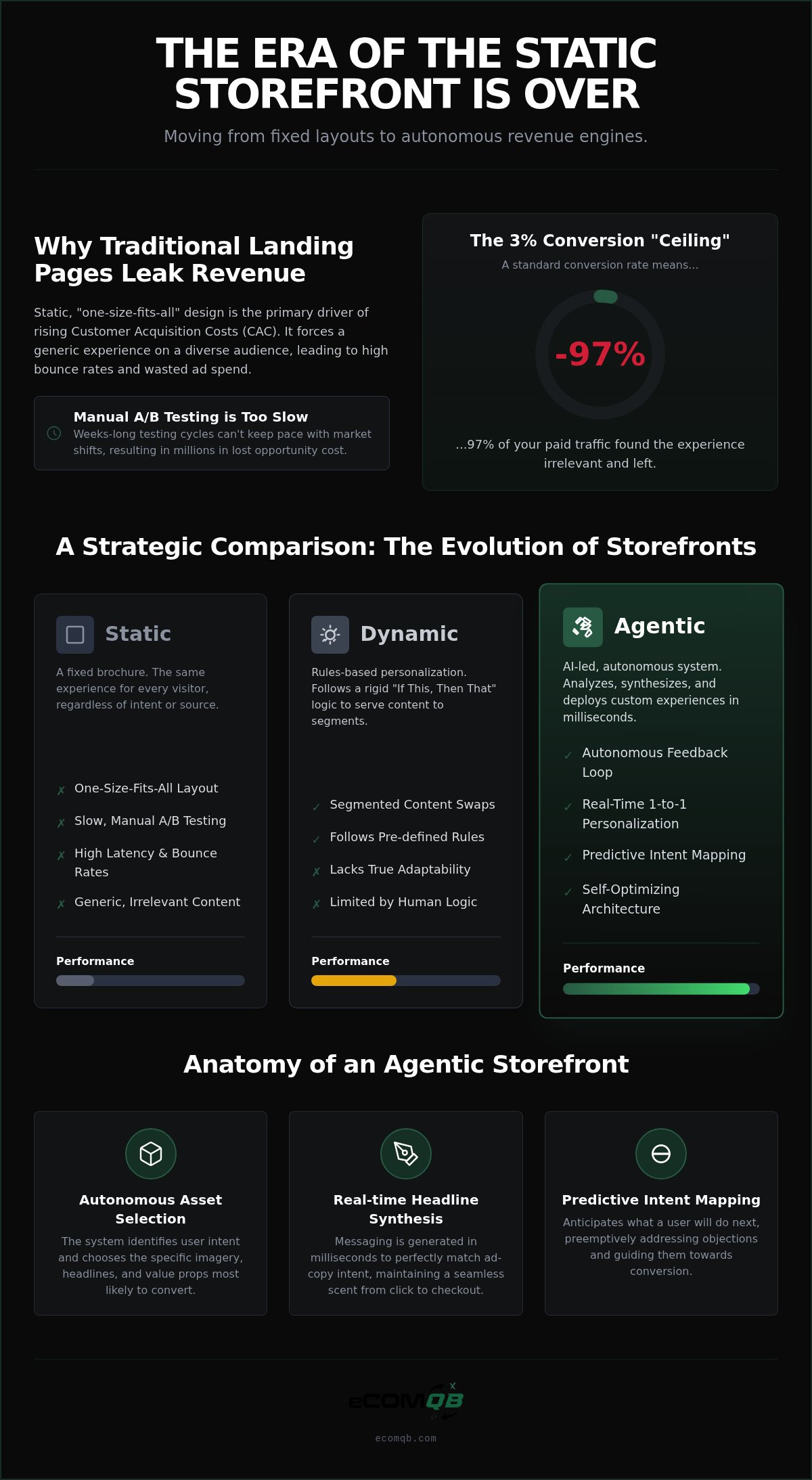
Static layouts are a relic. They assume every visitor is identical. They ignore the reality of Agentic commerce, where autonomous systems dictate the flow of trade. If your page looks the same for a repeat buyer as it does for a first-time browser, you're burning capital. One-size-fits-all design is the primary driver of rising CAC. It forces a generic experience onto a diverse audience, leading to immediate bounce rates and wasted ad spend. You're no longer competing on product quality alone; you're competing on the velocity of your relevance.
Traditional landing pages suffer from a terminal latency problem. You wait two weeks for a human-led A/B test to reach statistical significance. By then, the market has shifted. Your competitors have pivoted. You've lost seven figures in potential revenue because your design couldn't keep up with the data. This is why the shift from design as an asset to design as a system is mandatory for 8-figure growth. Your storefront must be an autonomous engine, not a fixed brochure.
The Death of the Static Conversion Rate
A 3% conversion rate isn't a benchmark. It's a ceiling. It proves that 97% of your traffic found your experience irrelevant. This is intent-decay. The moment a user clicks your ad, their intent is at its peak. Every second they spend looking at a generic hero image, that intent evaporates. AI-driven Shopify theme customization solves this by aligning the storefront to the visitor's specific metadata in milliseconds. Identifying these revenue leaks is the first step toward strategic mastery. You must recognize where your current Shopify storefront fails to capture the nuances of high-velocity traffic.
Why A/B Testing is Too Slow for 2026
- Mathematical limitations: Humans can't process the permutations of a thousand variables simultaneously.
- Opportunity cost: Manual design cycles stall your momentum while your ad budget bleeds.
- Predict and Execute: Moving beyond "Test and Learn" allows your system to anticipate user needs before they bounce.
Manual testing is mathematically flawed in high-velocity environments. You need to move from reactive adjustments to proactive execution. When an AI agent buys your traffic, only an agentic landing page can convert it. Static pages simply can't handle the precision required by modern media buying. The result is a widening gap between your ad performance and your on-site results. Bridging this gap requires a sound technical foundation, often achieved through professional e-commerce development from C Me Online. Close that gap, or get left behind.
Don't confuse "agency design" with "agentic systems." One is a business model; the other is a technological revolution. Most competitors focus on the beauty of a layout, but they ignore the strategic failure of static content. An agentic landing page is an autonomous feedback loop. It doesn't just swap a product image based on a UTM parameter. It analyzes visitor behavior, synthesizes new assets, and deploys a custom experience in milliseconds. This level of AI-driven Shopify theme customization moves the needle because it functions as a real-time architect for every unique visitor.
Dynamic content is rules-based. It follows a rigid "If This, Then That" logic. Agentic design is AI-led. It uses intent mapping to understand why a user is on the page before deciding what they see. The difference is stark; while dynamic templates follow a script, agentic systems write the play as it happens. This shifts the burden of optimization from your team to your technology. It allows you to scale 8-figure revenue without increasing your design headcount. If you're ready to move beyond static templates, you should speak with a strategist about your AI roadmap.
The Anatomy of an Agentic Storefront
The anatomy of an agentic storefront relies on autonomous asset selection. The system identifies the user's high-level intent and chooses the specific imagery, headlines, and value propositions that will trigger a conversion. Headline synthesis ensures that the messaging matches the ad-copy intent perfectly, maintaining a seamless scent from click to checkout. By integrating AI for Shopify personalization at the edge, you ensure that latency never kills your conversion rate. You gain speed, precision, and performance.
Predictive Intent Mapping: The New Standard
Standard systems react to what a user did. Agentic systems anticipate what a user will do next. Predictive intent mapping allows agents to anticipate user objections before they occur. If the data suggests a visitor is price-sensitive, the system synthesizes social proof that emphasizes value and durability. If they are looking for a quick solution, the page pivots to highlight fast shipping and ease of use. Agentic Design is an autonomous system that executes strategy without human intervention. This is the new standard for brands that demand peak performance and a decisive competitive advantage.
Static vs. Dynamic vs. Agentic: A Strategic Comparison
Architecture is destiny. For 8-figure brands, the choice of storefront infrastructure determines whether you scale with ease or struggle for every percentage point of growth. Static pages are fixed assets; they are rigid, manual, and increasingly obsolete. Dynamic pages offer reactive templates that change based on basic rules, but they still require heavy human intervention to maintain. Agentic systems represent the final tier of strategic mastery. These autonomous engines don't just react; they anticipate, learn, and execute. This evolution beyond standard AI-driven Shopify theme customization ensures your brand remains agile in a volatile market.
The strategic advantage of autonomy lies in its impact on long-term ROAS and profit margins. While static and dynamic systems require constant management, agentic systems thrive on data-density. They use high-velocity traffic to refine their own logic, delivering a higher rate of improvement with less operational overhead. You're no longer building pages; you're steering a self-optimizing revenue engine. This shift allows your team to focus on high-level brand strategy while the technology handles the tactical execution of every click.
Performance Metrics That Actually Matter
Conversion rate is a vanity metric if it doesn't translate to bottom-line growth. In agentic systems, we prioritize Revenue Per Session (RPS) and Average Order Value (AOV). Data shows that shoppers arriving from AI-powered discovery convert at nearly 50% higher rates and see a 14% increase in AOV. To capture this, your storefront must be in perfect sync with your agentic media buying efforts. We also track Time-to-Optimization as a competitive KPI. The faster your system learns from a new traffic source, the sooner you achieve peak performance. Speed is the ultimate currency.
Cost-of-Acquisition (CAC) Optimization
Rising CAC is often a symptom of the Ad-to-Page disconnect. When a high-intent visitor clicks an ad and lands on a generic page, the friction kills the conversion. Agentic design eliminates this friction through zero-latency personalization. By synthesizing the experience in real-time, the system ensures the landing page is a perfect continuation of the ad's promise. This alignment reduces bounce rates and stabilizes your acquisition costs even as platform algorithms fluctuate. The result is a compounding effect where autonomous improvements drive higher scale, lower costs, and dominant market positioning. You don't just survive the competition; you out-engineer them. To see how expert design can support this transformation, you can check out Britecode.
Deployment is a tactical maneuver. It requires a clear objective, a vetted tech stack, and a rigorous execution plan. Moving toward AI-driven Shopify theme customization isn't about cosmetic changes; it's about structural transformation. You must begin by auditing your current data infrastructure. If your tracking is fragmented or your product data is inconsistent, your agents will fail. Clean data is the prerequisite for autonomous growth. Once the foundation is secure, you can begin the transition from static templates to a managed growth system.
The roadmap to an agentic storefront follows a precise sequence. First, curate your technology stack by integrating AI logic directly into your Shopify environment. Second, establish brand guardrails. You must define the aesthetic and tonal boundaries that your autonomous agents cannot cross. Third, launch a "Seed" design. This serves as the initial training ground for the AI to begin its optimization loop. Finally, monitor the system. You aren't just looking for conversion wins; you're looking for the speed at which the system identifies and exploits new revenue opportunities. To execute this shift with precision, you should book your AI transformation briefing today.
The Shopify Agentic Tech Stack
Precision engineering requires the right tools. Your stack must prioritize speed, flexibility, and intelligence. Integrating headless architectures with AI-driven frontends allows you to deliver personalized experiences without the bloat of traditional apps. This is critical for SEO and content strategy Shopify integration, where page speed remains a dominant ranking factor. You need zero-latency page loads even while running complex agentic scripts. If your technology slows down the user, you've already lost the game.
Data Integrity: The Fuel for Autonomy
Your agent is only as effective as the intelligence it consumes. High-performance brands synchronize their data across every touchpoint. Connecting agentic email marketing data to the landing page experience creates a unified feedback loop. When the system knows exactly what a customer clicked in an email, it can instantly tailor the storefront to match that specific intent. Data integrity is the foundational layer of any autonomous growth system. Without it, your AI is guessing. With it, your AI is winning.
Scaling with eComQB: Managed Agentic Systems for Peak Performance
Apps are tools, not solutions. You can't just install a plugin and expect 8-figure velocity. A fully managed approach is the only way to deploy agentic systems at scale without accumulating technical debt. It requires a precise synergy between brand strategy and technical execution. At eComQB, we don't just provide AI-driven Shopify theme customization; we engineer a comprehensive eCommerce AI growth system. This ensures every autonomous decision aligns with your long-term brand equity while maximizing immediate returns.
The transition from manual management to systematic growth is a fundamental shift in how you view your business. You are moving from a world of reactive tweaks to a world of proactive dominance. By integrating brand strategy with technical execution, we create a seamless experience that feels human but performs with machine precision. This is the difference between a storefront that merely exists and one that actively hunts for revenue. We provide the architecture, the intelligence, and the execution required to win in the 2026 digital economy.
The Field General Advantage
We act as your tactical partner in the field. We orchestrate the entire agentic workflow, from high-intent media buying to the final storefront conversion. While competitors focus on designing pretty layouts, we focus on engineering revenue. Our commitment to AI transformation eCommerce brands means we take full ownership of the technology stack. We handle the technical complexities of machine learning models, data integrity, and real-time deployment. You maintain the bird's-eye view; we manage the mechanics of growth.
Your Next Move toward Optimization
Stagnation is the enemy of peak performance. To move from legacy tech to autonomous velocity, you must identify your first lever for transformation. This is typically your highest-volume landing page or your most complex traffic source. We provide the roadmap to replace manual bottlenecks with systemic efficiency. The transition to AI-driven Shopify theme customization is a decisive move that separates market leaders from also-rans. It's time to stop playing defense with static layouts. It's time to execute. Book your strategy call to execute your AI transformation with eComQB.
Secure Your Competitive Edge in the Autonomous Economy
The window for legacy design is closing. You've seen the shift from static layouts to autonomous engines that learn, adapt, and execute. Brands that cling to manual A/B testing cycles will continue to see their CAC rise while their competitors achieve 8-figure scaling. Strategic mastery in 2026 requires moving beyond basic AI-driven Shopify theme customization to embrace fully managed agentic workflows. By synchronizing your storefront with your media buying, you eliminate the friction that kills conversions and stall your competition.
eComQB is your tactical partner in this transformation. We specialize in managed AI transformation for 8-figure brands and redefining Shopify velocity through AI. Our strategic mastery in agentic media buying ensures your traffic always hits a high-performance destination that is optimized for profit. It's time to stop managing bottlenecks and start engineering revenue. The playbook for the future is ready. Book a call to scale your brand with agentic growth systems and secure your position as a market leader. Your peak performance starts now.
Frequently Asked Questions
What is an agentic landing page compared to a dynamic one?
An agentic landing page functions as an autonomous decision-maker rather than a static template. While dynamic pages rely on pre-defined rules and rigid "if-this-then-that" logic, agentic systems use real-time data to synthesize new layouts and content. They interpret user intent and execute design changes without human intervention. This shift moves your storefront from a reactive tool to a proactive revenue engine that evolves with every click.
How do agentic landing pages impact my Shopify store's speed?
Performance is non-negotiable for high-velocity brands. Modern agentic systems utilize edge computing and headless architectures to ensure that personalization happens in milliseconds. By offloading complex AI logic from the main Shopify liquid thread and utilizing the Web Pixels API, we maintain zero-latency page loads. This approach ensures your AI-driven Shopify theme customization doesn't compromise Core Web Vitals. You get hyper-personalization without the speed penalties of legacy scripts.
Can I use agentic design if I have a small product catalog?
Catalog size is irrelevant to agentic success. Agentic design focuses on intent mapping and persona alignment rather than just product variety. Even with a single SKU, an agent can rotate value propositions, social proof, and visual assets to match the visitor's specific psychological profile. The goal is to maximize the relevance of the experience for diverse traffic sources. Small catalogs often see high ROI because the system focuses entirely on one conversion path.
Does agentic design require a headless Shopify setup?
You don't strictly need a headless setup to begin your AI transformation. While headless architectures offer the greatest flexibility for complex agentic workflows, many systems integrate directly with Liquid via theme app extensions. However, for 8-figure brands seeking maximum velocity and design freedom, a headless frontend is the preferred tactical choice. It allows for more sophisticated asset synthesis and faster deployment of autonomous design changes across your entire storefront.
How do AI agents handle brand voice and compliance on landing pages?
Security and consistency are maintained through strict brand guardrails. Before any agent goes live, we establish a fixed library of approved assets, tonal parameters, and compliance rules. The AI operates within these boundaries, ensuring every headline and image remains on-brand. This controlled autonomy allows the system to be creative with performance while remaining compliant with legal standards like the EU AI Act. You maintain strategic control while agents handle execution.
What is the expected ROI when switching from static to agentic design?
ROI is driven by an immediate reduction in CAC and a long-term increase in Revenue Per Session. By eliminating the disconnect between ad intent and landing page content, brands typically see a stabilizing effect on acquisition costs. Verified data suggests that stores using AI-driven personalization see a 15% to 30% higher conversion rate. The compounding effect of these autonomous improvements often leads to significant gains in total profit margins as the system optimizes.
How does agentic media buying work with these landing pages?
Agentic media buying and landing pages form a unified growth loop. When an AI agent manages your Meta or Google ad spend, it passes granular intent data directly to the storefront. The landing page then adapts its messaging to perfectly mirror the ad that triggered the visit. This synergy ensures a seamless "scent" from click to checkout. It eliminates the friction found in traditional funnels and allows your entire marketing stack to optimize for revenue.
What data do I need to provide for an agentic system to function?
Success depends on high-quality first-party data and a robust asset library. You'll need to provide historical conversion data, customer segments, and a comprehensive set of brand assets including headlines, imagery, and social proof. The system also requires clean integration with your Shopify analytics and tracking pixels. As the AI-driven Shopify theme customization process begins, the agent uses this foundational data to train its predictive models and start the autonomous optimization cycle.