AI Growth Strategies for eCommerce: Engineering 8-Figure Velocity in 2026

In 2026, the gap between market leaders and the chasing pack is no longer about budget; it's about velocity. The global AI economy has surged to $1.08 trillion, and the brands winning the race aren't just using tools; they're deploying autonomous systems. If you're still relying on manual media buying and fragmented data, you aren't just falling behind. You're becoming obsolete. Implementing high-velocity ai growth strategies for ecommerce is the only way to outpace rising customer acquisition costs and the friction of stagnant LTV.
You recognize the bottleneck. You see the manual labor draining your margins and the content gaps slowing your momentum. It's frustrating to watch your scaling efforts hit a ceiling while your data remains trapped in silos. This article is your tactical briefing for the 8-figure transition. We'll show you how to master agentic systems and AI transformation frameworks that turn your brand into a self-optimizing engine. We will break down the shift toward zero-click buying, the rise of answer engine optimization, and the exact playbook for engineering predictable, autonomous revenue growth in the 2026 environment.
Key Takeaways
- Transition from fragile manual tactics to autonomous agentic systems to eliminate operational latency and secure a decisive competitive advantage.
- Implement high-performance ai growth strategies for ecommerce to automate media buying across Meta and Google with micro-second bidding precision.
- Achieve a "Segment of One" by leveraging behavioral intent data to adapt your storefront UI and UX in real-time for every visitor.
- Replace outdated email blasts with agentic revenue flows that trigger hyper-personalized communication at the exact moment of peak customer intent.
- Utilize a managed AI transformation framework to bridge the technical execution gap and accelerate your brand toward an 8-figure revenue target.
The 2026 Strategic Shift: From Manual Tactics to Agentic Systems
The commerce landscape of 2026 demands more than just faster tools. It requires a complete strategic overhaul. A modern ai growth strategies for ecommerce is no longer about using a simple chatbot to write product descriptions. It's about the seamless integration of autonomous agents into your core acquisition, conversion, and retention workflows. We've moved past generative AI, which focused on creation, into the era of agentic AI, which focuses on execution. Platforms like Omdena demonstrate how the advancement of machine learning classification algorithms is the catalyst for this shift toward autonomous execution. Implementing advanced ai growth strategies for ecommerce means shifting from human-led tasks to a system that operates at the speed of the digital economy. If your team is still manually adjusting bids or scheduling email blasts, you aren't managing a brand; you're managing a bottleneck.
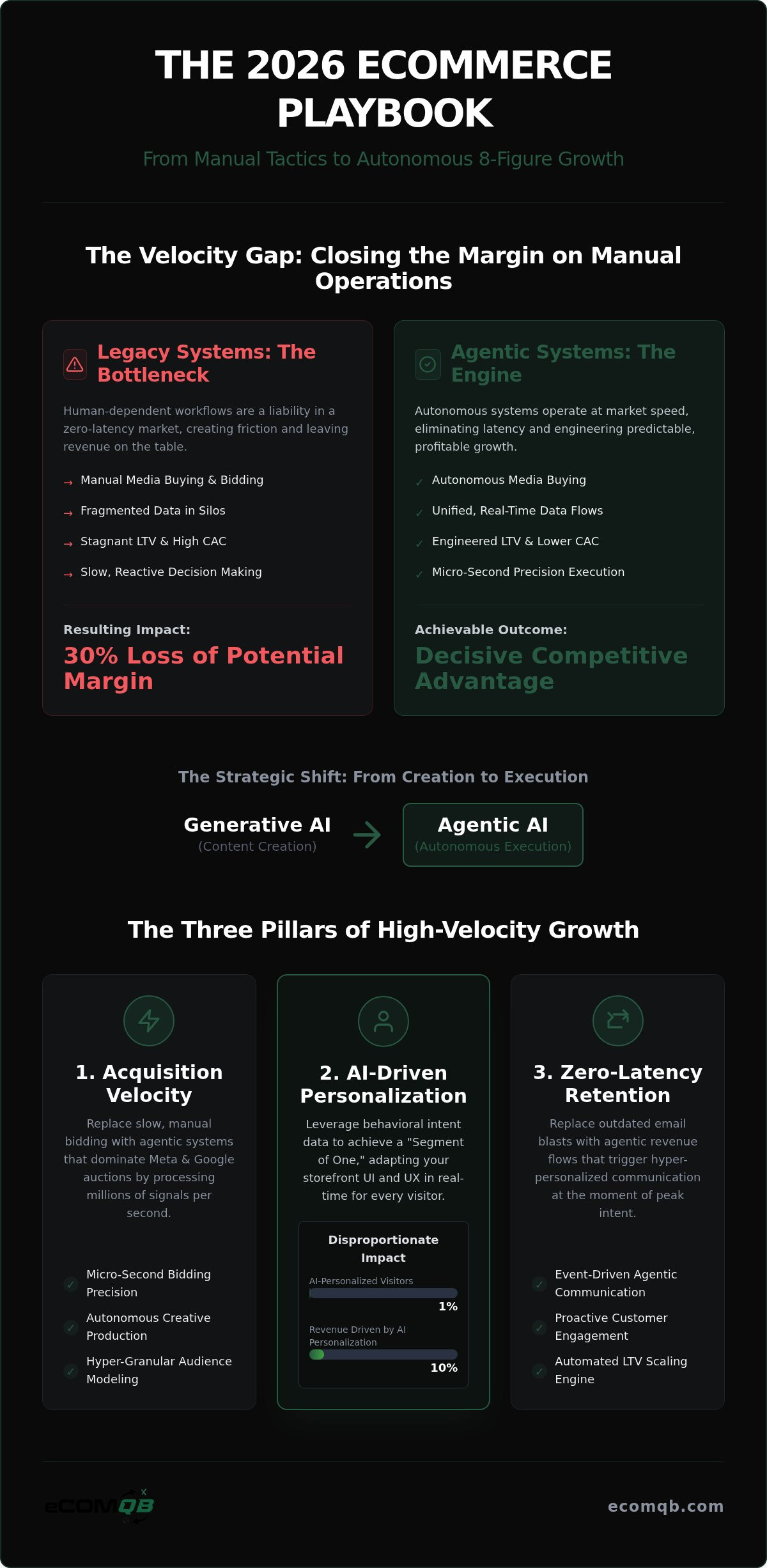
Manual eCommerce management is now a liability. In a zero-latency market, the time it takes for a human to analyze data, push a button, and hope for results is the time it takes for a competitor to steal your customer. This delay creates the "Velocity Gap." Brands tethered to legacy, human-dependent workflows are currently losing 30% of their potential margin. They lack the speed to capitalize on micro-trends or adjust to fluctuating acquisition costs in real-time. Precision execution is the only way to protect your profits and maintain a dominant market position.
The Three Pillars of High-Velocity Growth
Scaling to 8-figures requires three synchronized pillars of automation. First, acquisition must move toward engineering precision through agentic algorithms that manage spend with micro-second accuracy. Second, the customer experience must shift to real-time storefront adaptation. By utilizing advanced recommender systems, your site can predict behavioral intent and restructure its UI for every individual visitor. In 2026, AI touches roughly 1% of total e-commerce visitors but drives 10% of total sales. This discrepancy highlights the immense power of high-intent personalization. Finally, retention must evolve from static calendars to event-driven agentic communication, where every touchpoint is a response to live customer data.
Why Your Legacy Tech Stack is Leaking Revenue
Most brands are bleeding revenue through data silos. Your acquisition tools don't talk to your retention systems, and your personalization engine is blind to your inventory levels. This fragmentation is the hidden cost of "tool-first" thinking. When you stack disconnected AI applications, you create a system that still requires manual oversight to function. You're leaving points on the board and allowing your profit margins to erode. To dominate, you must move toward a unified, managed transformation. You need to understand Why Your Current Tech Stack is Leaking Revenue before you attempt to scale further. Fragmented systems won't survive the high-stakes auction environment of the coming year.
Engineering Acquisition Velocity with Agentic Media Buying
Manual bidding is a relic. In the hyper-competitive auctions of 2026, the human hand is too slow, too emotional, and too expensive. You need ai growth strategies for ecommerce that operate at the speed of light. Agentic systems now dominate Meta and Google Advertising Execution by processing millions of signals per second. They don't wait for a weekly review to shift budget. They reallocate capital instantly based on real-time performance metrics. This is the end of bidding fatigue. Precision is the only currency that matters when scaling to 8-figures.
The new playbook is creative-led. Your agents analyze performance data, identify winning hooks, and immediately brief autonomous creative production. This creates a loop of continuous improvement. Humans provide the vision. Machines provide the velocity. By utilizing hyper-granular audience modeling that no manual setup can replicate, you drive down CAC while your competitors are still guessing. If you're ready to stop guessing and start scaling, you can request a tactical audit to see how these systems integrate with your current brand goals.
Dominating Meta and Google Ads in 2026
Success in the 2026 auction environment requires a "Field General" mindset. You set the high-level objectives. You define the profit margins. You establish the risk parameters. Then, you step back and let the agents execute. Implementing agentic media buying allows your brand to move from slow testing cycles to a state of permanent optimization. These systems identify profitable pockets of traffic before they become saturated. They find, capture, and convert at a pace legacy workflows cannot match.
The Role of Agentic Landing Pages
Static product pages are conversion killers in a high-velocity market. If your ad promise doesn't match the landing page experience exactly, your ROAS will plummet. Deploying agentic landing pages and storefronts solves this friction. These pages are dynamic. They rewrite headlines, swap hero images, and reorder product benefits based on the specific intent behind the ad click. This creates a seamless ad-to-checkout flow that maximizes every dollar of ad spend. You aren't just buying traffic anymore. You are engineering a conversion machine that adapts to the visitor in real-time. It's about total alignment, total relevance, and total conversion.
AI-Driven Personalization: Converting Traffic into High-Value Customers
Stop treating your customers like statistics. The "Segment of One" is the new standard for 8-figure brands. Basic demographic targeting is dead. It's too slow. It's too vague. It's too inefficient. To win in 2026, your ai growth strategies for ecommerce must leverage behavioral intent in real-time. This means your storefront adapts instantly. It changes the UI. It modifies the UX. It predicts the Lifetime Value (LTV) of every visitor before they even scroll. You aren't just selling products; you're orchestrating an individualized journey that mirrors a high-end concierge experience.
Building High-Performance Shopify Storefronts
Speed is the ultimate conversion lever. Integrating agentic landing pages directly into your Shopify theme eliminates technical friction and decision fatigue. This isn't just about fast loading times; it's about the "Conversion Science" of AI-driven social proof. Your site should feel alive. It should display urgency that is actually relevant to the user's specific browsing history. By leveraging AI for Shopify personalization, you drive significant gains in Average Order Value (AOV). You can even predict and prevent cart abandonment by identifying hesitation patterns in milliseconds. You stop the exit before the customer even considers the "back" button.
Discovery must be effortless. AI-powered search helps customers find what they want before they even search for it. It analyzes past behavior, current trends, and real-time navigation to suggest the perfect product. This reduces the cognitive load on the buyer. It shortens the path to purchase. It maximizes revenue per session. Implementing these ai growth strategies for ecommerce ensures you capture the 40% increase in revenue that early adopters of hyper-personalization are already reporting. You can't afford to leave those margins on the table.
The End of One-Size-Fits-All Merchandising
Static collection pages are a waste of prime digital real estate. Autonomous merchandising allows your system to rearrange product grids for maximum margin and relevance. If a high-margin item is trending with a specific user profile, it moves to the top. Instantly. Precision. Speed. Profit. Predictive inventory display ensures you only show what is in stock and likely to sell to that specific user. This level of systemic optimization is why AI transformation eCommerce brands are outperforming legacy competitors. You are no longer guessing what your customers want. You are providing exactly what they need, exactly when they need it.
The Retention Engine: Scaling LTV through Zero-Latency Marketing
Acquisition is the front line. Retention is the treasury. If your ai growth strategies for ecommerce stop at the first purchase, you are leaving 8-figure growth on the table. The era of the "scheduled email blast" is over. It's too rigid. It's too impersonal. It's too slow. In 2026, high-velocity brands utilize agentic revenue flows that operate with zero latency. This means sending the right message at the exact millisecond of highest intent. You don't just reach the customer; you meet them where they are before they even realize they're ready to buy again.
Zero-latency marketing leverages predictive churn prevention. Your system identifies at-risk customers by analyzing subtle shifts in engagement data. It doesn't wait for a human to pull a report. It deploys autonomous "win-back" offers instantly. This proactive stance turns potential exits into profitable re-engagements. By scaling LTV through agentic SMS and email, your brand functions like a personal concierge for thousands of customers simultaneously. It's precise. It's scalable. It's the only way to protect your margins against rising acquisition costs.
Mastering Agentic Email and SMS
Revenue shouldn't stop when your team logs off. Implementing agentic email marketing creates a system that generates revenue while you sleep. These aren't just automated sequences. These are conversational commerce flows that can close sales directly within an SMS thread. AI optimizes send times and subject lines for every individual subscriber. It learns when they open, what they click, and why they buy. This level of optimization ensures your ai growth strategies for ecommerce remain effective across every touchpoint. If you want to see how these autonomous flows can overhaul your retention, you should book a strategic briefing to audit your current stack.
Maximizing Lifetime Value (LTV) with Data-Driven Precision
Scaling requires knowing your numbers with surgical accuracy. Use AI diagnostics to calculate "True LTV" and uncover hidden profit pockets within your existing customer base. This data fuels the "Loyalty Loop." Agentic systems identify your most valuable customers and turn them into brand evangelists through hyper-relevant rewards and exclusive access. Long-term retention is also supported by high-value education. Understanding how SEO and content strategy Shopify works allows you to provide consistent value that keeps your brand top-of-mind. You aren't just chasing the next transaction. You are building a self-sustaining ecosystem of high-value growth.
Deploying Your Managed AI Growth System: The Path to 8-Figure Scale
Execution is the graveyard of ambition. While identifying potential software solutions through an AI tool directory is helpful for staying informed, many 7-figure brands stall because they collect software like trophies but never build a cohesive system. They're drowning in "Tool Overload" while their margins evaporate. Transitioning to 8-figures requires more than a software subscription; it requires a managed AI transformation. This is the "Managed AI" advantage. By outsourcing the technical complexity of your ai growth strategies for ecommerce, you shift the burden of micro-second execution to experts. It's the difference between owning a collection of parts and driving a high-performance machine. You need a system that doesn't just suggest improvements but actually executes them across your entire stack.
- Step 1: AI Diagnostic. We perform a forensic audit of your current stack to identify revenue leaks and data silos. We find exactly where your capital is being wasted.
- Step 2: Infrastructure Setup. We deploy agentic workflows and Shopify optimizations to build a high-velocity foundation. You can't scale on a fragile base.
- Step 3: Acquisition Scale. We launch agentic media buying across Meta and Google to dominate the auction. This moves your spend from manual guesswork to algorithmic precision.
- Step 4: Experience Calibration. We implement real-time personalization and agentic landing pages. Every visitor receives a journey optimized for their specific behavioral intent.
- Step 5: Retention Mastery. We activate zero-latency email and SMS flows. Your retention engine begins to scale LTV autonomously, turning one-time buyers into brand evangelists.
This systematic approach ensures that every lever of your business is pulled simultaneously. Implementing these ai growth strategies for ecommerce isn't about incremental gains. It's about a total shift in how your brand interacts with the market. When your acquisition, experience, and retention systems are synchronized by autonomous agents, your growth becomes predictable. You stop chasing the market and start leading it.
Choosing a Tactical Partner for Growth
You don't need another vendor. You need a Field General. Most agencies are merely "AI-enabled," meaning they use modern tools to perform the same old, slow tactics. They're still thinking in terms of manual workflows and human-scale speed. You need an "AI-first" tactical partner who understands the mechanics of autonomous growth. We don't just provide advice; we provide execution. We bridge the gap between your current revenue and your 8-figure goal by taking command of the technology on your behalf. It's time to stop managing bottlenecks and start engineering your brand's velocity. The 2026 landscape waits for no one. Secure your competitive advantage now.
Dominating the 2026 eCommerce Landscape
The window for manual execution is closing. To dominate the high-velocity landscape of 2026, your brand must evolve from a collection of fragmented tools into a unified, autonomous engine. We've defined the shift from manual bidding to agentic media buying, the transition from basic segments to a "Segment of One," and the replacement of scheduled blasts with zero-latency retention flows. These ai growth strategies for ecommerce are no longer optional for leaders targeting 8-figure revenue; they are the baseline for survival in a zero-latency market.
True competitive advantage requires strategic mastery and the deployment of fully managed AI technology stacks. You don't need more software to manage. You need a field general to orchestrate agentic workflows across Meta and Google Ads while you focus on high-level vision. By bridging the gap between current operations and autonomous execution, you secure your position as an inevitable market leader. The path to peak performance is clear. It's time to stop managing bottlenecks and start engineering your brand's velocity.
Deploy Your Revenue Machine: Get a Managed AI Growth System Briefing
The future belongs to the decisive. Take command of your growth trajectory today.
Frequently Asked Questions
What are the best AI growth strategies for eCommerce in 2026?
The most effective ai growth strategies for ecommerce center on deploying autonomous agentic systems that orchestrate the entire customer journey. This requires a shift from manual bidding to agentic media buying and from static storefronts to real-time adaptation. Brands must prioritize zero-latency revenue flows that respond to behavioral intent instantly. By automating execution across acquisition and retention, you eliminate human bottlenecks and maintain a decisive competitive advantage in a high-velocity market.
How does agentic media buying improve ROAS?
Agentic media buying improves ROAS by processing millions of data signals per second to execute bids with surgical precision. Unlike manual management, these systems reallocate capital instantly based on real-time performance across Meta and Google auctions. They eliminate bidding fatigue and human emotion from the decision process. This results in lower acquisition costs and higher efficiency, ensuring every dollar of ad spend is deployed toward the highest-intent traffic available.
Can AI really help scale a Shopify store to 8-figures?
Scaling a Shopify store to 8-figures requires the systemic velocity that only AI can provide. By integrating agentic landing pages and automated revenue flows, you remove the operational ceilings that trap smaller brands. AI-driven systems handle the heavy lifting of personalization and merchandising at a scale no human team can match. It's about building a self-optimizing engine that maintains profit margins while accelerating your brand toward high-performance revenue targets.
What is the difference between generative AI and agentic AI for eCommerce?
Generative AI focuses on content creation, such as writing product descriptions or generating marketing images. Agentic AI focuses on autonomous execution. While generative tools help you make things, agentic systems actually do things. They manage your ad spend, adjust your storefront UI in real-time, and trigger personalized retention flows without manual intervention. The shift from creation to execution is what separates 8-figure leaders from the rest of the market.
How do I implement an AI growth system without a technical team?
You don't need an in-house technical team if you partner with a "Field General" for managed AI transformation. At eComQB, we handle the technical complexity of deploying and managing your AI technology stack. We bridge the gap between your current revenue and your growth goals by providing the infrastructure, expertise, and execution required. This allows you to focus on high-level brand strategy while we engineer your brand's velocity.
Will AI personalization actually increase my conversion rate?
AI personalization directly impacts conversion rates by delivering a hyper-relevant experience to every visitor. By using behavioral intent data to adapt your storefront in real-time, you reduce friction and shorten the path to purchase. High-level ai growth strategies for ecommerce ensure you capture the maximum value from every session. Research indicates that while AI may only touch 1% of visitors, it can drive roughly 10% of total sales through precision targeting.
How does eComQB manage AI transformation for brands?
eComQB manages AI transformation through a comprehensive, five-step tactical roadmap. We begin with a forensic AI diagnostic to identify revenue leaks, followed by infrastructure setup and the launch of agentic media buying. We then calibrate the customer experience with real-time personalization and activate zero-latency retention flows. This is a fully managed service, providing the benefits of advanced technology without increasing your operational overhead or requiring specialized technical hires.