Agentic Landing Pages for eCommerce: High-Velocity Examples and Strategic Frameworks

Your static landing pages have become expensive liabilities. While you're fighting for every point of ROAS on Meta and Google, generic experiences are silently bleeding your budget. The manual overhead of building unique pages for every campaign is a relic of a slower era. You need a system that thinks, adapts, and executes at the speed of your traffic. Implementing agentic landing pages eCommerce frameworks is no longer a luxury for the experimental; it's the mandatory pivot for brands targeting 8-figure scale.
We understand the frustration of plateauing performance and rising customer acquisition costs. You're ready to move beyond basic templates toward autonomous growth engines that analyze, optimize, and scale without manual intervention. This article provides the master blueprint for the next generation of conversion. You'll learn how to deploy self-optimizing storefronts that can double your conversion rates and triple session duration based on current industry performance data. We're breaking down the specific architectural examples and strategic frameworks you need to automate personalization, eliminate maintenance, and reclaim your competitive edge.
Key Takeaways
- Transition from static liabilities to autonomous systems that decode and respond to visitor intent in real-time.
- Master the three-pillar architecture of ingestion, reasoning, and rendering to build a frictionless path to purchase on Shopify.
- Examine high-performance frameworks for agentic landing pages eCommerce brands deploy to maximize ROAS on top-tier ad channels.
- Bridge the gap between media buying and conversion by feeding autonomous site data back into your advertising algorithms.
- Scale your operations to 8-figures by implementing self-optimizing storefronts that eliminate the need for manual page maintenance.
The Evolution from Static to Agentic: Redefining eCommerce Destinations
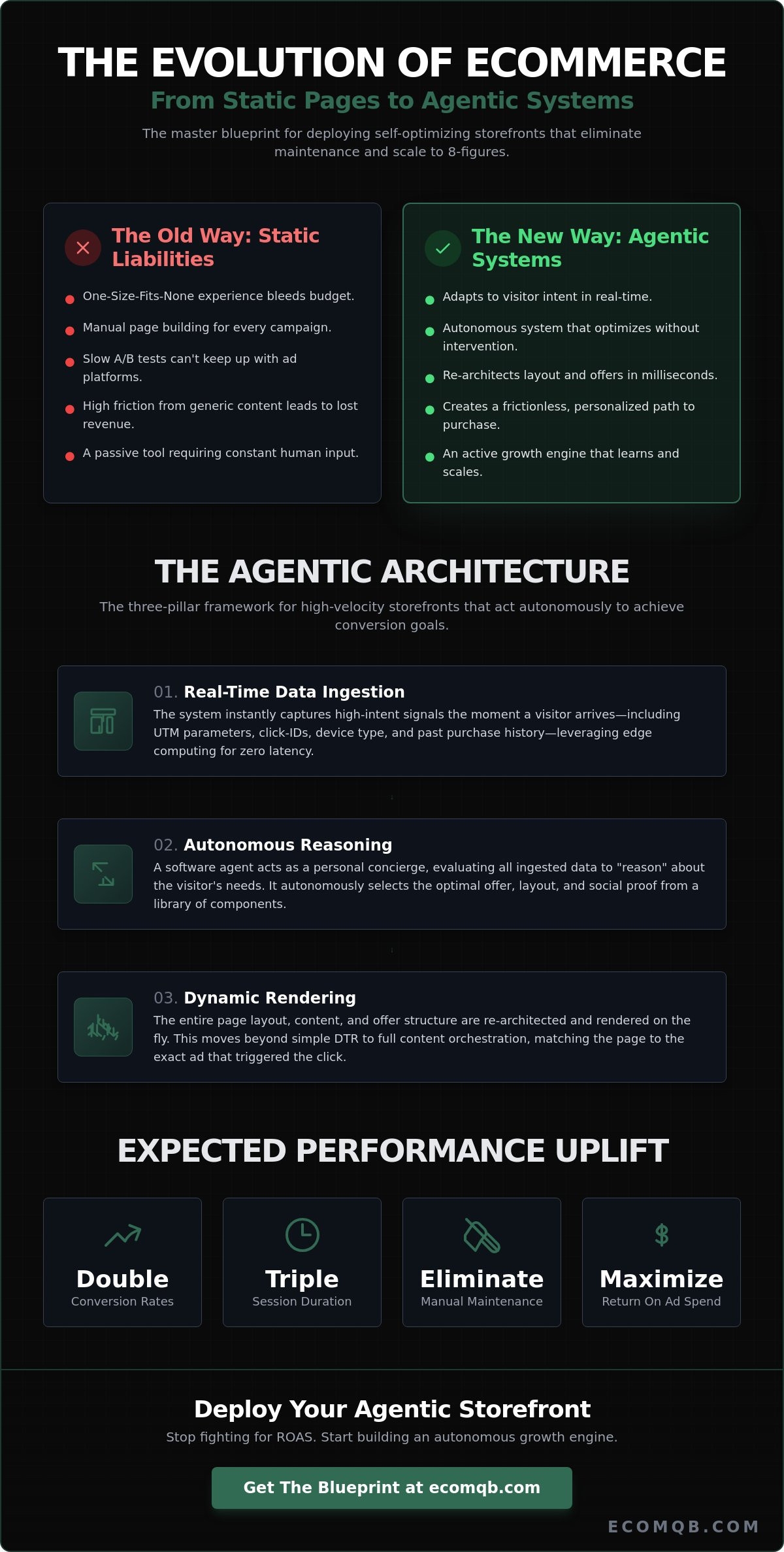
The era of the digital brochure is over. For years, eCommerce brands relied on static landing pages that served the same content to every visitor regardless of their specific needs. This approach is a strategic failure in 2026. High-velocity growth requires a fundamental shift from static destinations to autonomous systems. An agentic landing page is a living environment that adapts, reconfigures, and optimizes based on real-time intent. It doesn't just host traffic; it captures it. By implementing agentic landing pages eCommerce frameworks, you move from passive hosting to active conversion.
Traditional Conversion Rate Optimization (CRO) is no longer sufficient for leaders chasing 8-figure targets. Relying on A/B tests that take weeks to reach statistical significance is a recipe for stagnation. Modern advertising algorithms move too fast for manual iteration. You need agentic content orchestration. This moves beyond simple Dynamic Text Replacement (DTR) to a system that re-architects the entire page layout, offer structure, and social proof in milliseconds. It eliminates the "One-Size-Fits-None" conversion trap by ensuring the experience matches the high-intent signals of the individual buyer.
The Death of the Static Storefront
Legacy Shopify themes are built for stability, not speed. They struggle to keep pace with the hyper-specific targeting of modern Meta and Google campaigns. When a user clicks a high-intent ad and lands on a generic product description, that intent-latency creates friction. This friction translates directly into lost revenue. Strategic leaders are moving toward zero-latency customer experiences where the page content is as dynamic as the ad that triggered the click. Every second of delay in relevance is a second of lost profit. You must analyze, adapt, and convert in a single, fluid motion.
From Tools to Autonomous Agents
There is a massive distinction between a landing page builder and an agentic growth system. A builder is a passive tool that requires human input for every change. An agentic system utilizes a software agent to act on your behalf, making decisions in real-time without manual oversight. These agents "reason" about incoming user data. They evaluate the ad source, the device type, and behavioral history to present the optimal offer instantly. This level of precision is only possible with a robust AI eCommerce technology stack. It's the difference between a static billboard and a personal concierge. To win in this environment, your system must be fast, precise, and profitable. Agentic landing pages eCommerce strategies allow you to deploy these autonomous agents to close the gap between a click and a sale.
The Architecture of High-Velocity Agentic Landing Pages
Building for 8-figure growth requires more than a fast theme. It requires a structural overhaul of how your storefront interacts with traffic. While legacy competitors focus solely on load times, strategic leaders prioritize the authoritative definition of agentic commerce: systems that act autonomously to achieve specific goals. The architecture of agentic landing pages eCommerce frameworks rests on three non-negotiable pillars: real-time data ingestion, autonomous reasoning, and dynamic rendering. This is not a static template; it is a high-performance engine that reconfigures itself for every unique visitor.
Precision is the primary lever for conversion. Your landing page must integrate deeply with Shopify to ensure seamless checkout and real-time inventory synchronization. If a product is out of stock, the agent doesn't just show a "Sold Out" badge; it re-orchestrates the page to present the next best alternative based on the visitor's intent. We are also seeing a decisive shift away from traditional navigation menus. In their place, the "Intent Box" allows users to state their needs in natural language, reducing friction and shortening the path to purchase. These pages utilize feedback loops to learn from every click and bounce, ensuring the system becomes more efficient with every session.
Real-Time Data Ingestion
Success is measured in milliseconds. Your system must capture UTM parameters, click-ID data, and past purchase history the moment a user arrives. By leveraging edge computing, these agentic landing pages eCommerce destinations process complex data without sacrificing page speed. The goal is total alignment. If your Meta creative featured a specific "hook" related to product durability, the agentic page immediately prioritizes durability-focused content, testimonials, and technical specs. If you're ready to audit your current architecture, you can speak with a strategist today.
Autonomous Content Orchestration
Once data is ingested, the agent must decide how to present the offer. This involves selecting headlines, hero images, and social proof that resonate with the specific user persona. Dynamic social proof is a critical component here. Instead of showing generic reviews, the agent displays testimonials from customers with similar demographics or purchase histories. This level of precision is the cornerstone of modern Shopify conversion rate optimization. The system doesn't just guess; it reasons, executes, and wins.
3 High-Performance Examples of Agentic Landing Pages in 2026
Static templates are failing your media spend. Strategic leaders are moving toward what Bain & Company calls The Next Retail Revolution. This shift isn't just about adding a chatbot; it's about deploying autonomous systems that command attention, drive action, and close sales. By implementing agentic landing pages eCommerce models, you ensure every click lands on a page specifically reconfigured for that individual user. Shopify data confirms the impact: agentic storefront transactions convert at approximately double the rate of traditional browsing, with shoppers spending three times longer per session. These aren't incremental gains; they're a total redefinition of the conversion engine.
The Traffic-Aware Closer
This architecture is built for high-spend Meta and Google campaigns where every cent of ROAS matters. The page detects the specific pain point or "hook" mentioned in your ad creative and re-orchestrates the landing experience in milliseconds. If your ad highlights "all-day comfort for healthcare workers," the page doesn't just show a generic product. It prioritizes nurse-specific testimonials, clinical comfort ratings, and imagery that mirrors the ad's visual aesthetic. The result is a frictionless transition from the social feed to the checkout. You aren't just sending traffic to a page; you're sending it to a closer that knows exactly what was promised in the ad.
The Contextual Personalizer
Retention is the engine of 8-figure scale, and this example is designed for high-LTV flows. This agent recognizes returning users arriving via SMS or email. It intelligently hides products they've already purchased to avoid redundancy. Instead, it highlights complementary items that solve the next logical problem for the customer. By integrating agentic email marketing data, the page can pre-populate the cart with the user's preferred sizes and shipping details. It identifies intent, reasons through past behavior, and executes the upsell with surgical precision.
The Autonomous Bundle Engine
Average Order Value (AOV) is no longer a static target you hope to hit with a "frequently bought together" widget. This engine analyzes real-time session intent to build custom bundles on the fly. If a user spends time comparing high-performance gear, the agent bundles the top-tier SKU with essential maintenance tools and a limited-time loyalty offer. It doesn't offer a generic discount; it creates a logical, high-value solution tailored to the current browsing session. This level of agentic landing pages eCommerce orchestration allows you to maximize the revenue potential of every single visitor without manual intervention or constant A/B testing.
Closing the Revenue Gap: Integrating Media Buying with Agentic Destinations
The greatest revenue leak in modern eCommerce is the disconnect between the ad and the destination. You spend thousands on high-intent traffic only to dump it onto a generic product page. This is a tactical failure. Strategic leaders realize that agentic landing pages eCommerce frameworks are the missing half of agentic media buying. When your media buying bot and your landing page agent speak the same language, you eliminate the relevance gap that kills your ROAS. You stop managing siloed campaigns and start orchestrating a single, unified growth engine.
This integration reduces Customer Acquisition Cost (CAC) by ensuring every click lands on a perfectly relevant destination. It isn't just about matching a keyword; it's about matching the emotional state and the specific intent of the buyer. The "Field General" approach treats the entire funnel as a single tactical unit. You don't just win the click. You win the conversion, the upsell, and the long-term loyalty in one fluid motion. This is how 8-figure brands distance themselves from the competition and secure market dominance.
The Feedback Loop: Ads to Agents
The intelligence shouldn't stop at the click. In a high-velocity system, the agentic page informs the media buying bot which creative angles are actually converting, not just which ones are getting cheap clicks. This creates a closed-loop system where the landing page and the ad creative evolve in tandem. You scale high-performing intent clusters rather than just keywords. This automation of the creative-to-landing-page pipeline ensures your strategy remains sharp, relevant, and profitable. If you want to bridge this gap in your own funnel, schedule a strategic briefing with our team.
Maximizing Efficiency with Managed Systems
Managing these sophisticated agents requires more than a standard marketing team. It requires a specialized technology stack designed for autonomous execution. You are no longer "managing ads" in the traditional sense. You are managing a growth system. Positioning the eCommerce AI growth system at the center of your brand is the ultimate competitive advantage. It allows you to analyze, optimize, and scale without the manual overhead that slows down legacy brands. You gain the speed of an AI with the strategic oversight of a field general. This shift transforms your storefront from a static asset into a self-optimizing revenue engine.
Deploying Your Agentic Storefront with eComQB
Legacy technology is a bottleneck. It is the friction that prevents your brand from reaching its true potential. At eComQB, we function as your tactical partner, providing a full-service AI transformation that turns your storefront into a high-performance engine. We don't just offer tools; we deliver strategic mastery. By deploying agentic landing pages eCommerce frameworks, we help you transition from outdated, manual processes to a curated AI stack that executes strategy in real-time. This is how you engineer 8-figure velocity without bloating your operational overhead. We bridge the gap between legacy limitations and modern market demands with surgical precision.
The transition from legacy tech to a curated AI stack is a decisive move. Most brands are buried under a mountain of disconnected apps and manual spreadsheets that slow down response times. We strip away that corporate fluff. Our consultants work directly with your leadership to identify the critical levers for growth. We replace the manual overhead of page creation with autonomous systems that reason through data and present the optimal offer every time. This is strategic consulting designed for the speed of the digital economy. It is bold, assertive, and unapologetically focused on results.
Our Strategic Playbook for Shopify Brands
Our playbook for Shopify brands is methodical and precise. We begin with a step-by-step integration of agentic workflows that harmonize with your current store infrastructure. This isn't about disruption for the sake of it; it's about optimization. We utilize continuous data-driven diagnostics to refine every touchpoint, ensuring your system learns from every interaction. You maintain absolute brand integrity while gaining the technological leverage required to dominate your niche. We provide the specialized leadership and technical depth needed to orchestrate your next move while you remain focused on the ultimate objective: scale.
Execution Over Elaboration
In 2026, elaboration is a luxury you can't afford. Speed of implementation is the primary differentiator between market leaders and also-rans. While your competitors are stuck in the planning phase, we are in the field, executing. The eComQB promise is built on three pillars: precision, momentum, and results. We don't just identify a strategic need; we present a direct path toward optimization. It's time to stop reacting to the market and start dictating its pace. Your move is simple. You can continue to fight for scraps with static pages, or you can deploy a system that optimizes itself in real-time.
Secure your tactical briefing and deploy your agentic system.
Command Your Growth Trajectory
The window for legacy competition is closing fast. Static storefronts have become revenue leaks that punish your media spend and stall your momentum. Mastering agentic landing pages eCommerce frameworks is the decisive move that separates market leaders from those left behind. You've seen the architecture. You understand the high-velocity examples. You know that integrating autonomous reasoning with precision media buying is the only path to sustainable 8-figure scale.
Success requires three things: precision, speed, and execution. We function as your tactical partner to manage AI growth systems for 8-figure brands that demand peak performance. Our team provides expert Meta and Google advertising execution paired with curated AI technology stacks built specifically for Shopify. We strip away the complexity so you can focus on the ultimate objective: total market dominance. The next retail revolution is no longer a prediction; it's your current reality. It's time to stop reacting to the market and start dictating its pace. Build your engine. Secure your advantage. Win the game.
Deploy Your Agentic Growth System with eComQB
Frequently Asked Questions
What is the primary difference between an agentic landing page and a standard AI-generated page?
Standard AI-generated pages are static templates created once by a prompt. Agentic landing pages eCommerce frameworks are autonomous systems that reason about visitor intent in real-time. They don't just sit there. They reconfigure layouts, offers, and social proof in milliseconds based on specific traffic signals. One is a passive tool; the other is an active closer.
How do agentic landing pages improve ROAS for Shopify brands?
They eliminate the relevance gap that kills your margins. When your landing experience perfectly mirrors the ad creative's hook, friction disappears. Shopify data shows these storefronts can double conversion rates compared to traditional browsing. Higher efficiency at the point of sale means your media spend works twice as hard for every dollar invested.
Do agentic landing pages work with existing Shopify themes?
Yes, they function as a high-performance layer over your current infrastructure. You don't need a total store rebuild to gain a competitive advantage. These systems integrate with your product catalog and checkout to ensure seamless inventory synchronization. It's an upgrade to your legacy theme that adds autonomous intelligence without disrupting your core operations.
What data is required for an agentic landing page to function effectively?
The system requires high-intent signals to execute its strategy. This includes UTM parameters, click-ID data, behavioral history, and real-time inventory levels. The agent uses this information to "reason" through the best possible offer for that specific user. More data leads to sharper precision and higher revenue per session.
Can agentic landing pages help reduce customer acquisition costs (CAC)?
They are the primary lever for driving down acquisition costs in 2026. When your page matches the visitor's specific pain point, your bounce rate drops significantly. You stop wasting money on clicks that lead to generic, irrelevant destinations. This increased conversion efficiency makes your entire customer acquisition strategy more profitable and scalable.
How does eComQB manage the technical complexity of agentic workflows?
We provide full-service AI transformation and management. Our team handles the technology stack, data ingestion, and agent orchestration so you can focus on high-level strategy. You get the benefits of a sophisticated AI growth engine without the need for a massive internal dev team. We function as your tactical partner in engineering 8-figure velocity.
Is agentic personalization compliant with modern privacy regulations?
We prioritize brand integrity and follow all modern privacy standards. Personalization is driven by first-party data and the intent signals users provide during their active session. We utilize secure protocols to ensure your brand remains compliant while still delivering a hyper-relevant experience. You gain the technological edge without compromising on security or legal requirements.
How long does it take to deploy an agentic growth system?
We prioritize execution over elaboration. Our process is designed for rapid implementation to ensure you start capturing ROAS gains as quickly as possible. While timelines vary based on your specific catalog complexity, we move with momentum. We focus on getting your system live and optimizing so you can dictate the pace of your market.