How to Fix Declining eCommerce Revenue: The 2026 Strategic Recovery Playbook

Your 2024 playbook isn't just outdated. It's actively draining your capital. In a landscape defined by agentic AI and the 2026 E-Trust mandates, doing more of the same is a strategy for insolvency. You've watched your ROAS shrink, your customer acquisition costs climb, and your attribution data turn into a black box. If you're looking for how to fix declining eCommerce revenue, you must realize that the problem isn't your product. It's your legacy system. It's time to stop guessing and start executing with precision.
We agree that the traditional levers of growth have lost their tension. The friction is higher, the algorithms are less forgiving, and the competition is now fully automated. This article serves as your strategic recovery playbook to stop the bleed and engineer a high-velocity turnaround. We'll preview a systemic diagnostic framework, explain how to deploy agentic media buying, and show you how to automate growth workflows to eliminate overhead. You're about to learn how to diagnose, optimize, and scale your way back to market leadership.
Key Takeaways
- Stop the bleed by identifying the core misalignment between your current tech stack and the high-velocity demands of the 2026 market.
- Learn exactly how to fix declining eCommerce revenue by plugging the three lethal leaks that are quietly eroding your profit margins.
- Discover how Agentic Media Buying replaces manual bidding to deliver predictable ROAS through autonomous, real-time campaign optimization.
- Reclaim your retention revenue with agentic communication tools that turn stagnant email lists into high-performance profit centers.
- Deploy a battle-tested five-step recovery playbook designed to synchronize your entire growth engine for peak performance.
The Revenue Diagnostic: Why Your eCommerce Growth Has Stalled
Revenue decay is rarely a sudden event. It is a systemic misalignment. It happens when your operating model remains static while the market accelerates at a breakneck pace. In 2026, the digital economy moves at the speed of compute, not the speed of manual management. If you're currently analyzing how to fix declining eCommerce revenue, you must accept a hard truth: your 2024 playbook is an anchor. It's heavy, it's outdated, and it's dragging your brand into the red. High-performance leaders don't settle for tactical patching. They demand systemic diagnostics. This section isn't a general overview; it's a tactical briefing for leaders ready to re-engineer their growth engine.
The 2026 Efficiency Gap
The conversion window has collapsed. AI-assisted shoppers now use personal agents to filter options, verify environmental claims, and execute purchases in milliseconds. If your storefront suffers from "Legacy Friction," you aren't just losing sales; you're becoming invisible. Latency is the ultimate enemy of conversion in a zero-latency economy. Manual oversight creates bottlenecks where automated agents create flow. Precision is no longer a luxury for the elite. It is the baseline for survival. When you rely on human speed to solve machine-speed problems, the efficiency gap widens until your margins vanish. You must shift from manual oversight to automated precision to stay in the game.
Symptoms vs. Root Causes
Most brands waste capital treating symptoms. They see ad fatigue and react by inflating the creative budget. They see high bounce rates and immediately authorize a site redesign. These are often expensive distractions. Ad fatigue is usually a symptom of attribution failure. If you can't track the customer journey across platforms with 100% accuracy, you're bidding blind. A site redesign is useless if your data gaps prevent you from personalizing the experience. To engineer a high-velocity recovery, you must stabilize the three primary pillars of the revenue system:
- Acquisition: Moving beyond manual bidding to autonomous, agentic media buying.
- Conversion: Eliminating friction points that trigger the new 2026 "Cancellation Button" mandates.
- Retention: Maximizing customer lifetime value through hyper-personalized, automated touchpoints.
Fixing the root cause requires a shift in perspective. You aren't just selling products; you're managing a complex data ecosystem. When the data flows without friction, the revenue follows. Stop looking for a "quick fix" and start looking for the structural disconnects in your tech stack. That's the only way to restore revenue velocity and achieve a predictable ROAS in the current climate.
Identifying the Three Lethal Revenue Leaks
Revenue doesn't just vanish; it escapes through structural fractures. While global E-commerce sales are expected to grow 8.8% in 2024, many established brands are seeing their individual metrics slide. This divergence signals a leak, not a market collapse. If you are investigating how to fix declining eCommerce revenue, you must move beyond high-level metrics. You need to identify, isolate, and eliminate the specific leaks draining your capital. These fractures typically appear in three critical areas: data clarity, execution speed, and customer continuity.
Attribution Blindness and Data Gaps
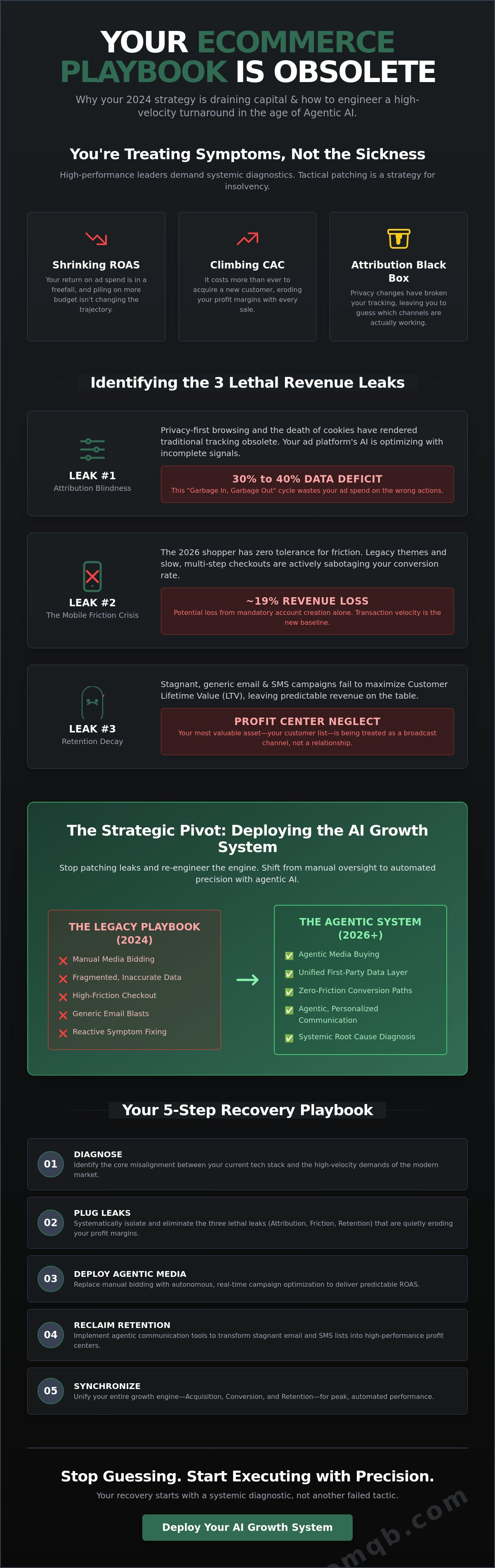
Privacy-first browsing and the death of the third-party cookie have rendered traditional tracking obsolete. Most brands are operating with a 30% to 40% data deficit. This is attribution blindness. When your tracking is fragmented, your ad platform's AI receives incomplete signals. This results in a "garbage in, garbage out" cycle where your budget is optimized for the wrong actions. To scale toward 8-figure territory, a unified data layer is mandatory. You cannot manage what you cannot measure. Precision requires a single source of truth that captures the entire customer journey across every touchpoint.
The Mobile Friction Crisis
The 2026 shopper is hyper-efficient and zero-tolerant. If your checkout requires manual data entry or mandatory account creation, you are actively sabotaging your conversion rate. Industry data suggests that mandatory account creation alone can kill nearly 19% of potential revenue. Mobile performance is no longer just about load speed; it is about transaction velocity. Legacy Shopify themes often carry technical debt that creates micro-stalls during the payment process. You must audit your flow for modern standards. One-click checkout, Apple Pay integration, and streamlined "Buy Now, Pay Later" (BNPL) options are the baseline. Anything less is a choice to lose money.
- The Algorithm Fatigue Leak: Manual bidding is a relic. Humans cannot process real-time auction data fast enough to compete with agentic AI systems.
- The Retention Void: Rising customer acquisition costs (CAC) make one-time buyers a liability. Without automated systems to maximize lifetime value, your growth is built on sand.
- The Attribution Leak: Fragmented data leads to misallocated spend and missed opportunities.
Plugging these leaks is the first step toward recovery. You cannot pour more fuel into a leaking tank and expect to reach your destination. If you suspect your current setup is bleeding capital, you should request a diagnostic audit to identify the exact points of failure. Once the leaks are sealed, you can pivot from defensive survival to offensive growth.
Strategic Pivot: From Manual Bidding to Agentic Media Buying
Legacy media buying is dead. If you're still relying on a human manager to toggle bids and adjust budgets, you've already lost the auction. The modern marketplace operates on millisecond intervals. While U.S. retail e-commerce sales continue to represent a massive portion of total trade, the competition for those dollars is now fought by autonomous systems. Understanding how to fix declining eCommerce revenue in 2026 requires a fundamental shift: you must move from manual oversight to agentic execution. AI agents don't just help with ads; they own the execution with zero latency.
Your current ROAS decline isn't a creative failure. It's a response-time failure. Manual bidding lag creates a gap between market opportunity and campaign adjustment. Agentic systems bridge this gap by processing millions of data points in real-time to execute high-performance Meta and Google campaigns. They identify intent before the user even clicks, ensuring your budget is deployed where it has the highest probability of conversion. This is the new standard for high-velocity brands.
Dominating the Meta and Google Algorithms
Traditional creative testing is too slow for the 2026 algorithm. You don't need a human to guess which headline works; you need to feed the algorithm what it craves: high-volume, high-quality data inputs. Agentic targeting identifies high-intent audiences faster than any human manager ever could. It shifts the focus from "testing" to "algorithmic feeding." By providing the system with the right parameters, the AI agents optimize for peak performance autonomously. For a deep dive into this transition, review our Agentic Media Buying Playbook.
Reducing CAC with Precision Targeting
Agentic Media Buying is the evolution of performance marketing, moving from static rules to autonomous intelligence. High customer acquisition costs often stem from bidding on low-value traffic. AI agents solve this by identifying and excluding low-LTV segments in real-time. Through dynamic creative optimization, the system matches the right asset to the right user at the exact moment of intent. This precision doesn't just lower your CAC; it improves the quality of the customers you acquire.
The final piece of the puzzle is the storefront. How to fix declining eCommerce revenue effectively also involves Agentic Landing Pages. These pages use AI to dynamically adjust the storefront experience to match the specific intent of the ad. When the ad and the landing page act as a unified, intelligent system, friction disappears. Conversion rates climb. Revenue velocity is restored. You aren't just buying ads anymore; you're orchestrating a growth system.
Closing the Loop: Fixing Retention with Agentic Email and SMS
Acquisition is the fuel, but retention is the engine. In a market where customer acquisition costs continue to climb, relying on a constant stream of new traffic is a high-risk strategy. Retention represents the "hidden profit" that offsets rising media costs and stabilizes your margins. If you are solving how to fix declining eCommerce revenue, you must look beyond the first click. You need a system that captures, nurtures, and maximizes the value of every customer you've already paid to acquire. Agentic Email and SMS are the solutions to stagnant LTV, transforming your database from a static list into a high-performance revenue generator.
The new standard is Zero-Latency Revenue. Traditional automated flows are too slow; they react in hours or days. In 2026, an intelligent growth system responds to customer behavior in seconds. Whether it's a specific browsing pattern, a search query on your site, or a sentiment shift in a support ticket, your communication must be instantaneous. Standard "one size fits all" flows for abandoned carts or welcome series are no longer enough to scale. You need autonomous agents that plan and execute personalized touchpoints based on real-time data signals.
Maximizing LTV Through Personalization
Static email blasts are a relic of a low-competition era. Modern AI personalization experiences drive repeat purchase velocity by matching specific products to individual needs with surgical precision. The difference lies in the "agentic trigger." Instead of a scheduled campaign, the system identifies a high-probability purchase window and executes a tailored message without human intervention. This ensures your brand stays relevant without becoming noise. To master these advanced strategies, review our Agentic Email Marketing guide.
Engineering the Zero-Latency Strategy
High-performance retention requires predictive intelligence. Your system should know when a customer is running low on a product before they do. Implementing predictive restock triggers and intelligent cross-sell sequences ensures you are always one step ahead of the consumer's needs. SMS should be used as a high-performance conversion lever, providing immediate value rather than repetitive annoyance. By automating the feedback loop, you also gather critical data that improves your product-market fit and refines your overall strategy.
A fragmented retention strategy is a choice to leave money on the table. You must synchronize your email and SMS channels to act as a single, cohesive unit that follows the customer across their entire journey. If your current retention metrics are flat, it is time to deploy a more sophisticated approach. You can schedule a retention strategy audit to see how agentic automation can restore your revenue velocity and secure your long-term profitability.
Deploying the AI Growth System: Your Playbook for Recovery
The diagnostic phase is over. Execution begins now. When determining how to fix declining eCommerce revenue, you cannot settle for incremental gains or surface-level tweaks. You need a complete systemic overhaul. Recovery isn't about working harder; it's about engineering a system that works faster than your competition. We've identified the leaks, isolated the friction, and mapped the path to recovery. Now, you must deploy the 5-step playbook designed for high-velocity brands ready to reclaim their market position.
- Step 1: Systemic Audit. Establish a unified data layer to eliminate attribution blindness and secure your first-party data.
- Step 2: Agentic Media Buying. Transition from manual bidding to autonomous AI execution on Meta and Google to restore ROAS.
- Step 3: Storefront Engineering. Replace legacy friction with high-converting, agentic landing pages that match real-time user intent.
- Step 4: Zero-Latency Retention. Deploy agentic email and SMS to maximize lifetime value and offset rising acquisition costs.
- Step 5: Managed Scaling. Orchestrate the entire stack through a centralized growth engine to maintain 8-figure momentum.
This is the foundation of the eCommerce AI growth system. It is the ultimate solution for leaders who demand results without the traditional overhead of massive internal teams. It's time to stop the bleed and start the engineering phase.
Systemic Optimization over Tactical Patches
A curated AI tech stack beats a collection of disconnected apps every single time. Most brands fail because their tools don't talk to each other, creating data silos and operational lag. eComQB functions as your "Field General" in the growth war, ensuring every component of your strategy is synchronized. We move your brand beyond basic Shopify development and into the realm of high-converting, intelligent storefronts. This is a managed transformation. You get the cutting-edge technology and strategic mastery without the burden of managing a dozen different vendors.
The Path to 8-Figure Velocity
True recovery is measured in profit margins, not vanity revenue. While how to fix declining eCommerce revenue starts with stabilizing the top line, the goal is sustainable, high-velocity growth. A systemic recovery typically follows a 90-day trajectory: 30 days to stabilize the data, 30 days to optimize the media buying, and 30 days to scale the retention engine. By the end of this cycle, your brand isn't just recovered; it is transformed. You are no longer guessing; you are executing with precision. The digital economy rewards the fast and the automated. It's time to make your move. Deploy your AI Growth System with eComQB and secure your competitive advantage today.
Seize Your Competitive Advantage
The digital landscape has shifted. Survival now belongs to the precise, the automated, and the bold. You've identified the structural leaks. You've seen the power of agentic media buying. You understand why retention must be reactive and intelligent. Learning how to fix declining eCommerce revenue is the first step; executing the transformation is the victory. Stagnation is a choice. Mastery is a strategy. It's time to transition from defensive troubleshooting to offensive market expansion.
We specialize in engineering 8-figure velocity through managed AI transformation. Our team delivers specialized Shopify development and agentic workflows without adding to your operational overhead. We function as your tactical partner, handling the technical complexity while you focus on leadership. Stop the bleed. Start the recovery. Secure your future in the zero-latency economy today.
Stop the Bleed: Deploy Your Managed AI Growth System
You have the playbook. You have the vision. Now, take the field and win.
Strategic Recovery: Frequently Asked Questions
How do I know if my revenue decline is market-wide or store-specific?
Compare your performance against sector benchmarks and platform growth rates to isolate the cause. If your conversion rate is dipping while your traffic remains steady, it's a store-specific friction issue. Market-wide declines usually manifest as a universal drop in search volume or a spike in CPM across all competitors. Analyze your internal data to isolate the anomaly and determine your next move.
What are the first three things I should check when sales start dropping?
Audit your attribution data, checkout latency, and ad platform signals immediately. These three pillars often reveal the root cause of the bleed. Check if your pixel is firing correctly, verify your mobile load speed, and look for sudden shifts in your CPC. Most revenue drops stem from a breakdown in one of these critical functions. Precision in diagnostics is the only way to ensure a fast recovery.
How long does it take to see results from an AI revenue recovery plan?
You should expect to see measurable stabilization within the first 30 days of deployment. The full impact of a systemic recovery typically manifests over a 90-day cycle as the AI agents gather enough data to optimize. This timeline allows the system to identify, iterate, and scale winning strategies. It is a process of rapid improvement, constant refinement, and eventual mastery. Results require patience and data depth.
Is my Shopify theme causing my conversion rate to drop?
Your theme is likely a contributing factor if it carries technical debt or lacks modern checkout integrations. Legacy themes often create micro-stalls that frustrate the 2026 hyper-efficient shopper. If you haven't updated your storefront to support one-click payments and zero-latency loading, you are losing revenue to friction. A high-performing storefront requires a lean, optimized architecture to maintain its competitive edge in a crowded marketplace.
Can Agentic Media Buying really lower my CAC in a competitive market?
Yes, it lowers acquisition costs by eliminating the latency and bias inherent in manual management. Agentic Media Buying identifies high-intent users in real-time and excludes low-value segments before you waste budget. In a competitive auction, the brand with the fastest, most precise bidding system wins. It's about out-executing the competition through superior technology and speed. Precision targeting is the ultimate lever for sustainable growth.
What is the most common mistake brands make when trying to fix revenue?
The most common error is applying tactical patches to systemic failures. Brands often try to solve how to fix declining eCommerce revenue by simply increasing ad spend or changing creative assets. These moves ignore the underlying data gaps and friction points. You cannot scale a broken system; you must fix the foundation before you can accelerate. Stop looking for quick fixes and start building a growth engine.
How does AI personalization improve LTV for established brands?
It transforms your retention strategy from generic blasts to predictive, individual touchpoints. AI personalization uses behavioral data to trigger the right offer at the exact moment of need. This increases repeat purchase velocity and strengthens the customer bond. For established brands, this move unlocks the hidden profit sitting dormant in their existing database. It turns a static list into a high-performance revenue generator that scales autonomously.
Do I need to hire a new team to manage an AI growth system?
No, you don't need to expand your internal headcount to achieve an AI transformation. A managed growth system provides the technology and expertise without the operational overhead of new hires. You get a field general approach that integrates with your existing operations. This allows you to scale your revenue velocity while keeping your team lean and focused. It is about strategic mastery, not increasing your payroll.