The eCommerce AI Implementation Plan: Engineering 8-Figure Revenue Velocity

Your current tech stack isn't an asset; it's a bottleneck. Most brands treat AI as a series of disconnected plugins, yet they wonder why customer acquisition costs continue to climb while operational bloat remains. You're likely managing fragmented tools that don't talk to each other, forcing your team into a cycle of manual bidding and endless creative testing. It's time to stop playing defense. To dominate in 2026, you need a rigorous eCommerce AI implementation plan that replaces manual friction with autonomous precision.
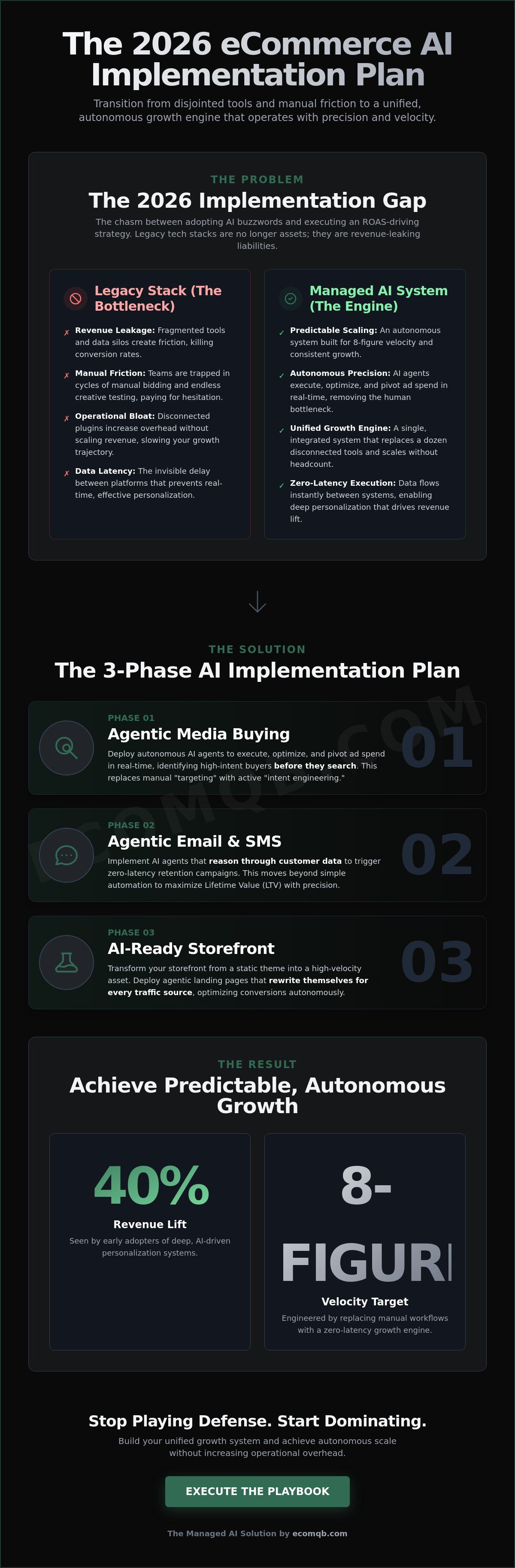
We agree that the old playbook of campaign-based marketing is dead. You're looking for predictable scaling, zero-latency execution, and a system that actually learns. This article provides the definitive blueprint to move from disjointed automation to a unified growth engine. We'll explore how to engineer agentic media buying, deploy zero-latency data systems, and achieve the 40% revenue lift seen by early adopters of deep personalization. You'll learn to build, optimize, and dominate the market without increasing your operational overhead. It's time to move from assistance to action.
Key Takeaways
- Stop chasing tools and start building systems. Identify the implementation gap to prevent revenue leakage caused by manual legacy workflows.
- Upgrade to agentic media buying. Discover how AI agents identify high-intent buyers before they search, optimizing your ad spend with autonomous precision.
- Master the eCommerce AI implementation plan. Transition from fragmented plugins to a unified, autonomous growth system that scales without increasing your headcount.
- Transform your storefront into a high-velocity asset. Learn why agentic landing pages outperform static themes by rewriting themselves for every traffic source.
- Secure your long-term growth. Deploy agentic email and SMS systems that reason through customer data to trigger zero-latency retention and maximize lifetime value.
The 2026 Implementation Gap: Why Legacy Tech Stacks Leak Revenue
The 2026 eCommerce landscape is a high-stakes game of milliseconds. Most brands are currently losing because they're trapped in the "Implementation Gap." This is the wide, expensive chasm between adopting AI buzzwords and executing an actual ROAS-driving strategy. Your legacy tech stack isn't just outdated; it's actively leaking revenue through data silos and manual friction. An effective eCommerce AI implementation plan isn't about adding another plugin to your Shopify sidebar. It is a total systemic transition from manual workflows to autonomous revenue engines that operate at the speed of the digital economy. To win, you must deploy, optimize, and dominate with precision.
The Death of the Manual Playbook
Manual bidding on Meta and Google advertising execution is no longer a strategic choice; it's a liability. Human reaction time cannot compete with the sub-second shifts of modern algorithms. When you rely on manual creative testing, you're accepting operational bloat that slows your growth trajectory. You're paying for hesitation. A Managed AI System is a unified engine for 8-figure velocity. It replaces the "guess and check" method with a playbook built on precision, momentum, and competitive advantage. If your team is still spending hours inside Ads Manager adjusting bids, you've already lost the lead. High-performance brands move faster by removing the human bottleneck from the tactical front lines.
Data Latency: The Silent Revenue Killer
Data latency is the invisible friction killing your conversion rates. When your email tool, SMS platform, and storefront operate as disconnected islands, you lose the ability to deliver real-time personalization. The foundational principles of Artificial intelligence in marketing have evolved far beyond simple recommendation engines. We're now in the era of agentic workflows. This requires a shift from "Human-in-the-loop" to "Agent-monitored" systems, where AI makes the tactical moves while you focus on the ultimate objective. This transition is exactly why eCommerce brand strategy consulting is now a managed AI system. You don't need a static brand deck; you need a living, breathing growth engine that executes at zero-latency.
The 2026 standard is built on three pillars: Speed, Precision, and Scale. Legacy systems fail because they prioritize human oversight over algorithmic execution. To hit 8-figure revenue velocity, your eCommerce AI implementation plan must prioritize the removal of every manual bottleneck. You're not just building a store; you're engineering a high-performance machine designed to outpace the competition. Every second of data delay is a second of lost profit. It's time to bridge the gap and move toward fully managed growth systems.
Phase 1: Deploying Agentic Media Buying for Immediate Scale
Scaling an 8-figure brand requires more than just better ads. It requires a fundamental shift in how capital is deployed across the digital landscape. In this phase of your eCommerce AI implementation plan, we move away from manual oversight and toward agentic media buying. These are not simple automation scripts. They are autonomous AI agents that execute, optimize, and pivot your ad spend in real-time. You're no longer just running campaigns; you're deploying a tactical advantage that works while your competitors sleep. This isn't just about efficiency. It's about systemic dominance.
The industry is rapidly shifting from passive "Targeting" to active "Intent Engineering." Instead of waiting for a user to trigger a search query, agentic workflows analyze billions of data signals to find buyers before they even realize they're in-market. This level of precision is one of the most critical AI use cases in retail today. It eliminates the expensive lag between a consumer's need and your brand's solution. By removing human bias from the creative testing cycle, you slash your CAC and stop subsidizing inefficiency. This is the primary lever for eCommerce marketing ROI optimization.
Meta and Google Dominance via AI Precision
Executing high-performance Meta campaigns now requires zero manual bidding. The system learns, adapts, and scales based on real-time performance metrics that no human could track. Similarly, Google Advertising execution has evolved into a high-stakes data-science competition. To stay ahead, you must adopt the agentic media buying playbook. It's about moving from button-clicking to system oversight. You're the field general, and the AI is your tactical strike team. If you're ready to see how these systems integrate into your specific brand, you can speak with our strategy team today.
Predictive Creative Optimization
Agentic systems identify winning creative assets in milliseconds. They don't wait for a 7-day window to tell you an ad is failing; they pivot the budget instantly. This predictive approach reduces ad waste by reallocating funds to high-performing cohorts before your ROAS takes a hit. Agentic media buying effectively eliminates traditional agency overhead by replacing manual labor with systemic intelligence. You get better results, faster execution, and lower costs. It's the only way to maintain 8-figure velocity in a zero-latency market. Stop managing pixels and start engineering growth.
Phase 2: Zero-Latency Retention through Agentic Email and SMS
Survival in the 2026 digital economy isn't about the first click. It's about the lifetime value (LTV) of every customer you acquire. As part of your eCommerce AI implementation plan, you must evolve beyond static retention tactics that rely on delayed responses. High-performance brands demand zero-latency execution. This means your system must reason, react, and respond to user intent while they are still engaged with your brand. You're not just sending messages; you're engineering AI personalization experiences that create a "segment of one" for every individual in your database. It's about precision, momentum, and results.
From Automated Flows to Agentic Reasoning
Most brands are stuck using static flows that trigger generic content based on a single action. If they click a link, they get Email A. If they don't, they get Email B. This approach is primitive. Agentic email and SMS systems use real-time reasoning to craft unique messaging based on deep browsing behavior, past purchase history, and current session intent. They don't just follow a script; they adapt to the customer's momentum. This shift toward agentic email marketing ensures your brand stays relevant in a crowded inbox. It is the difference between a generic broadcast and a tactical strike.
Reclaiming the Hidden Profit in Your List
Your current email list is likely a graveyard of missed opportunities. Static systems fail to capture high-intent recovery moments because they operate on fixed schedules. Agentic SMS changes the game by initiating recovery sequences exactly when a user's interest peaks, without the repetitive annoyance of traditional "batch and blast" methods. When you calculate the revenue impact of zero-latency communication, the numbers are undeniable. You are capturing profit that previously evaporated into the implementation gap. To scale effectively, your retention strategy must focus on three core pillars:
- Analyze real-time intent signals to determine the optimal message timing.
- Execute behavior-triggered reasoning to personalize content at the individual level.
- Optimize for zero-latency conversion to close the gap between interest and purchase.
To scale your brand toward 8-figure revenue velocity, your retention system must be autonomous. It should function as a fully managed growth engine that requires zero manual oversight. If your retention strategy still feels like a series of manual tasks, it's time to audit your retention system with eComQB. Stop leaving revenue on the table and start engineering a system that scales with your ambition. Your eCommerce AI implementation plan is only as strong as your ability to keep the customers you've already won.
Phase 3: Shopify Velocity and AI-Ready Storefronts
Your storefront is where the war for market share is won or lost. A standard Shopify theme is a bottleneck for high-performance scaling. It's built for generalists; it isn't engineered for elite execution. To fulfill a rigorous eCommerce AI implementation plan, your storefront must be as intelligent as your media buying. You need to move beyond static templates toward agentic landing pages. These are storefronts that rewrite their own headlines, offers, and social proof based on the specific traffic source. You aren't just designing a site; you're engineering a high-velocity conversion machine that acts in real-time.
Early adopters of deep personalization generate 40% more revenue than non-adopters, yet most brands still serve the same static page to every visitor. This is a strategic failure. Conversion Rate Optimization (CRO) is a technical engineering discipline, not a design project. When you integrate brand strategy with technical Shopify execution, you unlock the ability to scale to 8-figures without operational friction. Your store should function as a living, breathing extension of your growth system. It must read, react, and convert with zero human intervention.
The Anatomy of an AI-Ready Storefront
Speed, accessibility, and precision define the AI-ready storefront. Standard themes often bloat the DOM with unnecessary scripts, slowing down the very hooks needed for agentic personalization. Custom Shopify development is mandatory to bake AI data harvesting directly into your Liquid or Hydrogen code. This allows your system to "read" customer intent in high fidelity. If your current developer only knows how to install apps, you're falling behind. Focus on choosing an eCommerce growth agency that understands the technical mechanics of AI-driven commerce.
Dynamic Personalization at the Edge
Dynamic personalization happens at the edge of the user experience. It follows a precise three-step tactical playbook:
- Map Traffic Source Data: Connect UTM parameters and intent signals directly to your AI-driven landing pages.
- Deploy Agentic Personalization: Use AI to adjust product grids and value propositions in milliseconds based on real-time browsing behavior.
- Measure the Delta: Constantly analyze the performance gap between static pages and agentic execution to refine your revenue velocity.
Stop treating your website like a digital brochure. It is a tactical asset that must be optimized for the 2026 digital economy. When your storefront is AI-ready, you eliminate the latency that kills conversions. If your current store is holding back your growth trajectory, it's time to book a call with our technical team to build your high-velocity storefront. Move from static layouts to autonomous growth engines.
The Managed AI Solution: Execution Without Operational Overhead
The biggest mistake mid-market brands make is confusing a software subscription with a strategy. You don't need more apps; you need a unified, autonomous growth engine. Most guides suggest upskilling your current team or hiring an expensive internal AI department. This is a slow, resource-heavy path to failure. Your eCommerce AI implementation plan should focus on results, not infrastructure. At eComQB, we provide a fully managed AI transformation as a service. We don't just give you the playbook; we run the plays. This is the difference between having tools and having a system that scales your brand without increasing your headcount.
Revenue Generating AI Tools are high-performance instruments. Like any precision tool, they only work when managed by tactical experts who understand the mechanics of growth. You aren't just buying code; you're deploying a tactical strike team. Moving from buying software to deploying a growth system is the final step in engineering 8-figure velocity. It's about removing the operational bloat of manual management and replacing it with systemic precision. This transition allows your leadership team to focus on the bird's-eye view of the industry while the AI orchestrates the tactical moves. You stay focused on the ultimate objective while the system handles the execution.
Curated AI Stacks vs. App Overload
App overload is the silent killer of ROAS. When your data is fragmented across twelve different Shopify plugins, your brand loses the ability to act with speed. eComQB functions as your Field General for technical execution. We replace the chaos of disconnected apps with a curated eCommerce AI growth system. This unified approach ensures that your media buying, retention, and storefront are all reading from the same data source. It is the only way to achieve zero-latency revenue scaling. We eliminate the silos, remove the friction, and drive the results.
Claim Your Competitive Advantage
The window for AI-driven dominance is closing fast. As market leaders adopt agentic workflows, the gap between the innovators and the laggards will become insurmountable. Decisive leadership is required to pivot your brand toward this new standard. Your final strategic briefing is simple: audit your current stack for immediate revenue leaks. Identify where data latency is costing you conversions and where manual bidding is burning your budget. It's time to stop playing defense and start engineering your competitive advantage. The digital economy moves quickly; your growth system must move faster. Book Your Strategic Audit with eComQB today and move your brand toward the 8-figure mark.
Engineer Your Competitive Advantage
The window for manual execution has closed. To scale in 2026, you must transition from fragmented plugins to a unified, autonomous growth engine. We've mapped the path from identifying legacy data leaks to deploying agentic media buying and zero-latency retention systems. You now possess the blueprint for a high-velocity Shopify storefront that reasons, reacts, and converts at the edge. This is no longer a design project or a marketing experiment. It is a systemic engineering challenge that requires precision, momentum, and results.
Execution is the only differentiator that remains in a zero-latency market. Your eCommerce AI implementation plan is the definitive bridge between current operational bloat and 8-figure revenue velocity. By leveraging a fully managed AI transformation, you secure elite agentic media buying execution and specialized 8-figure velocity engineering. You eliminate the overhead while reclaiming the profit. Stop managing software and start leading your industry with a system designed for dominance. The digital economy rewards the decisive. You have the tactical playbook, the strategic mastery, and the technical partner. It's time to move from assistance to action.
Book Your Call to Deploy the Revenue Machine
Frequently Asked Questions
What is an eCommerce AI implementation plan?
An eCommerce AI implementation plan is a systemic blueprint for transitioning manual workflows into autonomous revenue engines. It moves your brand from fragmented, disconnected tools to a unified intelligence system that executes growth strategies with precision and scale. This plan ensures your data, marketing, and storefront work in a zero-latency loop, allowing you to scale without increasing operational bloat.
How does agentic media buying lower my CAC?
Agentic systems eliminate human lag and bias by optimizing ad spend in milliseconds. By using predictive analytics to identify high-intent buyers before they search, you stop wasting capital on low-performing cohorts. This precision ensures every dollar is deployed where it has the highest probability of conversion. You're no longer guessing; you're engineering acquisition with tactical certainty.
Can I implement AI on my existing Shopify store?
Yes, but a standard theme often acts as a bottleneck that requires technical optimization. Your eCommerce AI implementation plan should include custom Liquid or Hydrogen development to remove data latency. This allows AI agents to read customer intent signals in high fidelity and adjust the storefront in real-time. It's about turning a static store into a high-velocity asset.
What is the difference between AI automation and agentic workflows?
Automation follows fixed "if-then" rules, while agentic workflows reason and take independent action based on real-time data. While a basic bot might send a scheduled email, an agentic system analyzes current session behavior to decide which product, offer, and message will maximize conversion at that exact moment. It's the shift from passive tools to active, autonomous intelligence.
How long does a full AI transformation take for a DTC brand?
A comprehensive transformation typically moves from a tactical audit to full deployment within 90 days. Initial wins in agentic media buying often appear within the first 30 days, followed by the integration of retention systems and storefront optimization. Speed depends on your current tech debt and your leadership's commitment to adopting high-performance, autonomous growth systems.
Do I need to hire a technical team to manage these AI systems?
No, the most efficient path is a managed solution that provides the technical expertise as a service. Hiring an internal AI department is often too slow and expensive for mid-market brands. A tactical partner acts as your field general, managing the technical complexity while your leadership team remains focused on high-level strategy and market dominance.
What are agentic landing pages and how do they improve conversion?
Agentic landing pages are dynamic storefronts that rewrite their own content based on the traffic source and user intent. By adjusting headlines, social proof, and product grids in real-time, they eliminate the friction of a one-size-fits-all experience. This zero-latency personalization directly addresses the visitor's specific needs, leading to a measurable increase in conversion velocity and revenue.
Why is LTV more important than ROAS in a 2026 growth strategy?
High acquisition costs make single-purchase profitability difficult; lifetime value (LTV) is what secures your brand's survival. Brands that master agentic retention will outpace those focused only on the first click. Predictable revenue comes from engineering zero-latency communication that keeps customers coming back autonomously. You aren't just buying customers; you're engineering a long-term competitive advantage.