AI Workflow Automation for eCommerce: The 2026 Strategic Playbook

Most 8-figure brands aren't failing because of their products; they're failing because their operations are still tethered to the manual speed of 2023. By the time the EU AI Act compliance deadline hits in August 2026, the distance between the leaders and the laggards will be measured in millions of dollars in lost velocity. You've likely felt the weight of operational bottlenecking. You see the declining ROAS as your creative cycles lag behind the market, and you're tired of fragmented data scattered across Shopify and your marketing stack. It's time to stop managing friction and start orchestrating growth.
This guide is your masterclass in AI workflow automation eCommerce, designed to move you from manual tasks to agentic velocity. We'll show you how to build a high-performance automation framework that reclaims your strategic time and delivers predictable revenue scaling. We're moving beyond basic tools to a system of precision, speed, and scale. We will examine the exact architecture needed for zero-latency execution across your entire marketing and operations engine, ensuring your brand is built for the high-stakes environment of the next decade.
Key Takeaways
- Identify and eliminate the "Legacy Tax" of manual workflows that drain your margins and stall your competitive momentum.
- Master the deployment of AI workflow automation eCommerce to bridge the gap between fragmented data and agentic execution.
- Replace disconnected "Frankenstein Stacks" with integrated growth systems to slash operational overhead and technical friction.
- Execute a high-performance blueprint to audit revenue leaks, standardize your data, and scale your operations with precision.
- Shift from tactical management to strategic leadership by partnering with an expert team focused on 8-figure scaling.
The 2026 eCommerce Landscape: Why Manual Workflows Are Revenue Leaks
In the high-velocity world of 2026, manual workflows aren't just inefficient; they're predatory. They drain your margins, stall your momentum, and erode your competitive edge. We define AI workflow automation eCommerce as the systemic replacement of manual decision-making with agentic execution. It's the evolution from tools that help you work to systems that work for you. While traditional Business process automation (BPA) focused on digitizing paper trails, agentic automation focuses on autonomous intelligence. You aren't just automating a task; you're automating the intellect behind the task. This transition is the difference between a brand that reacts to the market and one that dictates it.
Every minute your team spends on manual bid adjustments or brute-force content creation is a "Legacy Tax." This tax is paid in lost ROAS, stagnant growth, and missed opportunities. In a market where 88% of organizations already leverage AI in at least one business function, human speed is no longer the benchmark. It's the bottleneck. Velocity has emerged as the primary KPI for 8-figure brands. If you can't iterate, pivot, and scale in real-time, you're already behind. We're witnessing a fundamental shift from AI-assisted models to AI-orchestrated enterprises. In this new era, the machine handles the mechanics while the leader directs the intent. Precision, speed, and scale are the only metrics that matter.
The High Cost of Strategic Latency
Waiting for human approval cycles is the fastest way to kill a winning campaign in 2026. Strategic latency is the gap between data ingestion and decisive action. It's where revenue goes to die. Slow data processing means you miss critical trend windows that open and close in hours. If your team takes three days to analyze a shift in Meta performance, you've already lost the arbitrage. Agentic systems move from reactive management to proactive dominance. They identify patterns, optimize bids, and execute creative swaps before your competitor even opens their dashboard. You must out-think, out-pace, and out-execute the field.
Reclaiming the Founder’s Strategic Time
High-performance leaders must shed low-leverage tasks immediately. If a task is repetitive, data-dependent, or rule-based, it belongs to the agent. Moving from "in the business" to "on the business" requires systemic trust in your automation framework. Adopting an AI Transformation for eCommerce Brands is the new industry standard for founders who refuse to be limited by their own bandwidth. By automating the friction, you unlock the freedom to focus on high-level strategy, brand narrative, and market expansion. You don't scale by working harder; you scale by building a system that works without you. Analyze, optimize, and scale with total confidence.
Architecting the Agentic Ecosystem: Three Pillars of High-Velocity Automation
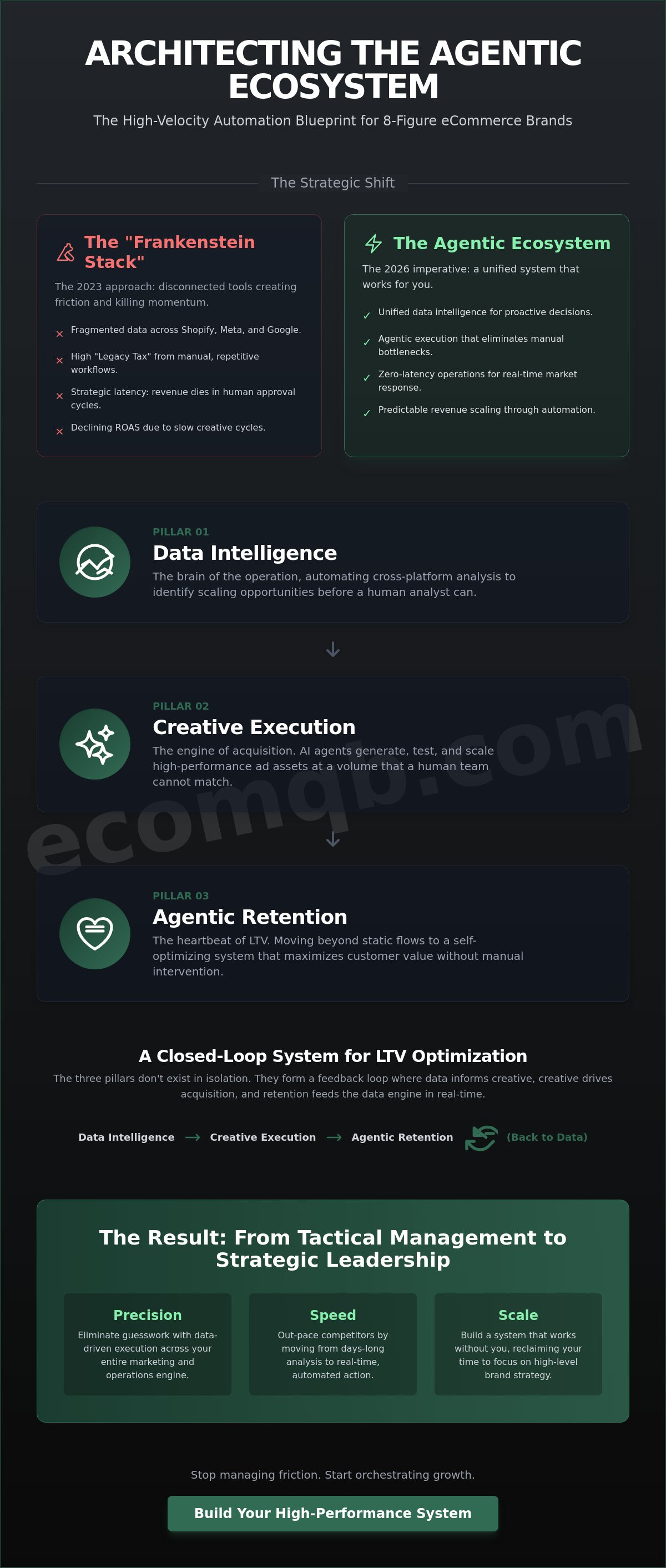
Scaling to 8 figures requires more than a collection of apps; it requires a unified architecture. Most brands build a "Frankenstein Stack" of disconnected tools that create more friction than they solve. A true AI workflow automation eCommerce ecosystem is built on three unbreakable pillars: Data Intelligence, Creative Execution, and Agentic Retention. These pillars don't exist in isolation. They form a closed-loop system where data informs creative, creative drives acquisition, and retention feeds the data engine. This feedback loop allows the system to communicate and optimize LTV in real-time without manual intervention. It's a self-optimizing organism designed for peak performance.
- Pillar 1: Data Intelligence. This is the brain of your operation. It automates the ingestion of metrics from Shopify, Meta, and Google, performing cross-platform analysis that identifies scaling opportunities before they become obvious to a human analyst.
- Pillar 2: Creative Execution. This is the engine. AI agents generate, test, and iterate high-performance ad assets at a volume that would break a traditional creative team. It turns creative into a data-driven variable rather than a subjective hurdle.
- Pillar 3: Agentic Retention. This is the heartbeat. Static email flows are obsolete. Automated emails in 2025, which made up only 2% of total sends, were responsible for 30% of email-driven revenue. Agentic systems take this further, delivering zero-latency customer journeys that adapt to behavior, intent, and purchase history instantly.
Agentic Media Buying and Ad Ops
Manual bid management is a relic of a slower era. Implementing agentic media buying allows your brand to operate at the speed of the algorithm. These systems eliminate the need for human oversight on routine adjustments, allowing for instant scaling when performance peaks. The Meta and Google feedback loop is now automated, ensuring your budget is always allocated to the highest-performing segments. AI-driven creative testing occurs at a velocity humans cannot match, identifying winners in hours, not weeks. To see how your current stack measures up, you can request a technical audit of your automation ecosystem.
Personalization at Scale: The End of Static Storefronts
Static storefronts are conversion killers. In 2026, the storefront must be as dynamic as the user's intent. We're moving beyond basic product recommendations to full dynamic storefront architecture. This includes agentic landing pages that rewrite their own copy and swap hero images based on real-time user signals. When a customer arrives from a specific ad, the entire storefront shifts to mirror that narrative. This level of AI workflow automation eCommerce also extends to the back end. Predictive inventory management automates the bridge between supply and demand, ensuring you never go out of stock on a trending SKU. You aren't just selling; you're orchestrating a personalized experience for every single visitor.
The Strategic Trade-off: Point Solutions vs. Integrated AI Growth Systems
You don't win a high-stakes race by bolting parts from ten different cars onto one chassis. Yet, most brands suffer from the "Frankenstein Stack" problem. They deploy fifteen different AI apps, but they lack a cohesive growth system. This fragmented approach creates automation silos where data doesn't flow, insights are lost, and execution is disjointed. True AI workflow automation eCommerce requires a unified architecture, not a patchwork of point solutions. When your tools don't talk, your revenue stalls. You need a system that breathes together, learns together, and scales together.
DIY automations carry a heavy hidden tax: operational overhead. You spend your strategic time troubleshooting API breaks, updating triggers, and managing tool sprawl. This is the silent killer of 8-figure scaling. Every hour spent playing IT manager is an hour lost on market dominance. The top 1% of brands understand this trade-off. They stop managing the tech and start leading the brand by outsourcing the technical stack to specialists. Evaluating ROI isn't about comparing subscription fees; it's about measuring the massive revenue lift of a unified system against the friction of manual work. Precision beats volume every time.
The Myth of the "Set and Forget" Tool
AI is not a magic wand; it's a high-performance engine. It requires constant tuning, strategic oversight, and human-in-the-loop governance to remain profitable. Without proper guardrails, "black box" automations can drift, leading to off-brand messaging or inefficient ad spend. You cannot automate strategy. Understanding managed AI services for eCommerce is how you bridge the expertise gap. It ensures your systems are always optimized, compliant, and aggressive. Maintain total control over your growth trajectory through expert governance.
Engineering High-Velocity Growth
There is a massive distinction between efficiency tools and revenue-generating systems. Efficiency tools save you ten minutes; revenue systems add seven figures to your top line. Systemic integration is the only path to 8-figure velocity. You need a framework where your email agent knows what your Meta agent is doing in real-time. Utilizing AI consulting for eCommerce provides the bridge to technical mastery. It turns your AI workflow automation eCommerce from a cost center into a strategic weapon. Build for speed, engineer for scale, and execute with certainty.
The High-Performance Implementation Blueprint: A 5-Step Automation Template
Theory is for observers; execution is for leaders. Transitioning your brand to a state of agentic velocity requires a methodical, high-performance blueprint. You don't just "turn on" AI workflow automation eCommerce; you architect it from the ground up. This five-step template is designed to strip away manual friction and replace it with systemic precision. It's the roadmap for moving from operational chaos to an 8-figure revenue engine that runs on data, speed, and trust.
- Step 1: Audit the Revenue Leaks. Identify exactly where manual friction is costing you the most. We look for high-volume, low-leverage tasks that delay your speed to market.
- Step 2: Clean the Data Foundation. Garbage in, garbage out. We standardize inputs across Shopify, Meta, and Google to ensure your agentic systems have a single source of truth.
- Step 3: Deploy Core Agentic Workflows. Start where the money is. We prioritize media buying and high-velocity email/SMS systems to drive immediate ROAS.
- Step 4: Establish the Feedback Loop. Connect your marketing data directly to inventory and creative. When a product trends, the system should know to scale spend and adjust creative instantly.
- Step 5: Scale with Managed Oversight. Optimization never stops. We monitor the system for anomalies and tune the engine for peak performance as your brand grows.
Phase 1: The Tactical Audit
Strategy without diagnostics is just guessing. We use AI diagnostics to find "leaking" revenue in your current funnel. This isn't a surface-level check; it's a deep dive into your customer journey to identify high-impact automation points. We map every touchpoint to see where human approval cycles are killing your momentum. By setting baseline KPIs for the new automated system, we ensure every move we make is measured against hard revenue growth. You can't manage what you don't measure. You can't scale what you don't control.
Phase 2: Execution and Optimization
Once the foundation is set, we move into aggressive execution. Implementing agentic email marketing is the first major move to maximize retention and lifetime value. We adopt an AI "General" approach to rapid iteration, where the system continuously tests and learns from every customer interaction. This isn't about minor tweaks; it's about constant, systemic improvement. We monitor the "Revenue Machine" for anomalies, ensuring that as you scale, the system remains stable and profitable. To begin your transition from manual work to agentic velocity, schedule your high-performance automation audit here.
Scaling Beyond the Tech: The eComQB Managed AI Transformation
Dominating the 2026 market requires more than just software. It requires a field general who understands the mechanics of growth. eComQB functions as your tactical partner, providing the AI workflow automation eCommerce infrastructure needed to out-pace the competition. We manage the technical complexities so you can focus on high-level brand leadership. Our approach isn't about adding more tools to your dashboard; it's about engineering a unified revenue engine. From Shopify website design and development to agentic media buying, we provide end-to-end execution that turns technology into a competitive weapon. Analyze, optimize, and scale with total confidence.
Our curated technology stack is built on proven, revenue-generating tools. We don't just hand you the keys; we drive the car. This managed transformation ensures your brand remains agile, compliant, and aggressive. With 88% of organizations already integrating AI into core functions as of 2025, the window for early-mover advantage is closing. We eliminate the friction, the learning curve, and the technical debt that holds most founders back. Our team handles everything from Meta advertising execution to agentic email and SMS marketing, ensuring your brand speaks with one voice across every channel. You get precision, speed, and results without the operational headache.
The results of this transition are documented and decisive. Research shows that 79% of brands using AI-driven conversational commerce reported increased sales in early 2026. However, these gains are only possible when the technology is integrated into a broader strategy. We bridge the gap between technical capability and commercial success. Whether it's deploying agentic landing pages or optimizing your Google advertising execution, every move we make is designed to increase your margins and accelerate your velocity. We are the tactical partner for brands ready to dominate.
The eComQB Advantage: Strategic Mastery
We don't chase "cool" automations. We chase profit margins and lifetime value. A fully managed eCommerce AI growth system is the only way to achieve 8-figure velocity in a fragmented market. By removing the burden of technical management, we allow your internal teams to operate at their highest level of leverage. You get the benefits of cutting-edge innovation without the operational headache of DIY maintenance. We focus on the metrics that matter: ROAS, LTV, and contribution margin. It's a professional, contemporary approach that is unapologetically focused on peak performance.
Your Next Strategic Move
The transition to agentic commerce is not optional. Legacy brands that fail to adapt are already losing ground to high-velocity competitors. With the EU AI Act compliance deadline approaching in August 2026, the cost of inaction is rising daily. Stop buying disconnected tools and start building a cohesive growth system. This is your opportunity to reclaim your strategic time and secure your brand's future. The playbook is ready. The system is proven. Deploy your high-velocity growth system with eComQB and lead your market with total confidence.
Orchestrate Your 8-Figure Ascent
The window for manual dominance has closed. By 2026, the gap between brands tethered to legacy workflows and those operating at agentic velocity will be permanent. You now hold the blueprint for systemic optimization. You understand that fragmented tools create friction while integrated systems create revenue. Master the pillars of data intelligence, creative execution, and retention to secure your market position. It's time to move beyond the "Frankenstein Stack" and embrace a unified architecture designed for peak performance.
Transitioning to AI workflow automation eCommerce is the single most critical move for brands ready to dominate. You can continue to pay the "Legacy Tax" of manual oversight, or you can deploy a system designed for 8-figure scaling. We provide the curated AI technology stacks, managed agentic media buying, and Shopify high-velocity storefront expertise needed to win. Stop managing the tech. Start leading the brand. Your next strategic move determines your trajectory.
Stop leaking revenue—deploy your Managed AI Growth System today. The future belongs to the fast, the precise, and the automated.
Frequently Asked Questions
How much does AI workflow automation for eCommerce cost?
Verified industry data shows that a full AI automation stack for a mid-sized brand typically costs between $300 and $1,500 per month in software fees alone. Entry-level tools for site search start at $49, while enterprise-level dynamic pricing systems can exceed $5,000 monthly. The total investment depends on your scale and whether you choose a fragmented DIY approach or a managed growth system designed for 8-figure velocity.
Will AI automation replace my current eCommerce marketing team?
AI doesn't replace high-level talent; it replaces low-leverage tasks. Your team shifts from manual execution to strategic orchestration. Instead of spending hours on bid adjustments or content formatting, your staff functions as a group of strategists who direct the AI agents. This transition allows your team to focus on brand narrative, market expansion, and high-level creative direction while the machine handles the mechanics.
Is AI workflow automation compatible with Shopify and Shopify Plus?
Yes, AI workflow automation eCommerce is built to integrate directly with Shopify and Shopify Plus via robust API connections. These systems synchronize data across your storefront, inventory management, and marketing apps in real-time. This ensures that your agentic workflows have a single source of truth, allowing for zero-latency execution across your entire digital ecosystem. We specialize in engineering these high-velocity storefronts for maximum performance.
What is the difference between simple automation and agentic workflows?
Simple automation follows rigid "if-this-then-that" rules that require human updates when conditions change. Agentic workflows use autonomous agents capable of analyzing data and making real-time decisions to reach a specific objective. While simple automation is reactive, agentic systems are proactive. They don't just follow instructions; they execute intent by adjusting bids, swapping creative, or personalizing customer journeys based on live performance signals.
How long does it take to see a return on investment from AI transformation?
Initial efficiency gains and reclaimed strategic time are usually visible within the first 30 days of implementation. Revenue lift from personalization and agentic media buying typically follows a phased trajectory, with significant performance compounding over 3 to 6 months. According to McKinsey, AI-driven personalization can lead to a 5-15% revenue lift once the models have sufficient data to optimize your specific customer segments.
Can AI automation help with customer service and retention?
Absolutely. 79% of brands report that AI-driven conversational commerce has increased their sales as of 2026. Automated systems move beyond basic chatbots to provide personalized, zero-latency support that adapts to purchase history and intent. By automating retention flows, you can capture more revenue from your existing base. Automated emails accounted for 30% of email-driven revenue in 2025 despite making up only 2% of total sends.
What are the risks of using "black box" AI tools for my brand?
The primary risks include brand drift, lack of transparency, and regulatory non-compliance. Using unmanaged tools can lead to messaging that contradicts your brand voice or violates new regulations like the EU AI Act. By August 2026, businesses serving EU customers must comply with strict transparency and documentation requirements. A managed system provides the human-in-the-loop governance necessary to mitigate these risks while maintaining peak performance.
How do I choose between a DIY AI stack and a managed growth system?
A DIY stack is often a "Frankenstein" collection of disconnected apps that create technical debt and operational friction. It requires your team to manage, update, and troubleshoot every integration. A managed growth system provides a unified architecture and expert oversight. You stop being an IT manager and start being a brand leader. If your goal is 8-figure scaling with minimal friction, a managed system is the inevitable strategic choice.