Agentic Meta Ads for eCommerce: The 2026 High-Velocity Playbook
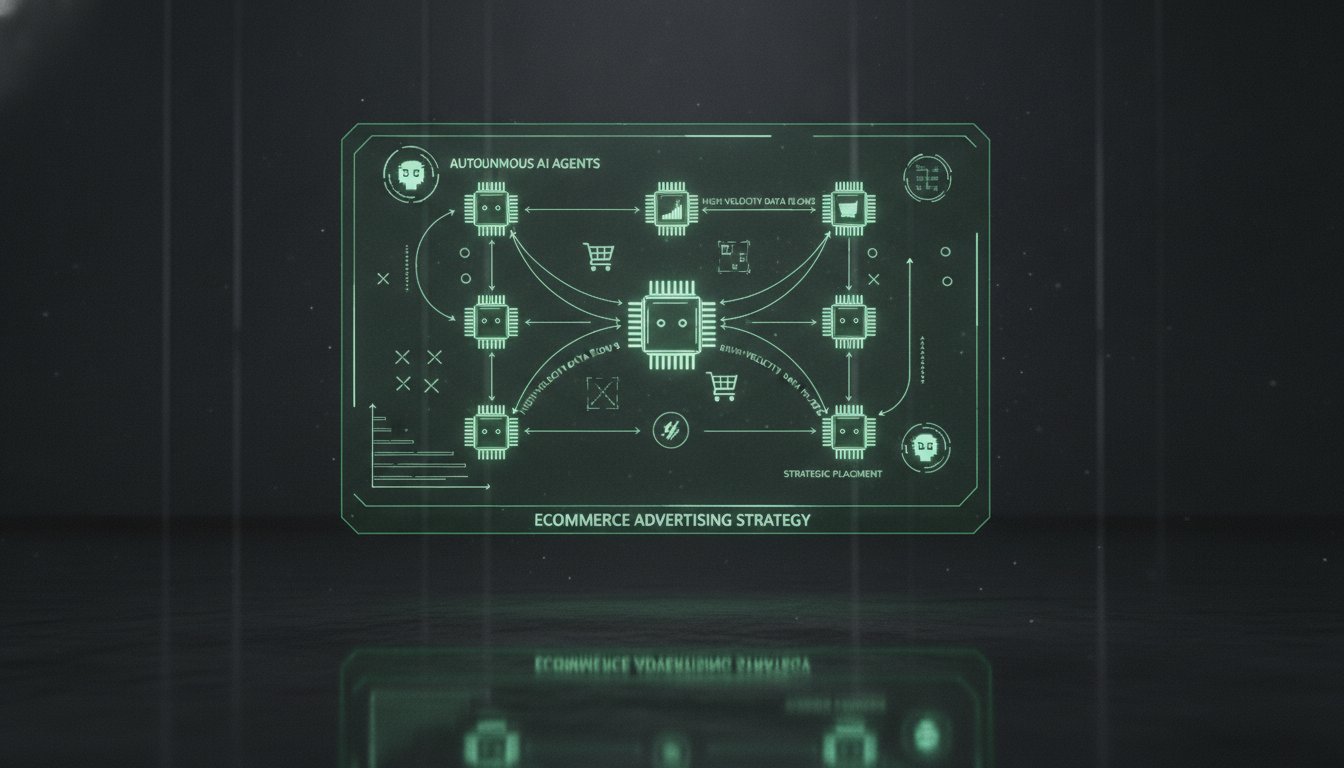
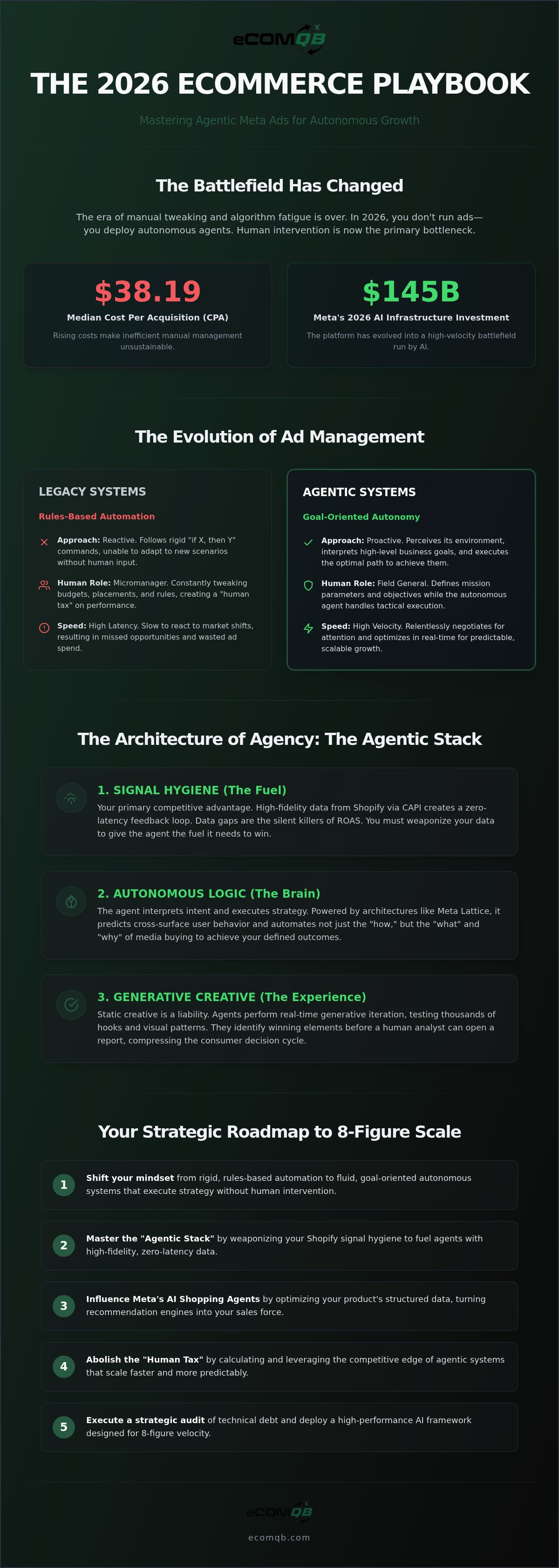
In 2026, you don't run ads; you deploy autonomous agents that negotiate for attention within Meta's self-contained shopping economy. The era of manual testing, constant tweaking, and algorithm fatigue is over. With Meta's AI infrastructure investment hitting $145 billion this year, the platform has become a high-velocity battlefield where human intervention is the primary bottleneck. Transitioning to agentic meta ads for ecommerce is the only way to survive a market where median CPAs have climbed to $38.19. You must adapt, automate, and accelerate to maintain your competitive edge.
You already know that the old playbooks are failing. Rising costs, fragmented data, and the widening gap between Shopify and Meta's Lattice architecture have turned scaling into a high-stakes gamble. We're here to change that trajectory. This guide provides the strategic blueprint to master the shift from manual automation to fully autonomous agentic media buying. You'll gain the tools to secure predictable ROAS at scale and eliminate the latency that kills growth. We'll examine the technical mechanics of full-funnel autonomy, the impact of new transparency laws, and the tactical moves required to dominate the 2026 ecosystem.
Key Takeaways
- Shift from rigid, rules-based automation to fluid, goal-oriented autonomous systems that execute strategy without human intervention.
- Master the "Agentic Stack" by weaponizing your Shopify signal hygiene to fuel agentic meta ads for ecommerce with high-fidelity data.
- Influence Meta’s 2026 AI Shopping Agents by optimizing structured data, turning recommendation engines into your most effective sales force.
- Abolish the "Human Tax" by calculating the competitive edge of agentic systems that scale faster and more predictably than legacy media buying.
- Execute a strategic roadmap to audit technical debt and deploy a high-performance AI framework designed for 8-figure velocity.
The Death of Manual Bidding: Understanding Agentic Meta Ads in 2026
Manual bidding is a relic. If you're still clicking buttons to adjust budgets or toggle placements, you're already behind. Meta's 2026 capital expenditure for AI infrastructure is projected between $130 billion and $145 billion. This massive investment signals a total systemic overhaul of the advertising environment. Agentic meta ads for ecommerce represent the shift from reactive rules to proactive autonomy. You aren't just automating tasks; you're deploying a digital workforce designed to win in a high-velocity market.
Traditional automation followed your commands. It was rules-based: if X happened, the system did Y. An intelligent agent operates on a different plane. It perceives its environment, interprets your high-level business objectives, and executes the optimal path without waiting for human permission. This transition provides a triadic advantage for high-performance brands: absolute precision, relentless velocity, and predictable scale. In this landscape, agentic meta ads for ecommerce allow the media buyer's role to shift from a button-pusher to a field general who defines the mission parameters while the machine handles the mechanics.
From Advantage+ to True Agency
Advantage+ Shopping was merely the training wheels for the current era. It automated the "how," but 2026 systems automate the "what" and "why." The engine driving this evolution is Meta Lattice, an architecture that predicts cross-surface intent with unparalleled accuracy. You no longer waste time setting bids or selecting placements. You define outcomes. The system negotiates for the highest-value users across the entire ecosystem, moving beyond simple automation into true strategic agency. It's a move from micromanagement to mastery.
The Closed-Loop Meta Economy
The marketing funnel has effectively collapsed. In 2026, discovery, recommendation, and checkout occur almost entirely within the Meta ecosystem. Meta's AI shopping agents manage the entire journey from initial intent to the final transaction. This shift fundamentally transforms your website's role. It's no longer just a destination for traffic; it's a critical data source that feeds the agentic engine. Traditional click-through metrics have become secondary to in-platform conversion signals. You aren't just buying ads anymore. You're powering a self-contained economy where speed to transaction is the only metric that matters.
The Architecture of Agency: How Meta’s AI Agents Execute Growth
The architecture of growth has shifted from human intuition to a high-fidelity "Agentic Stack." To dominate Meta's 2026 landscape, you must master three core pillars: Signal, Logic, and Creative. Logic is the brain that interprets intent. Creative is the sensory experience that captures it. But Signal is the fuel that powers the entire operation. Without high-velocity data, even the most sophisticated agentic meta ads for ecommerce will stall on the starting line. You aren't just running campaigns; you're managing a systemic loop that requires precision at every layer.
Signal Hygiene: The Fuel of the Machine
In 2026, signal hygiene is your primary competitive advantage. It is the difference between an algorithm that guesses and one that knows. You must optimize the Conversions API (CAPI) to meet modern standards, ensuring that every touchpoint from the initial discovery to the final Shopify checkout is captured with zero latency. Data gaps are the silent killers of ROAS. When your ad account loses visibility on a purchase, the agent loses its ability to optimize. High-performance brands don't just track sales; they weaponize their data to provide the machine with a perfect feedback loop. Eliminating these gaps ensures that your agentic meta ads for ecommerce have the ammunition they need to hit targets with surgical accuracy.
Autonomous Creative Strategy
Static creative is a liability. Agents now perform generative iteration, testing thousands of hooks and visual patterns in real-time. This goes far beyond basic A/B testing. These systems identify winning elements before a human analyst can even open a report. They analyze pixel-level data to see what stops the scroll and what drives the click. Recent research on AI and e-commerce highlights how these autonomous recommendations directly compress the decision-making cycle for modern consumers. By reducing the friction between discovery and intent, agents create a seamless path to purchase that manual creative simply cannot match.
To keep pace with this demand for volume, solutions like ShootEngine AI allow merchants to instantly turn a single product shot into a full suite of ready-to-sell assets, ensuring the agent always has fresh, high-quality content to test.
Maintaining brand integrity while letting the machine iterate is the new creative challenge. You provide the guardrails; the agent provides the volume. It's about defining the aesthetic DNA and letting the agentic system find the highest-performing expression of that brand. This ensures your creative remains fresh, relevant, and effective without requiring constant manual intervention.
Dynamic Budget Reallocation
The speed of the algorithm now exceeds the speed of human thought. Dynamic budget reallocation moves capital across campaigns and audiences in milliseconds. If a specific creative angle begins to fatigue, the agent shifts spend to a rising winner instantly. This ensures your capital is always working at its highest potential, maximizing yield while minimizing waste. If you're ready to stop managing pixels and start leading a growth system, you can speak with our team about an AI audit. Transitioning to an agentic model isn't just an upgrade; it's a total strategic pivot toward autonomous scale.
Winning the Recommendation Engine: Optimizing for Meta’s Shopping Agents
In 2026, the battle for attention isn't fought on the scroll alone. Meta is deploying AI shopping agents across Instagram, Facebook, and WhatsApp to manage the entire journey from discovery to purchase. To win, your agentic meta ads for ecommerce must do more than catch a human eye; they must convince the recommendation engine that your product is the definitive solution. You're optimizing for a Large Language Model (LLM) that prioritizes relevance, trust, and availability. You must persuade the gatekeeper to earn the recommendation.
The recommendation engine doesn't just look at your creative. It parses your entire digital footprint to determine if your brand is a safe bet for the user. This means your SEO strategy for Meta now requires a focus on machine readability. You must syndicate high-fidelity trust signals, including UGC and customer reviews, directly into your Meta ecosystem. These aren't just for social proof anymore. They are data points the agent uses to validate your product's quality and fit. If the agent can't verify your claims, it won't risk its own utility by recommending you to the user.
The New Catalog Standard
Basic titles and descriptions are the bare minimum in a high-velocity environment. Today's market leaders utilize semantic attributes to give the agent a deep, contextual understanding of every SKU. Every "ghost attribute" or empty field in your Shopify feed represents a missed revenue opportunity. When the machine can't categorize your product with absolute certainty, it defaults to a competitor who provided better data. Integrating your agentic media buying directly with your catalog health is the only way to maintain visibility. You must feed the machine the specifics it craves: material, fit, occasion, and technical specs. Precision in your data feed leads to precision in your delivery.
Conversion via Conversation
The path to purchase has been compressed into a dialogue. Modern agentic meta ads for ecommerce now lead directly into AI-managed threads on WhatsApp and Messenger. The agent acts as the ultimate concierge. It answers questions. It overcomes objections. It closes the sale. This reduces friction by keeping the user within the platform they already trust, eliminating the drop-off seen in traditional mobile web checkouts. You aren't just tracking clicks anymore. You're measuring "Conversation ROAS" to understand how effectively your agents turn inquiries into revenue. This is the new standard for post-click efficiency. It's about being present, being helpful, and being decisive in the moment of intent.
Legacy Management vs. Agentic Systems: Calculating the Competitive Edge
Manual media buying is now a liability. In the high-velocity environment of 2026, every minute spent manually adjusting a bid or refreshing a report is a minute of lost opportunity. This is the "Human Tax." It's a hidden cost that manifests as delayed reactions to market shifts and missed signals in the Meta Lattice architecture. While a human buyer sleeps, the market moves. By partnering with a specialized digital marketing agency Vijayawada, brands can ensure that agentic meta ads for ecommerce eliminate this latency by operating at the speed of the algorithm, ensuring capital is always deployed where it generates the highest yield.
The competitive edge of an agentic system lies in its ability to mitigate risk autonomously. Legacy systems often suffer from budget blowouts or creative fatigue because the response time is tethered to human oversight. Agents don't have this limitation. They identify performance decay in real-time and reallocate funds before waste occurs. Transitioning your brand requires more than just a software update; it requires a complete shift in operations. Our AI transformation services serve as the bridge between legacy stagnation and autonomous growth, providing the technical infrastructure needed to compete at the highest level.
The 8-Figure Velocity Gap
Scaling to 8 figures introduces a level of complexity that manual teams simply cannot navigate. At this volume, the sheer number of variables, from SKU-level performance to cross-channel attribution, creates a data fog. Agentic systems pierce this fog. They manage the full funnel with a level of granularity that human teams find impossible to replicate. Brands that rely on managed AI services consistently outperform in-house legacy teams because they prioritize systemic optimization over tactical tinkering. The result is a lower CAC and a more resilient path to scale.
Reclaiming Strategic Time
The role of the founder is evolving. You are no longer required to be a "button pusher" in the ad manager. By deploying agentic meta ads for ecommerce, you shift your focus back to brand strategy, product innovation, and high-level vision. AI growth systems reclaim 40+ hours of strategic time per month. This allows you to lead your brand with clarity while the machine handles the mechanics of execution. You move from the engine room to the cockpit, making the decisive moves that define your market position.
If you're ready to stop paying the "Human Tax" and start scaling with precision, it's time for a tactical upgrade. We can help you audit your current stack and identify the levers for autonomous growth. Schedule your AI performance briefing today and secure your position in the 2026 economy.
Deploying Agentic Ads: Your Strategic Roadmap to 8-Figure Scale
Deploying agentic meta ads for ecommerce requires more than a software subscription. It demands a tactical overhaul of your digital infrastructure. You must begin by auditing your current signal health and clearing the technical debt that creates friction in the Lattice architecture. This is the moment to deploy the eComQB 'Revenue Machine' framework. It is a system designed to bridge the gap between legacy operations and 8-figure velocity. You move from guessing to knowing. You shift from reacting to orchestrating. Successful deployment relies on the seamless integration of your ad agents with high-performance Shopify development to ensure the machine has a fast, high-converting destination to drive traffic.
Step 1: The Technical Foundation
The machine requires a mission. You must hard-code your brand DNA into the agent's logic to ensure every autonomous decision aligns with your identity. This involves setting strict guardrails for creative generation and defining the aesthetic boundaries the AI must respect. Without these constraints, autonomy becomes a liability. You establish the North Star KPIs that dictate the agent's behavior, focusing on contribution margin rather than vanity metrics. This foundation allows the system to iterate based on autonomous performance insights. You replace gut feelings with hard data. You prioritize precision, velocity, and scale over traditional trial and error.
Step 2: Managed Scaling
The "set it and forget it" promise is a myth that leads to stagnation. High-velocity growth requires strategic oversight to ensure the agentic fleet remains aligned with shifting market conditions. This is where eComQB functions as your Field General. We manage the complex technical stack so you can remain focused on the high-level vision. We monitor the feedback loops, adjust the strategic parameters, and ensure the agentic meta ads for ecommerce are constantly hunting for the highest-value opportunities.
The final move for full-funnel dominance is the integration of agentic email and SMS. When your acquisition agents talk to your retention agents, you eliminate the latency that kills revenue. You create a closed-loop system where every discovery leads to an intent, and every intent leads to a purchase. This is how you win in 2026. You build a system that doesn't just run; it dominates. You stop playing the game and start defining the rules.
Seize the Autonomous Advantage: Your Move to 8-Figure Dominance
The market has shifted. The era of manual bidding and reactive adjustments is dead. To dominate the 2026 landscape, you must deploy agentic meta ads for ecommerce that operate with zero latency and absolute precision. You've seen how signal hygiene and semantic catalogs have replaced traditional targeting. You understand that the "Human Tax" is a liability your brand can't afford to carry. High-performance leaders don't just survive; they dictate the terms of engagement.
Success in this high-velocity environment requires managed AI growth systems built on strategic mastery and closed-loop meta performance. You don't need another agency; you need a tactical partner to orchestrate your autonomous fleet. The playbook is in your hands. The infrastructure is ready. Now, it's time to execute and reclaim your strategic time. Secure your position at the top of the recommendation engine today.
Scale to 8-Figures with Agentic Media Buying
Your trajectory toward peak performance starts with a single decisive move. Let's build your revenue machine.
Frequently Asked Questions
What exactly are agentic Meta ads?
Agentic Meta ads are autonomous systems that interpret intent and execute strategy without human intervention. Unlike standard automation that follows rigid rules, these agents operate on goal-oriented logic to negotiate for attention within Meta's ecosystem. They perceive their environment, analyze real-time performance data, and adjust tactics to hit your high-level business objectives.
How do agentic ads differ from Meta's Advantage+ campaigns?
Advantage+ functions as rules-based automation, whereas agentic meta ads for ecommerce represent true strategic agency. While Advantage+ automates specific tasks like placement or basic targeting, agentic systems manage the entire mission. They move beyond the "how" of execution to decide "what" to prioritize based on real-time market shifts and sophisticated predictive modeling.
Do I need a specific budget to start with agentic media buying?
We focus on high-velocity brands positioned for 8-figure scale. While there is no fixed entry price, the system is engineered for environments where data volume is high enough to fuel the agentic engine. If you're spending at a level where manual management creates a bottleneck or latency, your brand is ready for the transition to autonomous media buying.
Will agentic ads work with my existing Shopify store?
Yes, agentic ads are designed to integrate seamlessly with your Shopify store. The connection between your storefront and Meta's Lattice architecture is the primary lever for growth. We optimize your signal hygiene to ensure there are zero data gaps between your checkout events and the ad account, allowing the agent to optimize for actual revenue in real-time.
How does Meta's 2026 'Shopping Agent' affect my ad performance?
Meta's 2026 AI shopping agents act as a concierge that manages the journey from discovery to purchase within the platform. Your ads must now influence these agents by providing high-fidelity trust signals and machine-readable structured data. This shift compresses the funnel, turning your ad from a simple visual into a data source that the recommendation engine uses to validate your product for the user.
Can I still control the creative output of an agentic system?
You maintain absolute control over the brand DNA and strategic guardrails. The agent operates within the aesthetic boundaries you define, ensuring that autonomous creative generation never compromises your brand integrity. You provide the high-level vision and the engine identifies the highest-performing expression of that vision across thousands of real-time iterations.
What is the expected ROI improvement when switching to an agentic strategy?
Transitioning to agentic meta ads for ecommerce typically results in more predictable ROAS and lower Cost Per Acquisition. By eliminating the "Human Tax" and responding to market shifts in milliseconds, the system maximizes capital efficiency. You stop wasting budget on creative fatigue and start scaling based on real-time performance insights rather than gut feelings.
How long does it take to deploy a managed AI growth system?
Deployment begins with a comprehensive audit of your signal health and technical infrastructure. The timeline depends on the complexity of your current stack and the depth of your data history. Our team functions as the Field General, managing the transition to ensure your AI growth system is calibrated for 8-figure velocity with minimal disruption to your current operations.