Shopify Agentic Landing Pages: Engineering Conversion for the 2026 AI Era

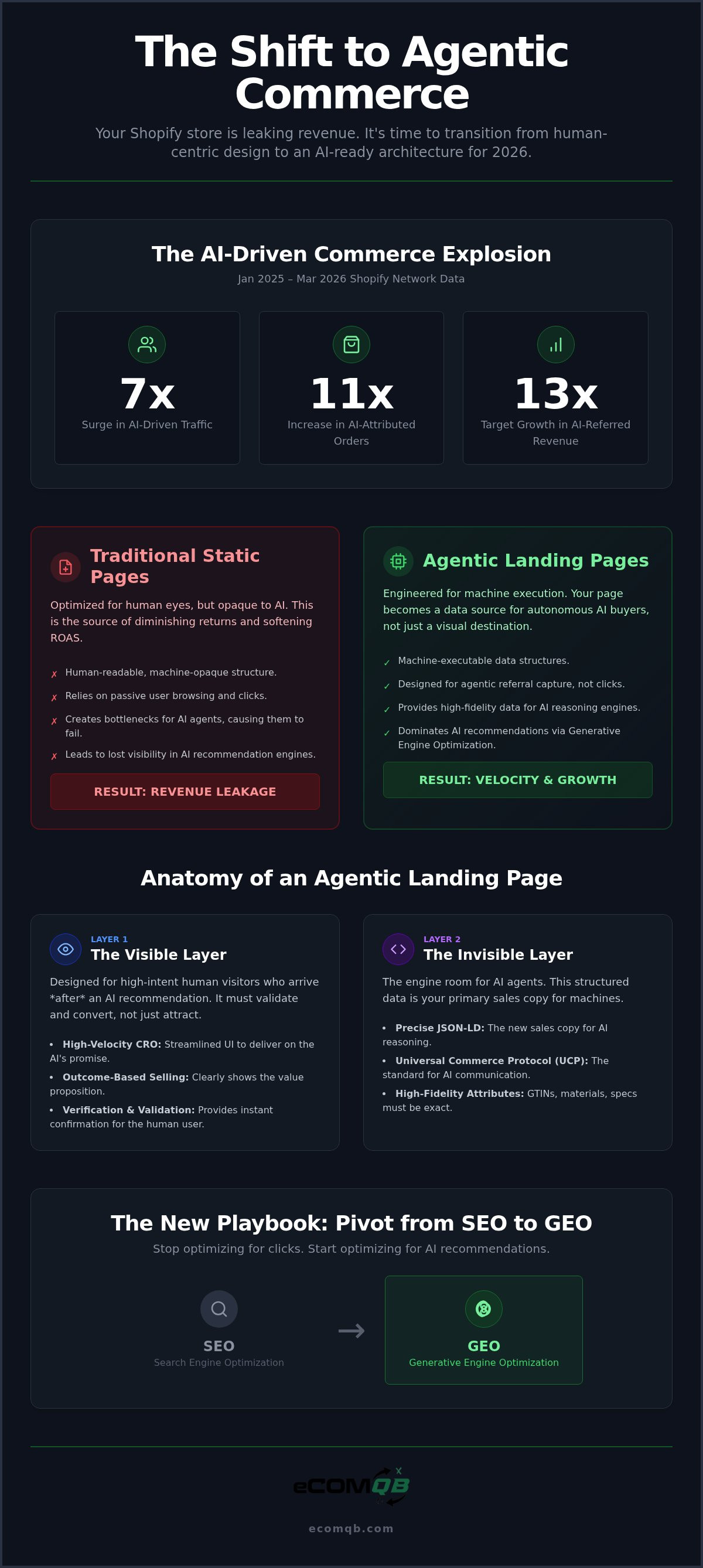
AI-driven traffic to Shopify stores surged 7x between early 2025 and March 2026, yet most 8-figure brands are still optimizing for a human click that may never happen. The webless web is no longer a forecast; it's the current theater of operations. To win in this environment, you must deploy shopify agentic landing pages engineered for machine execution rather than just visual appeal. If your data isn't structured for the Universal Commerce Protocol, your brand is effectively invisible to the hundreds of millions of users now delegating their shopping to AI agents.
You likely feel the pressure as traditional static pages yield diminishing returns and ROAS softens across every major channel. It's a frustrating bottleneck, but it's also your greatest opportunity for a tactical reset. This article provides the blueprint to master the transition from human-centric design to agentic-ready architectures that capture AI-driven revenue. We will examine the mechanics of AI discoverability, the requirements for 13x growth in AI-referred orders, and the exact steps to future-proof your Shopify tech stack for the 2026 economy.
Key Takeaways
- Transition from passive browsing to agentic execution by prioritizing machine-readable architectures that capture autonomous AI shoppers.
- Implement a dual-layer design strategy that balances high-impact visual conversion for humans with precise JSON-LD data for AI agents.
- Pivot from traditional SEO to Generative Engine Optimization (GEO) to ensure your products rank at the top of LLM-driven recommendations.
- Audit your technical stack to deploy shopify agentic landing pages that leverage structured data as your primary sales copy.
- Adopt a managed AI growth system to eliminate technical debt and maintain 8-figure velocity without increasing operational overhead.
The Shift to Agentic Commerce: Why Static Pages are Leaking Revenue
The digital storefront is undergoing a radical tactical shift. For over a decade, we optimized for the human eye. We obsessed over button colors, hero images, and scroll depths. That era is over. In the 2026 AI economy, your primary customer isn't always a person. It's an AI agent acting on their behalf. Agentic commerce occurs when LLMs like ChatGPT, Google Gemini, or Perplexity research products, reason through specifications, and execute purchases autonomously. If your site isn't built to communicate with these entities, you aren't just losing visibility; you're leaking revenue to competitors who have already made the pivot.
Legacy Shopify themes are often blind to the machine. They are human-readable but machine-opaque. While a visitor sees a beautiful layout, an AI agent sees a mess of unoptimized scripts and nested divs. To capture 8-figure velocity now, you must transition to shopify agentic landing pages. This architecture moves beyond visual storytelling. It focuses on machine-executable data structures that allow an AI to verify inventory, validate claims, and finalize a transaction without a single human click. This is the webless web in action. Your landing page is no longer a destination; it is a data source for an autonomous buyer.
The Death of the Passive Storefront
Traditional landing pages have become bottlenecks. They rely on passive engagement where you wait for a user to navigate your funnel. AI agents don't browse; they extract. If your tech stack forces an agent to guess your product attributes, that agent will recommend a competitor instead. Deploying shopify agentic landing pages allows you to bypass these bottlenecks by providing high-fidelity data directly to the agent's reasoning engine. You must identify the technical debt in your current product data. Leaky revenue occurs every time an AI-driven referral session fails because your storefront couldn't provide a real-time, structured response. The goal has shifted from traffic acquisition to agentic referral capture. You don't need more clicks; you need more successful executions.
Just as a high-end commercial property requires meticulous execution from Crandall Painting & Stucco to maintain its brand value and structural integrity, your digital storefront requires high-fidelity data to survive the shift to agentic commerce.
The 13x Growth Opportunity
The numbers dictate the strategy. Between January 2025 and March 2026, AI-driven traffic to Shopify stores grew 7x. Even more critical, AI-attributed orders increased 11x in that same window. High-performance brands are now targeting 13x growth in AI-referred revenue by the end of 2026. This isn't a speculative trend. It is a fundamental realignment of how commerce functions. Early adopters who implement agentic-ready architectures within a single quarter will dominate the AI recommendation landscape. You have a choice: maintain a static relic or engineer a high-velocity system that speaks the language of the modern economy. The theater of operations has moved, and it's time to adjust your positioning.
Understanding the narrative behind these shifts is essential; The Genie Chronicles provides a broader perspective on technological evolution as the official platform for 'The Genie Chronicle Complete Book'.
Anatomy of an Agentic Landing Page: Beyond Human Design
Engineering shopify agentic landing pages in 2026 requires a dual-layer framework. You are no longer just designing for a human thumb on a screen; you are designing for a reasoning engine. This architecture balances high-impact visual conversion with a robust data infrastructure. The Universal Commerce Protocol (UCP), launched in January 2026, serves as the operational standard for this interaction. It allows your storefront to communicate natively with AI agents across ChatGPT, Microsoft Copilot, and Google Gemini. You must treat your site as both a visual gallery and a high-fidelity data source.
The Invisible Layer: Data for AI Reasoning
The invisible layer is the engine room of your conversion strategy. While humans scan for visual cues, AI agents parse structured data to validate intent. Your JSON-LD is no longer a technical byproduct. It is your primary sales copy for the machine. Every product attribute, from Global Trade Item Numbers (GTINs) to specific material compositions, must be precise and accessible. This agentic plumbing is what allows Shopify Sidekick and other LLMs to reason through your catalog effectively. If your data is fragmented, your brand is disqualified before the human conversation even begins. Mastering this hidden infrastructure is a prerequisite for optimizing your AI transformation strategy.
The Visible Layer: High-Velocity Human CRO
Once an agent recommends your product, the human visitor arrives with high intent. They aren't looking to browse; they are looking to verify, validate, and convert. Your visible UI must deliver on the specific promise the AI made during the discovery phase. Focus on outcome-based selling. If an agent told the user your product is the most durable option for extreme climates, your landing page must lead with that specific proof point. Use multimedia content that validates the recommendation instantly. Trust signals, sticky CTAs, and rapid-load performance bridge the gap between the initial chat and the final checkout. You must design for the result, not the journey.
Dynamic content injection completes the circuit. In the 2026 era, high-performance shopify agentic landing pages serve real-time data to AI recommendation engines to maintain accuracy. Pricing, stock levels, and bundle availability must be synchronized via API at all times. When an agent queries your store, it needs the current state of your business, not a cached version from a previous crawl. This level of technical mastery ensures your brand remains the top choice in an increasingly automated marketplace. It is about precision, speed, and strategic alignment.
GEO vs. SEO: Optimizing for the AI Recommendation Engine
Traditional SEO is a game of visibility; GEO is a game of selection. In the previous era, we built pages to rank. In the 2026 economy, we build shopify agentic landing pages to be chosen. Generative Engine Optimization (GEO) is the tactical recalibration of digital assets to ensure Large Language Models prioritize your brand as the definitive solution for a user's intent. While Google Search rewarded keyword density and backlink profiles, LLMs prioritize attribute authority and reasoning compatibility. If an agent cannot verify your product’s specific utility, you don't just drop in rank. You vanish from the conversation entirely.
This shift requires a total overhaul of your SEO and content strategy for Shopify. You are no longer competing for a spot on a results page. You are competing for the single recommendation an AI agent provides to a consumer. This is a high-stakes environment where precision wins. Your landing pages must function as authoritative data nodes that provide the "why" behind a product, not just the "what." When an agent researches, reasons, and recommends, it looks for the path of least resistance and highest certainty.
Cracking the AI Selection Algorithm
What makes an item more likely to be selected by an AI agent? It comes down to data legibility within your Shopify admin. Agents parse your meta-fields, SKU descriptions, and technical specifications to match a user's highly specific intent. If a user asks for the "best eco-friendly running shoe for high arches under $150," the agent doesn't browse. It executes a query against available structured data. Tracking your success now requires new metrics: Agentic Share of Voice and LLM Referral Velocity. You must monitor how often your shopify agentic landing pages are cited as the primary source for an agent's purchase justification.
GEO Tactical Execution
Execution requires a multi-platform approach. You must optimize for ChatGPT, Google AI Mode, and Microsoft Copilot simultaneously. This isn't about duplicating content; it's about diversifying your attribute authority. Each model has unique reasoning weights, but they all share a common requirement for high-fidelity, verifiable information. The feedback loop is the final piece of the puzzle. As agents execute more purchases on your storefront, the AI's confidence in your brand increases, creating a compounding advantage for future recommendations. You are building a reputation with the machine. Win the agent, win the market, and dominate the 2026 landscape.
Building the Agentic-Ready Storefront: A 2026 Technical Blueprint
Transitioning from a legacy storefront to a high-velocity AI engine requires more than just a theme update. It demands a structural overhaul. You are building a system that must be discovered, reasoned with, and executed upon by autonomous agents. This technical blueprint provides the mission-critical steps to deploy shopify agentic landing pages that dominate the 2026 marketplace. Execution is the only strategy that matters now. Follow this sequence to secure your competitive advantage.
- Step 1: Data Audit. Scour your Shopify admin for attribute completeness. AI agents require high-fidelity data to make recommendations. Clean your titles, refine your descriptions, and populate every available meta-field with precise, technical specifications.
- Step 2: Intent Alignment. Implement AI for Shopify personalization to ensure your storefront adapts to the specific reasoning path an agent took to find you.
- Step 3: Channel Configuration. Toggle the Agentic Storefront sales channel. Ensure your product catalog is synced with ChatGPT, Microsoft Copilot, and Google Gemini to allow for direct, webless checkouts.
- Step 4: Dynamic Deployment. Launch landing pages that adapt their content based on the referral source. An agent coming from a technical query requires a different data set than one coming from a lifestyle-based prompt.
- Step 5: Latency Elimination. Establish zero-latency tracking. Your inventory and pricing must be synchronized via API in real-time to prevent agentic transaction failures.
Technical Requirements for Shopify Leaders
Precision is your primary leverage. Configuring your JSON-LD for "Agentic Selection" priority ensures that LLMs identify your products as the optimal solution for complex queries. Your inventory transparency must be absolute; if an agent detects a discrepancy between your data and your actual stock, it will delist your brand from future recommendations. This level of technical mastery is a core component of the eCommerce AI growth system. You must integrate these protocols to maintain 8-figure velocity in an automated economy.
Tracking and Attribution in 2026
Traditional analytics are insufficient for the agentic era. You must identify and categorize UTMs specifically from AI platforms like ChatGPT and Copilot. Measuring the delta between agentic conversion rates and human-direct traffic allows you to allocate resources with surgical precision. Use AI-driven diagnostics to identify where legacy channels are leaking revenue and pivot your spend toward high-performing agentic referrals. If you are ready to stop guessing and start engineering growth, schedule your tactical AI audit today. We will identify the bottlenecks in your current tech stack and deploy shopify agentic landing pages that capture the revenue your competitors are leaving on the table.
Deploying Agentic Velocity: The eComQB Managed Growth System
Manual landing page management is a strategic liability in 2026. The digital economy moves too fast for human-only workflows. If you are still manually tweaking storefronts, you are losing the race to the machine. eComQB provides the managed AI transformation necessary to eliminate operational overhead while maintaining peak performance. We don't just build pages; we engineer a system where shopify agentic landing pages work in concert with agentic media buying to capture every available revenue lever. You need a system that adapts at the speed of an LLM, not the speed of a design sprint.
Your brand must become the inevitable choice for AI recommendation agents. This requires a level of data precision and systemic optimization that most DTC teams aren't equipped to handle internally. By outsourcing the technical complexity to a tactical partner, you free your leadership to focus on high-level strategy while we manage the mechanics of growth. We bridge the gap between static assets and high-velocity execution, ensuring your brand remains visible in the webless web.
The Field General for Your AI Transformation
eComQB functions as the field general for your AI transition. We orchestrate the next move in your growth trajectory with surgical precision. Moving from the testing phase to dominating the agentic commerce landscape requires a specific playbook. Our approach is built on three pillars: precision, momentum, and scale. We handle the agentic plumbing, the attribute authority, and the real-time data synchronization. You see the results in your performance metrics, not in a list of tasks. We are deeply embedded in the mechanics of your growth, ensuring that every update to the Shopify API is leveraged for maximum competitive advantage. We don't just follow the trend; we set the pace.
Next Steps for High-Performance Brands
Assessing your readiness for shopify agentic landing pages is the first step toward future-proofing your tech stack. The ROI of fixing your product data for AI discoverability is immediate. Every attribute you clarify is a signal to the algorithm that your brand is the superior solution. It's time to take the field. Engaging with eComQB for a managed AI rollout ensures that your Shopify storefront is not just a website, but a high-performance conversion engine built for the 2026 era. Stop managing technical debt and start deploying agentic velocity. The transition is inevitable, but the winners are those who move with decisive leadership today.
Secure Your Advantage in the Agentic Economy
The transition from human-centric browsing to machine-executable commerce is a tactical reality. You've analyzed the shift. You understand the technical blueprint. Now, you must execute. Maintaining 8-figure velocity in 2026 requires more than just a clean UI. It demands shopify agentic landing pages that communicate natively with the AI agents controlling the flow of traffic. Every day you delay is a day your brand remains invisible to the autonomous buyer.
eComQB provides the managed AI systems necessary for high-velocity scaling. We specialize in strategic AI transformation for eCommerce brands who refuse to settle for legacy performance. We handle the technical complexity while you capture the growth. Our precision-engineered architectures ensure your brand is the first choice in the AI recommendation engine. The game has changed. Take the field with a partner who knows exactly how to orchestrate your next move.
Deploy Your Agentic Growth System with eComQB
Frequently Asked Questions
What is an agentic landing page?
An agentic landing page is a machine-executable storefront layer designed for AI discovery and autonomous purchasing. Unlike static pages built for human browsing, these pages prioritize structured data and reasoning compatibility. They allow Large Language Models to verify product specifications and inventory instantly to fulfill complex user requests.
How is agentic commerce different from traditional eCommerce?
Agentic commerce shifts the decision-making power from the human consumer to an AI agent acting on their behalf. Traditional eCommerce requires a user to navigate, compare, and click. In the agentic era, the AI researches, reasons, and executes the transaction within its own interface, often bypassing the traditional website entirely.
Does Shopify support agentic storefronts natively in 2026?
Yes, Shopify natively supports agentic storefronts as of 2026 through the Agentic Storefronts sales channel. This feature is currently live for ChatGPT and Microsoft Copilot. Google AI Mode and Gemini are in early access, while Meta's direct checkout remains a US-only limited release for eligible merchants.
How do I optimize my Shopify store for AI agents like ChatGPT?
You optimize by implementing shopify agentic landing pages that leverage the Universal Commerce Protocol (UCP). Focus on attribute completeness within your Shopify admin and ensure your JSON-LD is precise. AI agents require high-fidelity data to match products with specific user intent during the reasoning phase.
What is Generative Engine Optimization (GEO)?
Generative Engine Optimization (GEO) is the strategic evolution of SEO focused on influencing LLM recommendation engines. Instead of ranking for keywords, GEO focuses on establishing attribute authority and data legibility. It ensures your brand is the primary source cited by AI agents during the purchase justification process.
Can AI agents complete a checkout on my Shopify store?
AI agents can complete checkouts directly within conversational interfaces like ChatGPT or through Meta’s direct checkout systems. This webless transaction is made possible by Shopify's API integrations and the UCP. It allows for a frictionless purchase without the user ever landing on your primary storefront.
Why are my products not appearing in AI shopping recommendations?
Your products likely suffer from technical debt in your structured data or a lack of enrollment in the Agentic Storefront channel. If an agent cannot parse your inventory levels or product specifications with absolute certainty, it will recommend a competitor. Precision and data completeness are the only ways to win the recommendation.
How do I track revenue generated by AI agents?
You track agentic revenue by monitoring specific UTM parameters and referral headers from platforms like ChatGPT, Perplexity, and Copilot. Shopify’s 2026 analytics suite includes dedicated AI-attributed order metrics. These tools allow you to measure the conversion delta between agentic execution and traditional human traffic with surgical precision.