AI for eCommerce: 2026 Playbook for 8-Figure Brands

Profitability in 2026 isn't a math problem; it's a decision-speed and execution-latency problem. While your competitors struggle with rising Customer Acquisition Costs and fragmented data across Shopify, the elite 8-figure brands are shifting their strategy. You already know that legacy overhead is a silent killer of growth. You've felt the squeeze as margin compression turns record-breaking revenue into mediocre bottom-line results. It is time to stop playing defense and start engineering a high-performance profit engine.
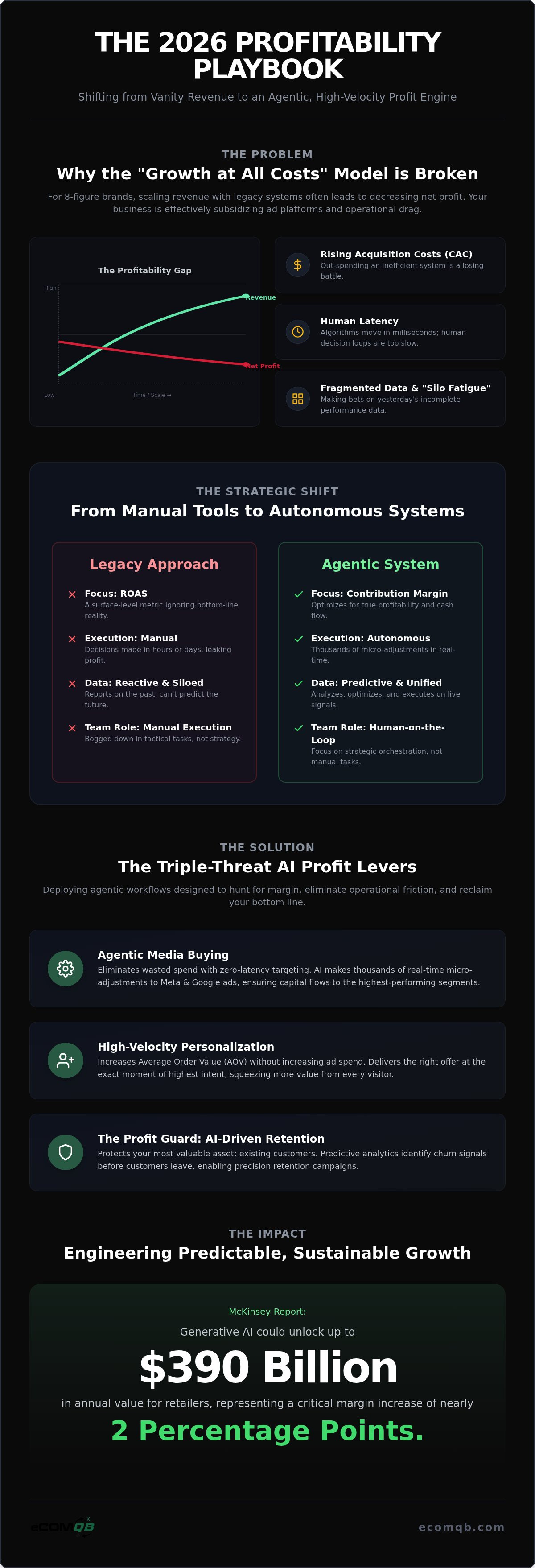
This playbook provides the tactical roadmap to master ai for ecommerce profitability and reclaim your competitive edge. We'll show you how to move beyond simple automation into agentic systems that analyze, optimize, and execute with surgical precision. McKinsey reports that generative AI could unlock up to $390 billion in annual value for retailers, representing a critical margin increase of nearly two percentage points. We are diving deep into agentic media buying, high-velocity personalization, and the new Agentic Commerce Protocol to eliminate operational drag. It's time to stop reacting to the market and start driving predictable, sustainable, and aggressive revenue growth.
Key Takeaways
- Stop chasing vanity revenue and start engineering sustainable margins by shifting to a profitability-first agentic model.
- Eliminate "silo fatigue" by replacing fragmented AI tools with integrated agentic systems that execute at high velocity.
- Master the tactical deployment of ai for ecommerce profitability to reclaim the revenue lift lost to legacy overhead and platform volatility.
- Transition your leadership to a "human-on-the-loop" framework, focusing on strategic orchestration rather than manual execution.
- Follow a 90-day deployment roadmap to identify profit leaks and scale your 8-figure brand with surgical precision.
The 2026 Profitability Crisis: Why Revenue Growth is No Longer Enough
The "Growth at All Costs" model is dead. It was buried by 2026's economic shifts and the aggressive rise of platform volatility. For 8-figure brands, revenue has become a vanity metric. If your net profit isn't scaling in lockstep with your top line, your business is effectively subsidizing the ad platforms. This is the profitability crisis. High Customer Acquisition Costs (CAC) and legacy overhead have turned traditional scaling into a liability. You cannot out-spend a fundamentally inefficient system.
Scaling revenue often leads to decreasing net profit when you rely on manual processes. As you grow, complexity increases exponentially. Without automation, you hire more people to manage that complexity, which increases your legacy overhead. This creates a cycle where every new dollar of revenue carries a higher operational cost. The solution is a strategic pivot toward algorithmic dominance. Media buying, once a creative craft, is now a data-war won by those who can process signals faster than the competition.
The Hidden Costs of Legacy eCommerce Operations
Human Latency is the silent killer of modern brands. Your team's decision-making loops are too slow for an algorithmic market. When data is fragmented across siloed Shopify apps, your field of view is obscured. You're making strategic bets based on yesterday's performance. This delay is expensive. Manual media buying is no longer a skill; it's a tactical liability. Algorithms move in milliseconds. Humans move in hours. That gap is where your profit disappears. You need a unified system that acts, rather than just reports.
Defining Profitability in the AI Era
Mastering ai for ecommerce profitability means shifting your focus from ROAS to Contribution Margin. ROAS is a surface-level metric that ignores the operational reality of your bottom line. Elite brands use AI to orchestrate inventory levels, forecast cash flow, and optimize every touchpoint of the customer journey. True profitability is about precision, speed, and systemic optimization. If you aren't using agentic workflows to bridge these gaps, your current tech stack is likely leaking revenue through sheer inefficiency. We are no longer just looking for growth. We are engineering sustainable, 8-figure velocity.
Engineering the Bottom Line: How AI Reclaims Compressed Margins
Maximizing ai for ecommerce profitability is the tactical deployment of agentic workflows designed to strip away operational friction. While simple automation follows rigid if-then rules, agentic systems are objective-oriented. They don't just wait for a command; they hunt for margin. These systems analyze data, determine the optimal path, and execute changes without human intervention. This shift from manual management to autonomous execution is how 8-figure brands eliminate operational drag and reclaim their bottom line.
Implementing a managed AI growth system allows you to scale without the traditional explosion in headcount. By replacing manual coordination with systemic precision, you reduce the legacy overhead that typically swallows your profits. AI-driven personalization further compounds this effect. It increases Average Order Value (AOV) by delivering the right offer at the exact moment of highest intent, all without increasing your top-of-funnel ad spend. You are effectively squeezing more value out of every visitor you've already paid to acquire.
Agentic Media Buying: Precision at Scale
Traditional media buying is plagued by latency. By the time a human identifies a winning creative or a failing audience, thousands of dollars have already been wasted. Agentic systems optimize Meta and Google ads in real-time, making thousands of micro-adjustments per hour. They eliminate wasted spend through zero-latency targeting, ensuring your capital is always flowing toward the highest-performing segments. To see how this works in practice, explore our Agentic Media Buying Playbook for a deep dive into high-velocity scaling.
The Profit Guard: AI-Driven Retention
Acquisition is expensive, but retention is where the real profit lives. Agentic systems act as a "Profit Guard" by using predictive analytics to identify churn signals before a customer even realizes they're leaving. Instead of generic blast campaigns, agentic email marketing triggers hyper-personalized sequences that expand Lifetime Value (LTV) autonomously. This level of precision ensures that your repeat purchase rates remain high and your reliance on expensive new customer acquisition remains low. If you're ready to deploy these levers in your own business, you can request a strategic audit of your current systems to identify immediate profit leaks.
By moving from standalone tools to integrated systems, you transform your tech stack from a cost center into a revenue machine. The goal is simple: maximize output, minimize friction, and engineer a business that is built for 2026's aggressive competitive environment. It's about precision, speed, and strategic mastery.
Legacy vs. Agentic: The Strategic Shift from Tools to Systems
Most 8-figure brands treat AI as a grocery list of features. They buy a tool for email, a tool for chat, and a tool for ads. This is a legacy mindset that creates "Silo Fatigue." In 2026, AI transformation for eCommerce is no longer about adding features; it's about re-engineering your entire operational architecture. You either own a system that scales, or you own a collection of subscriptions that drain your focus. It's a binary choice between tactical dominance and operational mess. True leadership requires moving beyond the tool-first approach to embrace systemic orchestration.
The competitive advantage in a high-speed market isn't found in the tools themselves. It's found in how those tools communicate, collaborate, and execute. When your tech stack is fragmented, your data is trapped. Insights from your Meta ads never reach your email sequences. Predictive signals from your storefront never inform your inventory management. This lack of synchronization is a profit killer. To maximize ai for ecommerce profitability, you must shift from managing individual tasks to orchestrating a unified growth machine.
The Failure of the Single-Tool Approach
Adding a chatbot won't fix a broken margin. Disconnected AI applications lead to data leakage, where critical customer signals disappear into the gaps between platforms. This fragmentation increases your team's cognitive load as they struggle to bridge these divides manually. Instead of solving problems, individual tools often create new ones. They require constant maintenance, demand separate logins, and offer conflicting metrics. You don't need more software. You need a cohesive system that eliminates friction and accelerates decision-making.
The Power of a Managed Growth System
The shift from "human-in-the-loop" to "human-on-the-loop" management is where real leverage lives. In a legacy model, humans perform the work. In an agentic model, humans orchestrate the system. This allows your leadership team to focus on high-level strategy while the machine handles the relentless execution of micro-tasks. eComQB acts as your field general, deploying a curated, managed technology stack that prioritizes outcomes over subscriptions. We don't just provide the playbook; we run the plays with precision. This systemic optimization is what drives 8-figure velocity. It ensures every component of your business is aligned, synchronized, and optimized for peak performance. Stop buying software and start buying results. Precision. Speed. Mastery.
The Triple-Threat Playbook: Three High-Impact AI Profit Levers
Strategy is useless without tactical execution. To maximize ai for ecommerce profitability, you must deploy specific levers that move the needle on contribution margin. We have identified three high-impact zones where agentic systems outperform human intuition every time. These aren't just features; they are profit engines. When integrated into a unified architecture, they transform your storefront from a static catalog into a high-velocity revenue machine.
Lever 1: Eliminating Discounting with Dynamic Offers
Site-wide discounts are a blunt instrument that destroys your margins. Elite brands are moving toward "Minimum Effective Discounting." This agentic approach uses real-time data to identify the lowest possible incentive required to convert a specific user. Why give 20% to a customer who was ready to buy at full price? AI identifies high-intent buyers and protects your margin by withholding unnecessary offers. Conversely, it can trigger aggressive, inventory-aware incentives for price-sensitive segments. This ensures you are never leaving money on the table or burning profit on users who don't need the nudge.
Lever 2: The End of the Generic Storefront
The one-size-fits-all storefront is an obsolete relic of the legacy era. Using AI for Shopify personalization allows you to engineer high-velocity revenue by adapting the entire customer journey in real-time. Landing pages now shift dynamically based on ad-click intent, showing the exact products and messaging that resonated in the creative. Predictive field-filling and intent-based layout adjustments reduce friction at the checkout, ensuring that your paid traffic doesn't bounce due to irrelevant content. You aren't just selling a product; you are orchestrating an experience optimized for a single outcome: the conversion.
Lever 3: Reclaiming Cash from Dead Stock
Dead stock is a silent drain on your cash flow. Agentic systems predict demand cycles with surgical precision, allowing you to optimize stock orders and reduce holding costs before they erode your profit. Inventory Velocity is the speed at which capital moves from purchase order to customer delivery, serving as the primary KPI for bottom-line health. AI-driven liquidation strategies identify slow-moving SKUs early, triggering automated, high-margin bundles or targeted offers to clear warehouse space. This keeps your capital fluid and your warehouse lean.
While AI streamlines your inventory data, physical efficiency is just as critical for maintaining margins; to see how automated machinery can transform your fulfillment line, visit Choice Bagging Equipment.
Integrating these levers into a single high-performance growth system is the difference between surviving and dominating. You cannot manage these complexities manually. If you are ready to stop leaking revenue and start engineering 8-figure velocity, book your tactical AI audit today. Let's find the friction in your funnel and eliminate it.
Deploying the Revenue Machine: Your Path to 8-Figure Velocity
The transition to a fully optimized agentic system isn't an overnight switch. It is a disciplined, 90-day roadmap designed to dismantle legacy friction and install high-velocity profit engines. We begin with a deep-dive diagnostic to identify exactly where your current tech stack is leaking revenue. This audit uncovers the human latency and silo fatigue that hold back your growth, providing a clear path to systemic recovery. You cannot fix what you haven't measured with precision. Audit, optimize, and accelerate.
The "wait and see" approach is the most expensive strategy you can adopt in 2026. While you deliberate, the market accelerates. Your competitors are already deploying agentic workflows to lower their CAC and protect their margins. Every day you spend in manual execution is a day you lose to algorithmic dominance. Mastery of ai for ecommerce profitability requires decisive action, not passive observation. The gap between the leaders and the laggards is widening. The cost of entry only increases as the technology matures. You either lead the change or you're buried by it.
The Managed Advantage: Scaling Without Overhead
The primary barrier to AI transformation is technical complexity. You don't need to become a data scientist to win. eComQB functions as your field general, handling the heavy lifting of agentic media buying and Shopify development while you focus on brand vision. DIY experimentation is a trap that leads to fragmented tools and wasted capital. Professional execution delivers a predictable ROI by moving you directly to the results phase. Secure your position as a market leader by leveraging a proprietary workflow stack that eliminates the need for massive internal overhead. Analyze, determine, and execute.
The Final Call: Secure Your Strategic Mastery
The next 12 months will define the winners and losers in the DTC space. The brands that thrive will be those that replaced manual drag with automated precision. This is your invitation to a high-performance tactical partnership. We don't just offer advice; we provide the systems that drive 8-figure growth. Stop playing defense against margin compression. It's time to orchestrate your next move with total confidence. Book your AI Growth Audit and secure your 2026 profitability to start engineering your revenue machine today. Precision. Speed. Mastery.
Orchestrate Your Strategic Advantage
The era of manual guesswork is over. You've seen the roadmap for engineering 8-figure velocity through agentic systems. By shifting from fragmented tools to a unified architecture, you eliminate the human latency that erodes your margins. Mastering ai for ecommerce profitability isn't just about incremental efficiency; it's about systemic dominance. You now have the playbook to deploy dynamic pricing, hyper-personalized journeys, and predictive inventory controls that reclaim your bottom line. These levers are the foundation of a high-performance profit engine designed specifically for the 2026 economy.
We provide the managed AI transformation for 8-figure brands that eliminates operational drag and legacy overhead. Our approach combines agentic media buying for Shopify excellence with end-to-end strategic mastery to ensure you scale with precision. You don't have to navigate this technical complexity alone. Stop reacting to market volatility and start driving it with a partner who understands the mechanics of growth. It is time to secure your position at the top of the leaderboard. Book Your Strategy Call to Deploy Your AI Growth System and start your transformation today. The field is yours to command.
Frequently Asked Questions
How does AI specifically improve eCommerce profit margins?
AI targets margin compression by eliminating human latency and optimizing decision speed. It identifies the minimum effective discount to protect unit economics and automates resource allocation across your entire funnel. By shifting from manual guesswork to algorithmic precision, you reduce the cost of every transaction. For high-volume B2B brands, integrating P2EZPay Merchant Services into this workflow ensures that payment processing is optimized for maximum profitability. This systemic optimization ensures that revenue growth translates directly into net profit rather than being swallowed by operational drag.
Is AI for eCommerce profitability only for large 8-figure brands?
While 8-figure brands see the most immediate impact from scale, any brand facing margin compression can benefit. The core principles of ai for ecommerce profitability apply to any high-velocity storefront looking to eliminate waste. Smaller brands use these systems to scale without the traditional explosion in headcount. It is about building a lean, profitable foundation regardless of your current revenue baseline.
What is agentic media buying and how does it lower CAC?
Agentic media buying is an objective-oriented system that optimizes ad spend in real-time without human intervention. It lowers Customer Acquisition Cost (CAC) by identifying and scaling winning creatives while killing underperforming segments in milliseconds. This zero-latency execution prevents capital leakage. You stop paying for impressions that don't convert and redirect your budget toward high-intent audiences with surgical precision.
Can AI help reduce my Shopify store operational costs?
AI reduces operational overhead by automating repetitive micro-tasks across your storefront and back-office. It handles everything from predictive inventory management to autonomous customer journey personalization. This eliminates the need for expensive manual coordination and reduces the legacy overhead that typically scales with your revenue. You achieve higher output with a leaner, more efficient team that focuses on strategy rather than maintenance.
How long does it take to see a profit increase after implementing AI?
Most brands begin identifying profit leaks within the first 30 days of deployment. Full systemic optimization typically follows a 90-day roadmap. During this window, agentic workflows stabilize, data signals clear, and execution speed accelerates. You'll see initial wins in reduced ad waste and increased AOV followed by a sustainable shift in your overall contribution margin as the system matures.
Will AI replace my current marketing team or help them?
AI transforms your marketing team from manual executors into strategic orchestrators. It removes the burden of repetitive data entry and campaign maintenance, allowing your talent to focus on high-level brand vision. This "human-on-the-loop" model increases their leverage and impact. You aren't replacing your team; you're upgrading their capabilities and removing the tactical friction that slows them down. Precision leads to performance.
What is the difference between a managed AI system and an AI tool?
An AI tool is a standalone feature that requires manual management and creates siloed data. A managed system is a unified architecture that orchestrates multiple agentic workflows toward a single profit objective. Managed systems eliminate the silo fatigue of individual subscriptions. You aren't just buying software; you're deploying a fully integrated growth engine that communicates across your entire Shopify stack without technical friction.
How do I start an AI transformation for my brand without technical knowledge?
You start by partnering with a field general who handles the technical complexity for you. A managed service model allows you to deploy advanced ai for ecommerce profitability without hiring data scientists or developers. The first step is a tactical audit of your current systems to identify immediate profit levers. Focus on your brand strategy and let the experts engineer the execution and optimization.