Agentic Workflows for eCommerce Marketing: Engineering 8-Figure Conversion Assets

The marketing funnel you built last year is officially a legacy system. With the AI commerce market projected to hit $20.9 billion in 2026, the gap between the market leaders and the laggards is widening at terminal velocity. You've likely felt the friction of manual copywriting bottlenecks or the sting of generic, robotic outputs that fail to convert. Deploying agentic workflows for ecommerce marketing is the only way to break the cycle of mediocrity and engineer 8-figure conversion assets at scale. It is about moving beyond simple prompt-and-response tactics toward a system that thinks, executes, and optimizes.
You understand that staying stagnant means losing ground in the 2026 AI search environment. This guide promises to show you how to build a high-velocity marketing engine that maintains absolute brand authority while expanding your catalog with zero added overhead. We will explore the tactical blueprint for integrating agentic systems that dominate organic visibility and drive relentless growth. It's time to stop playing defense and start orchestrating your next move.
Key Takeaways
- Shift from manual content generation to autonomous, systemic content engineering that drives 8-figure growth.
- Deploy agentic workflows for ecommerce marketing to expand your product catalog rapidly without increasing operational overhead.
- Secure search dominance in the 2026 landscape by optimizing assets for AI Overviews and entity-based discovery.
- Bridge the "Uncanny Valley" by embedding deep psychological triggers and precise brand guardrails into your AI systems.
- Implement a managed AI growth system to bypass technical bottlenecks and maintain a sharp competitive advantage.
Beyond the Generator: Why Agentic Workflows for eCommerce Marketing are Strategic Growth Levers
The 2026 digital economy moves at a speed that renders manual content creation obsolete. If your marketing team is still prompting a chatbot one product at a time, you aren't scaling; you are just managing a slightly faster bottleneck. High-performance brands have moved beyond simple generation into the era of systemic content engineering. This shift represents the transition from static tools to autonomous systems that analyze, execute, and optimize in real time. For an 8-figure brand, the objective isn't just to produce words. The objective is to build a revenue machine that operates with surgical precision.
Defining these systems requires a fundamental shift in perspective. Unlike traditional automation, an AI agent functions as an autonomous unit designed to achieve specific objectives within a larger ecosystem. When you deploy agentic workflows for ecommerce marketing, you are creating self-correcting loops. These loops ingest raw product data, apply sophisticated brand logic, and distribute high-converting assets across every channel. They don't just follow a script; they navigate the complexities of your catalog to ensure every SKU is a high-velocity conversion asset.
This is where the "Velocity Gap" becomes a critical differentiator. Manual processes create a structural drag on your brand's momentum, forcing you to choose between speed and quality. In a landscape where 98% of CMOs are already piloting AI, falling behind on execution speed is a tactical failure. Strategic agentic workflows for ecommerce marketing close this gap by providing the infrastructure to launch entire collections in minutes, not weeks. You need a system that thinks like a strategist, not just a tool that generates text.
The ROI of Automated Excellence
Every day a product remains unlisted or poorly described is a day of lost revenue. Calculating the opportunity cost of slow launches reveals a staggering drain on potential market share. High-quality, agentic-driven descriptions do more than just fill a page; they align expectations and reduce customer return rates. The content bottleneck is a primary margin killer for DTC brands, acting as a structural drag on every dollar of ad spend. By automating excellence, you protect your margins and maximize the lifetime value of every customer who enters your storefront.
Brand Voice as a Competitive Moat
Generic AI output is a liability that erodes trust and diminishes brand equity. Premium eCommerce brands require a distinct, authoritative voice that resonates with their specific audience. Agentic systems act as the ultimate brand guardrails, ensuring consistent authority across thousands of SKUs without the "uncanny valley" feel of standard generators. This approach allows you to integrate advanced technology while doubling down on the human elements of your brand. You maintain the strategic playbook; the agents handle the high-volume execution with absolute fidelity.
Engineering the Agentic Workflow: How High-Performance Brands Automate at Scale
Scaling a brand to 8 figures requires more than a clever prompt. It demands a sophisticated architecture. While your competitors are stuck in the cycle of manual content generation, high-performance leaders are deploying agentic workflows for ecommerce marketing to dominate the digital shelf. This isn't about using a tool; it's about engineering a system that functions as a relentless revenue machine. To win in 2026, you must move from isolated actions to an integrated, autonomous loop that executes with surgical precision.
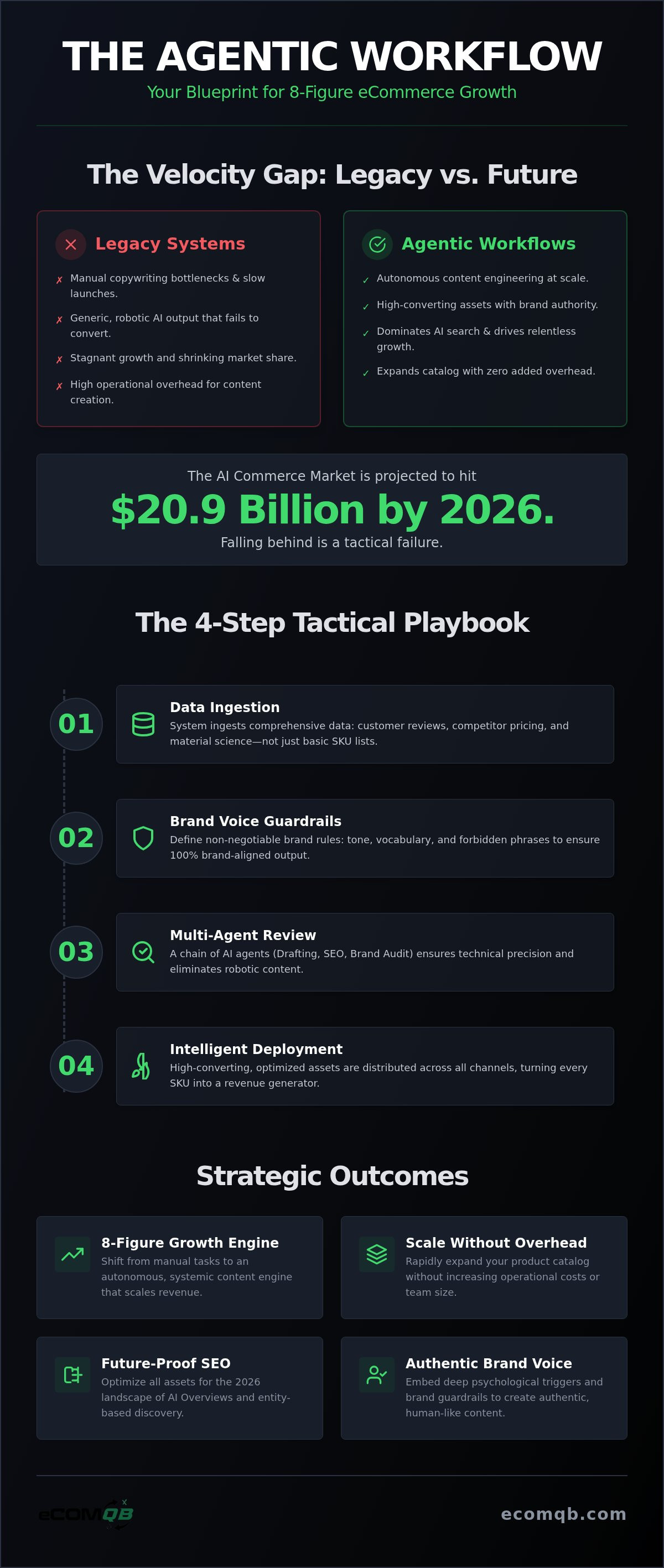
The engineering process follows a four-step tactical playbook designed for maximum velocity:
- Step 1: Data Ingestion. Your system needs more than a basic SKU list. Feed it customer reviews, competitor pricing gaps, and material science. High-performance agents ingest these data points to build a comprehensive context that standard generators ignore.
- Step 2: Brand Voice Guardrails. Establish the non-negotiables. Define your tone, vocabulary, and forbidden phrases. This ensures the output is always brand-aligned, assertive, and premium.
- Step 3: Multi-Agent Review. Implement a chain of command. One agent drafts the copy, while a second agent audits for SEO technicalities and a third verifies brand authority. This internal check-and-balance system eliminates the "uncanny valley" of robotic AI content.
- Step 4: Deployment and Feedback. Close the loop. The system pushes content to your storefront and monitors real-time performance data. If a description isn't converting, the workflow iterates automatically based on actual buyer behavior.
From Prompting to Orchestration
A prompt is a single command; orchestration is a strategy. As you look toward the Future of Marketing, the shift from static inputs to dynamic systems is inevitable. By building a managed AI growth system, you ground your AI in a proprietary knowledge base that reflects your brand's unique history and strategic objectives. This creates a competitive advantage that cannot be easily replicated by competitors using off-the-shelf tools. If you are ready to stop managing bottlenecks and start leading an automated front, you should book a strategic briefing to discuss your roadmap.
The Tech Stack of an 8-Figure Brand
Precision execution requires a robust technical foundation. Integrating agentic workflows for ecommerce marketing with your Shopify backend via high-performance APIs ensures that your catalog remains agile. Leveraging a Product Information Management (PIM) system as the central source of truth allows your agents to pull verified data instantly. This setup enables zero-latency deployment, allowing you to launch new collections or update thousands of product descriptions across multiple channels in minutes. You don't just move faster; you move with more authority.
Static vs. Strategic AI: Solving the Generic Content Paradox
Standard AI generators often produce content that feels hollow. It lacks the punch, the precision, and the persuasion required to move high-value inventory. This is the "Uncanny Valley" of eCommerce copy: text that looks human but feels robotic. To bridge this gap, you must transition from static tools to strategic agentic workflows for ecommerce marketing. These systems don't just output text; they architect conversion environments. By programming psychological triggers like social proof and loss aversion directly into the agentic logic, you ensure every description acts as a high-performance closer.
Strategic AI moves beyond the "what" to focus on the "why." While a basic generator describes a product's dimensions, an agentic system analyzes user intent data to determine which emotional lever to pull. It recognizes when a buyer is looking for durability versus status and adjusts the narrative accordingly. This real-time adaptability is why agentic content consistently outperforms static generators in rigorous conversion testing. You aren't just filling space on a page. You are deploying a digital sales force that understands the nuances of human desire.
Emotional Resonance at Scale
Selling a premium product requires a premium voice. Generic AI often defaults to passive descriptions, but agentic workflows mimic high-stakes confidence by utilizing assertive, benefit-driven syntax that commands attention. Instead of listing features, your agents should weave narratives that place the customer at the center of a success story. By layering brand-specific vocabulary with real-time intent data, you create content that resonates on a visceral level. Agentic workflows mimic high-stakes confidence in marketing copy by prioritizing decisive, action-oriented language over traditional descriptive fluff.
The Optimization Playbook
A static generator is a one-way street; an agentic workflow is a feedback loop. Every output is an opportunity for the system to refine its strategy through iterative prompting. When you integrate AI for Shopify personalization, your content becomes a dynamic asset that shifts based on user behavior. This allows your brand to deploy A/B testing at a scale impossible for human teams. You compare agentic outputs against legacy assets, find the winning formula, and scale it instantly across your entire storefront. This is how you maintain a sharp competitive edge in a saturated market.
SEO Mastery in 2026: Optimizing Agentic Content for Search Visibility
Organic search in 2026 is no longer a game of simple keyword matching. It is a game of entity relevance and systemic precision. To dominate the digital shelf, your agentic workflows for ecommerce marketing must prioritize Generative Engine Optimization (GEO). This means structuring every product description, category page, and blog post to be easily parsed by AI Overviews and traditional crawlers alike. You are no longer just writing for a human reader. You are feeding a sophisticated discovery engine that demands structured, high-authority data to rank your brand as the definitive solution.
Entity-based SEO has become the new frontline for 8-figure brands. Search engines now look for the deep, semantic connection between your product and the broader market category. Agentic systems excel here by injecting rich context that manual writers often overlook. They define the "what," the "who," and the "why" with clinical accuracy, ensuring search engines understand your product's unique value proposition. This approach eliminates the risk of "thin content" when scaling massive catalogs. Every SKU variant becomes a unique, high-authority asset that signals relevance to the algorithm.
The 2026 Search Landscape
The rules of organic reach have shifted toward zero-click optimization. To maintain visibility, you must implement SEO and content strategy for Shopify at the SKU level. This involves utilizing structured data and agentic precision to ensure your brand appears as the primary answer in AI-driven summaries. High-performance brands don't wait for traffic to find them. They engineer their assets to be unavoidable in the generative search environment.
Metadata and Automated Distribution
Precision execution extends to the SERP. Automating Meta titles and descriptions ensures maximum CTR even in the most competitive environments. Your agents should also generate rich alt-text and image descriptions to capture visual search traffic, which continues to grow as a primary discovery channel. This creates a powerful synergy between product copy and high-converting agentic landing pages. If you are ready to secure your visibility in the 2026 landscape, book a strategic SEO audit to identify your next growth levers.
Scaling Without Overhead: The eComQB Managed AI Approach
Strategic mastery is about knowing when to build and when to partner. Implementing a managed system ensures that your brand utilizes the most advanced technology without the burden of hiring a massive internal department. We handle the data ingestion, the brand voice guardrails, and the multi-agent review loops. This allows your team to move at terminal velocity, launching collections and optimizing storefronts while your competitors are still troubleshooting their prompts. You need a partner who understands the mechanics of growth and possesses the technical precision to execute your vision.
Managed AI Transformation
A fully managed system is the definitive solution for scaling DTC brands that demand excellence without the overhead. This approach moves you beyond the "grunt work" of catalog management and into a state of continuous optimization. Our framework for AI transformation for eCommerce brands is designed to integrate seamlessly with high-performance Shopify environments. We provide the infrastructure; you provide the vision. This partnership is built on a commitment to precision, momentum, and your brand's enduring competitive advantage.
Your Next Tactical Move
The first step toward 8-figure velocity is identifying the leaks in your current content and marketing tech stack. Every manual bottleneck is a drain on your margins and a gift to your competition. You can deploy a revenue-generating AI stack today without the risk of technical bloat or generic outputs. It is time to stop playing defense and start engineering a system that works as hard as you do. To audit your current infrastructure and map out a high-velocity path forward, Book a Strategy Call to Scale Your Brand with eComQB. Let's orchestrate your next move with the precision it deserves.
Master the New Standard of eCommerce Execution
The era of manual content creation is over. High-performance brands have transitioned from static tools to systemic content engineering. By deploying agentic workflows for ecommerce marketing, you replace bottlenecks with high-velocity loops that maintain absolute brand authority. You have seen how these systems dominate the 2026 search landscape, solve the generic content paradox, and scale your catalog without increasing overhead. This is about more than just speed. It is about building a durable competitive advantage that your rivals cannot replicate.
Success in the digital economy requires precision, momentum, and strategic partnership. You don't need more tools; you need a managed system that executes your playbook with surgical accuracy. As Shopify performance and growth specialists, we eliminate the technical friction that stalls most brands. We are agentic workflow orchestration experts dedicated to managed AI transformation for 8-figure brands. Stop leaking revenue and deploy a Managed AI Growth System today.
The field is open. It's time to take your position and lead.
Frequently Asked Questions
What is the difference between an AI generator and an agentic workflow?
An AI generator is a reactive tool that requires manual prompting for every output, while agentic workflows for ecommerce marketing are autonomous systems that analyze data and execute multi-step tasks independently. Generators produce text; agentic workflows engineer conversion environments. They operate in self-correcting loops that ingest raw data and distribute finished assets without constant human intervention.
Is AI-generated content bad for my store's SEO in 2026?
Standard AI content is a liability, but strategic agentic content is a visibility engine. Search algorithms in 2026 prioritize entity relevance and precision, favoring content that provides clear, structured answers for AI Overviews. By avoiding the "thin content" trap and focusing on Generative Engine Optimization, agentic systems secure higher organic reach than legacy manual methods.
How do I ensure agentic workflows match my brand's unique voice?
Matching your unique voice requires establishing firm tactical guardrails and grounding the system in a proprietary knowledge base. We program specific vocabulary, tone registers, and psychological triggers into the agentic loop. A multi-agent review process then audits every output to ensure that the final asset reflects your brand's authority, precision, and high-stakes confidence.
Can agentic AI handle complex technical specifications accurately?
Yes, agentic AI thrives on technical complexity by integrating directly with your Product Information Management (PIM) system. Unlike human writers who might overlook material science or specific dimensions, an agentic workflow ingests every data point with clinical accuracy. It translates raw specifications into benefit-driven narratives that maintain absolute technical fidelity across your entire catalog.
Do I still need a human editor if I use a managed AI growth system?
A managed AI growth system handles the high-volume orchestration and technical review, but you remain the field general. While the system eliminates the "grunt work" of catalog management, your role shifts toward strategic oversight and high-level decision-making. We provide the execution precision; you provide the vision that drives the revenue machine.
How many marketing assets can an agentic system generate per hour?
An agentic system can generate hundreds of high-converting assets per hour, depending on the complexity of the workflow and API latency. Traditional manual teams are limited by human stamina, but agentic workflows for ecommerce marketing maintain terminal velocity indefinitely. This allows your brand to launch entire collections or update thousands of descriptions across multiple channels in a single afternoon.
How do agentic workflows improve eCommerce conversion rates?
Agentic workflows improve conversion by utilizing real-time intent data to personalize the narrative for every buyer. They don't just describe a product; they pull psychological levers like social proof and loss aversion based on user behavior. This adaptability ensures that your storefront remains a high-performance environment that resonates with the specific desires of your audience.
Can agentic workflows work for high-end luxury eCommerce brands?
High-end luxury brands benefit significantly from the precision and authority of agentic systems. Maintaining a premium aura requires a level of consistency and sophistication that manual teams often struggle to sustain across large catalogs. By programming a high-performance tone into the workflow, luxury brands can scale their digital presence while emphasizing status, durability, and craftsmanship.