Engineering Velocity: The 2026 Guide to AI-Driven Shopify Development

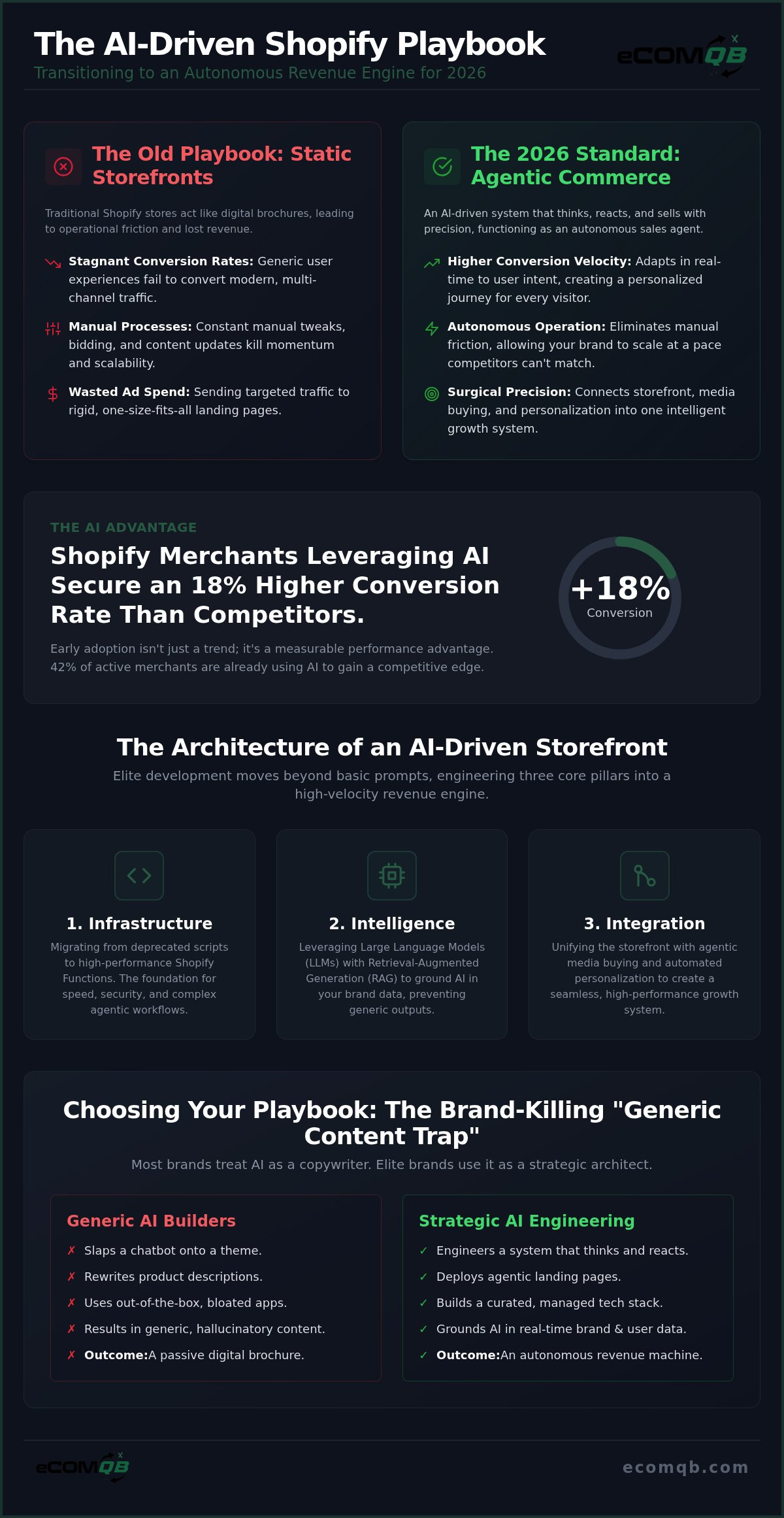
Recent data confirms that 42% of active Shopify merchants are already leveraging AI, securing an 18% higher conversion rate than their legacy competitors. Most brands are still treating AI as a glorified copywriter rather than a strategic architect. True AI-driven Shopify development isn't about slapping a chatbot onto a theme. It's about engineering a system that thinks, reacts, and sells with surgical precision. If your tech stack is still leaking revenue while you manually tweak product descriptions, you are losing the game.
You recognize that stagnant conversion rates and rising customer acquisition costs are the primary threats to your 2026 growth targets. Generic tools and bloated apps have created operational friction that slows your momentum. This guide provides the tactical playbook to transition from a static storefront to an agentic revenue machine that scales autonomously. We will break down elite development strategies for automated personalization, agentic media buying, and the critical migration from deprecated scripts to high-performance Shopify Functions. Prepare to build a future-proofed tech stack that converts at velocity.
Key Takeaways
- Transition from passive digital brochures to agentic commerce systems that react, adapt, and sell in real-time.
- Master the three pillars of elite AI-driven Shopify development to engineer a storefront that functions as an autonomous revenue engine.
- Avoid the brand-killing "Generic Content Trap" by prioritizing strategic engineering over basic, out-of-the-box AI builders.
- Identify the critical criteria for selecting a managed AI partner capable of unifying your storefront with high-velocity agentic media buying.
- Future-proof your 2026 tech stack to eliminate operational overhead and achieve peak performance at an 8-figure scale.
The Paradigm Shift: From Static Storefronts to Agentic Commerce
The digital brochure is dead. For years, brands treated their Shopify stores as static catalogs, simple destinations for traffic to land and, hopefully, convert. In the 2026 e-commerce economy, that approach is a liability. Modern consumers don't want a catalog; they want a responsive environment that anticipates their needs. This shift marks the rise of Agentic Commerce. These are storefronts that think, adapt, and sell in real-time without constant manual intervention. They function as autonomous sales agents rather than passive displays.
Winning in this high-stakes environment requires a fundamental pivot toward AI-driven Shopify development. It's no longer enough to just get a site live. Speed of build is a vanity metric that often masks poor performance. The only metric that matters is velocity of revenue. If your store isn't actively orchestrating the customer journey, it's leaking cash. High-performance brands are already initiating an AI transformation for eCommerce brands to stay ahead of the curve. They are moving from reactive updates to proactive engineering.
The Velocity Gap: Why Legacy Tech is Leaking Your Profit
Legacy tech stacks are brittle. They rely on static themes that fail to capture the nuance of modern, multi-channel traffic. When a customer arrives from a highly specific social ad, they shouldn't see a generic homepage. They should land in a personalized environment tailored to their intent. Static tech can't do this. It forces every visitor through the same rigid funnel, resulting in stagnant conversion rates and wasted ad spend.
Manual processes are the silent killers of 8-figure ambitions. Manual bidding, manual content updates, and manual segmenting create a "Velocity Gap." This gap represents the distance between your current revenue and your store's actual potential. Data gaps are equally dangerous. If your system isn't capturing and acting on behavioral signals in real-time, you're flying blind. You're making decisions based on yesterday's data while your competitors are moving at the speed of the digital economy.
The 2026 Standard: High-Performance Growth Systems
Stop buying themes. Start deploying systems. The 2026 standard for elite brands is a curated, managed AI technology stack. This moves the storefront from a standalone asset to the nerve center of an eCommerce AI growth system. This isn't about adding more apps; it's about integrating intelligence into the core architecture of your store.
A high-performance system integrates every touchpoint. It connects your storefront with agentic media buying and automated personalization. This isn't just about efficiency; it's about scale. By removing the operational friction of manual management, you free your brand to grow at a pace legacy competitors can't match. Precision, speed, and automation are the new requirements for dominance. You need a store that works as hard as your best salesperson, 24 hours a day, at a global scale.
Beyond the Prompt: The Architecture of AI-Driven Shopify Development
True AI-driven Shopify development is not an exercise in creative writing. It is the sophisticated engineering of commerce environments using agentic workflows to automate growth. While competitors use AI to rewrite product descriptions, elite developers build systems that think. This architecture relies on three non-negotiable pillars: Infrastructure, Intelligence, and Integration. These elements work in tandem to transform a store from a static site into a high-velocity revenue engine. Understanding the technical breadth of AI in Ecommerce is essential for brands aiming to dominate the 2026 market.
Modern storefronts leverage Large Language Models (LLMs) paired with Retrieval-Augmented Generation (RAG). This combination ensures your AI agents are grounded in your specific brand data, inventory levels, and customer history. It prevents the hallucinations common in generic tools. The result is an AI-engineered UX that anticipates user intent. It's the difference between a bot that answers questions and a system that closes sales. You aren't just generating content; you're engineering outcomes.
Agentic Landing Pages and Dynamic Storefronts
The days of sending all traffic to a single best-seller page are over. AI now enables the creation of unique, agentic landing pages for every traffic source in real-time. By analyzing incoming signals, the system generates layouts, copy, and offers tailored to the individual user. This is the science of Zero-Latency revenue. Implementing AI for Shopify personalization allows your store to evolve during the session. It moves beyond traditional A/B testing into a state of continuous, generative optimization.
Headless Architecture and AI-Enhanced SEO
Headless Shopify is the preferred foundation for high-performance AI agents. By decoupling the front-end from the back-end, you give your AI tools the freedom to manipulate the presentation layer without technical lag. This flexibility is critical for automating SEO and content strategy for Shopify at scale. AI-driven systems now manage technical SEO tasks like schema injection and semantic relevance with surgical precision. They ensure your brand remains visible as search engines shift toward AI-based discovery. If you're ready to upgrade your infrastructure, you should consult with a strategic partner to map out your deployment.
Strategic Engineering vs. Generic AI Builders: Choosing Your Playbook
Amateurs focus on the ease of setup. Leaders focus on the velocity of scale. While generic tools promise a store in seconds, they often deliver a digital brochure that lacks the intelligence to compete in a crowded market. True AI-driven Shopify development requires a strategic playbook, not a basic prompt. Convenience is the enemy of performance. If your build process is "easy," your competitive advantage is likely non-existent.
The "Generic Content Trap" is the first hurdle. Out-of-the-box AI tools produce uninspired, repetitive copy that erodes brand authority. In the 2026 economy, customers can spot low-quality AI content instantly. It feels robotic, hollow, and untrustworthy. Custom engineering ensures that every interaction reflects your brand's unique voice and strategic positioning. You need a system that doesn't just fill space but actively persuades and converts.
The Hidden Costs of "Free" AI Builders
Basic builders create technical debt that stifles growth. These rigid templates are brittle, generic, and unscalable. They lack the sophisticated architecture required to handle agentic media buying. If your storefront cannot interpret and act on the complex data signals sent by your ad agents, your entire growth system fails. You end up with a high-performance engine in a low-performance chassis. This misalignment leads to rising customer acquisition costs and leaking revenue funnels.
The limitation of generic tools extends to your operational agility. When you rely on "easy to build" solutions, you sacrifice the ability to customize the customer journey. You are locked into someone else's idea of a high-converting store. This lack of control makes it impossible to implement real-time generative optimization, leaving you stuck with static elements that underperform as market conditions shift.
The ROI of Custom AI Development
- Conversion Rate Optimization: Custom agents adapt the UI in real-time based on visitor behavior.
- LTV Expansion: Automated systems predict and trigger the perfect upsell at the perfect moment.
- CAC Reduction: Seamless integration between the store and media buying tools ensures every ad dollar is spent on high-intent traffic.
The long-term value of a high-performance tech stack is undeniable. It provides the infrastructure needed to scale without adding manual friction. You aren't just building a store; you are engineering a revenue machine that works 24/7. For brands seeking a professional, custom-built foundation to support these advanced systems, 1st Page Factory provides the e-commerce design expertise necessary to compete. This is how market leaders maintain their dominance while legacy brands struggle to keep pace.
The High-Performance Checklist: Evaluating Your AI Development Partner
Choosing a partner for AI-driven Shopify development is a high-stakes decision that determines your trajectory for the next three years. Most agencies are still selling 2022 solutions with a 2026 sticker. You don't need a vendor who simply follows instructions. You need a tactical partner who understands the mechanics of growth. A strategic failure in your tech stack today becomes an insurmountable revenue leak tomorrow. Precision, expertise, and foresight are non-negotiable.
The distinction between a "website designer" and a "revenue engineer" is found in their philosophy. While standard agencies focus on aesthetics and basic functionality, award-winning studios like Insight Multimedia demonstrate that creative excellence is a vital component of a brand's digital presence. However, high-performance partners must go further by focusing on building a revenue machine. This requires a deep understanding of how your Shopify environment integrates with agentic media buying and autonomous sales workflows. If they can't explain how their code reduces your CAC or increases your LTV, they are the wrong partner for an 8-figure brand.
Technical Proficiency vs. Strategic Mastery
Technical skill is the baseline; strategic mastery is the differentiator. Your developer must also be a performance marketer. They should possess the ability to manage complex API integrations and Large Language Model (LLM) deployments that actually drive sales. Ask them how they ground their AI agents in your specific brand data to prevent hallucinations. They must demonstrate a clear path for your storefront to scale alongside an agentic email marketing strategy. If these systems operate in silos, you are losing the synergy that defines the modern digital economy.
Vetting for data security and AI ethics is equally critical in 2026. As regulations tighten, your partner must ensure that your AI-driven systems are transparent, secure, and compliant. This isn't just about avoiding legal friction. It is about maintaining the brand authority and customer trust required for long-term dominance. Secure. Compliant. Authoritative. These are the hallmarks of elite engineering.
The Managed Growth Model
The "one-off build" is a relic of a slower era. In the 2026 economy, a "fully managed" AI transformation is the only way to avoid technical overwhelm. High-velocity brands require a "Field General" who manages the technology stack while the leadership team focuses on brand vision. A managed model ensures that your systems are constantly optimized, updated, and refined. It eliminates the operational friction that kills momentum.
- Red Flag: Agencies that use AI only for "copywriting" or basic image generation.
- Red Flag: Developers who cannot demonstrate real-time data integration between Shopify and external AI agents.
- Red Flag: Partners who offer no ongoing strategic management or performance optimization.
You are playing a high-stakes game. Don't settle for a partner who is still learning the rules. If you are ready to deploy a system that thinks, adapts, and wins, you need to schedule a high-performance briefing to audit your current trajectory.
Scaling with eComQB: The Fully Managed AI Growth System
eComQB functions as your strategic Field General. We don't just deliver a site; we deploy a comprehensive Revenue Machine. This is a curated technology stack specifically designed for 8-figure brands. Our approach to AI-driven Shopify development ensures that every line of code serves a single purpose: high-velocity revenue. We bridge the gap between high-level brand strategy and technical agentic execution, creating a seamless loop between your storefront and your media buying. Precise, scalable, and autonomous, our systems are built for the elite tier of commerce.
Most agencies stop at the "Thank You" page. We close the loop. By integrating your storefront architecture with agentic media buying, we ensure that data flows freely between your ads and your site. This synergy allows for real-time optimization that legacy teams simply can't match. We analyze, optimize, and dominate. Your store becomes a living organism that learns from every visitor, every click, and every conversion.
Your Blueprint for 8-Figure Velocity
Managed AI transformation is about gaining the technical edge without the operational friction. You don't need to hire a fleet of prompt engineers or data scientists. We provide the expertise and the infrastructure. Our system executes high-performance Meta and Google campaigns through agentic workflows that adapt faster than any human buyer. This isn't just about saving time; it's about achieving a level of precision that manual management can't reach. If you're ready to stop playing defense and start scaling, it's time to Book Your Tactical Call.
The Final Move: Seizing the Competitive Advantage
The window for early-mover advantage is closing rapidly. Waiting until 2027 to implement sophisticated AI-driven Shopify development is a fatal error. Your competitors aren't just using AI for copy; they're using it to automate the mechanics of growth. By reclaiming your strategic time, you can focus on brand vision while our systems handle the technical heavy lifting. Reclaim your time, reduce your overhead, and accelerate your growth.
Precision. Speed. Results. These are the requirements for dominance in the modern digital economy. Don't let technical debt or manual processes anchor your brand to the past. The future belongs to those who automate, innovate, and execute. Apply for your Managed AI Growth System today and secure your position at the top of the market.
Seize the Agentic Edge and Lead the Market
The era of the digital brochure is over. To thrive in the 2026 economy, your brand must transition from a static storefront to an agentic revenue machine that thinks, adapts, and sells in real-time. We've explored how elite architecture, custom engineering, and strategic partnerships form the foundation of 8-figure success. The decision to invest in AI-driven Shopify development is no longer optional. It is the definitive line between market leaders and those left behind by the speed of the digital economy.
As Managed AI Transformation Specialists, eComQB is dedicated to engineering 8-figure revenue machines for ambitious leaders. We function as your tactical Field General, deploying agentic workflow pioneers to eliminate operational friction and accelerate growth. Don't let legacy tech stacks anchor your ambitions to the past. The infrastructure you build today determines your dominance tomorrow. Precision, speed, and automation are your new competitive advantages.
The window for early-mover advantage is closing. It's time to stop reacting and start orchestrating your growth trajectory. Book Your Tactical Growth Call with eComQB and secure your future. The next level of performance is waiting for those bold enough to claim it.
Frequently Asked Questions
What exactly is AI-driven Shopify development?
AI-driven Shopify development is the strategic engineering of commerce environments using agentic workflows to automate growth. It moves beyond static templates and manual updates. This approach builds a responsive system that analyzes customer behavior in real-time. It transforms your store from a passive catalog into an active sales agent that closes deals 24/7. You aren't just building a website; you are deploying a revenue machine that learns and adapts to every visitor.
How does an agentic storefront differ from a standard Shopify theme?
A standard theme is a digital brochure that stays the same for every visitor. An agentic storefront is a dynamic environment that thinks and reacts. It uses AI agents to adjust layouts, product recommendations, and messaging based on live data signals. While a standard theme waits for a user to find what they want, an agentic system proactively guides them toward a conversion. It is the difference between a static map and a GPS.
Will AI-driven development hurt my store's SEO performance?
Strategic AI implementation actually accelerates your organic visibility. Modern AI-driven Shopify development utilizes technical SEO automation to manage schema, semantic relevance, and page speed with surgical precision. It ensures your store remains visible as search engines shift toward AI-based discovery models. By delivering highly relevant, personalized content to users, you improve engagement metrics that search algorithms reward. It's about engineering relevance at a scale humans simply can't match.
Do I need a huge budget to implement AI-driven growth systems?
High-performance systems are designed to pay for themselves through increased velocity. While implementing an AI growth system requires a strategic investment, it drastically reduces the operational headcount needed for manual management. You are trading high manual overhead for automated precision. For 8-figure brands, the cost of staying on legacy tech is far higher due to lost conversions and inefficient ad spend. It's an investment in competitive dominance.
Can eComQB integrate AI with my existing Shopify store?
We specialize in the managed AI transformation of existing Shopify environments. Our team audits your current infrastructure to identify revenue leaks and data gaps. We then deploy a curated technology stack that integrates with your store's core functions. This process is handled with tactical precision to ensure zero downtime. You get the power of advanced AI without the operational friction of a full rebuild or the technical overwhelm of managing multiple vendors.
What are the primary benefits of agentic media buying for Shopify brands?
It bridges the gap between your traffic source and your storefront. Agentic media buying uses autonomous workflows to manage Meta and Google campaigns with a level of speed humans can't replicate. It coordinates directly with your agentic landing pages to ensure every visitor sees a personalized offer. This creates a high-velocity feedback loop that lowers your CAC and increases your ROAS. It is the ultimate playbook for rapid scaling.
How long does it take to deploy a fully managed AI growth system?
We move quickly to establish your strategic advantage. Most brands see their initial agentic workflows and infrastructure live within a few weeks of the tactical briefing. This isn't a slow corporate rollout; it's a series of rapid-fire deployments designed to generate immediate momentum. Once the foundation is set, we move into continuous optimization. We ensure your system is always evolving to meet the demands of the digital economy.
Is AI-driven development suitable for small DTC brands or only enterprise?
This technology is the great equalizer for ambitious DTC brands. While enterprise stores have more data, smaller brands use these systems to outmaneuver legacy giants through superior agility. It allows a lean team to operate with the output of a much larger organization. If your goal is to scale to 8 figures and beyond, you need the same high-performance tools as the market leaders. Automation is how you win the game.