Agentic Workflows for eCommerce: The 2026 Autonomous Growth Blueprint

What if your eCommerce stack could make the next move instead of waiting for someone to update a rule? Agentic workflows for ecommerce shift growth from rigid scripts to systems that interpret changing signals, select an action, and evaluate the outcome. That matters when acquisition costs rise, campaigns lose momentum, or a merchandising change affects multiple connected tools.
Automation can save time, but fixed rules may not account for shifts in customer behavior, product availability, or media performance. When teams must manually connect insights across platforms, they spend less time setting strategy and more time clearing operational bottlenecks.
This guide explains how agentic workflows operate across a modern eCommerce tech stack, from media buying and retention to catalog management and storefront personalization. You’ll learn where coordinated agents can help optimize spend, adapt customer experiences, and reduce repetitive work, along with the controls needed to keep people in charge of consequential decisions. The goal is a more responsive growth engine, with leaders setting direction and workflows handling repeatable next steps.
Key Takeaways
- See how goal-driven agents can respond to changing signals, while fixed automations remain bound to preset rules.
- Understand how connected commerce data and clear execution controls support more reliable agent decisions.
- Identify where agentic workflows for ecommerce can improve media buying, customer retention, and storefront personalization.
- Use a staged deployment roadmap to start with focused operational wins before expanding agent autonomy.
- Compare building AI infrastructure in-house with using a managed growth system to limit operational overhead.
What Are Agentic Workflows in Modern eCommerce?
Most eCommerce automations execute preset instructions. Agentic workflows go further: they form a loop that reads changing data, reasons against a defined goal, takes an action, and evaluates the result. Rather than following only a fixed script, an agent can choose among approved actions as conditions change.
That distinction matters for brands pursuing scale. As media channels, customer behavior, and storefront performance shift, fixed rules can become stale or fail at the edges. Agentic workflows for ecommerce provide a way to adapt operations continuously, helping teams scale decision-making without turning every adjustment into another manual task. The broader concept of Agentic commerce explores how AI agents can take autonomous steps in purchasing and payment. Commerce workflows can also support the growth operations behind the storefront.
Linear Automations vs. Autonomous Agentic Systems
A traditional automation follows a deterministic chain: if a defined event happens, perform a specified action. That works well for predictable tasks. But an unexpected shift, such as a change in campaign performance alongside a change in product availability, may fall outside the original logic. Unless someone updates the rules, the workflow can’t weigh those competing signals.
An autonomous agent is guided by a target, such as improving customer acquisition efficiency within approved spend limits. It can assess multiple inputs, choose a permitted next step, and escalate situations it can’t confidently resolve. For example, a media workflow could consider campaign results alongside storefront conversion signals before adjusting a campaign, rather than reacting to a single threshold. Ambiguity becomes a decision to assess, not automatically a broken rule.
The Core Feedback Loop: Perception, Reasoning, and Action
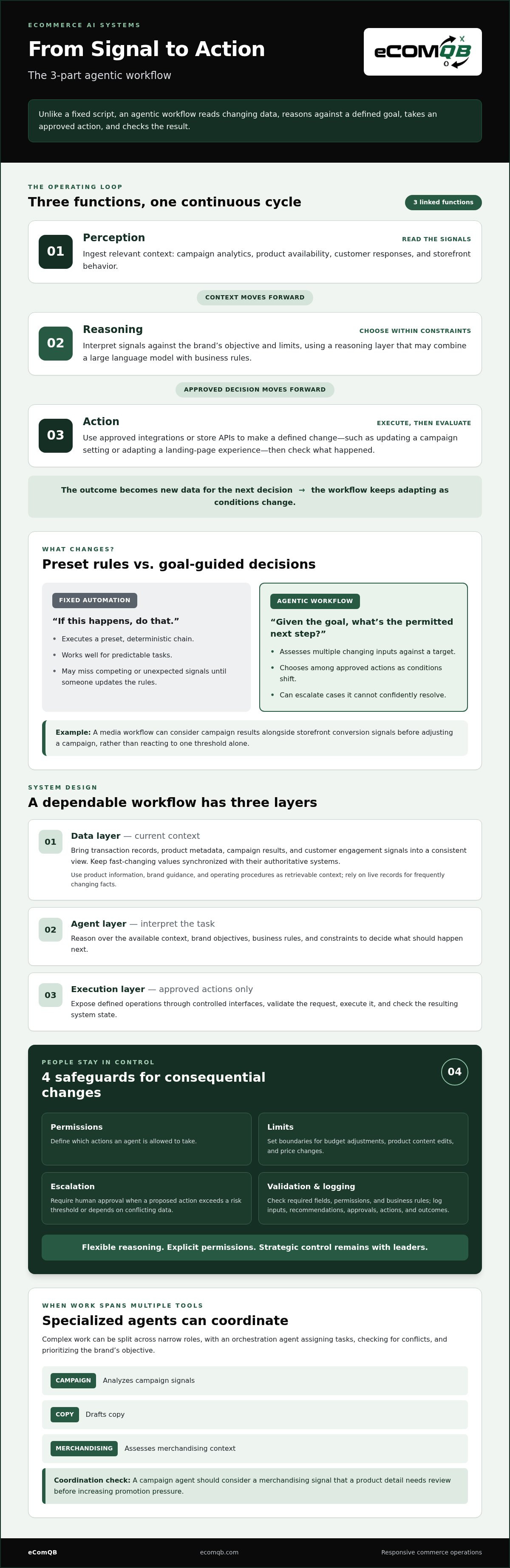
Every useful agentic workflow connects three functions:
- Perception: It ingests relevant signals, such as campaign analytics, product availability, customer responses, and storefront behavior.
- Reasoning: A reasoning layer, which may use a large language model alongside business rules, interprets those signals against the brand’s objective and constraints.
- Action: Approved integrations or store APIs carry out a defined change, such as updating a campaign setting or adapting a landing-page experience.
The loop then checks what happened and uses the new data to inform its next decision. Guardrails matter: define permissions, limits, and escalation paths before agents act on consequential changes. The aim isn’t autonomy for its own sake. It’s a responsive operating system that handles repeatable decisions quickly while leaders retain strategic control.
The Technical Architecture of eCommerce AI Agent Systems
An agent’s decisions are only as reliable as the data, permissions, and tools around it. A practical architecture connects commerce signals to reasoning, then routes proposed actions through controlled interfaces. For agentic workflows for ecommerce, that means designing for operational accuracy, not just adding a language model to an existing tech stack.
A useful design separates responsibilities: a data layer supplies current context, an agent layer interprets the task, and an execution layer exposes only approved actions. This structure also makes it easier to identify where a decision went wrong. Algolia’s overview of Agentic Architecture explores how perception, reasoning, coordination, and action fit together in a dependable system.
Unified Data Layer and Vector Memory
Bring transaction records, product metadata, campaign results, and customer engagement signals into a consistent view. Keep fast-changing values, such as product availability or campaign performance, synchronized with their authoritative systems. Vector embeddings can help agents retrieve relevant context from product information, brand guidance, and operating procedures, but they shouldn’t replace live records for frequently changing facts. Reliable context starts with knowing which source is authoritative for each data point.
Deterministic Guardrails and Safe Execution
Reasoning can be flexible; permissions should be explicit. Set boundaries for actions such as budget adjustments, product content edits, or price changes. Require human approval when a proposed action exceeds a defined risk threshold or relies on conflicting data. Before an API call executes, validate required fields, permissions, and business rules. Log the inputs, recommendation, approval status, action, and outcome so teams can review decisions and refine the workflow.
Multi-Agent Coordination and Tool Use
Complex work can benefit from specialized agents with narrow roles. One can analyze campaign signals, another draft copy, and another assess merchandising context. An orchestration agent assigns tasks, checks for conflicts, and prioritizes the brand’s objective. For instance, a campaign agent should not increase promotion pressure without considering a merchandising agent’s signal that a product detail needs review.
Agents should act through defined tools, not unrestricted access. A tool interface can expose specific operations, such as updating an approved advertising setting or publishing a reviewed storefront change, through the relevant platform API. The workflow validates the request, executes it, then checks the resulting system state. This is the practical bridge between LLM reasoning and commerce infrastructure: controlled inputs, scoped API actions, and a verifiable feedback loop.
Coordinating these layers across advertising, retention, and storefront systems takes careful planning. Discuss managed AI growth systems to align agent workflows with your commerce stack and operating goals.
High-Impact Commercial Use Cases Transforming DTC Brands
The strongest use cases connect decisions across the customer journey. Ad performance, product availability, storefront behavior, and retention signals can inform one another instead of sitting in separate dashboards. That’s where agentic workflows for ecommerce can help DTC teams move from isolated optimizations to coordinated growth decisions, with people setting objectives and boundaries.
Autonomous Media Buying and Creative Iteration
Media-buying agents can compare campaign performance across Meta and Google against goals such as efficient acquisition, then recommend or make approved budget adjustments as results shift. They can also flag patterns associated with creative fatigue and prepare an iteration brief, such as testing a different product benefit or audience angle. Human strategists still define guardrails and review higher-risk changes. For a deeper look at this approach, explore agentic media buying.
Dynamic Merchandising and Contextual Storefronts
A storefront can respond to both shopper intent and commercial context. For example, collection pages could rank products using relevant signals such as engagement, availability, and margin priorities, while landing pages adapt their message to the audience arriving from a campaign. The goal isn’t to personalize every element indiscriminately. It’s to present a useful, coherent path to purchase without promoting products or offers that conflict with current business priorities. See how AI for Shopify personalization can shape a more responsive storefront.
Zero-Latency Lifecycle Marketing
Lifecycle workflows can use browsing and engagement signals to time relevant email or SMS messages, rather than relying only on a fixed calendar. A shopper revisiting a product, for instance, may receive a message aligned with that interest, while another customer gets a distinct follow-up based on their activity. Agents can also recommend discount levels using purchase-propensity signals, but discount floors, margin rules, and approval requirements should constrain execution. That helps teams pursue conversion without letting automated incentives erode profitability. Explore the agentic email marketing playbook for more on adaptive retention.
Inventory and merchandising decisions can reinforce these use cases. When availability changes, workflows can update product visibility or page ranking, then adjust related campaign and retention recommendations. The result is a more coordinated commercial engine: acquisition attracts demand, storefronts respond to intent, and retention follows through with relevant next steps.
How to Implement Agentic Workflows: The 4-Stage Deployment Roadmap
Deploy autonomy in deliberate steps. A focused rollout lets your team verify data, compare agent decisions with operating standards, and expand permissions only when the workflow earns them. For agentic workflows for ecommerce, measure business outcomes and decision quality, not how many tasks an agent can perform.
Choose one contained workflow first, such as campaign monitoring or product content review. Establish a baseline before changing it: track time spent on the task, decision accuracy, conversion or revenue impact where relevant, and errors that require correction. Keep the comparison consistent so the team can distinguish genuine improvement from normal performance variation.
Stage 1 & 2: Data Sanitation and Supervised Pilot Execution
Stage 1: Clean the inputs. Standardize product tags, campaign attribution parameters, and customer cohort records. Resolve duplicate or conflicting fields, and identify which system is authoritative for each changing value. In a Shopify environment, ensure product and variant information aligns with the records used by connected marketing workflows.
Stage 2: Observe before acting. Run the agent in simulation mode so it proposes decisions without writing changes to live systems. Compare its recommendations with experienced operators’ decisions, then record where they diverge. Review the context the agent used, the rationale it produced, and whether the recommendation respected business priorities. Use those findings to refine data, instructions, and escalation rules before enabling execution.
Stage 3 & 4: Bound Autonomy and Enterprise Orchestration
Stage 3: Grant narrow permissions. Enable live actions only for tasks that passed supervised testing. Define strict limits for changes such as advertising budgets, set approval requirements for exceptions, and maintain a clear rollback path. Monitor results against the baseline, including task time, correction rates, and the relevant commercial outcome. If performance weakens or data quality shifts, pause execution and investigate.
Stage 4: Orchestrate across workflows. Once individual agents perform reliably, connect them across functions. A campaign workflow can share a signal with a landing-page or retention workflow, while each agent stays within its role and permissions. Assign ownership for monitoring the full process, resolving conflicts, and updating prompts, retrieved context, and model settings as business conditions change. Expand coordination only when each connected step has clear accountability.
Use this roadmap to replace manual friction with measured, controlled execution. Plan your agentic workflow deployment with a team that builds managed AI growth systems for eCommerce brands.
The Managed AI Growth Engine: Scaling Without Operational Overhead
Building agentic capability in-house can give a brand direct control, but it also means assembling and coordinating the expertise behind data pipelines, model behavior, integrations, and ongoing testing. The challenge isn’t simply launching an agent. It’s keeping the system useful as platforms, customer signals, and commercial priorities change.
For growth-focused brands, a managed system offers another route: align strategy, technology, and execution without building an internal AI function from scratch. The right operating model keeps attention on commercial outcomes, not an expanding stack of tools and maintenance tasks. For a broader roadmap, explore this guide to AI transformation for eCommerce brands.
The Hidden Cost of Building In-House AI Teams
Internal development requires more than hiring technical talent. Teams must connect commerce data, define agent permissions, test decisions, maintain integrations, and translate business goals into workflows. Those responsibilities compete for executive focus and can leave marketing, merchandising, and engineering working from different priorities.
There’s also a maintenance cycle. Foundation models and platform interfaces evolve, so custom workflows need review and adjustment to stay aligned with current systems and brand requirements. Before committing to a build, weigh the full operating load: recruitment, coordination, infrastructure upkeep, and the time required to turn a working prototype into reliable commercial execution.
The eComQB Advantage: Fully Managed Strategic Execution
eComQB provides fully managed AI growth systems, agentic media buying, AI personalization, and Shopify website design and development for eCommerce brands. Its services include digital advertising execution across Meta and Google, along with agentic email and SMS strategies. This combination helps brands coordinate marketing and storefront work without taking on the full burden of building and maintaining an in-house AI function.
Strategic alignment is the multiplier. Media decisions should support the storefront experience; landing pages should reflect the intent that campaigns attract; retention should build on the signals customers create. When these moves reinforce one another, teams can direct marketing activity with greater context and pursue GMV growth while limiting operational bottlenecks. Results still depend on the quality of the strategy, data, and oversight, not autonomy alone.
The directive is clear: don’t build complexity for its own sake. Choose a focused managed growth system, align it to the metrics that matter, and expand execution as workflows prove their value. That’s how brands can move toward a higher-velocity commerce engine without scaling operational headcount in lockstep with revenue.
Build Your Next Growth Advantage
Rigid rules can handle predictable tasks, but sustained eCommerce growth demands systems that respond as performance, customer intent, and storefront conditions change. The strongest agentic workflows for ecommerce pair connected data with clear guardrails, then expand autonomy in stages as results earn greater trust.
For high-velocity brands, the opportunity is to align paid media, Shopify storefronts, and retention channels around shared growth goals. eComQB implements fully managed AI growth systems and provides agentic media buying, dynamic personalization, and strategic execution, helping brands apply AI without building an in-house AI team.
Keep your focus on direction, priorities, and performance. Let a managed growth engine reduce operational friction while your team stays in command of the strategy. Deploy your managed AI growth system with eComQB and take the next step toward a more adaptive, scalable commerce operation.
Frequently Asked Questions
What is the difference between automated workflows and agentic workflows in eCommerce?
Automated workflows execute predefined rules, while agentic workflows interpret context and select actions toward a goal. A rule might send an abandoned-cart email after a fixed delay; an agent can consider browsing behavior, prior engagement, and campaign context before choosing an approved follow-up. Agentic workflows for ecommerce still need clear objectives and guardrails. They adapt within those boundaries rather than acting without oversight or replacing human strategy.
Can agentic workflows manage Meta and Google ad spend without human errors?
Agentic workflows can analyze Meta and Google campaign signals and adjust spend within permissions, but no system can promise error-free decisions. Start by running recommendations in observation mode and comparing them with experienced operators’ decisions. Then set budget limits, approval requirements for exceptions, and an audit trail. Human oversight remains important, especially when data conflicts or a proposed change could materially affect campaign performance.
How do AI agents integrate with Shopify stores and existing tech stacks?
AI agents typically connect through approved APIs or platform integrations that let them read relevant data and perform specific actions. A workflow might use Shopify product information alongside advertising performance and customer engagement signals, then send an approved update through a defined tool. Reliable integration depends on consistent records, clear permissions, and knowing which system owns each data point. Test proposed actions before enabling changes in live systems.
Are agentic workflows secure enough to prevent pricing glitches or data leaks?
Security depends on system design and ongoing controls, not on the word “agentic.” Limit each agent’s access to the data and actions it needs, validate changes against business rules, and require approval for sensitive pricing or customer-data actions. Keep decision logs and define a way to pause or reverse workflows. These safeguards reduce risk, but they can’t guarantee that errors or data exposure will never occur.
How fast can an online brand see ROI after deploying agentic workflows?
There’s no reliable universal timeline for ROI. Results depend on the workflow chosen, the quality of connected data, implementation effort, and the baseline performance it’s measured against. Start with a focused use case and compare measures such as task time, correction rates, conversion, or campaign efficiency before and after deployment. Set a review period that fits your data volume, and expand only when results support the next step.
Do brand owners need dedicated software engineers to maintain agentic systems?
Not necessarily. Brands still need clear business ownership for goals, permissions, and performance review, but they don’t always need to recruit a dedicated engineering team. Managed AI growth systems can handle implementation and ongoing execution across commerce workflows. eComQB provides fully managed eCommerce growth systems, including agentic media buying and AI personalization, so brands can apply AI capabilities without taking on the full in-house technical workload.
How do agentic workflows improve customer retention and lifetime value?
Agentic workflows can use customer engagement and browsing signals to make email and SMS journeys more relevant and timely. For example, a follow-up can reflect a customer’s recent product interest instead of sending every shopper the same message on a fixed schedule. Measure impact through repeat purchases, retention, and cohort-level lifetime value. Set contact and discount rules so personalization supports long-term customer relationships rather than relying on constant promotions.