High Performance eCommerce Tech Stack: Engineering 8-Figure Velocity in 2026
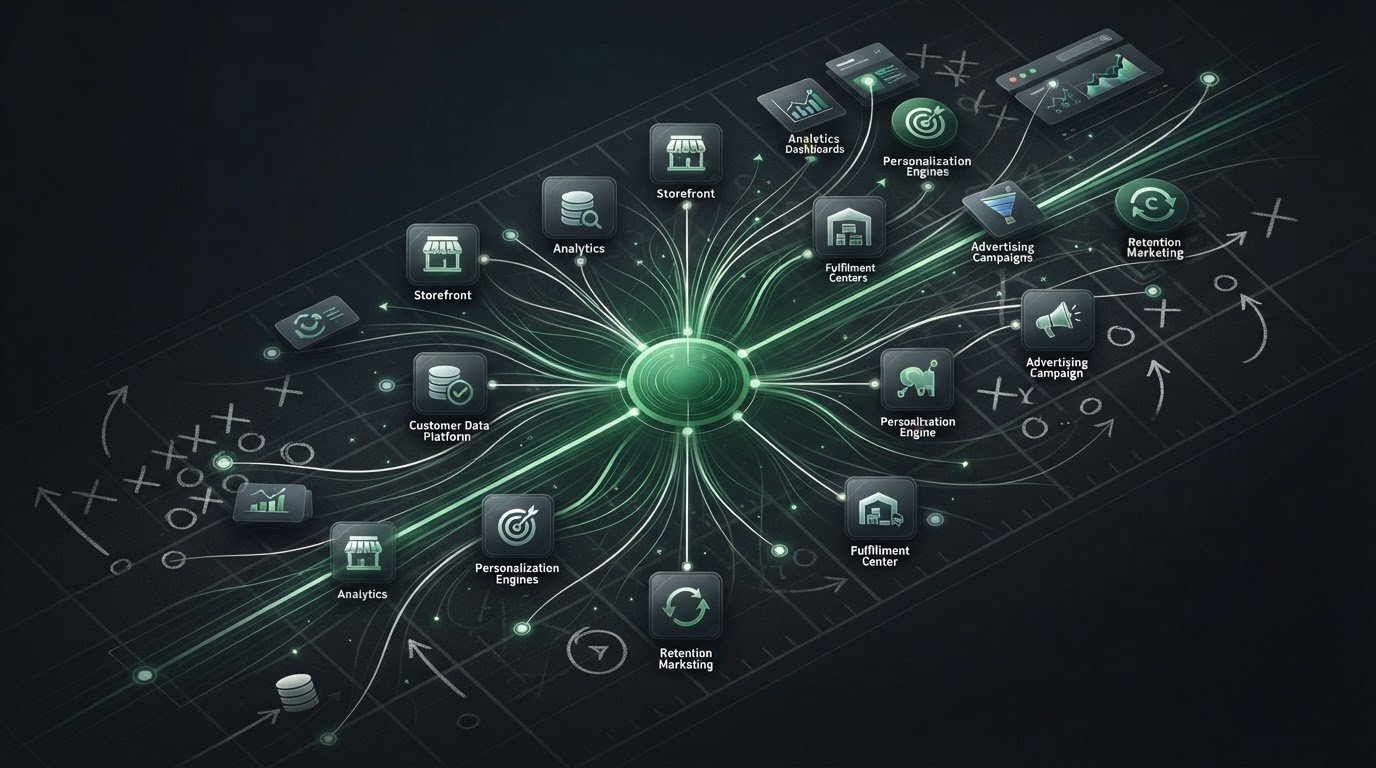
What if scaling your Shopify store to eight figures requires fewer tools, not more? A high performance ecommerce tech stack isn’t a longer list of apps. It’s a connected system that turns useful data into informed decisions and coordinated action.
Fragmented customer data, manual media buying, and disconnected platforms create work for your team. Each new tool can mean another handoff, workflow, and source of technical debt. That drag can make it harder to protect margins while you scale.
This guide explains how to build a more coordinated eCommerce stack: where Shopify fits, how AI tools and agentic workflows can support growth, and how to connect marketing, personalization, and storefront experiences. You’ll also find a practical implementation path, from auditing your current setup to piloting workflows and refining them. The aim is to reduce unnecessary complexity and make it easier to act on reliable signals.
Key Takeaways
- Find disconnected apps and manual workflows that create friction rather than supporting growth.
- Consider how an agentic core can coordinate workflows across separate tools.
- Assess platforms by how they support revenue-generating workflows, personalization, and retention.
- Plan a Shopify implementation in stages, beginning with a diagnostic and prioritizing the most limiting connections.
- Explore how managed growth support can coordinate technology and execution across your stack.
The Legacy Leak: Why Standard Tech Stacks Fail to Scale
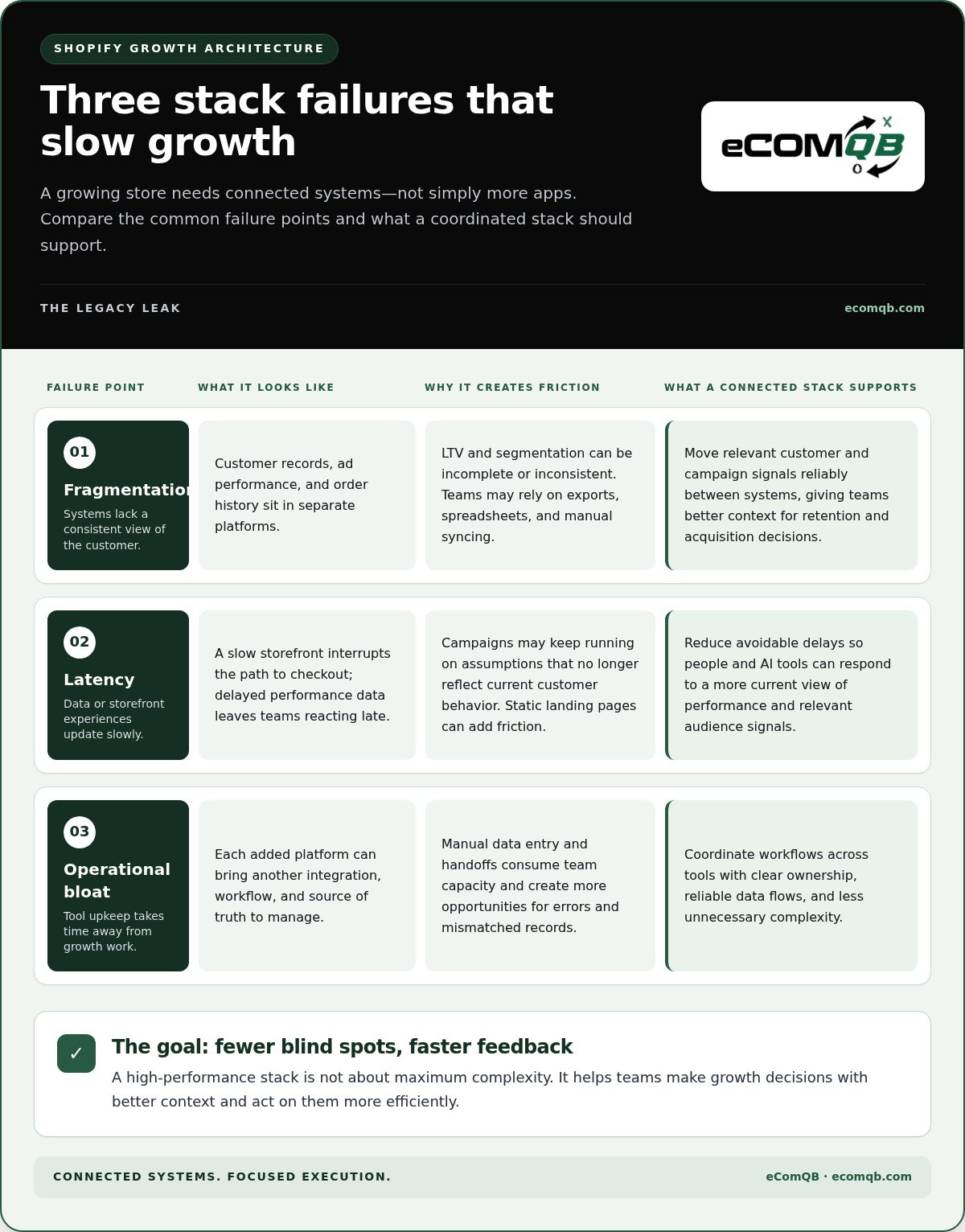
A growing Shopify store rarely needs another app as much as it needs its existing systems to work together. The Legacy Leak is the drain on revenue and team capacity caused by disconnected systems, delayed information, and manual data entry. Customer records may live in one platform, ad performance in another, and order history somewhere else. Each tool can work on its own, yet together they may leave the team making decisions with an incomplete picture.
A technology stack is the combination of tools and systems used to run a business. At 8-figure scale, the key question isn’t how many apps are installed. It’s whether the stack can move relevant data reliably and support timely action. Look for three common failure points: fragmentation, where systems lack a consistent view of the customer; latency, where data or storefront experiences are slow to update; and operational bloat, where maintaining tools takes time away from improving growth.
Adding more apps rarely fixes these issues. Each platform can introduce another integration, workflow, and source of truth to manage. Without clear orchestration, the stack gets wider without becoming more useful. Manual bidding and static landing pages can also make it harder to respond to changing performance and customer signals.
The Cost of Fragmentation
When customer, order, and marketing data sit in silos, lifetime value (LTV) calculations can be incomplete or inconsistent. A repeat customer might appear as a first-time buyer in one system, while another platform lacks the campaign context behind a purchase. This makes segmentation less reliable and can make it harder to decide where to focus retention and acquisition efforts.
A disconnect between a CRM and a media buying platform creates more friction. If purchase or audience signals don’t flow reliably between them, campaign decisions may rely on outdated or partial information. Teams often fill the gap with exports, spreadsheets, and manual syncing. That takes time away from strategy and creates more opportunities for errors and mismatched records.
Latency: The Speed Killer
Speed matters throughout the customer journey. A slow Shopify storefront can interrupt the path from product discovery to checkout. Delayed performance data can also leave teams reacting after an opportunity has passed. Without timely feedback, Meta and Google campaigns may keep running based on assumptions that no longer reflect current customer behavior.
Static landing pages can add friction when they don’t reflect relevant audience signals. A connected system can help teams coordinate data, personalization, and campaign workflows more quickly. Not every decision should run without oversight. The practical goal is to reduce avoidable delays so people and AI tools can act on a more current view of performance.
The goal of a high performance ecommerce tech stack is not maximum complexity. It’s fewer blind spots, faster feedback, and more focused execution. When systems work together, teams can make growth decisions with better context and act on them more efficiently.
Anatomy of a High-Performance Stack: The Agentic Core
A high performance ecommerce tech stack isn’t a pile of AI features added to a storefront. It’s a coordinated growth architecture. At its center is the Agentic Core: connected data, AI tools, and workflows that interpret signals and support actions across marketing and commerce systems.
In a conventional workflow, a person opens a tool, reviews a report, and moves information to another platform. An agentic workflow can monitor defined signals, recommend or carry out an action within set permissions, and report the result to the team. For example, a change in customer behavior could inform audience targeting, storefront content, and retention messaging. The value comes from coordinating these actions, not from any one app working alone.
Shopify can provide the transactional foundation, with connected services supporting media buying, personalization, and retention. Shopify Plus may suit brands with more demanding commerce needs, but no platform tier automatically creates 8-figure growth. Choose an architecture that fits the business: reliable data flows, clear ownership, and storefront experiences that can evolve without unnecessary complexity.
The Intelligence Layer
The intelligence layer turns shared signals into useful decisions. AI diagnostic tools can help surface potential revenue leaks, such as campaign traffic that doesn’t align with landing-page behavior or customer segments that aren’t reflected in retention messaging. Agentic workflows can route these insights into the next action instead of leaving the team to transfer information between systems manually.
This is a shift from descriptive analytics, which explains what happened, to guidance that recommends what to do next. With appropriate permissions and human oversight, selected workflows can move from recommendation to execution. The team sets the strategy and guardrails; AI tools can help speed up the operational response.
The Transactional Engine
The storefront is where the architecture meets the customer. Shopify’s Liquid themes can support a cohesive, platform-native experience. A headless approach separates the storefront presentation from commerce functions and can offer more flexibility for specific needs, but it also brings integration and maintenance considerations. Choose based on the experience and operating model you need, not because a complex build sounds more advanced.
Agentic landing pages can use available visitor context to present more relevant content, offers, or product discovery paths. Connect those experiences to reliable customer and campaign data, and set clear rules for what can change. This gives the storefront a way to respond to relevant signals instead of simply displaying the same content to every visitor.
Building this architecture takes coordination across Shopify, AI, and growth workflows. A useful next step is to map your Shopify growth architecture and identify where connected intelligence could create the most leverage.
From Tools to Systems: Choosing Platforms for Strategic Mastery
A platform should contribute to growth or enable a workflow that does. Audit each tool by asking whether it generates revenue, improves a revenue-generating workflow, or adds work without a clear benefit. Look for duplicate functions, manual handoffs, and data that is difficult to move between systems.
The Triad of Velocity gives your audit a strategic focus: media buying, personalization, and retention. These functions need to share useful customer and performance signals. A high performance ecommerce tech stack can connect them so acquisition insights inform a storefront experience, while purchase behavior shapes the next retention message. Prioritize Revenue Generating AI Tools that strengthen these connections over generic productivity apps that save clicks but don’t advance the growth system.
Evaluate platforms for more than their feature lists. Check whether their APIs support reliable data exchange, whether workflows can trigger actions across connected systems, and whether your team can set permissions and review outcomes. Agentic compatibility isn’t just “has AI.” It means a platform can participate in a governed workflow, use relevant signals, and pass information cleanly to the next step. That’s how tools become a system instead of another layer of overhead.
Media Buying: The End of Manual Bidding
Agentic media buying across Meta and Google connects campaign execution to a broader strategy. AI can process signals and adjust defined parts of a workflow, while people set objectives, budgets, brand guardrails, and escalation points. This doesn’t mean AI always outperforms a human trader. It can reduce repetitive monitoring and give strategists more room to guide performance.
The operating model shifts from campaign management to strategy orchestration: align audiences, creative, landing pages, and business goals, then use timely performance signals to guide the next move.
Retention: Zero-Latency Revenue
Agentic email marketing and SMS can make retention more responsive when purchase data and customer context inform what happens next. Static flows may miss changes in product interest or buying behavior. Connected workflows can adapt message timing and content to the signals available.
Build a closed loop: Shopify purchase data informs retention segments, campaign engagement updates customer context, and those signals feed future decisions. eComQB’s services in agentic media buying, AI personalization, and retention workflows bring the Triad together as a coordinated growth system.
The Execution Playbook: Implementing Your Growth Architecture
A high performance ecommerce tech stack takes more than a platform upgrade. Implement it in deliberate phases, each tied to a business outcome. This keeps the work focused, makes dependencies visible, and helps your team build momentum without turning the transformation into an unfocused technology project.
- Phase 1: Diagnose. Map your Shopify environment, data flows, and customer journey. Identify duplicated tools, manual handoffs, measurement gaps, and points where useful signals fail to reach the people or systems acting on them.
- Phase 2: Pivot the infrastructure. Prioritize platforms that integrate cleanly and support governed, agentic workflows. Address the most limiting connection first rather than replacing systems that already serve their purpose.
- Phase 3: Automate. Deploy workflows for repeatable tasks, such as routing customer signals into campaign or retention decisions. Define permissions, escalation rules, and human review before expanding automation.
- Phase 4: Optimize. Apply AI for Shopify personalization to make storefront experiences more relevant and improve the efficiency of acquisition traffic. Track conversion and acquisition performance, then refine based on actual results.
The SEO and Visibility Layer
Organic visibility can complement paid media by helping customers discover your brand outside campaigns. An AI SEO and content strategy for Shopify can help teams research topics, structure content, and move from insight to publication more consistently. Use AI to support production, not replace editorial judgment. Content still needs accurate information, a clear point of view, and a direct answer to the reader’s intent. Connect search insights with paid campaign learnings to sharpen messaging across channels.
Personalization at Scale
Personalization goes beyond inserting a first name into an email. Behavioral context, such as a visitor’s product interest or previous purchase, can inform which content or product recommendations appear. On Shopify, dynamic storefront elements can adapt to available signals, provided the experience remains useful, fast, and respectful of customer expectations.
Measure the effect through conversion rate, average order value, and acquisition efficiency. Treat each change as a test rather than a promise: results depend on the audience, offer, and execution. For support mapping these phases into a coordinated growth architecture, book a growth architecture conversation.
Managed Velocity: Deploying Your Revenue Machine
The “build versus buy” debate misses the practical question: who will coordinate the system and keep it aligned with revenue goals? A high performance ecommerce tech stack needs strategy, integration, and ongoing execution. For many growing brands, a managed approach offers a middle path: use the right technology with a partner connecting it to day-to-day acquisition, personalization, and retention.
eComQB’s fully managed eCommerce AI growth system brings curated AI technology and agentic workflows into a coordinated growth architecture. The work connects the stack to commercial priorities and supports execution without making every new capability a separate internal project.
The ROI of Managed AI
Compare the full burden of a sprawling stack with the work involved in a managed system. The cost of tech bloat isn’t limited to subscriptions. It can include time spent maintaining integrations, resolving data mismatches, managing vendors, and repeating manual tasks. A managed approach can coordinate execution around clear outcomes and help the team focus on decisions that need human judgment.
Agentic workflows can reduce repetitive handoffs and keep signals moving between marketing and customer experiences. This can support operational efficiency, but it doesn’t guarantee a specific financial result. Scaling from seven to eight figures without adding headcount shouldn’t be treated as a promise either. The practical aim is to increase the capacity of the existing team and scale people and systems in line with business needs.
Securing Your Competitive Advantage
Adopting an agentic stack gives a brand an opportunity to learn, refine workflows, and build operating experience. It doesn’t guarantee market leadership by 2027. Any advantage depends on disciplined execution: use AI-driven media buying to act on campaign signals, strengthen organic visibility with focused SEO, and connect both to relevant customer experiences.
Choose a growth partner that ties implementation to commercial priorities, not technology for its own sake. Align Shopify, media buying, personalization, and retention around shared goals, with clear guardrails and performance review. Managed growth should reduce complexity while making the system easier to improve.
Analyze. Optimize. Dominate. Start by identifying the operational bottleneck that costs your team the most focus, then map the workflow and outcome you want to improve. Plan your managed growth strategy.
Build the Growth System Your Next Stage Demands
An 8-figure growth plan needs more than another app. It needs a high performance ecommerce tech stack that connects customer data, storefront experiences, media buying, and retention around shared revenue goals. When those systems work together, your team can spend less time managing disconnected tools and more time making informed growth decisions.
The playbook is straightforward: find the leaks, connect the right platforms, and automate repeatable workflows with appropriate oversight. Prioritize Revenue Generating AI Tools that support acquisition and customer value, not complexity for its own sake. Then keep optimizing the system as your brand grows.
eComQB brings together Managed AI Growth Systems, Shopify expertise, and Agentic Media Buying Mastery to help brands build a coordinated growth strategy. If you’re ready to connect your stack to your growth goals, plan your growth strategy with eComQB.
Your next stage starts with a clear view of the system, its bottlenecks, and the workflows worth improving.
Frequently Asked Questions
What is a high performance eCommerce tech stack in 2026?
A high performance eCommerce tech stack is a connected set of platforms, data, and workflows designed to support growth without unnecessary operational drag. In 2026, it can include Shopify, AI-powered personalization, agentic media buying, and email and SMS tools that share relevant customer signals. The goal isn’t to collect the most software. It’s to coordinate technology around acquisition, conversion, retention, and clear business objectives.
How does an agentic tech stack differ from a traditional Shopify setup?
An agentic tech stack connects AI-supported workflows across platforms. A traditional Shopify setup may rely more on people to move data, interpret reports, and trigger actions manually. For example, customer and campaign signals could inform a personalized landing page or retention workflow. People still set strategy, permissions, and review standards. Connected systems can help carry routine actions forward instead of leaving every handoff to a person.
Can I implement an AI growth system without replacing my entire team?
Yes. An AI growth system can support your existing team by handling selected repeatable workflows, not by replacing people by default. Start by mapping tasks that consume time, such as moving data between platforms or preparing routine campaign updates. Then define what AI can recommend or execute, what requires approval, and how results will be reviewed. Your team remains responsible for strategy, judgment, brand standards, and customer experience.
How long does it take to see ROI from an AI transformation?
There’s no reliable universal timeline for ROI from an AI transformation. Results depend on your starting stack, data quality, workflow complexity, implementation priorities, and how you measure impact. Set a baseline before making changes, then track specific indicators such as time spent on manual tasks, campaign efficiency, conversion, or retention performance. Use focused pilots to learn what works before expanding, and avoid treating projected gains as guaranteed outcomes.
Is a managed AI growth system more expensive than hiring an in-house developer?
There’s no universal cost comparison. An in-house developer and a managed AI growth system involve different scopes, capabilities, and ongoing responsibilities. Assess the full operating model rather than a single line item. Consider the expertise needed to integrate platforms, maintain workflows, support Shopify development, and connect execution to revenue goals. A managed approach can reduce internal coordination demands; the right fit depends on your team’s needs and growth plan.
What are the most critical AI tools for scaling a Shopify brand to 8 figures?
The most useful tools depend on your growth constraints, but prioritize capabilities that connect directly to revenue: agentic media buying for Meta and Google, AI personalization for storefront experiences, and agentic email and SMS for retention. Add diagnostic and analytics capabilities that help your team act on reliable data. A high performance ecommerce tech stack connects these functions rather than treating them as isolated apps, with people setting goals and guardrails.
How does agentic media buying reduce customer acquisition costs (CAC)?
Agentic media buying can support CAC efficiency by helping teams respond to campaign signals, coordinate workflows, and reduce repetitive manual monitoring across Meta and Google. Its impact depends on data quality, campaign strategy, creative, landing-page relevance, and execution. AI doesn’t guarantee lower acquisition costs or replace strategic oversight. Set clear budget and brand guardrails, measure CAC alongside conversion and customer value, and use performance insights to guide ongoing decisions.
Why is Shopify the preferred platform for high-performance eCommerce stacks?
Shopify provides a commerce platform that can connect with development, marketing, and personalization capabilities. It isn’t automatically the right fit for every business, so platform choice should reflect your operating needs and customer experience goals. For Shopify brands, the priority is building integrations and workflows that keep storefront, campaign, and customer data aligned as the business scales.