AI Content Marketing for eCommerce: The 2026 High-Velocity Playbook

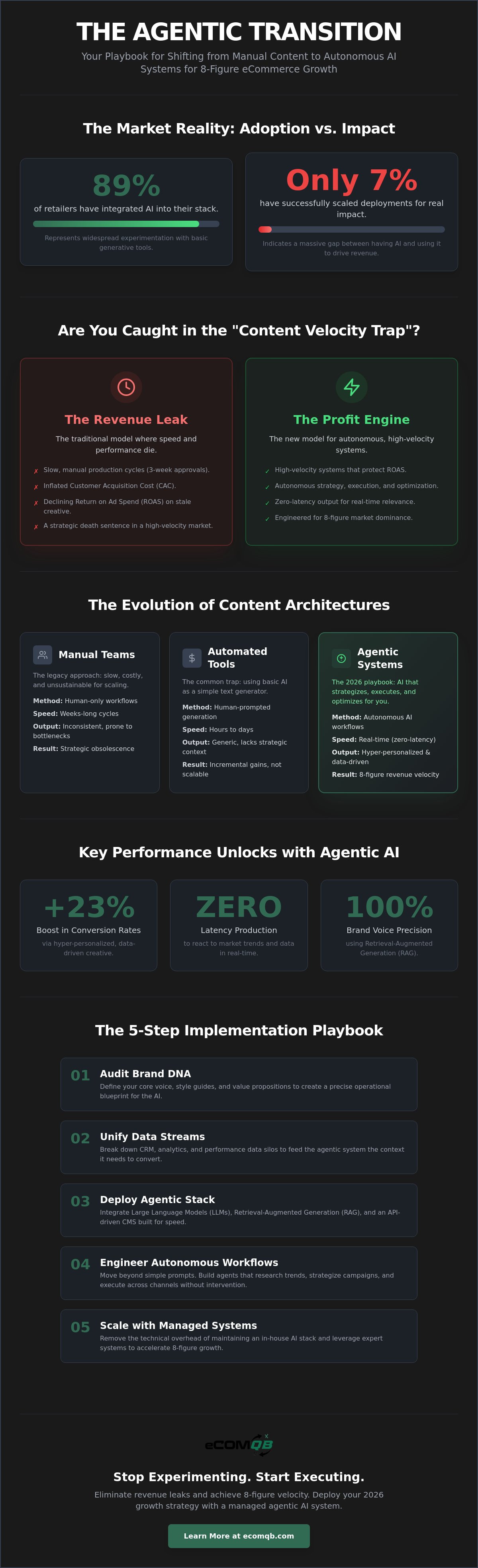
Eighty-nine percent of retailers have integrated AI into their stack, but only 7% have successfully scaled these deployments to drive real bottom-line impact. If you're still treating AI content marketing eCommerce as a tool for drafting basic product descriptions, you're already losing ground to competitors who've moved to autonomous systems. You've likely felt the friction of content production bottlenecks and the sting of declining ROAS on legacy creative. It's clear that the traditional model of high-overhead manual teams is no longer sustainable in a high-velocity market.
This playbook is your blueprint for the agentic transition. You'll learn to master the shift from manual creation to autonomous AI systems that drive 8-figure revenue velocity. We'll show you how to achieve zero-latency production, maintain a precise brand voice, and boost conversion rates by up to 23% through hyper-personalization. We're moving past simple automation into a world of strategic mastery, systemic optimization, and dominant market performance. It's time to stop experimenting and start executing your 2026 growth strategy.
Key Takeaways
- Eliminate the "Revenue Leak" by replacing slow, manual production cycles with high-velocity systems that protect your ROAS.
- Transition from basic generative tools to agentic AI systems that autonomously strategize, execute, and optimize your marketing workflows.
- Deploy a high-performance AI content marketing eCommerce stack engineered for zero-latency output and precise brand alignment.
- Execute a 5-step implementation playbook to audit your Brand DNA and integrate an API-driven CMS built for 2026 speed.
- Scale to 8-figures by leveraging managed growth systems that remove the technical overhead of building and maintaining an in-house AI stack.
The Content Velocity Trap: Why Legacy Marketing Fails in 2026
Speed is the ultimate differentiator. In the current market, brands relying on human-only workflows are hemorrhaging market share to more agile competitors. The 2026 landscape demands a pace that manual teams simply cannot sustain. When your rivals deploy thousands of personalized assets in minutes, your three-week approval cycle isn't a quality control measure. It's a strategic death sentence. This is why AI content marketing eCommerce has shifted from a luxury to a survival requirement for brands aiming for 8-figure dominance.
This operational lag creates a massive "Revenue Leak." Slow production cycles inflate your Customer Acquisition Cost (CAC) and erode your Return on Ad Spend (ROAS). If your creative is stale by the time it hits the feed, you're paying a premium for irrelevance. You're effectively subsidizing your own obsolescence by sticking to legacy content marketing models that prioritize process over performance. You need to identify, adapt, and deploy. Anything less is just noise.
Many leaders cling to the "Human Touch" as a shield against automation. In reality, it's often a mask for operational stagnation. High-performance eCommerce isn't about choosing between soul and scale; it's about using AI to amplify the brand's essence at a velocity that matches buyer intent. If your current eCommerce technology stack consulting hasn't addressed this fundamental bottleneck, your infrastructure is actively leaking profit. You need a system that is bold, assertive, and precise.
The Escalating Cost of Manual Production
Human-only teams are currently paying a "Time-to-Market" tax that destroys seasonal and trending campaign ROI. While your team brainstorms, the trend vanishes. Algorithmic content cycles move at the speed of data, not the speed of coffee breaks. You must analyze, optimize, and dominate. Overcoming the psychological barrier to AI-driven automation is the first step toward reclaiming your competitive edge. You don't need more meetings; you need more momentum.
Fragmented Data: The Silent Content Killer
Disconnected data silos are the primary reason AI-generated copy often falls flat. Without a unified data stream, your AI lacks the context to convert. Successfully implementing AI content marketing eCommerce requires breaking down these silos to feed the engine. The shift from "Creative Intuition" to "Data-Driven Precision" isn't optional for 8-figure brands. You need a system that ingests performance metrics and outputs optimized creative instantly. The "Content Velocity Trap" is the primary obstacle to 8-figure scaling, characterized by the inability to produce high-quality, data-backed assets at the pace of modern consumer demand.
Engineering the Agentic Content Stack: Beyond Simple Generative AI
Static tools are dead. To win in 2026, you need a system that doesn't just generate text but orchestrates entire workflows. Agentic AI is the shift from "tools you use" to "systems that work for you." This is the foundation of high-performance AI content marketing eCommerce. While your competitors are stuck tweaking prompts, you should be engineering agents that research, strategize, and execute with precision. It is about moving from passive assistance to active dominance.
The core of this stack is the Large Language Model (LLM); think of it as the central nervous system. Modern models like GPT-5.4 or Gemini 3.1 Pro act as the "brain," processing vast amounts of market data to make real-time decisions. By integrating AI-powered ad creative for eCommerce into your organic strategy, you create a unified front. Paid and organic channels no longer live in silos. They share data, insights, and assets to drive 8-figure velocity. Experts at the Harvard Division of Continuing Education emphasize that the future of AI in marketing lies in this level of deep integration and autonomous capability.
From Prompts to Autonomous Agents
Prompt engineering was a temporary bridge. In 2026, it's a legacy skill. Agentic systems use "tools," including APIs, search engines, and analytics platforms, to perform tasks without human intervention. They don't just write a blog post; they check current trends, analyze competitor gaps, and publish to your CMS. To maintain a razor-sharp brand voice, high-velocity brands use Retrieval-Augmented Generation (RAG). This ensures your AI pulls from your specific data, not generic training sets. It's about being bold, accurate, and consistent.
The Infrastructure of Scalability
Your tech stack is either an accelerator or a bottleneck. For true AI integration, your eCommerce website content management must be API-first. This allows agents to push and pull content seamlessly across your storefront. You also need a "Brand DNA" vault, which is a centralized repository of your values, tone, and past successes. This feeds the engine, ensuring every piece of content hits the mark. Finally, technical SEO compliance must be baked into the automation. Your agents should optimize metadata, internal links, and schema markup as they build. If you're ready to audit your current infrastructure, you might want to speak with a tactical partner who understands these mechanics.
Comparing Content Architectures: Manual vs. Automated vs. Agentic
The architecture of your marketing department determines your revenue ceiling. You cannot build an 8-figure brand on a 6-figure foundation. In 2026, the gap between legacy operations and high-performance systems has become a chasm. To lead your category, you must understand where your current model sits on the maturity curve. Transitioning your AI content marketing eCommerce strategy from manual labor to agentic systems is the only way to maintain a competitive advantage in a zero-latency economy.
Manual workflows are the legacy model. They rely on human output, which is linear, expensive, and inherently slow. This model is a strategic bottleneck that limits your ability to test, learn, and pivot. Automated workflows represent the "V1" AI approach. These systems use simple triggers and basic scripts to move data. While more efficient than manual labor, they are rigid and lack the ability to adapt to shifting market signals. They do what they are told, but they don't think.
Agentic workflows are the eComQB standard. These systems are self-correcting and goal-oriented. If a content angle underperforms, the agent identifies the failure, analyzes the data, and rewrites the creative. This architecture must be fueled by agentic media buying to reach its full potential. When your content engine and your ad engine share the same agentic logic, you achieve total market synchronization. You analyze, optimize, and dominate.
Performance Benchmarks: What to Expect
The difference in output is staggering. A legacy team might struggle to produce five high-quality articles per month. An agentic stack can deploy 500 optimized pages per day. This isn't just about volume; it's about precision. By matching content to specific buyer intent at scale, agentic systems drastically lower your acquisition costs. Agentic systems deliver a 10x higher ROI than traditional agencies by eliminating the overhead of human management and the latency of manual revisions.
The Role of the Human Strategist
The human element does not vanish; it evolves. You must shift your focus from being a "writer" to becoming an "Editor-in-Chief" and a "System Architect." Strategic mastery is the only human skill that remains un-automatable in 2026. You need a "Field General" mindset to oversee the mechanics of growth. Your job is to define the objective, set the parameters, and orchestrate the agents. You provide the vision, the soul, and the direction. The agents provide the speed, the scale, and the execution. This is how you lead, win, and scale.
The 5-Step Playbook for AI Content Implementation
Execution separates the leaders from the laggards. Implementing AI content marketing eCommerce isn't a theoretical exercise; it's a tactical deployment that requires a disciplined sequence. You don't need broad "best practices." You need a field-tested playbook that moves you from fragmentation to 8-figure velocity. This is about building a system that is bold, assertive, and precise. If you're ready to stop guessing and start scaling, follow this sequence.
Step 1: Audit your Brand DNA. You can't automate what you haven't defined. Map your brand voice, core values, and historical winners. Step 2: Deploy an API-driven CMS. Your infrastructure must be built for speed. A headless or Shopify-integrated CMS allows your AI stack to push content directly into your storefront without manual friction. Step 3: Configure agentic workflows. Move beyond basic prompts. Engineer agents that handle research, drafting, and fact-checking autonomously. Step 4: Implement a high-stakes review protocol. Humans act as the final strategic gatekeepers. This ensures brand safety and creative soul. Step 5: Synergize with paid social. Your organic content must feed your paid social strategy for ecommerce to create a unified revenue engine.
Phase 1: Foundation and Data Readiness
Precision starts with your data. Create a vector database of your top-performing marketing angles; this acts as the "memory" for your agentic systems. Clean your product data immediately. Inaccurate descriptions lead to high return rates and eroded trust. Set your KPIs around three specific levers: Velocity, Relevance, and Revenue. You aren't just tracking word counts. You're tracking market dominance. If your current foundation feels shaky, it's time to book a tactical briefing to shore up your infrastructure.
Phase 2: Execution and Scaling
Once the foundation is set, you scale. Automate the SEO feedback loop so your system moves from keyword discovery to a published page in hours, not weeks. Use AI to generate specific agentic landing pages eCommerce for every unique ad angle you deploy. This ensures a seamless transition from click to conversion. You can now scale your social presence across multiple platforms without increasing your headcount. You are no longer managing people; you are orchestrating an autonomous growth system. This is how you win in 2026. You analyze, optimize, and dominate.
Scaling to 8-Figures: Why Managed AI Systems are the Final Play
Building an in-house agentic stack is a full-time engineering commitment. While the promise of AI content marketing eCommerce is undeniable, the technical debt associated with maintaining custom LLM pipelines, RAG databases, and API integrations can quickly paralyze a growth team. You didn't enter the market to manage software updates; you entered it to dominate your category. The build versus buy dilemma is often the final hurdle between a 7-figure plateau and 8-figure velocity. For brands focused on peak performance, the choice is clear. You must decide whether to be a software house or a revenue engine.
A managed eCommerce growth system removes the technical overhead that suffocates most AI initiatives. It provides the infrastructure, the expertise, and the execution required to scale without friction. Consider the trajectory of high-growth Shopify brands that have successfully transitioned from 7 to 8 figures. They didn't achieve this by hiring more copywriters. They achieved it by deploying agentic content systems that operate with total autonomy. The eComQB approach is about engineering this "Revenue Machine" specifically for your brand DNA. We analyze, optimize, and dominate the mechanics of your growth so you can lead with vision.
The Competitive Advantage of AI Transformation
The window for early adoption is closing. Brands that wait until 2027 to implement these systems will find themselves permanently priced out of the market. The cost of acquisition is rising, and only those with the speed and volume of an agentic stack will survive the squeeze. You need to dominate search intent with a velocity that manual teams cannot match. This is the "Zero-Latency" vision. Imagine content that updates as fast as your inventory, reacting to real-time market shifts and buyer behavior. It is about precision, momentum, and authority.
Your Strategic Next Move
Success requires an honest assessment of your current infrastructure. Assessing your brand’s readiness for AI transformation eCommerce brands is the first step toward a fully autonomous content and media buying engine. You need a roadmap that prioritizes high-impact levers and eliminates operational waste. The transition to agentic systems is no longer a "future" consideration; it is the current standard for market leaders. You possess the playbook. You understand the stakes. Now, you must choose to either scale with precision or stagnate in the legacy model.
Dominate the Zero-Latency Economy
The transition from manual content production to autonomous agentic systems is no longer a strategic option. It's a survival requirement. You've identified the bottlenecks, engineered the stack, and mastered the playbook. Now, you must decide if you'll lead your category or follow the laggards into obsolescence. High-performance AI content marketing eCommerce is about speed, precision, and dominance. It's about out-thinking, out-pacing, and out-executing the competition before they even see the move coming.
At eComQB, we specialize in the mechanics of growth. We've engineered 8-figure growth trajectories for Shopify brands using proprietary agentic workflows that consistently outperform traditional agencies. Our fully managed AI transformation ensures your team focuses on strategic leadership while we handle the technical execution. There's no overhead. There's only momentum. Stop managing tools and start orchestrating revenue. Deploy Your Revenue-Generating AI Content Engine with eComQB and secure your market position today. Your 8-figure future is waiting for you to take the field.
Frequently Asked Questions
How does AI content marketing improve eCommerce SEO in 2026?
AI improves SEO by enabling Generative Engine Optimization (GEO) at scale. In 2026, search is about being cited in AI-generated answers and providing real-time relevance. Your system must identify buyer intent, optimize technical schema, and refresh content as fast as your inventory changes. This ensures your storefront remains visible, authoritative, and dominant across all search engines. You don't just chase keywords; you dominate intent.
Will Google penalize my Shopify store for using AI-generated content?
Google prioritizes high-quality, helpful content regardless of its source. Penalties only apply to low-effort, repetitive generation that fails to add value to the user journey. By using a "Human-in-the-Loop" protocol, you ensure every page meets rigorous E-E-A-T standards and brand requirements. Your focus remains on user experience and strategic relevance. High-performance brands use AI to scale quality, not to bypass it.
What is the difference between generative AI and agentic AI for marketing?
Generative AI is a tool that creates content based on specific, manual prompts. Agentic AI is a system that autonomously strategizes, executes, and self-corrects based on real-time performance data. While generative tools require constant human management, agentic systems function as independent team members. They research, draft, and optimize workflows without manual intervention. This is the shift from passive assistance to active dominance.
How much can I reduce my content production costs with AI systems?
AI systems can reduce content production costs by 30-40% by eliminating manual bottlenecks and high-overhead workflows. You replace traditional, slow-moving teams with lean, agentic systems that operate with zero latency. This efficiency allows you to reallocate capital toward high-impact media buying and strategic growth initiatives. You aren't just saving money; you're buying speed—a concept that applies to all forms of digital media, where you can learn more about Glow Mastering to see how automated solutions are revolutionizing professional audio production. It's about maximizing your ROI through systemic optimization and elite execution.
Can AI maintain my unique brand voice and tone across thousands of pages?
AI maintains your unique brand voice through Retrieval-Augmented Generation (RAG) and a centralized "Brand DNA" vault. By feeding the engine your specific values, tone, and winning marketing angles, you ensure every asset stays aligned. This technology prevents the generic "AI feel" that plagues low-velocity competitors. Your AI content marketing eCommerce strategy stays precise, consistent, and bold across every single touchpoint, regardless of the scale.
What technical infrastructure do I need to support an agentic content stack?
You need an API-first CMS and a robust data infrastructure to support agentic systems. Headless architectures or Shopify-integrated environments allow your AI to push and pull content seamlessly across your entire storefront. You also require vector databases to house your brand intelligence and performance metrics. This technical foundation is the prerequisite for 8-figure velocity. You build for scale, precision, and performance.
How do I integrate AI content with my Meta and Google ad campaigns?
Integration occurs through a unified data stream where organic content informs your paid social strategy. Your agentic systems analyze which organic angles convert and instantly adapt your ad creative to match that intent. This synchronization ensures a seamless transition from a social feed to a landing page. You achieve total market alignment by using AI content marketing eCommerce to fuel your agentic media buying engine.
Is AI content marketing suitable for luxury or high-end eCommerce brands?
AI is highly effective for luxury brands when used to enhance precision and exclusivity through hyper-personalization. It allows for tailored experiences that traditional, manual marketing cannot match at scale. By automating the mechanical aspects of content, your creative team can focus on the "brand soul" and high-level storytelling. You deliver a tailored, high-stakes experience to every customer. It's about elite execution and strategic mastery.