ECommerce Google Advertising Management: The 2026 Strategic Playbook for High-Velocity Brands

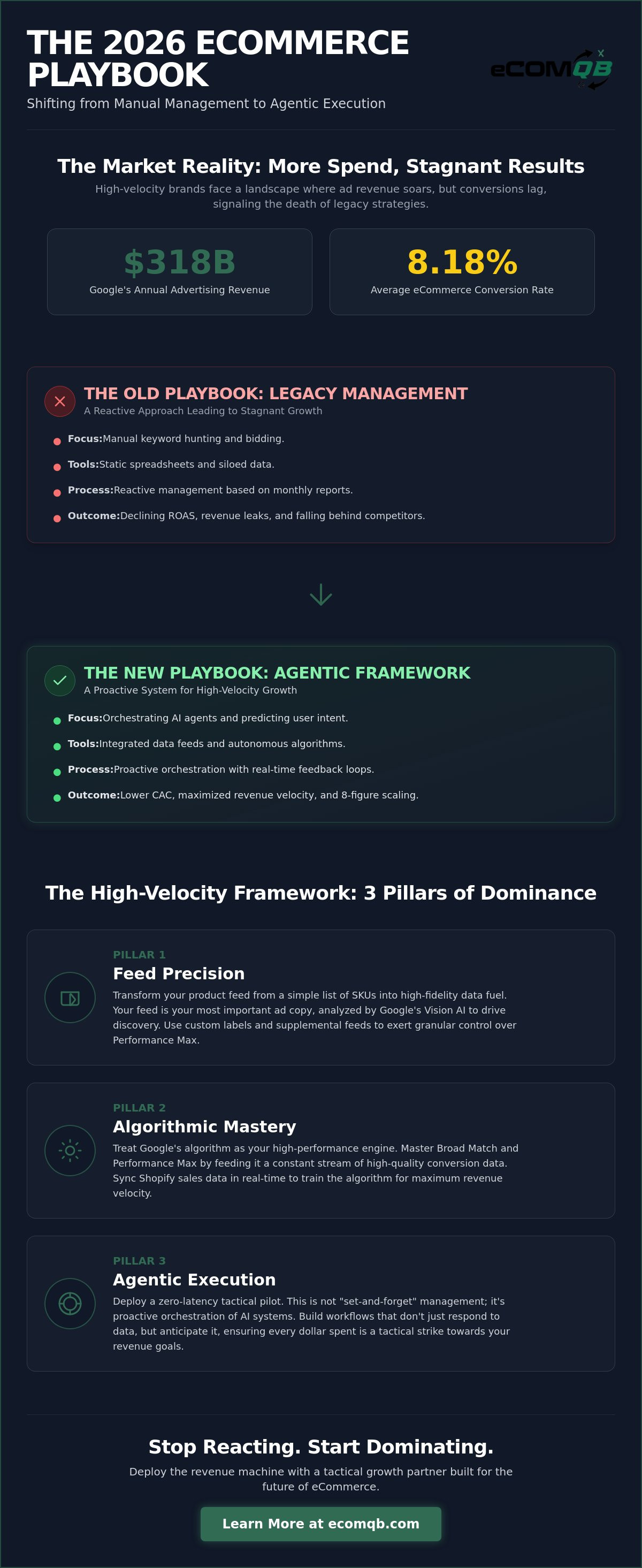
The era of manual keyword hunting is dead. If you're still treating your campaigns like a static spreadsheet, you aren't just falling behind; you're handing market share to competitors who've already automated your downfall. High-velocity brands now face a brutal reality where Google's advertising revenue has climbed to $318 billion, yet average conversion rates remain locked at 8.18%. Modern eCommerce Google advertising management requires more than just standard best practices. It demands a shift toward agentic execution where your data, feed, and algorithms align for zero-latency growth.
You've likely felt the sting of declining ROAS despite an aggressive increase in spend. It's a common friction point in an ecosystem that evolves faster than traditional teams can pivot. This playbook provides the framework for 8-figure scaling by mastering the transition from manual bidding to autonomous, agentic execution. We'll examine the strategic impact of the 2026 Merchant API integration, the global rollout of AI Max for Search, and the specific levers required to lower your CAC through systemic optimization. It's time to stop reacting and start leading the field with precision, pace, and performance.
Key Takeaways
- Stop hunting keywords and start orchestrating agents. Learn why manual bidding is a relic and how to pivot toward a fully automated, high-velocity ecosystem.
- Implement a sophisticated eCommerce Google advertising management strategy built on feed precision, algorithmic mastery, and agentic execution.
- Pressure test your data structure. Discover how to transform your product feed into a high-performance asset that drives AI-driven discovery and conversion.
- Close the feedback loop. Sync Shopify sales data to Google in real-time to train the algorithm for maximum revenue velocity and lower CAC.
- Identify the hallmarks of a tactical growth partner. Learn how to deploy agentic media buying and storefront optimizations to hit 8-figure milestones.
The 2026 Pivot: Why Legacy eCommerce Google Advertising Management is Obsolete
Legacy eCommerce Google advertising management is no longer a viable strategy; it is a structural weakness. The era of the manual bid is over. It's done. Finished. In a world where Google's advertising revenue has surged to $318 billion, the platform has fundamentally transformed from a tool for human operators into a self-optimizing ecosystem for algorithms. Relying on a "human-only" approach leads to stagnant growth and wasted spend. You cannot out-calculate a machine that processes millions of signals per second. Success in 2026 requires a deep technical stack where data is the only currency that carries weight.
The rise of the algorithm has turned traditional management on its head. We have moved from reactive management to proactive orchestration. This is the core of agentic media buying. It's about building systems that don't just respond to data but anticipate it. To win, you must master the transition to fully automated ecosystems. This requires three things: precision, velocity, and authority. Without these, your brand is just noise in a crowded marketplace. You need a partner who functions as a tactical extension of your team, not a vendor checking boxes.
The Shift from Keywords to Intent
The mechanics of online advertising have evolved from simple keyword matching to deep intent prediction. Broad match and Performance Max (PMax) have redefined the search landscape by prioritizing user intent over specific phrases. You aren't just buying clicks anymore; you're acquiring high-LTV customers through algorithmic pattern recognition. Agentic media buying is the orchestrator of AI-driven ad platforms that ensures every dollar spent is a tactical strike toward revenue. Transitioning to this model means moving your focus from the "what" to the "who." It’s about finding the right buyer at the precise moment they are ready to convert.
The Hidden Cost of Legacy Management
The "set-and-forget" agency model is a silent killer for eCommerce brands. It creates massive revenue leaks through inefficiency and latency. When your data is siloed in a cross-channel environment, you lose the bird’s-eye view necessary for systemic optimization. Staying legacy is a conscious choice to surrender market share to AI-native brands. These competitors don't wait for monthly reports; they use real-time data loops to pivot instantly. They understand that siloed data is a liability. They prioritize integration, transparency, and speed. If your current eCommerce Google advertising management partner isn't operating with zero-latency data, they are the bottleneck holding you back from 8-figure scaling. You need to identify, optimize, and dominate before the competition even sees the move.
The High-Velocity Framework: Feed Precision, Algorithmic Mastery, and Agentic Execution
High-velocity growth isn't a result of luck. It's the byproduct of a rigorous, three-pillar framework designed for the 2026 digital economy. In the competitive arena of eCommerce Google advertising management, these elements must function as a single, unified machine. If one component lags, the entire system stalls. You need precision, speed, and dominance to maintain a winning trajectory. Success requires a comprehensive process that bridges the gap between your Shopify storefront and Google's bidding engine. This framework consists of:
- The Feed: Your high-fidelity data fuel.
- The Algorithm: Your high-performance engine.
- Agentic Workflows: Your zero-latency tactical pilot.
Merchant Center: The Engine Room of ECommerce
The Merchant Center is where your raw data meets Google’s Vision AI. Your product feed is no longer just a list of SKUs; it is your most influential ad copy. AI doesn't just read titles; it analyzes image metadata, product attributes, and category alignment. Use custom labels and supplemental feeds to exert granular control over Performance Max. This is where agentic media buying changes the game by automating feed health monitoring and performance adjustments.
Algorithmic Mastery: Training the Machine
Training the machine is a high-stakes endeavor. You must feed the algorithm high-quality, first-party data to build accurate customer profiles and drive Enhanced Conversions. Use conversion value rules to tell Google exactly which sales drive the most profit, not just the most volume. This focus on eCommerce ROAS improvement ensures the ad engine optimizes for your bottom line. It is about teaching the AI to hunt for value, not just traffic.
Systemic optimization requires aligning your Shopify backend with Google’s Merchant API, which officially replaced the legacy Content API in April 2026. This connection ensures your inventory, pricing, and availability are synced with zero latency. AI agents now monitor these connections 24/7. They function as tactical pilots, adjusting budgets in real-time to capitalize on demand spikes. They reallocate spend across Search, YouTube, and Discover without human intervention. This proactive orchestration ensures your brand captures every high-intent user at the exact moment they are ready to buy. It eliminates the friction of manual oversight. It prioritizes performance over activities. If your current system isn't this integrated, you're leaving revenue on the table and falling behind AI-native competitors. You can book a tactical briefing to see how your current framework compares to 8-figure standards.
Evaluating the Playbook: Traditional Agency vs. Managed AI Growth Systems
Choosing a partner for eCommerce Google advertising management is a high-stakes decision that determines your brand's ceiling. Most brands fall into the vendor trap. They hire agencies that focus on task completion rather than revenue outcomes. These vendors treat your ad account like a checklist. They adjust a bid here, change a headline there, and call it management. In the 2026 landscape, this reactive approach is a recipe for stagnation. You don't need a vendor to manage your spend; you need a tactical partner to orchestrate your growth. High-performance growth systems are built on precision, pace, and profit. They move beyond vanity metrics to address the hard reality of your bottom line.
The difference between a standard agency and a managed AI growth system is structural. While traditional firms rely on manual labor and gut feelings, modern systems utilize a curated tech stack to achieve zero-latency execution. This isn't just about using tools; it's about building an integrated ecosystem where data flows seamlessly between your storefront and the ad engine. Recent research on Google Ads effectiveness highlights that technical precision and data quality are now the primary drivers of performance. If your partner lacks the technical depth to align your Shopify backend with Google's API, they are a liability, not an asset.
The Traditional Agency Model is Broken
The "Junior Account Manager" problem is the open secret of the agency world. You sign with a senior strategist, but your account is handed to a recent graduate who is learning on your dime. This model is fundamentally flawed. Hourly billing and percentage-of-spend models create misaligned incentives. They reward activity over results. Standard firms often lack the technical infrastructure to handle the complexities of 2026's AI-driven platforms. They focus on clicks and impressions while your actual profit margins erode. It's a legacy approach that can't keep up with the speed of the digital economy.
The Rise of the Managed Growth System
Managed growth systems represent the next evolution of eCommerce Google advertising management. eComQB integrates AI transformation for eCommerce brands directly into the ad management process. This isn't a "set-and-forget" service. It is a proactive orchestration of agentic media buying that provides 24/7 monitoring and optimization. We shift the focus from surface-level data to eCommerce profit margin optimization through smarter, value-based bidding. This ensures every dollar spent is an investment in profitable scale. We don't just report on what happened; we engineer what happens next. It's time to move from task-based management to systemic revenue generation.
The Tactical Audit: 4 Critical Levers to Pressure Test Your Google Ads Management
High-stakes growth leaves no room for guesswork. You must pressure test your eCommerce Google advertising management framework to identify where revenue is leaking. If your system isn't optimized for the 2026 ecosystem, you're likely overpaying for traffic. With an industry average Google Ads CPC of $5.42 and a CPL reaching $66.69, every inefficiency is a direct hit to your profit margin. You must audit, refine, and deploy with absolute precision. This tactical audit focuses on four critical levers:
- Step 1: The Feed Health Check. Is your data structured for AI consumption? Beyond titles, your feed must utilize the Merchant API to ensure zero-latency updates for pricing and availability.
- Step 2: The Data Loop. Are your Shopify sales syncing back to Google in real-time? Use the Data Manager API to import offline conversions and high-value signals that train the bidding engine.
- Step 3: Creative Velocity. Are you testing enough assets to satisfy Performance Max? AI-driven campaigns require a constant stream of high-quality images and videos to find winning combinations.
- Step 4: Strategic Alignment. Does your Google strategy support your Meta spend? Your search ads should capture the high-intent demand generated by your social discovery campaigns.
Auditing Your Current Performance
Identifying revenue leakage is the first step toward dominance. Many brands suffer from fragmented tracking that obscures the true path to purchase. You should aim for the 2026 benchmark for reducing eCommerce customer acquisition cost through systemic optimization. Data gaps in Google Ads kill 8-figure scaling because the algorithm cannot optimize for profit without complete, real-time conversion signals. If your data retention policy isn't set to the new 37-month granular standard, you're losing the historical context needed for long-term intent prediction.
The Selection Checklist for 2026 Partners
The right partner functions as a tactical extension of your team. When evaluating a provider for eCommerce Google advertising management, ask if they own the technical stack or just rent the platform. A high-performance partner should be able to execute agentic landing pages that dynamically match ad intent to the storefront experience. They must offer a fully managed eCommerce AI growth system that prioritizes revenue velocity over simple task completion. Don't settle for a vendor when you can have a field general. You can request a tactical audit to see exactly where your current strategy is falling short of 8-figure standards.
Deploying the Revenue Machine: Google Advertising Execution with eComQB
Execution is the final differentiator. Strategy without deployment is just theory. eComQB engineers 8-figure velocity by treating your ad account as a high-performance machine. Our approach to eCommerce Google advertising management moves beyond the superficial. We don't just adjust bids; we orchestrate ecosystems. We align your data, your feed, and your storefront into a single, aggressive growth engine. This is where high-stakes confidence meets strategic mastery. We don't just manage your spend. We maximize your dominance.
The integration of agentic workflows into your existing Shopify storefront is the catalyst for this transformation. We eliminate the friction between discovery and conversion by ensuring your data loops are closed and your storefront is optimized for AI-driven intent. This isn't about incremental gains. It's about systemic optimization. We move you from the reactive cycle of 'managing ads' to the proactive reality of 'scaling brands.' With eComQB as your tactical partner, you aren't just participating in the market; you're leading it.
Our Strategic Approach to Google Ads
We build curated AI technology stacks designed for rapid improvement. These aren't off-the-shelf tools. They're precision-engineered systems that provide a genuine competitive advantage. Our agentic media buying out-works, out-thinks, and out-paces the competition. We focus on peak performance for DTC leaders who refuse to settle for industry averages. Our methodology is built on three core pillars:
- Precision: Targeting high-LTV customers with surgical accuracy.
- Pace: Optimizing budgets and creative assets in real-time to maintain momentum.
- Profit: Prioritizing margin-first bidding to ensure sustainable 8-figure scaling.
Your Next Move toward Optimization
The path forward is clear. You must stop the revenue leaks caused by legacy management and start the scaling process. Transitioning from legacy operations to an AI-driven growth engine is the only way to maintain a bird’s-eye view of your industry. You need a field general who understands the mechanics of growth and knows exactly how to orchestrate the next move. Don't let your brand be a casualty of the AI shift. Take control of your trajectory and secure your position at the top of the search results. Your next move determines your velocity. Book your tactical briefing with eComQB today.
Dominate the 2026 Search Landscape
The shift to agentic media buying isn't a future possibility; it's a current requirement for survival. You've mastered the framework for 8-figure velocity: precision feeds, algorithmic mastery, and agentic workflows that operate with zero latency. Winning in 2026 demands precision, pace, and performance. To protect your margins and out-pace the competition, you need a partner who functions as a tactical extension of your leadership. Our managed AI growth systems provide the specialized Shopify and Google Ads integration necessary to turn raw data into predictable revenue. This is the new standard for eCommerce Google advertising management. Stop reacting to market shifts and start engineering them. You have the playbook. You have the strategy. Now, take the field with a partner built for high-stakes dominance. Your 8-figure future is ready for deployment.
Scale your brand with eComQB's Agentic Google Advertising Execution
Frequently Asked Questions
What is the difference between Google Ads management and agentic media buying?
Agentic media buying replaces manual, reactive task management with proactive systemic orchestration. While traditional management relies on human operators to adjust bids and budgets, agentic systems use AI to monitor and optimize campaigns in real-time. This shift ensures zero-latency execution across your entire account. It is the difference between a vendor checking boxes and a field general who can identify, optimize, and dominate.
How does Google's Performance Max (PMax) affect eCommerce management in 2026?
Performance Max serves as the foundational campaign type in 2026; it controls budget allocation across Search, YouTube, Discover, and more. It has shifted the focus of eCommerce Google advertising management from keyword bidding to feed precision and creative velocity. Success now depends on your ability to supply the algorithm with high-fidelity first-party data and a constant stream of high-quality assets.
Why is a high-quality product feed essential for Google Shopping success?
Your product feed is your most influential ad copy because Google's Vision AI uses it to predict user intent. In the 2026 ecosystem, the Merchant API ensures your pricing, inventory, and attributes are synced with zero latency. A high-fidelity feed allows the algorithm to match your products with the right buyers at the exact moment they are ready to convert. Precision here is non-negotiable.
Can AI-driven Google Ads management help reduce my Customer Acquisition Cost (CAC)?
AI-driven management reduces CAC by eliminating spend on low-intent traffic and prioritizing high-value conversions. By utilizing conversion value rules and real-time data loops, the system identifies which users are most likely to drive profit. This systemic optimization ensures your budget is always allocated to the most efficient path to revenue. It turns your ad spend into a surgical strike for growth through precision, pace, and performance.
How does eComQB integrate Google Ads with my Shopify store data?
We integrate your Shopify store data using the Data Manager API to create a real-time feedback loop. This connection ensures that every sale, customer signal, and inventory change is communicated to Google Ads instantly. By syncing your backend with the ad engine, we provide the algorithm with the granular data it needs to optimize for actual profit margins rather than just surface-level clicks.
What metrics should I focus on when evaluating a Google Ads management partner?
You must move beyond vanity metrics like CTR and CPC to focus on profit margin and revenue velocity. A high-performance eCommerce Google advertising management partner should be measured by their ability to lower CAC and scale total revenue systemically. Evaluate their technical depth, their ability to own the tech stack, and their track record of turning data into a competitive advantage for 8-figure brands.
Is manual keyword bidding still relevant for eCommerce brands in 2026?
Manual keyword bidding is obsolete in the 2026 digital economy. The platform has evolved into an AI-driven ecosystem where automated bidding is the default for high-velocity campaigns. Your role has shifted from manual bid adjustments to strategic orchestration and data quality control. Trying to out-calculate the algorithm manually is a choice to lose market share to AI-native competitors who prioritize speed and precision.
How long does it take to see results from a managed AI growth system on Google Ads?
Initial tactical optimizations often yield immediate improvements in efficiency within the first two to four weeks. However, the full impact of a managed AI growth system is realized after 30 to 90 days. This period allows the machine learning loop to accumulate enough first-party data to reach peak performance. It is a process of rapid refinement, systemic learning, and eventual market dominance.