AI-Driven Product Recommendations: The 2026 Revenue Acceleration Playbook

Rule-based merchandising widgets merely display static inventory; autonomous predictive engines actively drive purchase velocity. Outdated "frequently bought together" carousels and manual catalog tagging rules are quietly bleeding your storefront conversion rates while customer acquisition costs climb. You already know the friction. Strategic teams burn hundreds of operational hours hardcoding brittle cross-sell logic, only for generic carousels to completely miss real-time shopper intent. Transitioning to autonomous ai driven product recommendations replaces that manual overhead with algorithmic precision, evaluating granular in-session signals to deliver hyper-relevant cross-sells in milliseconds.
In this 2026 revenue acceleration playbook, you'll discover how predictive recommendation architectures eliminate manual merchandising, drive systematic 15% to 37% lifts in average order value, and scale customer lifetime value without expanding engineering headcount. We break down the exact technical and operational blueprint, guiding you through sub-50ms vector retrieval, unified data models, and managed agentic systems engineered to maximize every storefront touchpoint.
Key Takeaways
- Deploying autonomous ai driven product recommendations replaces static merchandising logic with real-time intent models that scale average order value.
- Modern neural networks and vector embeddings compute shopper affinity in sub-50 milliseconds, eliminating brittle manual tag dependencies.
- Manual cross-sell rules collapse as catalog complexity scales, draining operational resources while algorithmic systems continuously optimize conversion.
- High-velocity execution requires clean semantic catalog metadata and unified behavioral data streams across every customer touchpoint.
- Isolated SaaS widgets create fragmented data silos, whereas unified managed AI systems transform your storefront into an integrated growth engine.
Beyond Static Widgets: What AI-Driven Product Recommendations Deliver in 2026
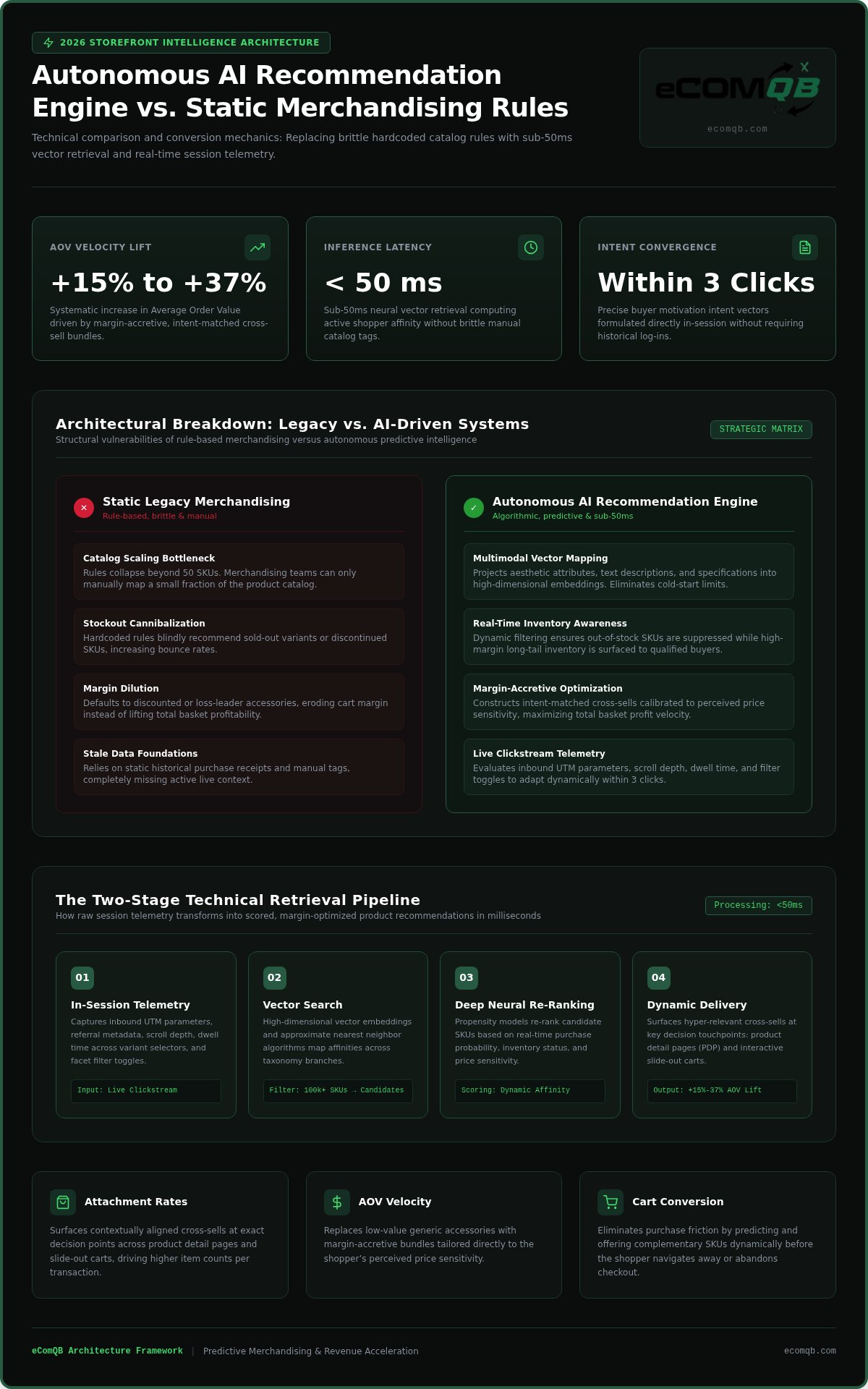
Static merchandising is dead. Legacy storefronts still rely on rigid "frequently bought together" modules populated by manual merchant tags or stale historical purchase receipts. Modern enterprise commerce requires continuous, predictive machine intelligence. Rather than guessing what a customer might want based on last month's cohort data, autonomous algorithmic recommender systems synthesize live clickstream events, device telemetry, and product attribute graphs in milliseconds. The distinction is decisive: manual rules enforce rigid merchant assumptions, while autonomous predictive models adapt dynamically to active buyer intent.
Modern architectures evaluate session-level behavioral signals in real time to calculate dynamic affinity scores. By processing thousands of micro-interactions on the fly, these engines drive decisive commercial gains across vital performance indicators:
- Attachment Rates: Surfaces contextually aligned cross-sells at exact decision points, driving lift across product detail pages and slide-out carts.
- AOV Velocity: Replaces low-value generic accessories with margin-accretive, intent-matched bundles tailored to the customer's perceived price sensitivity.
- Cart Conversion: Eliminates decision friction by predicting complementary SKUs before the shopper navigates away.
The Mechanics of Contextual Intent Recognition
True intent recognition begins before the visitor even clicks a product card. The engine evaluates inbound UTM parameters, referral sources, and paid ad creative metadata to establish an initial context baseline. As the user navigates, the system tracks real-time micro-signals: active scroll depth, image carousel interactions, faceted filter toggles, and dwell time across specific variant selectors. These live behavioral telemetry streams feed candidate generation pipelines, formulating precise intent vectors within three clicks. Modern ai driven product recommendations don't require historical logged-in profiles; they decode active buyer motivation directly within the live session.
The Failure Modes of Legacy Merchandising Rules
Static rules engines break down the moment your catalog scales beyond fifty SKUs. Relying on manual "if-this-then-that" cross-sells drains strategic merchandising hours and introduces critical operational vulnerabilities:
- Catalog Blind Spots: Merchandising teams can only manually map a fraction of your catalog, leaving high-margin long-tail inventory invisible to interested buyers.
- Stockout Cannibalization: Hardcoded rules blindly recommend sold-out variants or discontinued collections, driving immediate bounce rates and abandoned sessions.
- Margin Erosion: Legacy widgets default to recommending discounted or loss-leader accessories, diluting overall cart profitability instead of lifting basket value.
The Core Technical Architecture Powering Predictive Recommendation Engines
High-velocity commerce requires mathematical precision, not superficial pattern matching. Modern recommendation architecture operates as a two-stage retrieval pipeline. Candidate generation networks first filter hundreds of thousands of SKUs down to relevant candidates in milliseconds. Next, deep neural re-ranking models score each product based on real-time purchase propensity. While legacy collaborative filtering relied strictly on historical user-item co-occurrence matrices, modern deep content-based architectures project live session trajectories, aesthetic attributes, and product specifications into unified vector spaces.
Vector Search and Multimodal Semantic Embeddings
Modern engines convert product photography, text descriptions, and customer actions into high-dimensional vector embeddings. Approximate nearest neighbor algorithms then compute stylistic and functional affinities across separate taxonomy branches. A shopper viewing minimalist activewear receives recommendations for contextually aligned lifestyle accessories, even if those items share zero merchant tags. This multimodal vector mapping eliminates catalog cold-start blind spots. Newly released SKUs immediately match live shopper vectors without waiting for weeks of historical purchase data.
Dynamic Reinforcement Learning and Real-Time Feedback Loops
Autonomous recommendation engines operate as continuous reinforcement learning systems. The model scores every user micro-interaction as an active reward or penalty signal:
- Instant Recalibration: Quick skips downgrade adjacent product styles, while extended hovers boost matching aesthetics instantly.
- Cart Signal Adaptation: Adding an item immediately shifts downstream candidate rankings from similar alternatives to complementary cross-sells.
- Fatigue Suppression: The inference engine dynamically rotates ignored SKUs, preventing visual staleness across long browsing sessions.
Margin-Aware Algorithmic Prioritization
Raw conversion volume means little if fulfillment costs eat your gains. Sophisticated ai driven product recommendations weave real-time gross margin and stock availability directly into the inference scoring layer. Instead of simply maximizing click-through rates on low-margin accessories, the algorithm calculates Expected Net Margin by balancing purchase probability against net dollar profit. Embedding this level of precision into your broader eCommerce AI growth system ensures every carousel impression protects bottom-line profitability. If you want to replace static merchandising logic with high-velocity algorithmic decisioning, you can book an AI revenue audit to pinpoint your store's optimization levers.
Manual Rules vs. AI-Driven Product Recommendations: Strategic Comparison
Rigid merchant rules force static assumptions onto fluid customer behavior. When catalog depth expands, rule-based systems inevitably collapse under their own operational overhead. Autonomous ai driven product recommendations replace brittle manual logic with self-learning models that calculate affinity and purchase velocity instantly.
| Performance Vector | Manual Rule Engines | Autonomous AI Recommendations |
|---|---|---|
| Inference Latency | Slow relational queries; static batch updates | Sub-50ms vector retrieval at the edge |
| Operational Overhead | High; continuous manual SKU tagging and rule audits | Zero maintenance; autonomous candidate generation |
| Catalog Scalability | Breaks down past 50 SKUs; frequent dead ends | Effortlessly scales across millions of dynamic vectors |
| Revenue Impact | Plateaus early; risks margin dilution | Drives 15% to 37% AOV lift with margin awareness |
Operational Overhead and Scalability Thresholds
Manual catalog tagging is an operational trap. Strategic growth teams waste hundreds of hours configuring "if-this-then-that" rules, auditing broken SKU links, and managing seasonal cross-sells. The moment your team launches new product lines, manual configurations lag behind, creating costly conversion blind spots. Autonomous machine learning systems execute continuous candidate retrieval without human intervention. Your growth team steps off the catalog maintenance treadmill, redirecting strategic energy toward creative positioning and channel acquisition.
Revenue Velocity, AOV Expansion, and Retention
Precision drives revenue velocity. When shoppers encounter irrelevant or repetitive widgets, friction spikes and buying momentum stalls. Visitors who click on contextual ai driven product recommendations are 4.5 times more likely to add items to their cart and complete checkout. Dynamic personalization doesn't stop at the checkout drawer. Syncing real-time in-session affinity data directly with predictive email and SMS flows transforms one-time buyers into repeat brand advocates, systematically accelerating lifetime value.
Deploying High-Velocity AI Recommendation Systems: The 5-Step Playbook
Deploying autonomous recommendations isn't about toggling on another fragmented app. Elite brands treat personalization as an integrated growth engine requiring systematic calibration, clean data ingestion, and rigorous algorithmic governance. Executing this five-step deployment framework transforms static catalog displays into adaptive revenue drivers without generating technical debt.
Step 1 & 2: Data Sanitation, Event Tracking, and Storefront Hygiene
Garbage in yields conversion failure. Before vectorizing catalog inventory, scrub out orphan SKUs, normalize inconsistent variant tags, and enrich product descriptions with deep semantic attributes. Once catalog data is structured, activate lightweight client-side event listeners. These trackers monitor real-time visitor micro-signals, capturing scroll depth, hover velocity, variant toggles, and search refinements. As detailed in our operational breakdown of AI for Shopify personalization, streaming unified behavioral data directly into your decisioning layer is what separates high-converting storefronts from generic shops.
Step 3 & 4: Touchpoint Strategy and Widget Placement Optimization
Configure model constraints around gross margins and regional stock levels before deploying customer-facing components. Set algorithmic thresholds that prevent the engine from showcasing inventory with low availability or negative contribution margins. Next, map specialized algorithms to strategic customer journey phases:
- Product Detail Pages: Deploy visual and functional similarity models to present relevant alternatives before shoppers bounce.
- Slide-Out Cart Drawers: Trigger impulse complementary cross-sells calculated to hit free-shipping thresholds and lift basket value.
- Post-Purchase Surfaces: Serve single-click upsells calibrated against the customer's completed order context.
Maintain strict edge latency budgets under 100 milliseconds across all touchpoints to preserve Core Web Vitals and frictionless page speeds.
Step 5: Autonomous Multi-Armed Bandit Testing Protocols
Ditch legacy A/B split testing. Static 50/50 traffic splits leave money on the table while you wait weeks for statistical significance. Modern ai driven product recommendations rely on multi-armed bandit algorithms. These adaptive models continuously measure engagement yield, automatically routing high-intent traffic to top-performing recommendation algorithms while systematically testing challenger models on small user cohorts. Ready to deploy an integrated personalization infrastructure across your catalog? Scale your revenue with high-performance AI growth systems engineered for sustained conversion velocity.
Engineering the Growth Machine: Managed AI Systems with eComQB
Enterprise SaaS tools don't build market leaders; disciplined execution does. Subscribing to standalone recommendation software merely adds technical overhead and subscription bloat to your balance sheet. Deploying enterprise-grade ai driven product recommendations requires more than buying another point solution. It demands an integrated operational system that aligns data pipelines, storefront engineering, and revenue strategy into a single growth engine. eComQB removes that burden entirely by delivering a fully managed growth machine designed for decisive market advantage.
The Advantage of Fully Managed AI Transformation
Recruiting machine learning data scientists, data engineers, and specialized front-end developers is expensive, slow, and operationally distracting. eComQB bridges the gap between advanced data modeling and real-world commercial performance. We engineer custom Shopify storefronts wired directly into sub-50ms vector databases, removing technical debt from your internal team. By synchronizing predictive recommendation logic with agentic media buying, inbound paid ad cohorts immediately encounter algorithmic merchandising tailored to their exact acquisition context.
Synchronizing Storefront Personalization with Retention Marketing
Isolated data silos destroy customer lifetime value. Session telemetry captured on the storefront shouldn't stay trapped on product pages. When an anonymous shopper evaluates specific product categories, those behavioral signals should instantly dictate lifecycle communication. We stream live catalog interaction signals directly into predictive email and SMS flows, as broken down in our playbook for agentic email marketing. The result is an automated, real-time loop where dynamic abandonment sequences deliver intent-matched cross-sells automatically.
Building for 8-Figure Velocity and Dominant Market Positioning
Cobbling together a brittle patchwork of disconnected plugins creates slow load times, conflicting upsell offers, and diluted margins. Category leaders don't rely on generic plug-and-play widgets. High-performance ai driven product recommendations operate best as part of an integrated, proprietary architecture engineered to capture every cent of gross margin. Shift your focus from managing software configurations to driving aggressive, predictable revenue velocity. Book your strategic growth call with eComQB to take command of your storefront's AI transformation.
Accelerate Storefront Velocity and Claim Market Dominance
Static merchandising belongs to the past. Ambitious 8-figure scaling demands algorithmic precision at every digital touchpoint. Transitioning to autonomous ai driven product recommendations transforms your storefront from a passive catalog into an active, self-optimizing revenue engine that drives AOV and protects gross margin in real time.
Winning this game requires disciplined execution, not more disconnected software. eComQB provides fully managed end-to-end execution combining technical Shopify architecture with custom AI workflows. We deploy proven growth frameworks engineered specifically for high-velocity brands, delivering full-stack optimization that seamlessly links storefront conversion, agentic media buying, and predictive retention.
Stop leaving basket value on the table with brittle rules and fragmented plugins. Take command of your data, outpace the competition, and build an unassailable commercial moat. Book your strategic growth briefing with eComQB today and execute the playbook built for category leadership.
Frequently Asked Questions
How do AI-driven product recommendations differ from standard collaborative filtering?
Standard collaborative filtering relies on historical co-purchase patterns, while modern ai driven product recommendations decode live in-session intent. Collaborative filtering requires extensive past transaction logs and fails when buyer behavior changes quickly. Modern AI architectures deploy multimodal vector embeddings and neural re-ranking, evaluating real-time clickstream events, dwell time, and device context to predict purchase propensity within milliseconds, completely bypassing stale cohort assumptions.
Will deploying real-time AI product recommendations slow down our storefront page load speeds?
No, enterprise-grade recommendation engines operate on edge-cached vector networks that execute well under sub-50 millisecond inference budgets. Modern systems decouple recommendation calls from your primary Shopify Liquid or headless rendering pipeline via asynchronous edge APIs. This architecture ensures personalized candidate sets populate without blocking critical render paths, protecting your Core Web Vitals, organic search rankings, and mobile page performance.
How does an intelligent recommendation engine handle new product launches with zero historical purchase data?
Intelligent engines solve the cold-start problem by utilizing multimodal semantic embeddings rather than transaction history. When you launch a SKU, the model extracts high-dimensional vectors from product imagery, technical specifications, and descriptive metadata. It instantly maps the new item's stylistic and functional proximity to established catalog items. As soon as a shopper shows interest in matching aesthetics, the new SKU surfaces immediately.
Can our merchandising team set custom guardrails for margins and out-of-stock inventory?
Yes, robust recommendation models ingest real-time enterprise resource planning and inventory feeds to enforce strict business rules. You can program the scoring layer to filter out zero-inventory variants automatically and deprioritize low-margin collections. The inference engine balances user affinity against gross margin yield, ensuring your storefront promotes items that maximize net profitability rather than just chasing hollow click-through rates.
What average order value uplift can high-growth eCommerce brands expect after deployment?
High-growth retail storefronts typically record an average order value increase between 15% and 37% after deploying autonomous ai driven product recommendations. Replacing static accessory carousels with margin-aware, intent-driven bundles lifts cross-sell attachment rates at slide-out cart drawers and checkout touchpoints. Because the system presents contextually relevant items that match live buyer intent, shoppers convert at significantly higher rates across every session.
How do AI recommendation engines utilize real-time intent from paid advertising campaigns?
The recommendation engine reads inbound UTM parameters, campaign tags, and creative metadata at the entry session layer. If an ad highlights a specific aesthetic, problem angle, or product collection, the model registers that inbound intent immediately. It personalizes downstream PDP modules, collection grids, and cart drawers to align with that paid angle, preventing the context disconnect that causes paid acquisition traffic to bounce.
Why choose a managed AI growth system over off-the-shelf Shopify recommendation applications?
Off-the-shelf apps create disconnected software silos, generate script bloat, and force your team to manage complex configuration settings manually. A managed system like eComQB delivers end-to-end operational execution, combining custom front-end Shopify engineering with proprietary algorithmic stacks and agentic workflows. We eliminate technical overhead, align your merchandising with media buying and retention flows, and continuously optimize the models to protect gross margins and maximize net revenue.