Engineering Shopify Velocity: The 2026 Store Speed Optimization Playbook

Every 100 milliseconds of latency on your storefront isn't just a technical glitch; it's a 3.5% tax on your total revenue. In a 2026 market defined by AI-driven search and instant gratification, shopify store speed optimization has evolved from a developer's checklist into a high-stakes competitive weapon. If your mobile performance scores are stalling, your tech stack is bloated, or your conversion rates are dipping, you're not just losing traffic. You're actively funding your competitor's growth.
You've likely felt the sting of watching high-intent shoppers bounce because your site couldn't keep pace with their expectations. Legacy advice about resizing images or minifying CSS no longer moves the needle in an era of Shopify Functions and Web Pixels. This playbook promises to hand you the strategic levers needed to engineer sub-second load times, secure perfect Core Web Vitals, and maximize your ROAS. We'll dissect the shift from legacy scripts to compiled WebAssembly, the eradication of "ghost code," and the predictive loading tactics that define the industry's elite storefronts. It's time to stop reacting to lag and start engineering velocity.
Key Takeaways
- Quantify the financial impact of latency and learn to treat site speed as a high-leverage profit driver rather than a technical chore.
- Identify the specific 2026 Core Web Vitals that dictate search rankings, with a primary focus on mastering the new Interaction to Next Paint (INP) standard.
- Execute a ruthless tech stack audit to eliminate "ghost code" and transition from resource-heavy legacy apps to high-performance Shopify Functions.
- Master the technical mechanics of shopify store speed optimization by deploying AVIF assets, speculative pre-fetching, and main-thread code hygiene.
- Establish a high-velocity foundation to unlock the full potential of AI-driven growth systems, including Agentic Media Buying and real-time personalization.
The Invisible Revenue Leak: Why Milliseconds Matter in 2026
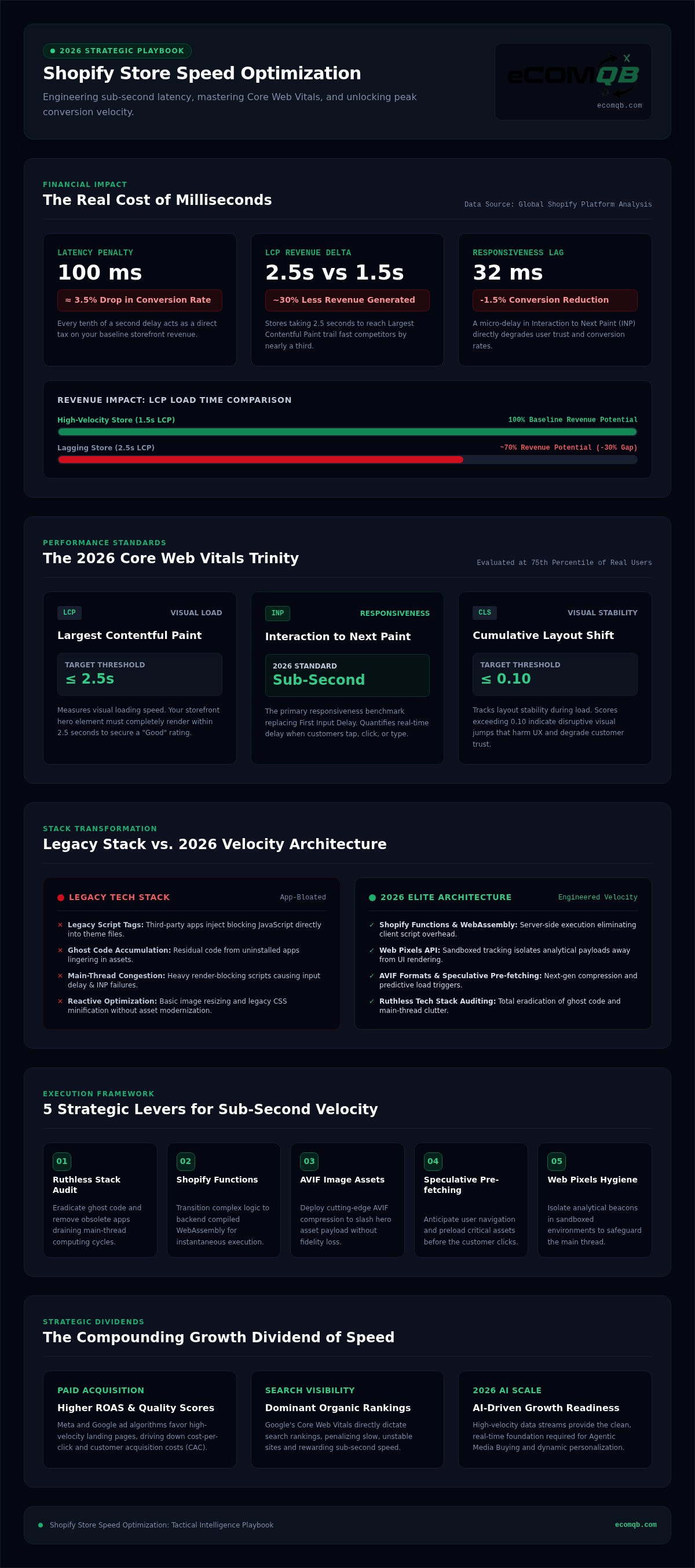
Latency is the silent killer of 8-figure growth. In the high-stakes environment of 2026, your storefront's load time isn't just a technical detail; it's a direct reflection of your brand's operational maturity. The math is brutal. According to Shopify platform global data analysis, every 100 milliseconds of latency results in an approximate 3.5% drop in conversion rates. If your store takes 2.5 seconds to reach Largest Contentful Paint (LCP), you're likely generating 30% less revenue than a competitor hitting the 1.5-second mark. This isn't a technical glitch. It's an invisible revenue leak that drains your bank account every second you remain stagnant.
Modern shoppers have been conditioned by the industry's giants to expect instant gratification. They don't wait. They don't forgive. They don't return. When a page lags, the psychological link between site velocity and brand trust breaks instantly. Speed signals authority, reliability, and precision. Sluggishness suggests a "legacy" mindset that can't keep pace with the modern economy. For ambitious leaders, shopify store speed optimization is the most effective lever available to reduce Customer Acquisition Cost (CAC) and protect margins.
Velocity as a Competitive Advantage
Speed is the primary engine for boosting Meta and Google ad efficiency. Ad algorithms prioritize high-velocity destinations because they provide a superior user experience, leading to higher Quality Scores and lower costs per click. When you master web performance optimization, you aren't just fixing a site; you're weaponizing your tech stack. The "Amazon Effect" has trained your customers to expect sub-second responses. Meeting this standard is the baseline for any high performance eCommerce website that intends to dominate its category.
The Cost of Inaction
Ignoring the mechanics of your storefront speed is a strategic failure with compounding consequences. Slow sites do more than just lose sales; they sabotage your broader AI transformation for eCommerce brands. High-velocity data is the essential fuel for AI-driven personalization and predictive modeling. If your site lags, your data stream becomes fragmented, and your AI tools lose their predictive edge.
The long-term impact on your brand's health is severe:
- Organic Visibility: Google's ranking algorithms prioritize Core Web Vitals, pushing slow stores into obscurity.
- Interaction Sabotage: A mere 32-millisecond delay in Interaction to Next Paint (INP) can slash conversions by 1.5%.
- Brand Authority: Lag creates a "friction tax" that erodes customer loyalty and increases churn.
In 2026, shopify store speed optimization is the prerequisite for scale. You can either engineer velocity now or watch your market share evaporate one millisecond at a time.
Decoding 2026 Velocity Metrics: Beyond Simple PageSpeed
The native Shopify Speed Score is a useful diagnostic, but it's far from the ultimate scoreboard. High-performance brands don't settle for dashboard approximations. They focus on real-user field data. In 2026, shopify store speed optimization requires a surgical understanding of how Google and Shopify evaluate your storefront. You aren't just racing against a clock; you're competing for the 75th percentile of actual mobile and desktop visits. Mastering this data is the difference between a store that feels fast and one that actually converts.
The Core Web Vitals Trinity
To maintain an elite storefront, you must align with the official Core Web Vitals thresholds. This trinity defines the user experience through three distinct lenses: loading, stability, and responsiveness. Precision in these areas is mandatory for organic visibility and ad efficiency.
- Largest Contentful Paint (LCP): This measures visual load speed. To rank as "Good," your hero element must render in 2.5 seconds or less.
- Cumulative Layout Shift (CLS): This tracks visual stability. A score above 0.10 indicates layout shifts that frustrate users and kill trust.
- Interaction to Next Paint (INP): This is the 2026 gold standard. Replacing the obsolete First Input Delay, INP measures the time between a user action and the visual response. A "Good" score is 200 milliseconds or less.
If your INP lags, your conversion rate follows. Every 32-millisecond delay in interactivity can cost you 1.5% in sales. This is why Real User Monitoring (RUM) is superior to synthetic lab data. While Lighthouse offers a snapshot, RUM captures the messy, high-stakes reality of your actual customers. It's the only metric that truly reflects your revenue potential.
Advanced Performance Indicators
Beyond the trinity, precision engineering requires monitoring Total Blocking Time (TBT) and Time to First Byte (TTFB). TBT identifies main-thread congestion that prevents interactivity. TTFB reveals server-side bottlenecks that can delay your entire rendering sequence. These metrics are particularly critical when deploying AI for Shopify personalization. AI tools require a high-velocity foundation to deliver real-time experiences without introducing latency. If your current stack feels unmanageable, you can book a strategic performance audit to identify your primary levers for growth. Precision, speed, and execution are the only paths to a dominant 2026 storefront.
The App Bloat Crisis: Auditing Your Legacy Tech Stack
The "App Trap" is a strategic paradox. Ambitious brands often attempt to solve performance issues by installing more software, only to find their storefronts buried under a mountain of third-party scripts. In 2026, the primary barrier to shopify store speed optimization isn't your theme; it's the app-heavy tech stack cannibalizing your main thread. Every script you add is a direct tax on your conversion rate. If you aren't auditing your stack with a "field general" mindset, you're effectively funding your competitor's growth through your own latency.
Free apps are never truly free. They are paid for in milliseconds, visual instability, and lost revenue. When an app is uninstalled, it often leaves behind "ghost scripts" and orphan Liquid code that continue to execute, dragging down your performance long after the tool is gone. Transitioning from app-dependency to lean, custom-coded functionality is no longer optional for high-velocity brands. It is a mandatory requirement for survival.
Identifying the Performance Killers
To fix the leak, you must first find it. Use Chrome DevTools to inspect your network tab and identify which third-party scripts are hijacking your browser runtime performance. Look for multiple tracking pixels, redundant analytics, and heavy JavaScript libraries that block interactivity. A world-class Shopify design and development agency prioritizes lean architecture over the convenience of a "one-click" app. Your objective is a clean, surgical code base that executes with precision and speed.
The Strategy of Consolidation
A ruthless audit follows a simple triadic structure: Keep, Consolidate, or Kill. If a feature doesn't directly contribute to your bottom line, kill it. If you have five apps performing distinct tasks, replace them with one robust, integrated solution. Better yet, move that logic into your theme using custom Liquid implementation. This approach eliminates the need for external requests and keeps your storefront agile.
Establish a strict Performance Budget for every new feature. Before any code is deployed, it must pass a speed impact assessment. If a new marketing tool adds 200ms to your Interaction to Next Paint (INP), it must justify that cost with a verified lift in average order value. In the game of shopify store speed optimization, precision is your greatest asset. To ensure your site remains optimized as you scale, explore Frais de gestion mensuels pour services SEO to understand the investment required for professional oversight. Build lean, stay fast, and outpace the competition.
Velocity is engineered, not accidental. Moving from a bloated storefront to a high-velocity asset requires a surgical, phased approach to execution. In 2026, the technical baseline has shifted. You can't rely on legacy tactics to win in an AI-accelerated market. True shopify store speed optimization is a series of rapid-fire tactical briefings translated into code. It's about stripping away every unnecessary byte while maintaining a visual experience that commands authority.
Visual Mastery without the Weight
Images are usually the heaviest tax on your LCP. Stop using legacy formats. AVIF and WebP are the 2026 standards for high-fidelity, low-weight assets. Automate your compression. Use responsive image syntax (srcset) to ensure mobile users aren't downloading desktop-sized files. This is where many brands fail by misapplying lazy loading. Never lazy-load your hero image. Instead, use fetchpriority="high" to tell the browser exactly what to prioritize. Compress, convert, and cache. This triadic approach ensures your visual narrative remains sharp without compromising your performance budget.
Streamlining the Technical Foundation
Code hygiene is the floor of performance. Minifying Liquid, CSS, and JavaScript is a baseline requirement for rapid parsing. You must also implement Critical CSS to render the above-the-fold content instantly while the rest of the styles load in the background. Anticipate your user's next move. Use "Pre-connect" and "Pre-fetch" to warm up connections to third-party domains and pre-load the next likely page in the customer journey. This speculative loading creates an "instant" feel that legacy sites can't replicate.
Execution at this level is why a robust SEO and content strategy for Shopify requires a technical speed foundation. Google ranks results based on the 75th percentile of real-user loads. If your technical foundation is weak, your content strategy will never reach its full potential. Leverage the Shopify Edge. Shopify’s Cloudflare-powered infrastructure allows your store to render up to 2.4 times faster than rival platforms by delivering content from the server closest to the user.
Finally, optimize your typography. Use WOFF2 formats and font-display: swap to eliminate "invisible text" during the load sequence. Every element must be optimized for zero-latency rendering. If you're ready to stop the lag and start scaling, you can book a performance sprint to audit and accelerate your storefront today. Precision engineering is the only way to outpace the competition.
From Speed to Scale: Integrating Velocity into Your AI Growth System
Velocity is the silent engine behind every 8-figure scaling strategy. In 2026, you cannot separate technical performance from your growth engine. If your storefront lags, your entire marketing machine misfires. High-velocity foundations are the mandatory prerequisite for Agentic Media Buying. When your media buying agents make split-second decisions to capture high-intent traffic, your destination must be ready to receive them. shopify store speed optimization isn't a backend task. It's the frontline of your customer acquisition strategy.
The Synergy of Speed and AI
AI personalization experiences require zero-latency to feel seamless. If a personalized product block takes 500ms to hydrate, the user has already scrolled past the offer. Fast sites feed high-fidelity data into your growth engine. Every millisecond of delay increases the risk of data fragmentation, which leads to inaccurate AI models and wasted ad spend. We build Agentic Landing Pages that load instantly, ensuring the promise made in your ad is fulfilled the moment the user clicks. Speed builds trust. Lag breeds skepticism. For brands scaling toward 8 and 9 figures, velocity is the ultimate trust builder.
Executing the High-Performance Playbook
Managed performance is a continuous process, not a one-time fix. The digital economy moves too fast for "set and forget" solutions. You need a system that audits, optimizes, and protects your velocity as you scale. eComQB functions as your tactical partner in this high-stakes environment. We are the field generals who understand technical complexities but remain focused on the ultimate objective: revenue generation. Moving beyond simple technical fixes means treating speed as a strategic asset that fuels your entire ecosystem.
Your final checklist for maintaining 8-figure velocity requires a disciplined approach to site health. Focus on these three critical levers:
- Main-thread monitoring: Ensure new marketing tools don't hijack your Interaction to Next Paint (INP) scores.
- Speculative pre-fetching: Use predictive intent to render product pages before the user even clicks.
- Edge-first delivery: Maximize Shopify’s global infrastructure to minimize the physical distance between your data and your customer.
The high-performance game is won in the margins. shopify store speed optimization is the foundation upon which all other growth initiatives are built. You can either lead the pack with a high-velocity storefront or get left behind in the legacy era. Precision engineering is the only way forward.
Dominate the 2026 Economy with High-Velocity Execution
Site speed has moved past the realm of technical maintenance. It is now the primary lever for protecting your margins and scaling your brand. By mastering shopify store speed optimization, you eliminate the friction that sabotages your ROAS and erodes customer trust. You've seen the data. Every millisecond of latency is a tax on your potential. High-performance brands don't leave these gains to chance. They audit, optimize, and dominate. They engineer success through surgical code hygiene and strategic asset management.
As specialists in 8-figure Shopify scaling and managed AI growth systems, we know that velocity is the prerequisite for elite performance. Our experts in high-performance digital advertising execution understand that even the most sophisticated campaigns fail on a sluggish storefront. It's time to stop reacting to lag and start building a competitive weapon. Precision engineering is the only path to market leadership in an AI-accelerated landscape. Your growth trajectory depends on the speed of your next move.
Stop leaking revenue and engineer your high-velocity Shopify machine today. The future belongs to the fast.
Frequently Asked Questions
How do I check my Shopify store speed accurately in 2026?
Precision requires looking at field data rather than isolated synthetic tests. Utilize the Shopify Web Performance dashboard and Google Search Console to access the Chrome User Experience Report (CrUX). These tools aggregate real-user interactions over a rolling 28-day window. While Lighthouse offers a diagnostic snapshot for debugging, the 75th percentile of actual visits is the only metric that dictates your search rankings and impacts your conversion floor.
Will deleting apps really speed up my Shopify store?
Removing redundant apps is a primary lever for shopify store speed optimization. Every app adds third-party JavaScript that competes for main-thread execution, often delaying critical interactivity. Modern 2026 architectures utilize Theme App Extensions to ensure that uninstalling an app cleanly severs its assets. If you're still running legacy code, deleting an app might leave behind "ghost scripts" that require manual removal by a specialist to restore peak velocity.
What is a good Core Web Vitals score for a high-growth eCommerce brand?
Aim for "Good" ratings across the three critical thresholds to maintain a competitive advantage. Your Largest Contentful Paint (LCP) must be 2.5 seconds or less to satisfy visual load requirements. Cumulative Layout Shift (CLS) should remain under 0.10 to ensure visual stability. Finally, your Interaction to Next Paint (INP) must stay below 200 milliseconds. These benchmarks are the technical floor for any brand looking to dominate an AI-driven market.
How does site speed affect my Google and Meta ad performance?
Speed directly influences your Quality Score and Customer Acquisition Cost (CAC). Google and Meta prioritize high-velocity destinations because they provide a superior user experience. Slow load times lead to higher bounce rates, which signal to ad platforms that your landing page is irrelevant. This friction sabotages your Agentic Media Buying efforts. Optimization ensures your ad spend translates into revenue rather than being wasted on bounces caused by avoidable lag.
Can a custom Shopify theme be faster than a pre-made one?
Custom themes are almost always faster because they lack the "kitchen sink" bloat of pre-made templates. Off-the-shelf themes include generic features and redundant CSS to appeal to a wide audience. A custom-engineered storefront focuses exclusively on your specific requirements, utilizing lean Liquid architecture and optimized assets. This precision reduces the browser's workload, allowing your site to achieve the sub-second load times necessary for 8-figure scaling and market dominance.
What is Interaction to Next Paint (INP) and why should I care?
Interaction to Next Paint (INP) measures the time it takes for your store to visually respond to a user action, such as a click or tap. It's the 2026 gold standard for responsiveness because it covers the entire lifecycle of a user's visit. For every 32 milliseconds of delay in INP, conversion rates typically drop by 1.5%. Ignoring this metric means you're ignoring the primary cause of abandonment during the checkout process.
Do I need a developer for Shopify store speed optimization?
Strategic shopify store speed optimization requires specialized technical expertise. While basic tasks like image resizing are accessible, high-level improvements involve Shopify Functions, Web Pixels API, and main-thread management. A developer acting as a tactical partner can migrate legacy Ruby scripts to compiled WebAssembly, ensuring your backend logic executes in under 5 milliseconds. This level of precision is impossible to achieve through app installations or surface-level theme settings alone.
How often should I perform a speed audit on my Shopify store?
Treat performance as a continuous growth system rather than a one-time project. Conduct a deep tactical audit at least once per quarter or immediately following any significant tech stack modification. High-velocity brands often implement automated monitoring to catch regressions in real-time. Performance decays as you add new marketing tools and content. Constant vigilance is the only way to protect your conversion rates and maintain your status as an industry leader.