AI-Enhanced SEO for Ecommerce: A Practical 2026 Guide

AI search won’t replace ecommerce SEO. It will expose whether your product data and content are clear enough to understand, credible enough to trust, and useful enough to surface. That’s the strategic edge of ai enhanced seo for ecommerce: making your products easier for people and AI-powered search to interpret without sacrificing the SEO fundamentals that already drive discovery.
The terminology can feel crowded, and visibility in an AI answer doesn’t automatically translate into revenue. You need a practical way to connect what search systems can find and represent with the outcomes your business cares about: qualified acquisition, stronger conversion, and lasting customer value.
This guide offers that playbook. You’ll learn how to strengthen product and category information, improve content structure and technical foundations, and understand concepts like Answer Engine Optimization and Generative Engine Optimization. You’ll also see how to measure progress beyond mentions or citations and build an ongoing optimization system that layers AI onto proven growth frameworks. The goal isn’t to chase every new search trend. It’s to make your ecommerce experience easier to discover, trust, and choose.
Key Takeaways
- AI-enhanced search adds new ways for shoppers to discover products, but it doesn’t make strong SEO fundamentals obsolete.
- Make product information accessible, consistent, and clear so search systems can interpret what you sell.
- Use ai enhanced seo for ecommerce to align product content, technical foundations, and credible brand signals.
- Prioritize improvements by business goals, product importance, information gaps, and customer questions, not by tool hype.
- Connect AI visibility to acquisition, conversion, and retention through a managed system of implementation, monitoring, and optimization.
What Is AI-Enhanced SEO for Ecommerce in 2026?
Search is no longer just a list of pages to click. AI-generated answers and assisted product discovery are changing how shoppers research options, compare products, and decide what to consider next. For ecommerce brands, that creates a visibility challenge: your store needs to be discoverable, and its products need to be represented accurately when a search system summarizes information.
AI-enhanced SEO for ecommerce means improving how search systems interpret, trust, and surface information about your store and products. That includes making product details clear and consistent, creating useful content around real customer needs, and maintaining the technical foundations that let search systems access your pages. The goal isn’t to make AI like your site. It’s to make the facts about your products easy to understand and verify.
You’ll see overlapping labels for this work. AI SEO is a broad umbrella; Answer Engine Optimization (AEO) often describes visibility in direct answers, while Generative Engine Optimization (GEO) focuses on how generative systems use and cite information. Large Language Model Optimization (LLMO) is another term in circulation. These labels aren’t settled or perfectly distinct, so focus on the work, not the acronym. Start with the established principles of Search Engine Optimization (SEO), then adapt them for AI-assisted discovery.
How AI-enhanced SEO differs from traditional ecommerce SEO
Traditional SEO often measures whether a page ranks for a relevant search. AI-assisted discovery adds another question: can a system accurately describe or cite your product in a generated answer? A ranking and a citation are different outcomes, but both rely on sound foundations such as crawlability, relevance, useful content, and authority. AI optimization adds a discovery layer; it doesn’t replace conventional search work.
Why ecommerce brands should care about AI product discovery
Shoppers may use conversational systems to explain what they need, compare product types, and narrow their choices before visiting a store. If your product information is thin, unclear, or inconsistent across pages, a system has less reliable context to work with. Shoppers may get an incomplete picture of what you sell, even when your product page is available to search.
Consider a product page that names an item but barely explains its purpose, materials, dimensions, or intended customer. A shopper looking for a product with specific qualities may not find a clear match in that page. Accurate, specific details give people and search systems a stronger basis for understanding the offer. They also help customers make informed comparisons once they reach your store.
Strengthen the source information before chasing new terminology or tools. Keep product claims accurate, explain meaningful differences between options, and support product pages with useful category content. Then assess whether your conventional SEO foundations make those pages accessible and relevant. AI can influence how products are discovered, but sound SEO and trustworthy product information remain the operating base.
How AI Search Systems Discover and Interpret Ecommerce Products
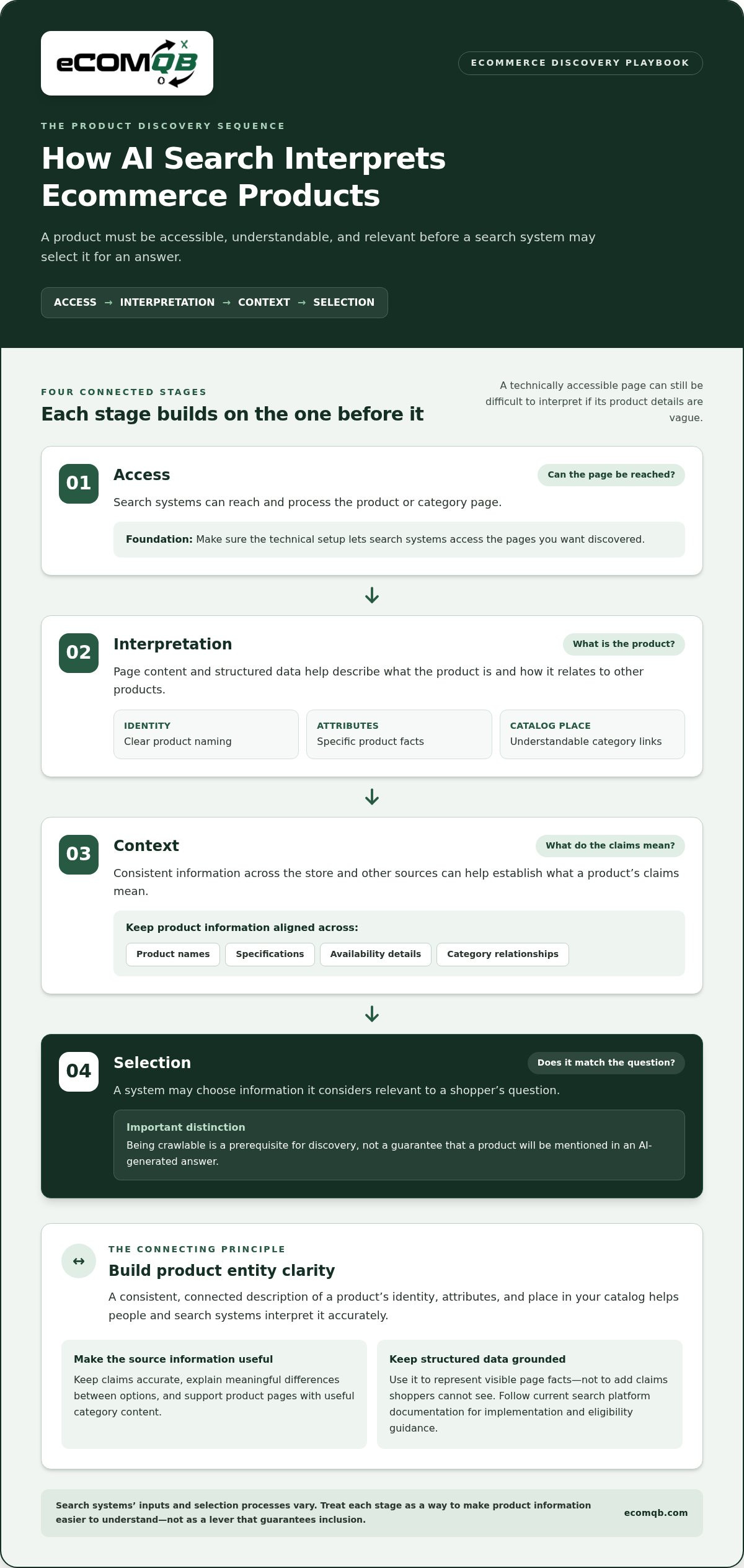
Product discovery is a sequence, not a switch. A page must be accessible, its product facts understandable, its information supported by trustworthy context, and the product relevant to the question before a system may select it for an answer. Each stage depends on the one before it. A technically accessible page with vague details is still hard to interpret.
- Access: Search systems can reach and process the product or category page.
- Interpretation: Page content and structured data help describe what the product is and how it relates to other products.
- Context: Consistent information across the store and other sources can help establish what the product claims mean.
- Selection: A system may choose information it considers relevant to a shopper’s question. Being crawlable does not guarantee a product will be mentioned.
Crawlability is a prerequisite for discovery, not a promise of visibility in an AI-generated answer. Systems may draw on page text, structured data, and information from other sources, but their inputs and selection processes vary. Treat each layer as an opportunity to make the product easier to understand, not a lever that guarantees inclusion.
Product entity clarity is the consistent, connected description of a product’s identity, attributes, and place in your catalog, presented so people and search systems can interpret it accurately. This definition keeps the focus on information quality instead of trying to reverse-engineer a particular answer engine.
Make product and category information easy to interpret
Set a clear naming and data standard across product pages, category pages, and catalog records. Keep product names, specifications, availability details, and category relationships aligned. If a product appears under multiple categories, make those relationships understandable instead of relying on ambiguous labels or inconsistent naming.
Structured data can describe product information in a format machines can process. Use applicable product properties and follow current search platform documentation for implementation and eligibility guidance. Treat markup as a representation of visible page facts, not a way to add claims shoppers can’t see. Review the page, structured data, and catalog feed together, then correct mismatches in stock status, naming, or specifications at their source.
Build content that answers real shopping questions
Map customer questions to the pages best equipped to answer them. Product pages can clarify specifications and differences; category pages can help shoppers compare options; supporting content can address care, use cases, and buying considerations where those topics fit your products. Don’t force every question onto every page.
Use direct headings that reflect the question, then answer it plainly before adding useful context. For example, a comparison section can state the practical difference between two product types, then explain which attributes matter to a shopper’s decision. Keep claims specific, evidence-led, and consistent with the actual product information. This is the practical core of ai enhanced seo for ecommerce: clear facts, organized context, and content built around genuine intent.
If product information is fragmented across pages and systems, an ecommerce SEO strategy discussion can help identify where to focus first.
Traditional SEO vs. AI-Enhanced Ecommerce SEO: What Changes?
AI discovery changes the visibility target, not the fundamentals. A page can earn a traditional search ranking and still be left out of a generated answer. Ecommerce teams need to strengthen established SEO while also making product information easy to summarize, compare, and represent accurately.
AI SEO extends search optimization; it does not replace its core foundations. Useful pages, technical access, clear information, and credible brand signals remain essential. The added work is to account for conversational discovery, answer-ready content, consistent product details, and visibility beyond the traditional results page.
| Area | Traditional SEO emphasis | AI-enhanced ecommerce SEO adds |
|---|---|---|
| Goal | Earn relevant organic visibility for pages. | Help products and brand information appear accurately in generated answers and assisted discovery. |
| Page foundations | Accessible architecture, relevant content, internal links, and a strong user experience. | Consistent product facts and relationships that systems can interpret across pages and catalog records. |
| Content structure | Pages that address search intent and help visitors. | Direct answers to product questions, followed by context for comparison and decision-making. |
| Authority | Credible brand signals and relevant references. | Consistent, trustworthy descriptions of the brand and products across relevant discovery experiences. |
| Measurement | Rankings, organic visits, and conversions. | Those measures plus AI visibility, representation accuracy, and the business results associated with discovery. |
Neither column is a checklist that guarantees visibility. Search systems weigh multiple signals, and no single ranking factor determines whether a page ranks or a product appears in an AI answer. Keep the existing SEO engine in good shape: make important pages accessible through clear site architecture, connect related content with internal links, and give shoppers a useful product-page experience. Machine-readable information matters, but the page still has to help a person make a decision.
What ecommerce teams add for AI discovery
Build answer-oriented content around real product questions and category-level choices. A category page might help shoppers understand which attributes to compare, while a product page explains the item’s distinguishing details. Keep each answer direct, then provide context that supports a considered purchase. This strengthens machine interpretation and the shopper’s experience.
Track representation as well as traffic. Periodically review relevant AI-assisted discovery experiences to see whether your brand or products appear, whether the details are accurate, and which questions produce meaningful visibility. Pair those observations with organic sessions, product-page engagement, conversion performance, revenue per visitor, and repeat-purchase behavior. A mention alone isn’t business impact; connect it to the journey and outcomes you can measure.
Use the SEO and content strategy for Shopify playbook to connect AI discovery priorities with a broader search strategy. Preserve what already works, add structured answer and measurement practices, then prioritize changes by their contribution to acquisition, conversion, and retention.
How to Build an AI-Enhanced Ecommerce SEO Program
Build the program around business outcomes, not a new tool. A disciplined sequence helps you identify where product discovery is breaking down, focus effort where it matters, and test whether improved visibility connects to customer and revenue performance. That’s the operating model for ai enhanced seo for ecommerce: establish a baseline, fix the fundamentals, then optimize and govern continuously.
- Set business goals and a baseline. Define which product categories matter most and what growth should look like across acquisition, conversion, and retention. Record current organic visibility and relevant business measures, such as revenue per visitor and conversion performance, before making changes.
- Prioritize products and customer questions. Start with strategically important products and categories, then identify the questions shoppers ask as they compare options. Prioritize pages where clear answers could support product discovery and help customers choose.
- Audit the foundations. Review priority product pages, category structure, crawl access, structured data, and consistency between page content and catalog records. Flag facts that are missing, contradictory, outdated, or difficult to verify. Separate technical access issues from content gaps so the team can assign and sequence fixes deliberately.
- Improve the highest-impact gaps. Resolve inaccurate product information and technical barriers first. Then strengthen page content around relevant product details and customer questions. Avoid broad, low-priority rewrites when a focused correction can improve the clarity of an important page.
- Measure and refine. Revisit conventional search metrics and review relevant AI discovery experiences for accurate product representation. Connect visibility trends with conversion performance, revenue per visitor, and recommendation effectiveness where applicable. Treat these as signals to investigate, not proof that one change caused a result.
Audit discovery foundations before adding AI tools
Use the audit to decide what actually needs intervention. A page blocked from discovery needs a different fix than a page that is accessible but missing key product facts. Inconsistent availability details across the product page and catalog call for data-quality work, not more content. This diagnosis keeps implementation focused and prevents technology from masking unresolved foundations.
Measure, improve, and govern the optimization cycle
Set a recurring review cadence that fits your team’s operations. Check whether priority pages remain accurate, whether generated or automated outputs reflect the source information, and whether recommendations support relevant product decisions. Monitor data quality and hallucination risk. Oversight reduces exposure but doesn’t guarantee error-free outputs. Use the findings to update content, processes, or system configuration.
Keep the wider growth system in view. The eCommerce AI growth system connects AI initiatives across acquisition, conversion, and retention, so search visibility can be assessed alongside the customer journey it supports.
Ready to turn your audit priorities into a managed optimization plan? Discuss your ecommerce SEO program.
How eComQB Integrates AI SEO Into a Managed Ecommerce Growth System
AI SEO works best as one part of a coordinated growth system. eComQB layers AI onto proven frameworks across acquisition, conversion, and retention, rather than treating AI as a standalone growth engine. That means connecting discovery improvements to the product experience and the business measures that matter, then maintaining the systems and information behind them.
The approach draws on almost 25 years of experience. The original digital growth program began in 2002 and spun off into eComQB in 2017 after 15 years. That history informs a practical principle: technology should support a clear growth strategy, not replace it.
From AI stack selection to continuous optimization
AI Stack Curation selects and integrates best-in-class AI platforms across the ecommerce ecosystem. AI Implementation & Onboarding provides a roadmap, setup, integration, and configuration to put the selected stack to work. The objective is alignment: the right capabilities connected to business priorities, with roles and data flows that make sense for the brand.
From there, Managed AI Operations keeps the system under active review. Ongoing work includes model performance reviews, automation health monitoring, and recommendation accuracy analysis. Revenue Optimization also addresses merchandising improvements, lifecycle flow optimization, and campaign performance analysis, helping teams assess how AI-supported activity fits into the broader customer journey.
Revenue Audits add a business-performance lens. They assess revenue per visitor, conversion performance, recommendation effectiveness, lifecycle marketing efficiency, and repeat-purchase behavior, then produce a prioritized roadmap. These measures help teams evaluate whether improvements in discovery and personalization support meaningful outcomes, rather than treating AI visibility as the finish line.
Governance that keeps AI aligned with business goals
As a brand’s AI stack evolves, governance helps keep it purposeful and controlled. That can mean maintaining clean AI architecture, making strategic decisions about platform adoption or retirement, and enforcing data quality. eComQB’s Governance & Oversight also includes monitoring outputs for hallucination risk. Monitoring helps teams identify issues and respond; it doesn’t eliminate every possible error.
This is why ai enhanced seo for ecommerce should be managed as an operating capability, not a one-time checklist. Search content, product information, and automated outputs need ongoing attention as business priorities and systems change. The AI transformation strategic playbook provides broader context for integrating AI into ecommerce operations while keeping implementation connected to business strategy.
Ready to connect AI SEO with your growth priorities? Book a call with eComQB to discuss a managed approach for your ecommerce business.
Turn Your Next SEO Move Into a Growth Advantage
The strongest next step isn’t to overhaul everything. Choose a priority category, identify one discovery or product-information gap, and define the business signal you want to improve. That gives your team a focused starting point and a way to judge whether the work is moving in the right direction.
From there, build a repeatable cycle: improve the experience, observe how shoppers and search systems respond, and refine the approach using reliable performance data. That’s how ai enhanced seo for ecommerce becomes more than a visibility tactic. It becomes part of a disciplined growth system, shaped by customer needs and connected to the results your business values.
eComQB can help map that next move, from AI implementation through ongoing operations and governance. Book a free consultation to discuss where your ecommerce growth system can go next.
Start with a clear priority, build with intent, and keep momentum on your side.
Frequently Asked Questions
What is AI-enhanced SEO for ecommerce?
AI-enhanced SEO for ecommerce prepares your store’s information for discovery in both conventional search and AI-assisted experiences. For example, if shoppers ask for a product with a particular material or feature, clear product attributes and useful explanations give systems better information to interpret. That work should also serve your business: stronger discovery is most valuable when it brings relevant shoppers to pages that help them make informed decisions.
Is AI SEO different from traditional ecommerce SEO?
AI SEO adds new discovery needs, but it doesn’t call for a separate strategy that competes with traditional SEO. A practical plan can use one shared content and technical roadmap: maintain accessible pages and a good shopping experience, while adding answers to conversational queries and checking how products are described in generated responses. This helps teams prioritize connected improvements instead of splitting budgets between disconnected programs.
Can AI search recommend specific ecommerce products?
AI-powered search may discuss or present specific products in response to a shopper’s question, but no brand can control whether a particular item is selected. The outcome can depend on the query, the system, and the information available to it. A useful readiness check is to compare the product’s page and catalog details against the questions shoppers might ask, then close any gaps without treating inclusion as guaranteed.
How can an ecommerce brand measure AI search visibility?
Choose a consistent set of relevant shopping questions and review whether your brand or products appear accurately in applicable AI search experiences. Record the query, the product details shown, and any inaccuracies so you can compare reviews over time. Then assess the observations alongside organic search performance and business indicators such as revenue per visitor or conversion performance. Treat visibility checks as directional unless your method supports stronger attribution.
Does ecommerce AI SEO require AI-generated content?
No. AI-generated copy isn’t a requirement for improving ecommerce discovery. Start with the questions customers need answered and the information already available about your products. If AI helps with research or drafting, have a knowledgeable reviewer verify each claim against current product records, check that the content fits the brand, and remove material that doesn’t help a shopper decide. Accuracy and usefulness matter more than publishing volume.
Can structured data guarantee that products appear in AI answers?
No. Structured data can describe product information in a machine-readable format, but it can’t guarantee a product will appear in an AI answer, search feature, or ranking. For example, markup that says a product is available should agree with the visible page and current catalog information. Keep those sources aligned, validate updates as the catalog changes, and treat structured data as one part of a broader discovery strategy.