Revenue-Generating AI Tools: How eCommerce Brands Turn AI Into Growth in 2026

More AI tools can mean less growth. Revenue generating ai tools create value when they strengthen a proven growth system, not when they add another disconnected dashboard or unclear metric. The key question isn’t how many tools your brand can adopt. It’s which capabilities can support revenue, and how they’ll work together.
If you’re overwhelmed by overlapping options, unsure whether a tool can improve acquisition, conversion, or retention, or concerned about fragmented data, that hesitation is strategic. AI can support growth, but it doesn’t drive results on its own. The advantage comes from matching the right capabilities to clear business goals, reliable data, and accountable oversight.
This article explains where AI can influence eCommerce revenue, how to assess whether a tool fits, and what it takes to connect implementation, ongoing management, and governance. Use the framework to move beyond isolated experiments and build an integrated growth system that can be monitored, refined, and scaled with purpose.
Key Takeaways
- Assess revenue generating ai tools by the growth activity they support, not by how much content or automation they produce.
- Map AI capabilities to acquisition, conversion, and retention, then connect each workflow to a clear business metric and accountable owner.
- Compare tools by their data inputs, outputs, workflow fit, and success measures to reduce overlap and avoid tool sprawl.
- Use a structured rollout: audit revenue opportunities, prioritize a use case, implement it, and review performance against its objective.
- Build AI into a managed growth system, with stack curation, implementation, ongoing operations, audits, and governance working together.
What Are Revenue-Generating AI Tools for eCommerce?
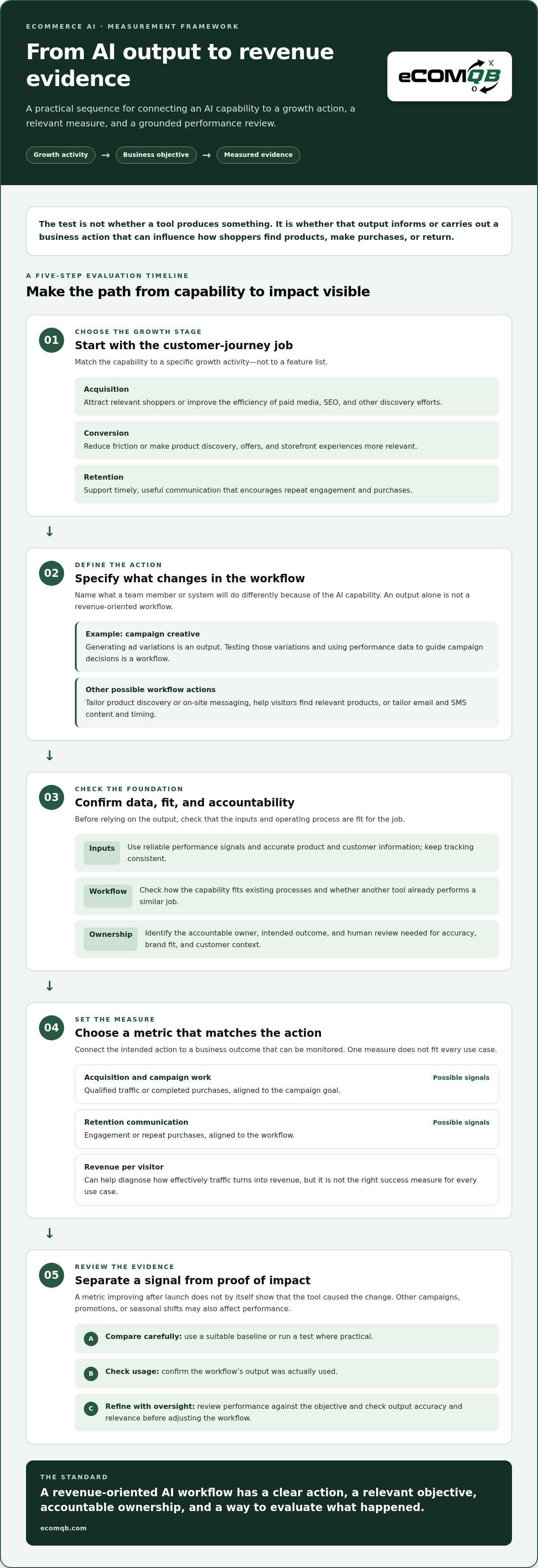
Revenue generating ai tools are AI capabilities applied to measurable eCommerce growth activities. The key word is applied. A tool may draft product descriptions, summarize customer feedback, or automate a task, but that output alone doesn’t make it revenue-generating. It needs to inform or carry out a business action that can influence how shoppers find products, make purchases, or return.
Assess each capability through three growth-system lenses:
- Acquisition: Can it help attract relevant shoppers or improve the efficiency of paid media, SEO, and other discovery efforts?
- Conversion: Can it reduce friction or make product discovery, offers, and storefront experiences more relevant?
- Retention: Can it support timely, useful customer communication that encourages repeat engagement and purchases?
These categories connect AI activity to the customer journey. Generating ad variations is an output. Testing those variations and using performance data to guide campaign decisions is a revenue-oriented workflow. AI can support decisions and execution, but it can’t guarantee revenue. Results depend on input quality, the strategy behind the workflow, and how the team uses and evaluates the output.
What makes an AI tool revenue-generating?
Start with the action, not the feature. Identify what a team member or system will do differently because of the AI capability, then define the business outcome that action could influence. The broader field of artificial intelligence in marketing includes applications such as personalization, customer behavior analysis, and targeted advertising. Each use still needs a relevant objective and a way to measure it.
Separate evidence from attribution. A metric improving after a tool launches doesn’t prove the tool caused the change. Other campaigns, promotions, or seasonal shifts may also affect performance. Compare results against a suitable baseline or run a test where practical, and check whether the workflow’s output was actually used. Revenue per visitor can help diagnose how effectively traffic turns into revenue, but it isn’t the right success measure for every use case. Choose a metric that matches the action.
Why eCommerce teams need more than a tool list
A stack assembled feature by feature can create overlap. Two tools may generate similar recommendations, while separate platforms store inconsistent customer or campaign data. That makes it harder to identify which action influenced performance and who owns the next decision.
Instead, map capabilities to an existing growth framework. Give each one a clear workflow, data source, owner, and intended outcome. This shifts the focus from isolated experimentation to coordinated execution across acquisition, conversion, and retention. An integrated eCommerce AI growth system treats AI as a layer within proven growth processes, not a substitute for strategy, oversight, or sound measurement.
How Revenue-Generating AI Tools Support Acquisition, Conversion, and Retention
Evaluate AI by the job it supports in the customer journey, not by a long catalogue of features. Acquisition brings qualified shoppers to the store. Conversion helps them choose and buy. Retention gives them a reason to return. Revenue generating ai tools can contribute at each stage, but results depend on relevant data, sound implementation, clear operating processes, and human oversight.
AI connects growth stages by turning customer and performance signals into actions that teams can test, monitor, and refine. Use AI to support the next best action, then assess whether it serves the business objective.
AI capabilities for acquisition and campaign optimization
In acquisition, agentic media buying can support ongoing campaign optimization by analyzing performance signals and informing campaign adjustments. Generative AI can help teams produce creative variations for testing, but more versions don’t guarantee a winning ad. The value comes from a disciplined test process and reliable measurement that help teams learn which messages reach the intended audience and support the campaign objective.
Keep the feedback loop grounded in data. Review the signals tied to the campaign goal, such as qualified traffic or completed purchases, and make sure tracking is consistent. Changes in results can have multiple causes, so don’t treat a tool’s recommendation or a timing coincidence as proof of impact. A clear agentic media buying strategy connects automation to accountable decisions instead of letting optimization run without direction.
AI capabilities for conversion and retention
At the conversion stage, AI personalization can help tailor product discovery or on-site messaging to a shopper’s behavior. Conversational guidance can answer product questions and help visitors find relevant options. Both experiences depend on accurate product and customer information. Monitor recommendation accuracy, outdated details, and responses that need correction. Personalization is useful when its guidance is relevant and trustworthy.
Retention workflows can use AI to tailor email and SMS content or inform when messages are sent. For example, a team might test whether behavior-based timing makes a product follow-up more relevant. Treat timing as a hypothesis to evaluate, not a guaranteed lift. Track a metric that fits the workflow, such as engagement or repeat purchases, and retain human review for brand fit, accuracy, and customer context. An agentic email marketing playbook can help teams plan where automation supports the lifecycle while keeping oversight in the process.
Connect the stages before expanding the stack. If an acquisition workflow attracts visitors but the storefront offers poor recommendations, the customer journey remains disconnected. Teams working to align these capabilities can explore AI-enabled growth systems.
How to Compare Revenue-Generating AI Tools Without Adding Tool Sprawl
A bigger stack isn’t automatically a stronger growth engine. Revenue generating ai tools earn a place when they solve a defined business problem, fit the workflows your team already runs, and produce an output someone can act on. Compare capabilities in context, not as isolated feature lists.
Tool sprawl is unmanaged overlap and fragmented workflows that make it harder to coordinate action, trust data, and measure results. Before adding a platform, map its role against your current systems and processes. Does it fill a real gap, improve an existing workflow, or repeat work another tool already performs?
Which evaluation criteria matter for eCommerce AI tools?
Use the same criteria for each option. Clarify the business problem, confirm the necessary data is available and usable, identify the workflow owner, and decide how the output will be reviewed. Then name the success metric. A useful capability should contribute something distinct, not create another dashboard whose recommendations no one owns.
The comparison below turns those questions into a working scorecard. Tailor the metric to the specific objective, and record how the output becomes a decision or action.
| Growth stage | Input data | Workflow owner | Output and action | Success metric |
|---|---|---|---|---|
| Acquisition | Campaign and creative performance signals | Paid media lead | Insights or creative variations for review and testing | Metric tied to the campaign objective |
| Conversion | Product information and on-site behavior | eCommerce or conversion lead | Recommendations or personalized storefront content | Metric tied to the specific visitor experience |
| Retention | Customer engagement and purchase context | Email and SMS lead | Message suggestions or timing recommendations | Metric tied to engagement or repeat behavior |
Use the scorecard to reveal practical dependencies. If product data is incomplete, a personalization capability may produce poor recommendations. If no one can review and apply campaign insights, the analysis may not change execution. If two platforms draw from different versions of customer data, their outputs can conflict. Resolve workflow and data questions before expanding the stack.
Why AI governance matters as the stack grows
Governance keeps the architecture deliberate. Assign ownership for data quality, output review, and performance monitoring. Monitor hallucinations, inaccurate recommendations, and other errors, then decide whether a platform should be integrated, adjusted, or retired. Oversight helps teams manage risk, but it doesn’t make AI error-free. Clean architecture gives every capability a purpose, a place in the workflow, and a clear standard for continued use.
More tools can add complexity without adding capability. Compare each option against the same growth priorities, operating requirements, and measurement plan. That discipline helps eCommerce teams build a connected, accountable stack that is ready to optimize.
How to Implement and Measure Revenue-Generating AI Tools
Implementation should follow a business priority, not a technology trend. A disciplined rollout starts by identifying a revenue opportunity, choosing a workflow, and defining how you’ll judge its performance. This gives revenue generating ai tools a clear job and gives your team a way to decide whether to refine, expand, or retire the capability.
Start with a revenue audit and prioritized roadmap
Audit the customer journey and current operating processes before selecting tools. Look for friction, missed opportunities, and weak handoffs. Metrics such as revenue per visitor (RPV), conversion performance, recommendation effectiveness, lifecycle efficiency, and repeat purchases can reveal where to investigate. These are diagnostic signals, not a checklist every brand must optimize in the same way.
Turn the findings into a roadmap. Rank opportunities by business relevance, data readiness, workflow ownership, and the team’s ability to measure change. A weak recommendation experience, for example, may point first to product-data quality or merchandising rules, not an immediate need for another AI platform. Connect each priority to an observed problem, an implementation decision, and an appropriate success measure. A broader AI transformation strategic playbook can help frame this work as a coordinated change to the growth system, rather than a series of disconnected experiments.
Implement, monitor, and optimize the system
Once a priority is set, treat implementation as operational work. Configure the capability for its intended task, connect the necessary data and systems, and define who reviews outputs and acts on them. Establish a baseline and measurement method before launch. If the workflow supports recommendations, review whether they’re accurate and relevant. If it informs campaign analysis, assess whether the insights inform decisions and how the chosen campaign metric responds.
Use this sequence to keep execution accountable:
- Audit: Identify a specific opportunity in revenue performance or the customer journey.
- Prioritize: Select a workflow based on business value, data readiness, and clear ownership.
- Define: Set the intended action, baseline, success metric, and review process.
- Implement: Configure the system and connect it to the workflow and relevant data.
- Review: Monitor output quality, automation health, and the metric tied to the objective. Adjust the workflow as needed.
Match measurement to the job. RPV may help assess a storefront or traffic-quality change, while recommendation accuracy is more direct for a product-discovery workflow. Lifecycle efficiency and repeat purchases may be relevant to email and SMS initiatives. Avoid crediting AI for every movement in a metric. Promotions, seasonality, traffic mix, and other changes can affect performance too. Use a consistent review approach and interpret results in context rather than against an invented universal benchmark.
Optimization continues after launch. Review merchandising recommendations, lifecycle flows, and campaign analysis as operating conditions and data change. Monitoring can surface inaccurate outputs, weak automation, or workflow friction, but it can’t guarantee error-free AI. An AI implementation and measurement plan can align the system with your growth priorities.
How eComQB Builds a Managed Revenue-Generating AI System
AI creates leverage when it’s built into the growth operation, not bolted on as a standalone experiment. eComQB curates, implements, manages, and optimizes AI-enabled systems for eCommerce brands, layering capabilities onto proven acquisition, conversion, and retention frameworks. The result is a connected operating model: the right tools, clear ownership, ongoing oversight, and decisions tied to business priorities.
The process is consultative. eComQB works across hundreds of AI tools to shape a stack around a brand’s goals and workflows, rather than adding platforms indiscriminately. The focus is on turning revenue generating ai tools from a scattered collection of features into a managed system that teams can implement, monitor, and refine.
What eComQB’s managed AI operations involve
The work moves from selection to sustained optimization. AI Stack Curation selects best-in-class platforms across the eCommerce ecosystem and considers how they fit together. AI Implementation & Onboarding provides an AI implementation roadmap, setup, integration, and configuration aligned with the brand’s systems and processes.
After implementation, Managed AI Operations include ongoing model performance reviews, automation health monitoring, recommendation accuracy analysis, merchandising improvements, lifecycle flow optimization, and campaign performance analysis. Governance & Oversight provides executive-level oversight of the AI ecosystem, including clean architecture, strategic platform adoption or retirement, output monitoring for hallucinations, and data-quality enforcement. Governance doesn’t eliminate every error. It creates a structure for identifying issues, reviewing outputs, and making adjustments. Where personalization is a priority, an AI personalization playbook can help connect the experience to the broader growth system.
The operating sequence is deliberate:
- Curate the stack around prioritized growth needs and existing workflows.
- Implement and onboard through structured planning, setup, integration, and configuration.
- Manage operations with ongoing workflow attention and performance monitoring.
- Audit and optimize to surface opportunities, address friction, and refine the system.
Choose the next move for your growth system
Revenue Audits assess revenue per visitor (RPV), conversion performance, product recommendation effectiveness, lifecycle marketing efficiency, retention, and repeat-purchase behavior. They produce a prioritized roadmap to guide the next move. Revenue Optimization connects findings to focused actions across merchandising, lifecycle flows, and campaign performance, keeping the work anchored in business priorities.
The foundation behind this approach dates to 2002, when the original digital growth program began. After 15 years, it spun off into eComQB in 2017. Today, eComQB brings almost 25 years of experience to the work of aligning AI with eCommerce growth systems. AI requires active management, clear ownership, and continuous review. It isn’t a set-it-and-forget-it solution, and it doesn’t guarantee results.
Ready to map the right next move for your brand? Book a consultation to discuss your growth priorities and how a managed AI system can support them.
Make Your Next AI Move Count
Your next advantage won’t come from chasing every new capability. It will come from identifying a meaningful business constraint, assigning a clear owner, and building the discipline to learn from each decision. That’s how AI becomes a stronger part of your growth operation over time: not through a bigger stack, but through sharper execution and better-informed next moves.
Use that principle to decide where revenue generating ai tools belong in your business. Start with a workflow your team can act on, evaluate, and improve without losing sight of the customer experience. A focused first move creates room to build momentum with purpose.
Ready to define that move? Book a free consultation to discuss the growth priorities your AI system should support. Your next step can be clear, considered, and built for progress.
Frequently Asked Questions
Can AI tools directly increase eCommerce revenue?
AI can contribute to revenue, but a tool alone can’t ensure sales growth. Its recommendations or automation must fit the offer, customer experience, and business process. For example, a campaign system may suggest shifting spend, but the team still needs to assess the recommendation against campaign goals and reliable tracking. Treat revenue impact as something to test and evaluate, not a result guaranteed by adopting AI.
Which AI tools can support eCommerce acquisition, conversion, and retention?
For acquisition, AI can help analyze campaign signals or generate creative variations for testing. For conversion, personalization and conversational guidance can help shoppers find relevant products or answers. For retention, AI can support tailored email and SMS content or timing decisions. Choose based on the workflow that needs support, then review output quality. A recommendation that surfaces irrelevant products needs attention before it can serve shoppers well.
How do I choose AI tools for my eCommerce business?
Start with a specific operating problem, such as slow campaign analysis or a product catalog that makes relevant recommendations difficult. Then check whether the required data is dependable, who will own the workflow, and where the AI output enters the team’s process. Compare the capability with tools already in use. If it adds another review queue without improving a decision or action, it may not be the right fit.
How can eCommerce brands measure whether AI tools are working?
Define a baseline before changing the workflow, and select a measure that reflects its intended job. For a product recommendation feature, record which shoppers saw recommendations and whether the items were relevant, not just whether the feature was active. Where practical, compare similar audiences or periods and document other changes, such as promotions or traffic shifts. This makes the review more useful and reduces the risk of crediting AI for unrelated movement.
What happens if an eCommerce business uses too many AI tools?
Too many overlapping tools can create conflicting recommendations, duplicate tasks, and uncertainty about which data or output teams should trust. For example, separate systems may generate different customer segments for the same email workflow. Assign an owner to each capability, map dependencies, and periodically review whether it still has a distinct role. Consolidating or retiring redundant platforms can make workflows easier to manage and performance easier to interpret.
Do revenue-generating AI tools need ongoing management?
Yes. Data, customer behavior, and business priorities change, so teams need to review whether AI outputs remain accurate and useful. Ongoing management can include model performance reviews, automation health monitoring, recommendation accuracy analysis, and monitoring for hallucinations or data-quality issues. Keep a human owner accountable for reviewing exceptions and making adjustments. Oversight helps manage risk and maintain alignment with business goals, but it doesn’t make AI error-free.