AI for Customer Lifetime Value: Engineering 8-Figure Retention in 2026

Your current retention strategy is likely a post-mortem. Most brands treat Customer Lifetime Value as a static historical record rather than a real-time tactical weapon. This passive approach is why exploding acquisition costs are eating your margins while high-value customers churn unnoticed. To scale an 8-figure brand in 2026, you must stop measuring the past and start engineering the future. Leveraging ai for customer lifetime value isn't just an upgrade; it is the only way to transform your data into a zero-latency revenue engine.
You know the frustration of watching dashboards that identify problems only after the revenue has vanished. We are going to fix that. This article reveals how to transition from predictive models to agentic AI systems that intercept churn, personalize experiences, and maximize profit with surgical precision. We will explore the exact playbook for building agentic landing pages, deploying AI-driven SMS, and navigating the 2026 regulatory environment. It is time to stop reacting and start winning. Prepare to analyze, optimize, and dominate your market.
Key Takeaways
- Eliminate data latency by shifting from historical AOV metrics to real-time behavioral analysis that captures 8-figure revenue opportunities.
- Master the architecture of ai for customer lifetime value to transform passive data into an active, deep-learning engine that predicts and influences intent.
- Pivot from predictive dashboards to agentic AI systems that autonomously intercept churn, resolve friction, and maximize profit.
- Implement a precision-engineered framework to unify Shopify data and assign surgical LTV scores across your entire customer base.
- Scale with momentum by utilizing curated AI technology stacks that deliver sophisticated growth mastery without the burden of operational overhead.
The CLV Crisis: Why Traditional Metrics Fail in 2026
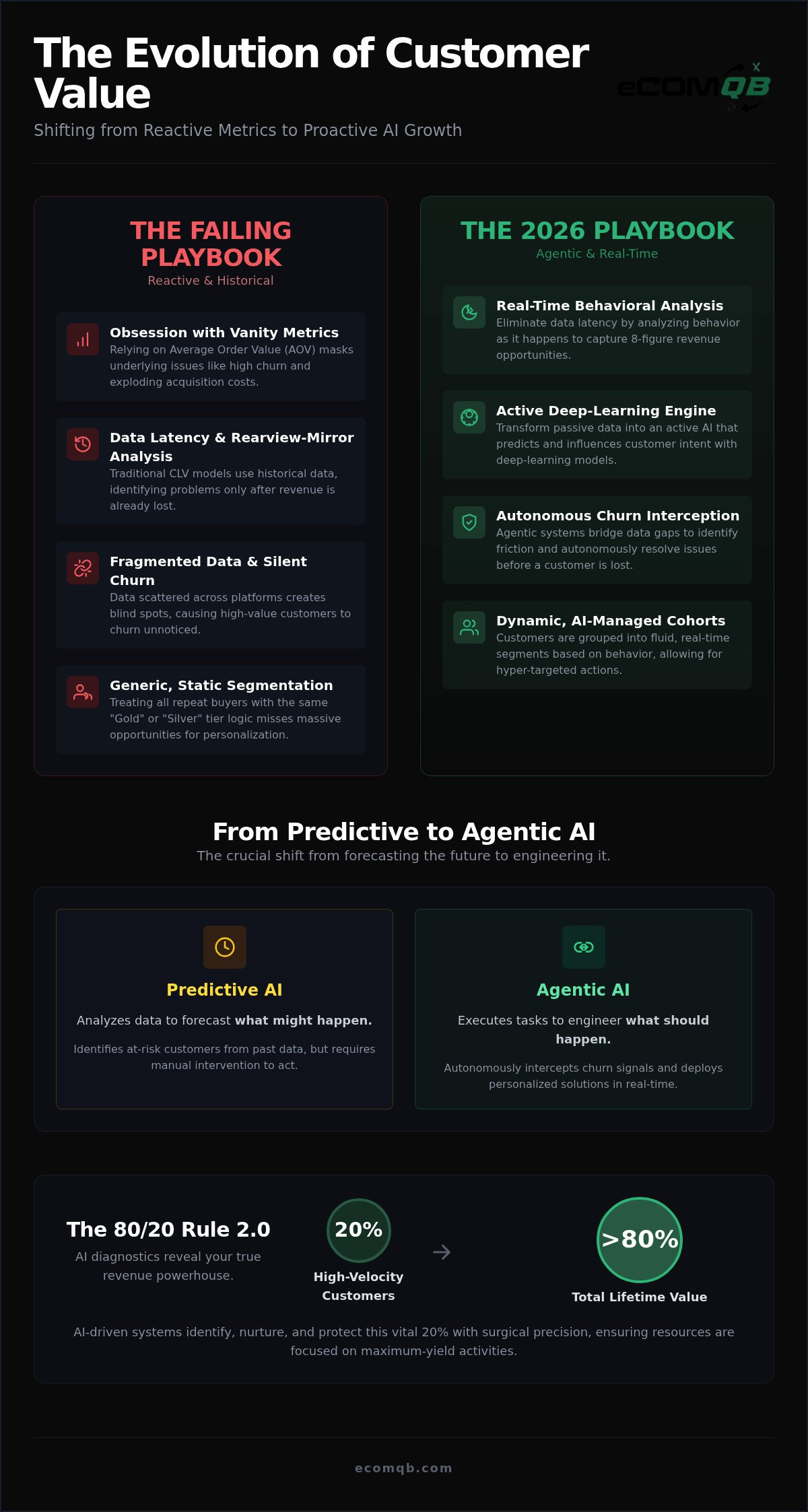
The obsession with Average Order Value (AOV) is a terminal mistake. In high-stakes eCommerce, AOV is a vanity metric that often masks underlying rot. If your strategy relies on the first transaction to fuel growth, you're already losing. Customer acquisition costs are no longer just rising; they are exploding. You can't buy your way to profit in a market where every competitor has access to the same bidding tools. The real game is won or lost in the retention gap.
Traditional Customer Lifetime Value (CLV) models are broken because they are reactive. They rely on historical data that arrives too late to be actionable. This data latency creates a leaky funnel where your most valuable assets drift away while you analyze last month's performance. Leveraging ai for customer lifetime value allows you to pivot from looking in the rearview mirror to steering the vehicle in real-time. You must analyze, consolidate, and act before the window of opportunity closes.
The 80/20 Rule 2.0: Identifying Your Revenue Powerhouse
Most brands treat every repeat buyer with the same generic email sequence. This is a strategic failure. AI diagnostics reveal that your growth is actually driven by a specific 20% of your audience. These aren't just loyal customers; they are high-velocity assets with specific behavioral triggers. Your current tech stack likely miscalculates their worth because it lacks the predictive depth to see intent. You need to identify, nurture, and protect these powerhouses before they hit the churn threshold. By utilizing ai for customer lifetime value, you can segment these high-performers with surgical precision, ensuring your resources are focused where they generate the highest yield.
The Hidden Data Gaps Killing Your Profit Margins
Fragmentation is the enemy of precision. When your data is scattered across Meta, Google, and Shopify, you develop blind spots that lead to silent churn. This occurs when your best customers stop buying without warning. Your legacy system won't flag it until they've been gone for months. By that point, the cost to win them back is prohibitive. Understanding Why Your Current Tech Stack is Leaking Revenue is the first step toward reclaiming your margins. Agentic systems bridge these gaps, unifying fragmented signals into a single, decisive strike. You need a system that identifies friction points in real-time, allowing you to intercept a failing customer relationship before it terminates.
What is AI for Customer Lifetime Value? Defining the Architecture
Stop calculating. Start engineering. AI for CLV is not a spreadsheet formula or a basic math problem. It is a sophisticated system of machine learning models designed to predict and influence future purchase behavior in real-time. Legacy brands still rely on RFM analysis. Recency, Frequency, and Monetary value are historical artifacts. They tell you where your revenue was, not where it is going. Leveraging ai for customer lifetime value means moving beyond these static snapshots into deep-learning behavioral analysis.
The architecture of a modern growth system prioritizes the "Next Best Action" for every individual user. This isn't about broad strokes. It is about identifying high-LTV prospects before they even make their first purchase. By analyzing pre-acquisition signals, AI allows you to bid more aggressively on the users who will actually drive your 8-figure growth. You are no longer just buying traffic. You are acquiring future profit with surgical precision.
Machine Learning Models for LTV Forecasting
Probabilistic models like "Buy 'Til You Die" (BTYD) are a starting point, but they lack the muscle for 2026 eCommerce. Deep learning is the standard for brands that demand scale. These models ingest unstructured data, such as email sentiment, granular browsing patterns, and support ticket history. This creates a high-definition view of customer intent. "AI-driven CLV is the intersection of predictive precision and automated execution." By processing these complex signals, your system can forecast value with an accuracy that legacy tools cannot match. If you want to see how these architectures apply to your specific Shopify store, you can explore a managed AI growth system tailored to your brand.
Dynamic Customer Segmentation at Scale
Static tiers like "Gold" or "Silver" are dead. They are too slow for the digital economy. Modern leaders use fluid, AI-managed cohorts that update every time a customer interacts with the brand. This allows for the deployment of "Churn Propensity" scores. When a high-value customer shows signs of cooling off, the system doesn't wait for a report. It triggers an immediate, agentic response. These dynamic segments are pushed directly into your Meta and Google advertising execution, ensuring your retargeting spend is always optimized for the highest possible return. You aren't just watching the game; you are calling the plays before the defense can react.
Predictive vs. Agentic AI: Engineering Value in Real-Time
Dashboards are for observers. They show you the wreckage of what happened yesterday. If you want to build an 8-figure brand in 2026, you need to lead, not just watch. The industry is moving beyond simple forecasting. Predictive models identify the pattern; agentic systems execute the solution. This is the critical evolution of ai for customer lifetime value. It transforms passive insights into autonomous actions that drive revenue while you sleep. You don't need another report. You need a system that acts, adapts, and wins.
The shift from manual email flows to autonomous, zero-latency revenue triggers is the hallmark of a high-performance brand. Predictive AI tells you what will happen. Agentic AI makes it happen. This distinction is the difference between surviving and dominating. By deploying systems that function like a digital field general, you ensure every customer interaction is optimized for maximum profit. You are no longer reacting to churn; you are engineering retention with surgical precision.
Agentic Workflows: The End of Manual Retention
Manual retention strategies are slow, rigid, and inefficient. They rely on "if-then" logic that can't keep up with the speed of the digital economy. Agentic workflows eliminate this operational overhead by deploying AI agents that autonomously adjust SMS and email frequency based on individual LTV signals. If a high-value customer shows a churn signal, the agent doesn't wait for a human to review a dashboard. It intercepts, engages, and converts instantly. This removes the friction that anchors most Shopify founders to their desks. To master this transition, follow the Agentic Email Marketing: The 2026 Playbook to implement zero-latency revenue systems today.
LTV-Based Media Buying: Winning the High-Stakes Game
Stop optimizing for short-term ROAS. It is a tactical trap that leads to low-margin "one-timers" who never return. High-performance brands use agentic media buying to feed predicted LTV data directly back into Meta and Google algorithms. This allows you to bid aggressively for prospects with 8-figure potential while ignoring the low-value noise. You are aligning your ad spend with long-term profitability rather than vanity metrics. This tactical shift moves you from reactive bidding to proactive market dominance. It's about precision, momentum, and results. When you align your acquisition spend with ai for customer lifetime value, you aren't just buying traffic; you are acquiring future wealth.
Implementing an AI-Powered Retention Framework
Implementing ai for customer lifetime value requires a systematic playbook, not a collection of disjointed tactics. You need a clear, high-velocity roadmap to transition from fragmented data to a unified revenue engine. This isn't about adding another app to your Shopify store. It's about engineering a system that identifies, values, and captures profit with surgical precision. You must build the architecture before you can expect the results.
The first phase is data consolidation. You must unify your Shopify, advertising, and support data into a single source of truth. Silos are where revenue goes to die. Once unified, you deploy the predictive layer. This assigns a specific LTV score to every customer ID in your database. You aren't guessing anymore; you're quantifying. Step three is agentic integration. You connect these LTV insights directly to your marketing execution channels. Finally, you use AI diagnostics for continuous optimization. The system learns, adapts, and improves its own performance without human intervention.
Personalization at Scale for Shopify Brands
Generic storefronts are a liability in 2026. High-performance brands use agentic landing pages that adapt content in real-time based on a visitor’s predicted LTV. If a high-value prospect returns, they shouldn't see the same offer as a first-time browser. Dynamic pricing and offer management allow you to protect your margins while aggressively reclaiming high-churn-risk segments. Mastering AI for Shopify Personalization is the only way to maintain 8-figure momentum. It ensures every touchpoint is optimized for the highest possible yield.
Measuring Success: Beyond the ROAS Trap
ROAS is a deceptive metric. It tells you about the transaction, but it says nothing about the brand's health. For 8-figure scaling, the LTV:CAC ratio is the only metric that matters. The LTV:CAC ratio is the ultimate diagnostic for brand health in 2026. You also need to track Retention Velocity. This measures how quickly your customers return and how much they spend over specific intervals. It is the pulse of your growth system. If you're ready to stop tracking vanity metrics and start engineering real profit, you can book a strategic AI growth audit to see exactly where your system is leaking revenue.
The eComQB Advantage: Managed AI Growth for LTV Mastery
Building an in-house AI team is a strategic distraction for most brands. It requires massive capital, specialized talent, and months of technical calibration. This diverts your focus from market leadership and product innovation. You need tactical results, not a research department. eComQB functions as your field general, deeply embedded in the mechanics of your growth. We provide curated AI technology stacks that deliver sophisticated power without the operational complexity. This is about precision, performance, and total profit.
Our approach unifies every lever of your brand into a single strike force. We integrate Shopify website design with agentic media buying to create a seamless, high-velocity growth engine. By leveraging ai for customer lifetime value, we ensure your brand scales with surgical precision. You don't need to manage ten different vendors or twenty different apps. You need a managed system that executes on your behalf. We remove the friction of manual management, allowing you to maintain your focus on the ultimate objective of 8-figure dominance.
Revenue Generating AI Tools: Your Tactical Playbook
We deploy revenue-generating AI tools that transform how you interact with your audience. Our agentic workflows autonomously handle retention and scaling by processing data at speeds no human team can match. These systems adjust your Meta and Google advertising execution in real-time based on shifting LTV signals. A fully managed AI transformation allows high-performance brands to outpace the competition without increasing operational overhead. You gain the tactical advantage of a world-class AI department without the recruitment burden. Book your tactical briefing with eComQB to audit your LTV strategy.
Scaling to 8-Figures and Beyond
The real-world impact of shifting to agentic growth systems is a total redefinition of your bottom line. Manual bidding is a relic of a slower era. By aligning your entire operation with ai for customer lifetime value, you achieve zero-latency revenue execution across every channel. This creates a competitive moat that is impossible to replicate with legacy tools or standard SaaS platforms. You move faster, bid smarter, and retain longer. You are no longer just participating in the market; you are dictating its terms. In the AI economy, speed is the only currency that matters.
Master the 2026 Retention Playbook
The era of passive observation is over. To scale an 8-figure brand in 2026, you must pivot from analyzing historical data to engineering future profit. We've established that traditional metrics are failing and that agentic systems are the only way to achieve zero-latency revenue. Mastering ai for customer lifetime value is the foundational requirement for market dominance. You must unify your data, deploy predictive layers, and automate your response to customer intent. Precision, momentum, and results are the only benchmarks that matter.
eComQB provides managed AI transformation for high-growth DTC brands that demand peak performance. We combine expertise in agentic media buying with Shopify excellence to focus on high-stakes revenue generation. Don't let your retention funnel leak profit while you wait for manual reports. It is time to act with surgical precision and strategic mastery. Ready to engineer 8-figure velocity? Deploy your AI growth system with eComQB.
Your growth trajectory is waiting for the next move. Take the field and win.
Frequently Asked Questions
How does AI actually predict Customer Lifetime Value?
AI predicts value by analyzing deep-learning behavioral patterns instead of relying on historical averages. It ingests unstructured data like browsing habits, email sentiment, and support interactions to forecast future purchase frequency and spend. This allows the system to assign an LTV score to every customer ID with surgical precision. You move from guessing to quantifying intent. It identifies your revenue powerhouses before the next transaction even occurs.
Can AI help reduce Customer Acquisition Cost (CAC) while increasing LTV?
Yes, AI reduces CAC by optimizing your bidding for high-value prospects. Instead of wasting ad spend on one-time buyers, agentic media buying directs your budget toward users with the highest predicted LTV. This improves your LTV:CAC ratio by lowering the cost to acquire profit, not just traffic. You bid aggressively where it matters and ignore low-margin noise. It is a tactical shift that aligns acquisition with long-term profitability.
What is the difference between predictive and agentic AI for eCommerce?
Predictive AI identifies patterns and tells you what is likely to happen. Agentic AI takes the field and makes it happen. While a predictive model might flag a churn risk on a dashboard, an agentic system autonomously triggers a personalized SMS or adjusts an ad bid to intercept that churn. One is for observation; the other is for execution. Agentic workflows remove human latency and operational overhead from your growth engine.
Is my Shopify store's data enough to start using AI for LTV?
Your Shopify data is the foundation, but it must be unified with advertising and support data for total mastery. High-performance ai for customer lifetime value systems require a consolidated view of the customer journey to be effective. We unify fragmented signals from Meta, Google, and Shopify into a single source of truth. This elimination of data silos is what allows the AI to function with zero latency and maximum precision.
How long does it take to see results from an AI-driven retention strategy?
Initial predictive insights are often visible within the first 30 days of data consolidation. The true momentum of an agentic system builds over 90 days as the machine learning models calibrate to your specific audience behavior. You will see immediate improvements in retention velocity and bidding efficiency. This is a game of rapid improvement and compounding gains. The goal is a sustained, 8-figure revenue engine, not a temporary spike.
What are the best AI tools for increasing customer retention in 2026?
The best approach is not a single tool, but a curated technology stack. You need agentic email and SMS, AI-driven personalization for storefronts, and predictive modeling layers. eComQB provides these as managed growth systems, eliminating the need for you to stitch together disconnected SaaS apps. We deploy agentic landing pages and storefronts that adapt in real-time. This integrated playbook ensures every lever in your retention framework is optimized for yield.
Does eComQB manage the AI implementation for me?
Yes, eComQB provides a fully managed AI transformation. We function as your tactical partner, handling everything from Shopify development to agentic media buying. You don't need to build an expensive in-house AI team or manage complex technical integrations. Our field general approach ensures the tech stack is engineered for your ultimate objective: revenue. We remove the operational burden so you can focus on leading your brand to its next milestone.
Why is LTV more important than ROAS for scaling a brand?
ROAS is a deceptive metric that only measures the immediate transaction. It ignores the cost of churn and the value of a recurring relationship. Utilizing ai for customer lifetime value provides a high-definition view of your brand's long-term health and scalability. Scaling to 8-figures requires you to optimize for profit, not just vanity numbers. By focusing on LTV, you ensure every dollar spent on acquisition is an investment in a high-velocity revenue asset.