ECommerce Brand Scaling Strategy: The 2026 Agentic Playbook

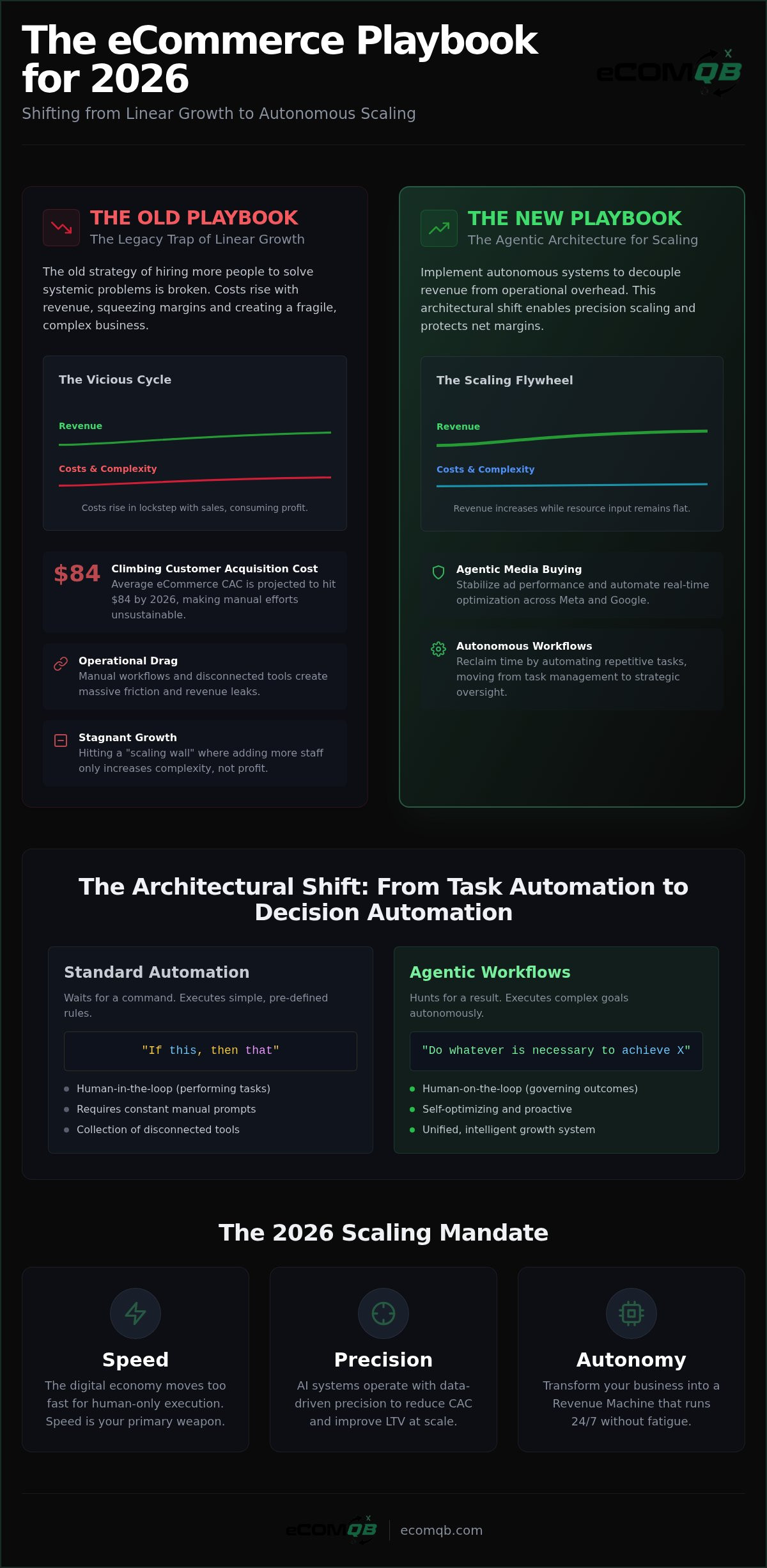
Why are you still hiring more bodies to solve a problem that autonomous systems should have already fixed? With average eCommerce CAC climbing toward $84 in 2026, the old playbook of throwing more money at manual eCommerce growth systems is dead. You have likely felt the weight of linear growth where costs rise alongside revenue, leaving your margins thin, your team exhausted, and your growth stagnant. It's time to stop managing volatility and start engineering certainty.
This guide provides the architectural shift required to scale with precision. We will show you how to implement agentic AI that decouples your revenue from your operational overhead. You will learn to deploy agentic media buying to stabilize your accounts, hyper-personalization to drive LTV, and autonomous workflows to reclaim your time. We are moving past the era of manual workflows into a future of autonomous scaling, strategic mastery, and aggressive market dominance.
Key Takeaways
- Decouple revenue from operational headcount by transitioning from linear growth to systemic, exponential scaling.
- Build unified eCommerce growth systems to move your leadership from manual task management to high-level strategic oversight.
- Leverage agentic media buying to stabilize ad performance and automate real-time optimization across Meta and Google.
- Execute a 5-step roadmap to identify hidden revenue leaks and harden your Shopify storefront for maximum velocity.
- Adopt a managed AI strategy to eliminate operational friction and maintain a decisive competitive advantage in the 2026 market.
Scaling vs. Growing: Why Your Brand Strategy Must Evolve
Growth is deceptive. It looks like progress on a spreadsheet but feels like drowning in the office. Linear growth is the silent killer of 8-figure brands. You add revenue, you add staff, and you add complexity. Eventually, the complexity consumes the profit. This is the Legacy Trap. Real scaling requires an architectural shift toward Scalability, where your output increases while your resource input remains flat. If your costs rise in lockstep with your sales, you aren't scaling; you're just getting bigger and more fragile.
To win in 2026, you must decouple revenue from headcount. Manual processes are no longer just slow; they are a liability that creates massive operational drag. Every minute your team spends on manual data entry or basic campaign adjustments is a minute lost to your competitors. You need to transition from a business that relies on human effort to one that thrives on systemic precision. This is the only way to protect your net margins as the market becomes more volatile and expensive.
The Threshold of Friction: Identifying the Scaling Wall
When you hit the scaling wall, manual workflows become revenue leaks. Every manual email, every manual ad adjustment, and every manual customer service ticket represents a point of failure. Adding more staff is the instinctive reaction, but for high-performance brands, it's the wrong move. More people create more communication overhead. They create more meetings. They create more drag. To protect your contribution margins, you must implement eCommerce growth systems that automate the heavy lifting. You don't need a bigger team. You need a smarter architecture. Audit your workflows, identify the friction, and automate the repetition.
The 2026 Scaling Mandate: Speed, Precision, Autonomy
The digital economy moves too fast for human-only execution. Speed is your primary weapon. Precision is your shield. Autonomy is your engine. A true eCommerce AI growth system operates with a level of data-driven precision that human teams cannot match. It reduces CAC by identifying patterns in milliseconds. It improves LTV by personalizing at scale. It transforms your business into a Revenue Machine that runs 24/7 without fatigue. This isn't just about efficiency. It's about decisive leadership. You are either architecting for autonomy or you are managing your own obsolescence. High-stakes scaling requires a playbook that prioritizes results over activity.
The Agentic Architecture: Building a Scalable eCommerce Growth System
Stop collecting tools. Start building systems. Most 8-figure brands are buried under "app sprawl" where data lives in disconnected silos, creating friction and blind spots. A true eCommerce growth system isn't a collection of logins; it's a unified intelligence layer that synthesizes customer data, inventory levels, and market trends. This architectural shift moves your team from human-in-the-loop, where they perform repetitive tasks, to human-on-the-loop, where they govern strategic outcomes. You stop managing people who manage tools. You start managing an eCommerce AI growth system that manages the growth trajectory.
DIY tool sprawl is the fastest way to hit a ceiling. When you patch together disparate AI tools, you create intelligence gaps where data gets lost in translation. A managed approach ensures that your agentic landing pages talk to your email agents, which talk to your media buying stack. This level of synchronization is what creates the Revenue Machine. It transforms your operations from a series of manual hand-offs into a high-velocity sprint, protecting your net margins while your competitors drown in complexity.
Beyond Tools: The Rise of Agentic Workflows
Static apps wait for a command. Autonomous agents hunt for a result. The difference is the Strategic Middle, the space where decisions are made. While standard automation handles "if this, then that," agentic workflows handle "do whatever is necessary to achieve X." Agentic workflows are self-optimizing systems that execute complex goals without constant human prompts. This is the end of task automation and the beginning of decision automation. Your systems should analyze, decide, and execute in real-time without waiting for a manual prompt or a Monday morning meeting. For businesses in the Middle East, partnering with a data-driven agency like EmirAds can facilitate the integration of these autonomous decision-making layers into existing marketing structures.
Executing an AI transformation for eCommerce brands is not a weekend DIY project. High-stakes scaling requires a curated tech stack that integrates personalization, SEO, and visibility mastery into a single cohesive engine. This requires a robust eCommerce Digital Strategy that prioritizes system interoperability over individual features. You need a field general to orchestrate these moves, ensuring every piece of technology serves the ultimate objective of decoupled growth.
At the center of this engine is a high-velocity storefront. For brands on Shopify, this means hardening the infrastructure to handle traffic surges while maintaining millisecond load times. A managed system ensures every component works in harmony to drive revenue autonomously. If you are ready to stop fighting your tech stack and start leveraging it, you should audit your current architecture for hidden friction points that are leaking profit.
Performance Marketing at Velocity: Agentic Media Buying and Retention
Manual media buying is a bottleneck you can no longer afford. In the 2026 landscape, the speed of algorithmic shifts on Meta and Google outpaces human capability. High-performance eCommerce growth systems solve this by deploying autonomous agents that manage ad accounts in real-time. This isn't just automation; it's agentic media buying. These systems analyze thousands of data points, adjust bids instantly, and rotate creatives based on live performance metrics. You stop chasing ROAS and start engineering it with surgical precision.
The goal is to eliminate revenue latency. This is the dead time between a customer's action and your brand's response. When your retention strategy relies on manual campaign scheduling, you lose profit to the gap. By integrating agentic email marketing, your system triggers hyper-personalized responses the moment intent is detected. You move from broad blasts to individual conversations, maximizing the lifetime value of every customer acquired. This is how you protect your margins while scaling at velocity.
Agentic Media Buying: Dominating the Modern Algorithm
Traditional media buying is reactive. You check the dashboard, spot a trend, and make a manual tweak. That delay is expensive. Agentic systems operate with a "Field General" mindset, executing a high-level strategy through autonomous bidding and audience refined. These agents identify high-intent segments faster than any human buyer, shifting budget to the winners before the opportunity expires. It's about aggressive offensive maneuvers. For brands looking to master these tactics, Canavan Digital provides the strategic expertise needed to deploy AI-powered marketing solutions that scale with precision. You set the objectives, define the constraints, and let the system execute for maximum efficiency. Analyze, adjust, and dominate.
Standard personalization is often just a first-name tag in an email. True scaling requires AI for Shopify personalization that adapts your entire storefront in milliseconds. When a user clicks an ad, the landing page should reflect their specific stage in the funnel, their past behavior, and their predicted needs. Combined with agentic SMS and email, this creates a seamless loop that recovers lost LTV and drives repeat purchases. You aren't just selling a product; you're orchestrating an experience that feels individual but scales systemically. Precision, relevance, and profit are the only metrics that matter.
The 5-Step Scaling Roadmap for 8-Figure DTC Brands
Scaling is a sequence, not a sprint. To move from manual growth to autonomous velocity, you need a repeatable framework that eliminates human error and maximizes capital efficiency. This 5-step roadmap is designed to transition your brand into a high-performance engine where revenue is decoupled from headcount. We start with the foundation, harden the infrastructure, and then deploy the agentic layer to take the territory.
- Step 1: Audit and Diagnose. Identify revenue leaks, operational friction, and attribution gaps.
- Step 2: Infrastructure Hardening. Optimize your Shopify storefront for speed, conversion, and 10x traffic volume.
- Step 3: Deploying the Agentic Layer. Integrate autonomous eCommerce growth systems to handle decision-making at the strategic middle.
- Step 4: Media Acceleration. Scale ad spend aggressively through agentic buying protocols on Meta and Google.
- Step 5: Optimization Loop. Use AI-driven insights to continuously improve net profit margins and customer lifetime value.
Phase 1: Diagnostic and Infrastructure
Success begins with a clean data layer. You cannot scale what you cannot measure with precision. We start by analyzing your LTV/CAC ratios to find the exact scaling sweet spot for your brand. This phase is about removing the "noise" from your data to ensure your AI agents have a clear signal. We then focus on infrastructure hardening. Your Shopify storefront must be technically capable of handling high-velocity traffic without a dip in performance. Speed is a conversion lever. Stability is a scaling requirement. Clean the data. Harden the site. Prepare for the surge.
Phase 2: Execution and Acceleration
Phase 2 moves from preparation to aggressive offensive maneuvers using integrated eCommerce growth systems. We launch agentic campaigns across Meta and Google, allowing autonomous buyers to hunt for high-intent audiences in real-time. Simultaneously, we transition your retention workflows to autonomous, trigger-based systems. You stop looking at vanity metrics like ROAS in isolation. Instead, we establish the KPIs that actually drive wealth: Contribution Margin and Marketing Efficiency Ratio (MER). This is the shift from being a "store owner" to being a "field general" of a global revenue machine.
If your current architecture is built on manual patches and guesswork, you are leaving millions on the table. It is time to stop guessing and start engineering. You should book a strategy briefing to audit your current scaling roadmap for hidden friction points.
Deploying the Revenue Machine: Managed AI Transformation with eComQB
Strategy without execution is just an expensive hallucination. You've seen the roadmap; you understand the architecture; now you must decide how to build it. High-performance brands do not settle for the chaos of DIY tool sprawl or the slow pace of manual management. They require a tactical partner that functions as a field general for their growth. eComQB provides the managed eCommerce growth systems necessary to transform your business from a manual operation into a high-velocity revenue machine. We don't just offer advice; we deploy the technical infrastructure that drives results.
The 2026 economy rewards speed and punishes hesitation. By integrating a fully managed AI growth system, you eliminate the operational drag that keeps most 8-figure brands stuck in linear growth. We handle the technical complexity, the algorithmic shifts, and the system optimizations. This allows you to focus on leading the brand while your architecture generates revenue autonomously. You aren't just surviving the digital shift; you are positioning your brand as the inevitable market leader.
The eComQB Advantage: Precision and Mastery
Most agencies provide reports. We provide systems. The eComQB advantage lies in our ability to curate and manage high-stakes technology stacks that decouple revenue from headcount. We move past the surface-level metrics to focus on contribution margins and marketing efficiency. Our playbook for achieving 8-figure velocity is built on precision, speed, and relentless optimization. We eliminate the friction of disconnected silos and replace them with a unified intelligence layer. This is how we handle the complexity so you can focus on the mission. We are the tactical partner you need to maintain a decisive competitive advantage.
Getting Started: The Path to 10x Velocity
The journey to autonomous scaling begins with a surgical audit of your current operations. We identify the revenue leaks, the data gaps, and the operational friction points that are currently throttling your growth. Our team looks deep into your LTV/CAC ratios and storefront performance to find the quickest path to 10x velocity. Once the leaks are plugged, we begin the deployment of agentic workflows. You will see a measurable impact on your revenue as we stabilize your media buying and automate your retention loops. The transition from manual to managed is fast, methodical, and results-driven. Stop managing the technical debt of the past and start architecting eCommerce growth systems that generate wealth. It is time to deploy your Revenue Machine with eComQB and reclaim your margins.
Architecting Your Decisive Competitive Advantage
The transition from manual growth to autonomous scaling is the defining shift for 8-figure brands in 2026. By deploying integrated eCommerce growth systems, you move beyond the limitations of human-managed workflows and enter the territory of systemic precision. You have the roadmap to decouple revenue from headcount, stabilize volatile ad accounts, and eliminate the revenue latency that drains your profit. This is about more than efficiency; it is about architecting a business that wins by default.
We specialize in the technical execution of these high-stakes maneuvers. From curated AI technology stacks to managed agentic media buying, we provide the infrastructure required to run our proven 8-figure scaling playbooks. You don't need more tools; you need a managed system that executes your strategic vision without friction. The future belongs to the leaders who choose to build, optimize, and dominate.
Book Your Strategy Call to Deploy the Revenue Machine
Your trajectory is waiting. Let's start the transformation.
Frequently Asked Questions
What is an eCommerce brand scaling strategy?
It is an architectural shift from linear growth to exponential expansion. Unlike basic marketing plans, a scaling strategy focuses on decoupling revenue from operational headcount. It utilizes eCommerce growth systems to automate decision-making at the strategic middle. This ensures that as sales volume increases, your overhead remains flat. It's about building a repeatable revenue machine that thrives on systemic precision rather than human effort.
How is scaling different from growing in eCommerce?
Growing is linear; scaling is exponential. In a growth model, your costs and headcount rise in lockstep with your revenue, often leading to a "Legacy Trap" where profit margins thin out as complexity increases. Scaling involves implementing systems that handle increased load without a proportional increase in resources. It requires a fundamental shift in how you manage data, media, and customer retention to protect your net margins while accelerating velocity.
What are agentic media buying and agentic marketing?
Agentic media buying is the deployment of autonomous AI agents to manage ad accounts on Meta and Google in real-time. Unlike standard automation that follows rigid rules, agentic systems analyze thousands of live data points to execute complex goals without human prompts. Agentic marketing extends this autonomy to email, SMS, and storefront personalization. These systems hunt for results, adjust bidding strategies instantly, and rotate creatives to maintain a decisive competitive advantage.
When is a brand ready to transition to a managed AI growth system?
A brand is ready when manual workflows become a bottleneck for profit. If your team is buried in task management rather than strategic oversight, you have hit the threshold of friction. Typically, 8-figure DTC brands reaching for the next level of velocity require eCommerce growth systems to eliminate operational drag. If your CAC is rising and your LTV is stagnant despite increased headcount, it's time to transition to a managed architecture.
Can Shopify brands implement agentic workflows?
Yes, Shopify is a primary platform for agentic integration. High-velocity brands use Shopify's robust API to connect agentic landing pages, autonomous email triggers, and AI-driven storefront personalization. The key is infrastructure hardening. You must ensure your data layer is clean and your site speed is optimized for millisecond response times. When properly architected, agentic workflows transform a standard Shopify store into a self-optimizing revenue machine that runs 24/7 without fatigue.
How does AI improve eCommerce profit margins?
AI improves margins by eliminating human error and reducing operational overhead. By automating the strategic middle, brands execute complex media buying and retention strategies without hiring additional staff. AI-driven precision also reduces wasted ad spend by identifying high-intent audiences faster than human buyers. This efficiency lowers your customer acquisition costs while simultaneously increasing lifetime value through hyper-personalization; this directly impacts your contribution margins and overall net profit.
What is the role of agentic landing pages in scaling?
Agentic landing pages adapt to the individual user’s funnel stage in real-time. Instead of a static experience, these pages use AI to modify headlines, offers, and social proof based on the visitor’s specific intent and past behavior. This level of zero-latency personalization significantly increases conversion rates. In a high-stakes scaling environment, these pages act as a conversion force multiplier, ensuring that every dollar of ad spend is maximized for impact.
How do you reduce CAC while scaling ad spend in 2026?
Reducing CAC at scale requires moving beyond manual bidding. In 2026, the average eCommerce CAC ranges between $68 and $84; this makes precision mandatory. You must utilize agentic media buying to identify and capture high-intent segments before the algorithm prices you out. By combining this with autonomous storefront personalization and trigger-based retention, you create a seamless loop that converts traffic more efficiently. Precision, speed, and autonomy are the only levers for sustainable scaling.