Automated Ad Bidding for eCommerce: Engineering 8-Figure Velocity in 2026

The era of the manual toggle is dead. In 2026, clinging to manual bid adjustments is a calculated risk to your brand's survival. As Google Ads enforces its Bidding Target Optimization and Meta’s Advantage+ algorithms dominate 62% of conversion spend, the divide between the scaling elite and the struggling majority is widening. Mastering automated ad bidding for ecommerce is no longer about saving time. It is about engineering a system that processes data, optimizes creative, and executes trades at a velocity no human operator can match.
You have likely watched algorithm volatility wipe out a week of profit in a single afternoon. You know the frustration of seeing a winning campaign stagnate because you could not scale it fast enough without breaking the machine. This article provides the blueprint to transition from manual micro-management to agentic media buying. You will learn to secure a definitive competitive advantage by aligning your spend with real-time inventory levels and high-performance creative. We are breaking down the 2026 playbook for predictable ROAS, automated scaling workflows, and the strategic mastery required to hit 8-figure velocity.
Key Takeaways
- Break the manual scaling ceiling. Learn why replacing intuitive guesswork with systemic, math-driven execution is the only way to reach 8-figure velocity.
- Deploy agentic media buying as your digital "Field General." These advanced workflows execute precise, high-velocity adjustments that standard platform tools can't replicate.
- Identify the "Black Box" trap. Understand why generic platform goals often conflict with your bottom line and how to regain strategic control over your brand's profitability.
- Secure a definitive competitive advantage by mastering automated ad bidding for ecommerce through rigid profit guardrails and high-integrity data audits.
- Shift from operator to architect. Discover how managed AI growth systems eliminate operational overhead and keep your ad spend perfectly synced with real-time inventory levels.
Beyond the Manual Lever: Why Traditional Bidding Fails Modern eCommerce
Automated ad bidding for ecommerce is the systemic execution of math over intuition. It is the refusal to let human emotion dictate capital allocation. In the 2026 landscape, the digital marketplace moves with a ferocity that renders gut feelings obsolete. If you aren't bidding at machine speed, you're overpaying for every impression. This isn't just about efficiency; it's about survival. Strategic mastery requires you to stop viewing bidding as a series of manual adjustments and start seeing it as a high-performance engine designed for precision, speed, and scale.
The Manual Ceiling is the invisible barrier where human oversight becomes a growth bottleneck. You can manage five campaigns with a spreadsheet; you cannot manage five hundred with one. During high-traffic periods, the hidden costs of latency are devastating. While a human buyer analyzes a dashboard, the market has already moved. This delay creates a revenue leak that compounds hourly. If your strategy relies on a person clicking a button to save a campaign, you've already lost the auction to a more agile competitor.
The Death of the Manual Media Buyer
The role of the media buyer has fundamentally shifted from a technician to an architect. Human intuition cannot compete with the millisecond-level signals processed in a programmatic auction. While a buyer sleeps, the algorithm is active. It identifies shifts in consumer behavior and adjusts spend instantly. The transition from pulling levers to designing systems is the hallmark of 8-figure brands. Manual bidding produces inconsistent ROAS, unpredictable scaling, and operational fatigue. It is a legacy approach that lacks the rhythmic drive required for modern dominance.
Understanding the Signal-to-Noise Ratio
Modern algorithms ingest thousands of data points that no human could process. They track device health, local weather patterns, and historical conversion paths simultaneously. They filter out the noise to find the high-intent signals that drive real profit. By leveraging historical data, these systems predict future auction winners with startling accuracy. They don't just react to what happened; they anticipate what will happen next. A Revenue Machine is a system that converts data into velocity. When you align your spend with these systemic insights, you remove the friction from your growth trajectory and secure a definitive competitive advantage.
The Mechanics of Agentic Media Buying: Precision, Speed, and Scale
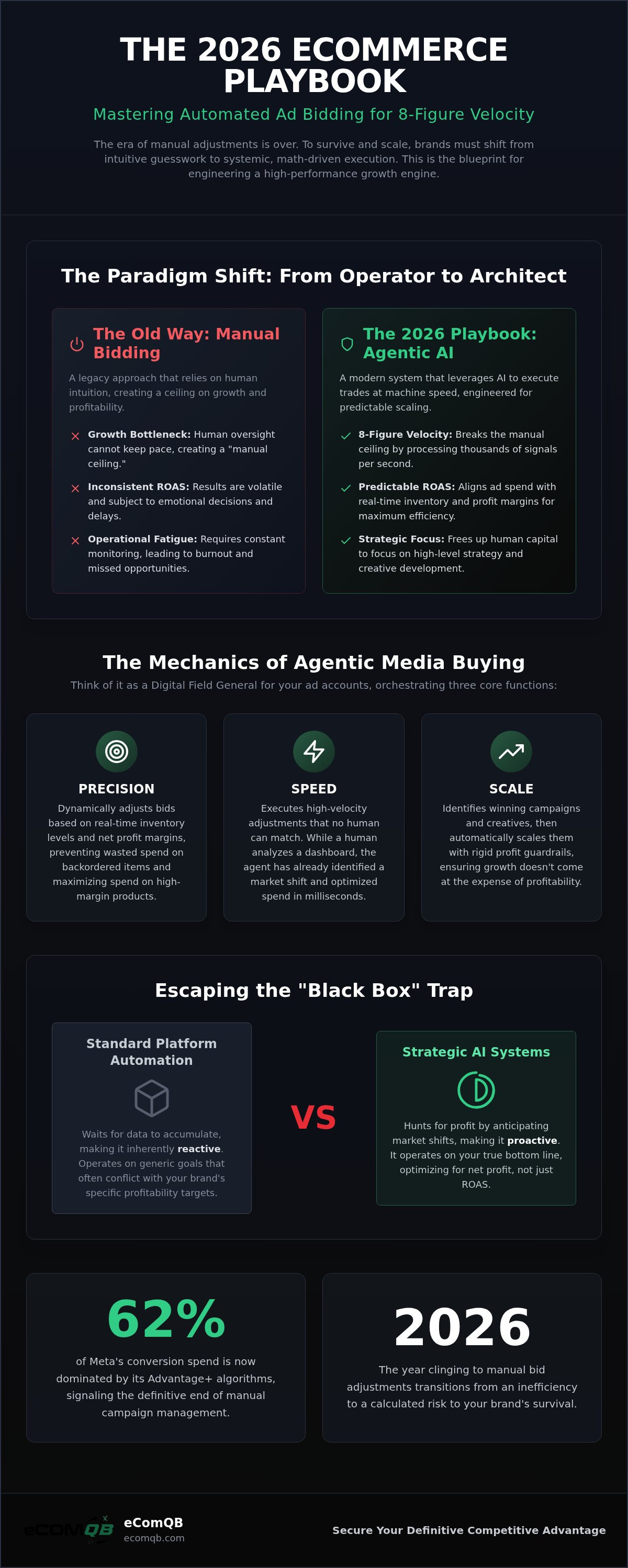
Standard platform automation is passive. It waits for data to accumulate before making a move. Agentic media buying is proactive. It hunts for profit. Think of this system as a Field General for your Meta and Google accounts. It doesn't just follow a rigid script; it evaluates the digital battlefield in real time. While basic tools react to what happened yesterday, agentic workflows anticipate what will happen in the next millisecond. This shift from reactive to predictive execution is the foundation of 8-figure scaling.
Most brands treat automated ad bidding for ecommerce as a simple "set and forget" feature. That is a strategic error. True velocity requires a system that integrates your Shopify inventory levels and net profit margins directly into the bidding engine. If a high-demand SKU is running low on stock, the agent throttles the bid to prevent wasted spend on backordered items. If a product has a massive margin, the agent increases bid aggressiveness to capture every possible conversion. This is Zero-Latency execution. It ensures you never miss a window to scale a winning creative asset because you were waiting for a manual sync.
How AI Agents Orchestrate the Auction
Static rules are brittle. They break the moment the market shifts or a competitor enters the auction. Agentic media buying moves beyond these limitations by using dynamic, goal-oriented agents. These systems analyze the complex interplay between creative performance and bid aggressiveness. They understand that a high-engagement ad allows for more aggressive bidding without sacrificing your target ROAS. By operating outside the constraints of standard platform settings, these agents optimize for your specific bottom line rather than just platform-wide averages. They prioritize outcomes, not just activities.
Data Personalization and Bidding Synergy
Winning in 2026 requires more than just aggregate data. You need surgical precision. By connecting your Shopify customer data directly to the bidding engine, you can use LTV prediction to inform your front-end bids. It's illogical to bid the same amount for a one-time discount seeker as you would for a high-potential repeat customer. AI personalization identifies which users deserve the highest bids based on their predicted future value. It creates a powerful synergy between your marketing spend and your long-term growth. Brands ready to move beyond basic settings should explore a managed AI growth system to bridge this technical gap and secure their market position.
Platform Automation vs. Strategic AI: Choosing Your Growth Engine
Native platform tools like Meta Advantage+ and Google Performance Max are powerful, but they aren't neutral. They're designed to maximize platform liquidity. By 2026, Advantage+ Shopping Campaigns account for 62% of e-commerce conversion spend, yet many brands find themselves trapped in a "Black Box." The platform's objective is to find a conversion within your target, even if that customer has zero lifetime value or relies on heavy discounting. This is where generic automated ad bidding for ecommerce reaches its strategic limit. You need a Brand-First AI stack that sits on top of these algorithms to prioritize your specific profitability goals over platform spend targets.
The "Black Box" problem creates a fundamental conflict of interest. Platform algorithms prioritize their own ecosystem health and data density. A Brand-First approach uses AI to filter these signals through your unique business logic. It isn't about losing control; it's about gaining superior strategic visibility. Instead of guessing why a campaign is fluctuating, a curated AI system provides the data-driven insights needed to make high-level moves. You move from being a passenger in the platform’s journey to being the architect of your own growth trajectory.
The Limitations of Native Platform Bidding
Meta and Google want you to spend. They optimize for volume, not necessarily for your net margin. Effective August 17, 2026, Google Ads implemented Bidding Target Optimization, which strictly enforces tCPA and tROAS for budget-limited campaigns. This update prevents campaigns from significantly over-performing their targets, effectively capping your efficiency if your settings are too conservative. Without strategic guardrails, these automated engines can over-optimize on low-value customers who never return. You must maintain a layer of intelligence that distinguishes between a "cheap" conversion and a "profitable" customer acquisition.
The Managed AI Advantage
DIY platform settings are a recipe for stagnation. A fully managed eCommerce growth system provides the specialized leadership required to dominate a crowded market. It replaces tactical micro-management with systemic optimization. By automating the execution of bids, you reclaim strategic time to focus on creative direction and brand positioning. Expert oversight ensures the AI growth engine stays aligned with your long-term objectives. You gain a partner that understands the technical complexities but remains focused on the ultimate objective: 8-figure velocity. This managed approach ensures your bidding strategy is proactive, precise, and unapologetically focused on results.
Architecting Your Playbook: Implementing Automated Bidding for Maximum ROAS
Execution is where strategy meets the market. Deploying automated ad bidding for ecommerce requires a rigorous, four-phase implementation. Phase 1 is a non-negotiable audit of your data integrity. If your tracking pixels are leaking signals, your AI is flying blind. Phase 2 demands the establishment of profit guardrails. You must define your Max CAC and Min ROAS targets before the algorithm spends a single dollar. This isn't just setup; it's the creation of a high-performance environment where machine learning can thrive without risking your liquidity. You are building a system designed for precision, speed, and scale.
Setting the Strategic Guardrails
Calculate your break-even ROAS with surgical precision. Use the Google Ads Bid Target Adjustment Tool, released in July 2026, to align your targets with historical performance before the strict August 17 enforcement takes effect. Setting bid caps during the initial "Learning Phase" prevents the system from over-bidding on unproven signals. Success also depends on integrating Shopify conversion rate optimization data into your bidding logic. When your system knows which landing pages convert at a higher clip, it can allocate capital to the highest-probability winners. This creates a rhythmic drive toward profitability that manual adjustments simply cannot replicate.
Creative as the Ultimate Bidding Lever
High-velocity bidding engines require a constant stream of fresh, high-impact visuals to feed the algorithm. For brands needing professional social media content and live-action video production to meet these demands, Kynda Creative provides the creative horsepower necessary to maintain performance at scale.
Phase 3 moves the focus to the creative asset. In 2026, the algorithm rewards creative that users actually want to see. Meta’s March 2026 update reinforced this by prioritizing conversion signals over detailed targeting, requiring 15 to 50 assets to optimize effectively. Automate your asset rotation to kill fatigue before it kills your ROAS. Use AI to identify winning signals early, allowing you to scale budgets into high-engagement creative before the market saturates. Finally, Phase 4 utilizes agentic reporting to diagnose performance shifts in real-time. This ensures your playbook remains agile, responsive, and dominant. It provides a tactical briefing on creative decay, auction density, and competitor movement. You aren't just running ads; you're orchestrating a market takeover. If you're ready to stop guessing and start scaling, book your strategic briefing now and secure your 8-figure playbook.
The eComQB Advantage: Deploying Managed AI Growth Systems
eComQB functions as the tactical partner for brands ready to engineer 8-figure velocity. We don't just manage accounts; we transform them. Our philosophy is built on the deployment of Revenue Generating AI Tools that turn raw data into a lethal competitive weapon. By leveraging a managed AI growth system, you access the cutting-edge mechanics of automated ad bidding for ecommerce without the crushing operational overhead of manual oversight. This is the transition from legacy media buying to a high-stakes growth trajectory. We provide the specialized leadership, the technical stack, and the strategic mastery required to win. We strip away the corporate fluff to focus on what matters: peak performance and results.
Agentic Media Buying in Action
Precision is our baseline. We execute Meta and Google advertising with the surgical focus of a field general. Our agentic workflows don't just follow platform rules; they rewrite them to favor your bottom line. There is a powerful synergy between our agentic media buying and AI-enhanced SEO. This combination ensures that your brand captures high-intent traffic across every digital touchpoint. We engineer a seamless customer journey that moves prospects from an initial ad click through to a frictionless Shopify checkout. We identify, target, and convert with a speed that leaves traditional agencies in the dust. Our systems are built to analyze, optimize, and dominate the auction in real-time.
Your Next Move: Securing Competitive Advantage
For businesses looking to strengthen their organic search presence alongside paid media, you can discover Digitalix and their data-driven SEO strategies tailored for the Singapore market.
In the 2026 economy, speed is the ultimate currency. If you aren't bidding at machine velocity, you are essentially subsidizing your competitors' growth. Choosing eComQB means choosing a growth technology partner over a standard agency. We don't just report on what happened; we orchestrate what happens next. Our managed service model removes the technical complexity, allowing you to focus on high-level brand strategy. We act as the authoritative expert in your corner. We understand the technical complexities of the 2026 auction environment so you don't have to. This is your opportunity to reclaim your time, protect your margins, and scale your winners with total confidence. The market is moving. The algorithms are evolving. Your move must be decisive. Engineer Your Revenue Velocity with eComQB and secure your position at the top of the leaderboard.
Secure Your 8-Figure Momentum
The manual era is finished. To thrive in the 2026 landscape, you must move beyond basic platform toggles and embrace a systemic approach to growth. Mastering automated ad bidding for ecommerce is no longer a luxury; it's the baseline for protecting your margins while scaling winners at a velocity human operators can't match. You now possess the strategic blueprint to transition from a reactive buyer to a definitive architect of your brand's revenue.
Victory requires a relentless focus on data integrity, creative volume, and rigid profit guardrails. By integrating your Shopify logic directly into your bidding engine, you ensure every dollar spent is a tactical move toward market dominance. eComQB provides the specialized leadership and Managed AI Growth Systems for 8-Figure Brands required to win. Our Agentic Media Buying Precision and Shopify Strategic Mastery remove the operational friction, letting you focus on high-level vision. It's time to stop fighting the algorithm and start orchestrating it. Engineer Your Revenue Velocity with eComQB. Your peak performance starts now.
Strategic Insights: Automated Bidding FAQ
Is automated ad bidding better than manual bidding for Shopify stores?
Yes, automation is the only way to scale without hitting a manual ceiling. Manual bidding creates a growth bottleneck that limits your brand's potential. Automated ad bidding for ecommerce processes millisecond-level signals from your Shopify store, allowing for rapid adjustments that humans can't match. It eliminates the latency that drains profit during high-traffic periods. You stop reacting to yesterday's data and start dominating the current auction in real time.
How much data do I need before I can use automated bidding effectively?
Precision requires a solid baseline of conversion signals to inform the algorithm. Most platforms recommend 30 to 50 conversions per month per campaign to achieve stability. However, high-growth brands often accelerate this process by feeding the system rich data directly from Shopify's API. Without sufficient volume, the machine lacks the statistical significance needed to win. More data leads to faster optimization, sharper precision, and a more definitive competitive advantage in the auction.
What is agentic media buying and how does it differ from Smart Bidding?
Agentic media buying is a proactive, goal-oriented system that outpaces standard platform settings. While Smart Bidding is reactive and confined to platform-specific data, agentic workflows act as a tactical field general. These agents integrate external signals, including your actual profit margins and inventory levels, to make autonomous decisions. They don't just seek any conversion; they hunt for the most profitable opportunities. This approach ensures your growth engine is aligned with your brand's specific success metrics.
Can automated bidding help reduce my Customer Acquisition Cost (CAC)?
Automated bidding reduces CAC by surgically removing waste from your ad spend. The system analyzes thousands of signals to identify and ignore low-probability users. It focuses your budget on high-intent audiences and rewards your most engaging creative assets. This precision ensures your capital is only deployed in auctions where the probability of a profitable conversion is high. Over time, this efficiency drives down acquisition costs and stabilizes your ROAS at scale.
What happens to my ROAS during the "Learning Phase" of automated bidding?
Expect temporary volatility during the initial learning window. The algorithm is testing various audiences and creative combinations to find the most efficient path to conversion. ROAS may dip as the system gathers necessary data. Use profit guardrails and bid caps to prevent excessive spend during this phase. Once the system stabilizes, the resulting predictability and scale far outweigh the short-term fluctuations. You are investing in long-term velocity and systemic mastery.
How do I maintain control over my budget with an automated bidding system?
You maintain control through strategic guardrails and Max CAC targets. Automation is not a blank check. You define the financial parameters and profit margins that the system must respect. These boundaries ensure the algorithm operates within your specific profitability window. You remain the architect of the overall growth strategy while the machine handles the tactical execution. This approach provides more strategic visibility and control than manual micro-management ever could.
Does automated bidding work for both Meta and Google Ads simultaneously?
Cross-platform synergy is essential for high-velocity brands. While Meta and Google have separate engines, a unified system orchestrates spend across both channels to prevent overlap. Integrated automated ad bidding for ecommerce allows you to shift capital dynamically based on real-time performance. This ensures your brand captures high-intent traffic wherever it lives. You create a seamless customer journey while maximizing the yield on every dollar spent across the entire digital landscape.
Why should a high-growth brand use a managed AI growth system instead of native tools?
Native tools are designed to maximize platform spend, not your net profit. A managed AI growth system provides the specialized leadership and advanced technology needed to win without the operational overhead. It moves your brand beyond the platform's "Black Box" and into a realm of surgical precision. You gain a tactical partner focused on 8-figure velocity. This managed approach ensures your bidding strategy remains proactive, precise, and unapologetically focused on your bottom line.