AI-Powered Shopify Analytics: Engineering 8-Figure Precision in 2026

Your current dashboard is a rearview mirror in a race moving at Mach 1. While you're squinting at yesterday’s Meta ROAS, your competitors are already using AI-powered Shopify analytics to dictate tomorrow’s demand. Most brands are currently drowning in fragmented data, paralyzed by reporting latency, and bleeding cash on inventory that won't move. You've felt the sting of wasted ad spend and the uncertainty of inaccurate LTV projections. It's the difference between guessing and commanding. It's time to stop reacting and start orchestrating.
We agree that a unified source of truth is the only way to win in the 2026 digital economy. This article provides the strategic blueprint to move beyond passive reporting. You'll learn to engineer a predictive system that optimizes margins, anticipates churn, and triggers agentic workflows automatically. We are moving from static charts to a high-performance engine designed for 8-figure precision and relentless revenue growth. We'll break down the tech stack required to turn your data into a decisive competitive advantage and a engine for high-velocity results.
Key Takeaways
- Identify your "Whales" early. Learn how predictive modeling identifies high-value customers before they spend, allowing for aggressive and precise acquisition.
- Eliminate the "Latency Tax." Deploy AI-powered Shopify analytics to unify data from Meta and Google into a single, real-time source of truth.
- Architecture wins over apps. Understand why a managed AI stack provides the clarity and scalability that a bloated collection of standard plugins cannot.
- Build for velocity. Follow a two-step implementation guide to clean your data pipeline and establish a robust Customer Data Platform.
- Trigger agentic growth. Move beyond static charts to automated insights that activate marketing and inventory workflows without manual intervention.
The Death of the Dashboard: Why Standard Shopify Analytics Fail at Scale
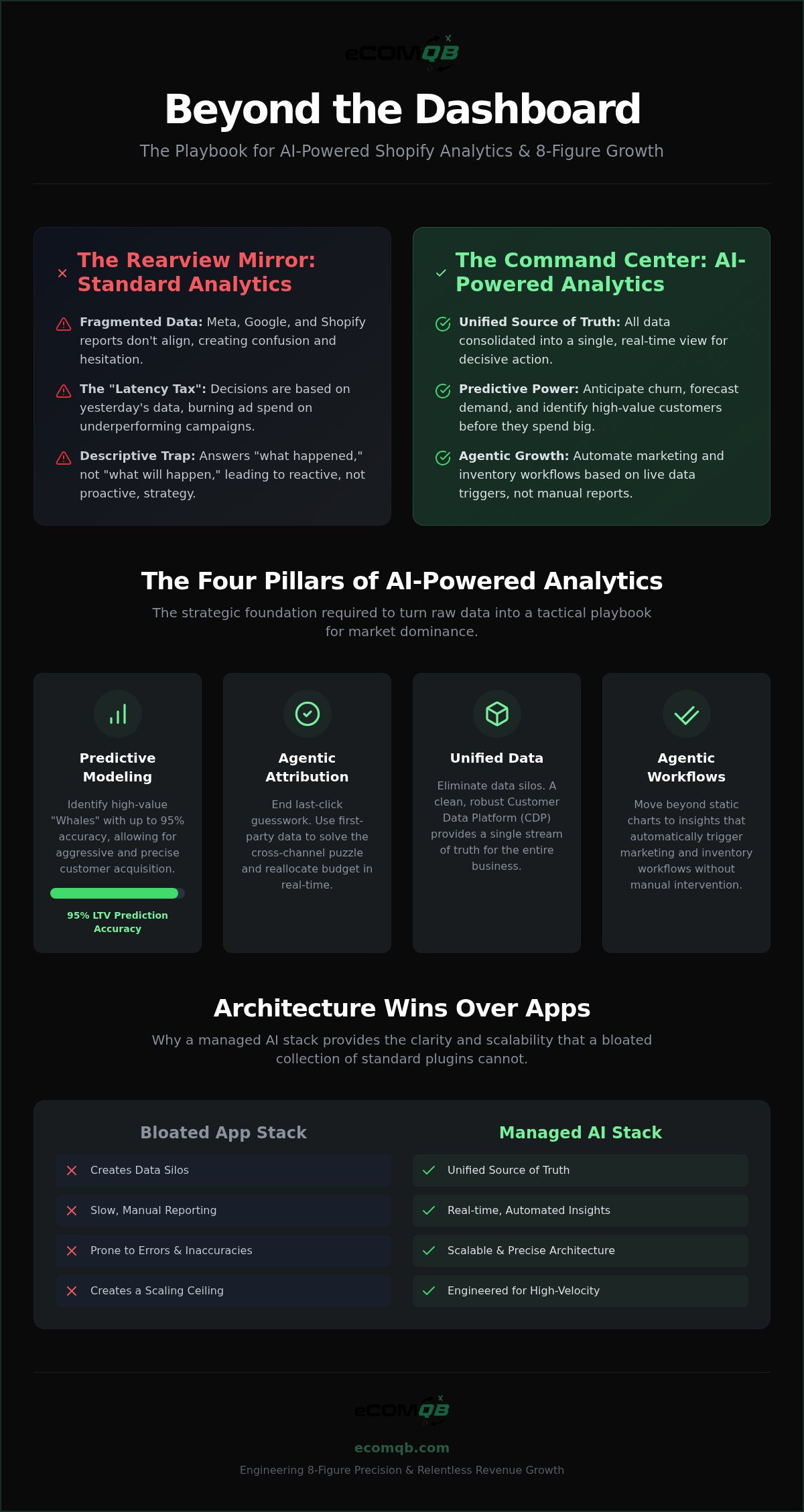
Most merchants are currently caught in a war of fragmented truths. Meta reports a 4x ROAS, Google claims credit for the same sale, and Shopify shows a different revenue total entirely. This friction creates hesitation. Hesitation kills scale. High-performance brands don't just observe data; they orchestrate it. They replace passive observation with AI-powered Shopify analytics designed to find the signals in the noise. It is about moving from a state of reactive guessing to a state of decisive leadership.
The Descriptive Analytics Trap
Descriptive analytics answer the least valuable question in business: "What happened?" While it's nice to see a green arrow on your daily sales chart, this data is purely reactive. Making 8-figure decisions based on 7-figure descriptive data is a recipe for stagnation. You need to shift toward Predictive analytics to understand what will happen next. This shift allows you to anticipate market shifts rather than merely documenting them after your margins have already taken a hit.
Vanity metrics like total sessions or gross revenue often mask leaking profit margins. You might be scaling top-line revenue while your contribution margin erodes due to rising CAC and shipping inefficiencies. For brands manufacturing in Asia, leveraging a sourcing partner like Buying Office Asia ensures that procurement costs are optimized before products even reach the warehouse. AI-powered Shopify analytics strip away the fluff to reveal the raw mechanics of your growth. It provides the precision required to cut losing campaigns early and double down on winners with absolute certainty. Precision, mastery, and results are the only metrics that matter at scale.
Data Silos and the Scaling Ceiling
Manual data aggregation is the ultimate scaling ceiling. If your team spends hours every Monday morning stitching together spreadsheets from five different platforms, you've already lost the week. This manual process is slow, prone to error, and creates a massive reporting lag that prevents real-time optimization. You cannot win a high-velocity game with low-velocity information.
Data silos prevent you from seeing the full customer journey. When your email data doesn't talk to your paid social data, you miss the blind spots where revenue is leaking. Identifying these gaps is the first step toward aggressive scaling. A unified data environment aligns every touchpoint into a single stream of truth. This alignment allows for the kind of confident, rapid-fire decision-making that leaves competitors chasing shadows.
The Four Pillars of AI-Powered Shopify Analytics in 2026
To win in 2026, you need a system that acts, not just tracks. High-velocity growth requires a foundation built on four strategic pillars that turn raw data into a tactical playbook for market dominance. These pillars provide the clarity, confidence, and control necessary to outpace the competition. By deploying AI-powered Shopify analytics, you move from passive reporting to active revenue engineering.
Predictive Modeling vs. Simple Forecasting
Standard forecasting looks at the path behind you. Predictive modeling looks at the terrain ahead. Modern systems now achieve up to 95% accuracy in identifying high-value "Whales" within days of their first interaction. This allows you to dictate aggressive CAC thresholds that would terrify your competitors because you already know the back-end yield. Predictive LTV is a strategic lever for media buying that allows brands to front-load acquisition spend on customers with the highest long-term yield. You are no longer just buying traffic; you are investing in guaranteed future revenue.
Agentic Attribution: The End of Guesswork
The cookie-cutter era is over. Last-click attribution is a relic that belongs in the previous decade. Agentic systems use first-party data to solve the cross-channel puzzle in real time. Unlike static Marketing Mix Modeling, these systems reallocate budget in flight based on live data signals. If a specific Meta creative is driving high-intent traffic that eventually converts on Google Search, the system identifies the synergy and scales it immediately. As highlighted in a Harvard Business Review Analytic Services report, the integration of AI is no longer a luxury for brands seeking to maintain a competitive edge in complex digital environments. It is the only way to maintain a unified source of truth in a post-cookie world.
Intelligence doesn't stop at the storefront. Inventory intelligence uses AI to optimize your supply chain, ensuring you never stock out of winners or over-invest in stagnant SKUs. Prescriptive profitability then layers on real-time margin protection. It monitors every SKU, accounting for shipping fluctuations and ad spend to ensure every sale is a profitable one. This is how you protect your bottom line while chasing 8-figure velocity. Analyze, predict, and execute with total certainty. If your current stack feels like a collection of disconnected tools rather than a unified engine, it might be time to audit your growth system and eliminate the blind spots holding you back.
Managed AI Stacks vs. Standard Apps: The Architecture of Mastery
Installing another app is not a strategy. It is an invitation for "App Bloat" and data fragmentation. Most merchants currently suffer from the paradox of choice. They have fifty tools but zero clarity. Each plugin adds a "script tax" that slows your site and a "data tax" that obscures your vision. True 8-figure velocity requires architecture over features. It demands a unified data warehouse where AI-powered Shopify analytics can synthesize every touchpoint into a single, lethal stream of intelligence.
Elite brands are abandoning the DIY software configuration. They realize that a fragmented tech stack is a leaking bucket. Managed AI stacks provide a systemic advantage by centralizing your intelligence. This isn't just about reporting. It's about building an "Agentic" performance stack where the data itself drives the next move. You shift from managing a collection of tools to commanding a unified growth engine. Precision, clarity, and speed become your default settings.
The Managed Growth Advantage
You are an ambitious leader, not a data scientist. Spending your time debugging API connections or reconciling CSV files is a waste of your strategic capacity. Managed AI transformation eliminates this operational overhead. It allows you to focus on brand vision while the technical precision is handled by specialists. eComQB integrates deep brand strategy with high-performance technology. We ensure your data pipeline is clean, fast, and profitable. This is how you reclaim your time and sharpen your competitive edge.
Agentic Workflows: Turning Data into Action
The final frontier of AI-powered Shopify analytics is the agentic workflow. In this model, data doesn't just sit in a dashboard waiting for a human to notice it. Instead, specific data signals trigger automated responses across your ecosystem. For example, a drop in predicted LTV for a specific cohort can immediately activate agentic email marketing sequences to win them back. You move from the exhausting task of reading reports to the high-level role of approving AI-generated moves. It is the shift from observation to orchestration. You set the objectives; the system executes the tactical plays.
Implementing an AI-Driven Analytics Playbook
Execution is the only differentiator in a high-velocity market. To deploy AI-powered Shopify analytics, you need a methodical playbook that prioritizes precision over activity. Most brands fail because they attempt to build sophisticated models on top of a broken foundation. You must audit, clean, and unify before you can scale. This is about building a system that thinks, learns, and wins.
- Step 1: Audit the 'Script Tax'. Every redundant tracking script slows your site and muddies your data. Identify the bloat and clean the pipeline.
- Step 2: Establish a Unified CDP. Centralize your customer data. This becomes the single source of truth for every subsequent AI move.
- Step 3: Deploy Predictive Models. Implement specific algorithms to forecast LTV and churn. Know which customers are your future whales.
- Step 4: Connect to Execution. Integrate your intelligence with agentic media buying systems. Data must dictate the spend in real time.
- Step 5: Systemic Feedback Loops. Ensure the system gets sharper with every transaction. Continuous optimization is the only path to 8-figure mastery.
Data Hygiene and Pipeline Integrity
Garbage in equals garbage out. If your naming conventions across Meta, Google, and TikTok are a mess, your AI modeling will provide flawed insights. Standardize your UTMs. Enforce strict tagging protocols. Zero-latency data syncing is non-negotiable for real-time optimization. You cannot make split-second decisions on hour-old data. A truly integrated AI-powered Shopify analytics system requires a pristine data stream to function at peak performance.
The Feedback Loop: Analytics as a Strategic Coach
Your analytics should function as a 24/7 strategic coach. Use AI diagnostics to pinpoint exactly why revenue is dipping before the trend becomes a crisis. Set 'Guardrail KPIs' that trigger automated alerts the moment a campaign deviates from your target thresholds. Real-time margin tracking is an absolute necessity for 8-figure DTC brands to prevent silent profit erosion. This level of oversight allows you to stay aggressive while remaining profitable. You are no longer just running a store; you are commanding a high-performance growth engine. Ready to deploy a system that thinks for itself? Book a strategy session to engineer your 8-figure analytics playbook today.
Engineering 8-Figure Velocity: The eComQB Managed Analytics System
Software is a tool. Strategy is the win. At eComQB, we don't treat analytics as a back-office chore or a passive reporting function. We treat it as a weapon. For high-velocity brands, AI-powered Shopify analytics must serve as the primary intelligence layer that dictates every move on the digital battlefield. Our managed system is engineered to strip away the noise and deliver the precise signals required to maintain 8-figure momentum. Analyze. Optimize. Dominate.
We integrate this precision data directly into our AI transformation eCommerce brands framework. This ensures that your technical infrastructure isn't just "functional" but strategically aligned with your growth objectives. Data without direction is just overhead. We provide the direction, the technology, and the tactical oversight to turn your data pipeline into a high-performance revenue engine. This is how you future-proof your brand for the era of autonomous commerce.
From Technical Complexity to Strategic Clarity
The technical burden of AI implementation often paralyzes ambitious leaders. eComQB removes this friction entirely. We take the "Field General" approach, providing tactical oversight of your entire growth system so you don't have to. We customize the AI stack to your specific brand strategy, ensuring your technology supports your goals rather than dictating them. Our systems maintain sub-second data latency. This speed is critical for peak performance marketing where a delay of even a few minutes can result in thousands of dollars in missed opportunities or wasted spend.
Your Tactical Partner in Growth
There is a massive divide between a software vendor and a growth partner. A vendor sells you a login; a partner delivers a result. eComQB functions as your tactical partner, deeply embedded in the mechanics of your growth. We provide continuous monitoring and systemic optimization to ensure your store never lags behind the market. We don't just hand you a dashboard and wish you luck. We orchestrate the moves, monitor the guardrails, and refine the playbook in real time. Precision, mastery, and results are our only benchmarks. If you're ready to move beyond the limitations of generic tools, it's time to scale your brand with the eComQB AI Growth System and claim your competitive advantage.
Own the Future of Autonomous Commerce
The digital landscape of 2026 demands more than just data collection; it requires strategic orchestration. You've seen why standard dashboards fail and how the four pillars of AI-powered Shopify analytics-predictive LTV, agentic attribution, inventory intelligence, and prescriptive profitability-create an unshakeable foundation for growth. Shifting from a fragmented app stack to a managed architecture isn't just a technical upgrade. It's a decisive move to eliminate the latency tax and reclaim your strategic edge. You are moving from a state of observation to a state of absolute command.
We are specialists in 8-figure Shopify velocity. eComQB provides fully managed AI growth systems designed for ambitious leaders who demand DTC strategic mastery. Don't let your data remain a passive record of the past. Transform it into a high-performance engine that dictates your next winning move. Precision is the only path to dominance in a high-velocity economy. You have the blueprint. Now you need the engine.
Book Your Strategic AI Audit with eComQB to engineer your path to mastery. The era of reactive commerce is over. It is time to lead with absolute certainty and relentless momentum. Your next level of growth is waiting.
Frequently Asked Questions
How does AI-powered Shopify analytics differ from the standard Shopify dashboard?
Standard Shopify reports are historical records that document past performance. In contrast, AI-powered Shopify analytics function as a predictive engine that forecasts future trends and prescribes specific actions. While basic dashboards provide surface-level data like total sales, an AI-driven system identifies hidden correlations between customer behavior and long-term profitability. It moves your brand from reactive reporting to proactive orchestration by automating the insights that drive 8-figure velocity.
Can AI analytics help reduce my Customer Acquisition Cost (CAC)?
AI analytics reduce CAC by identifying high-value customer cohorts before they fully convert. By analyzing early behavioral signals, the system allows you to bid more aggressively for high-value "Whales" while cutting spend on low-yield traffic. This precision ensures your media buying budget is allocated only to the most profitable opportunities. You stop wasting capital on broad targeting and start engineering an acquisition strategy that prioritizes margin over raw volume.
What is the ROI of implementing a managed AI growth system?
The ROI of a managed AI growth system is found in the elimination of the "Latency Tax" and the protection of profit margins. By centralizing data and automating workflows, brands see a direct reduction in operational overhead and wasted ad spend. Most 8-figure merchants realize significant gains through improved inventory turnover and higher customer retention rates. It is an investment in systemic precision that transforms analytics from a cost center into a primary revenue driver.
Do I need a data scientist to use AI-powered analytics?
You don't need an in-house data scientist when you deploy a fully managed AI technology stack. Our team functions as your tactical partner; we handle the technical complexities of data modeling and pipeline integrity. This allows your leadership team to focus on brand vision and high-level strategy rather than debugging API connections. We bridge the gap between sophisticated data science and actionable business moves, providing the clarity you need to scale without the technical burden.
How does predictive LTV modeling impact my Meta and Google ad strategy?
Predictive LTV modeling allows you to set dynamic CAC thresholds based on the expected yield of specific audiences. Instead of a flat target, you can justify higher bids for segments that AI-powered Shopify analytics identify as high-retention cohorts. This intelligence flows directly into your Meta and Google strategies, informing creative testing and budget allocation. You gain the confidence to outbid competitors for the customers who will drive the most value over the next twelve months.
What is the most common data gap in 8-figure Shopify stores?
The most common gap is the lack of a unified source of truth across fragmented platforms. Many 8-figure stores suffer from "attribution blindness," where Meta, Google, and Shopify reports often contradict each other. This misalignment leads to hesitant decision-making and inefficient scaling. Establishing a unified Customer Data Platform (CDP) is the critical first step in closing this gap. It ensures every dollar of spend is accurately tracked and every customer interaction is part of a single narrative.
How long does it take to see results from an AI transformation?
Initial gains from data hygiene and pipeline cleaning are often visible within the first thirty days. This phase eliminates immediate waste and provides a clearer view of current performance. Sophisticated predictive models typically require sixty to ninety days of clean data to reach peak accuracy. During this window, the system learns your specific brand patterns, allowing for the deployment of agentic workflows that trigger automated growth moves. Speed and precision are the priorities from day one.
Is my data secure when using third-party AI analytics stacks?
Security is a non-negotiable pillar of our managed AI stacks. We utilize enterprise-grade encryption and strictly adhere to global data regulations, including the EU AI Act of 2026. Your first-party data remains your most valuable asset; our systems are designed to protect that integrity while extracting maximum strategic value. We ensure your analytics environment is both lethal in its precision and robust in its defense, providing total peace of mind as you scale your brand.