AI for eCommerce Customer Segmentation: Engineering High-Velocity Growth in 2026

Your current customer segments are likely dead before the data even syncs. In the high-velocity market of 2026, static buckets are a liability that drains your ROAS and fuels churn. Most brands are still fighting with fragmented data across Shopify, Meta, and Klaviyo, losing sight of high-value customers in the noise. It's time to stop guessing and start dominating. Implementing AI for eCommerce customer segmentation is no longer a luxury; it's the fundamental requirement for brands that intend to win.
You understand that broad targeting is a race to the bottom. You've seen the diminishing returns of traditional lists and the exhaustion of manual campaign management. We're here to hand you the playbook for a total strategic overhaul. You'll master the transition from rigid categories to autonomous, agentic segmentation that identifies, engages, and converts every prospect with surgical precision.
This article breaks down the mechanics of high-performance growth. We'll cover the deployment of real-time grouping, the power of predictive purchase behavior, and the systems required for hyper-personalized marketing that scales effortlessly. It's time to analyze, adapt, and accelerate your path to eight-figure velocity.
Key Takeaways
- Replace static demographic buckets with dynamic behavior tracking to stop revenue leaks. Master the transition to real-time data syncs that capture every dollar of potential growth.
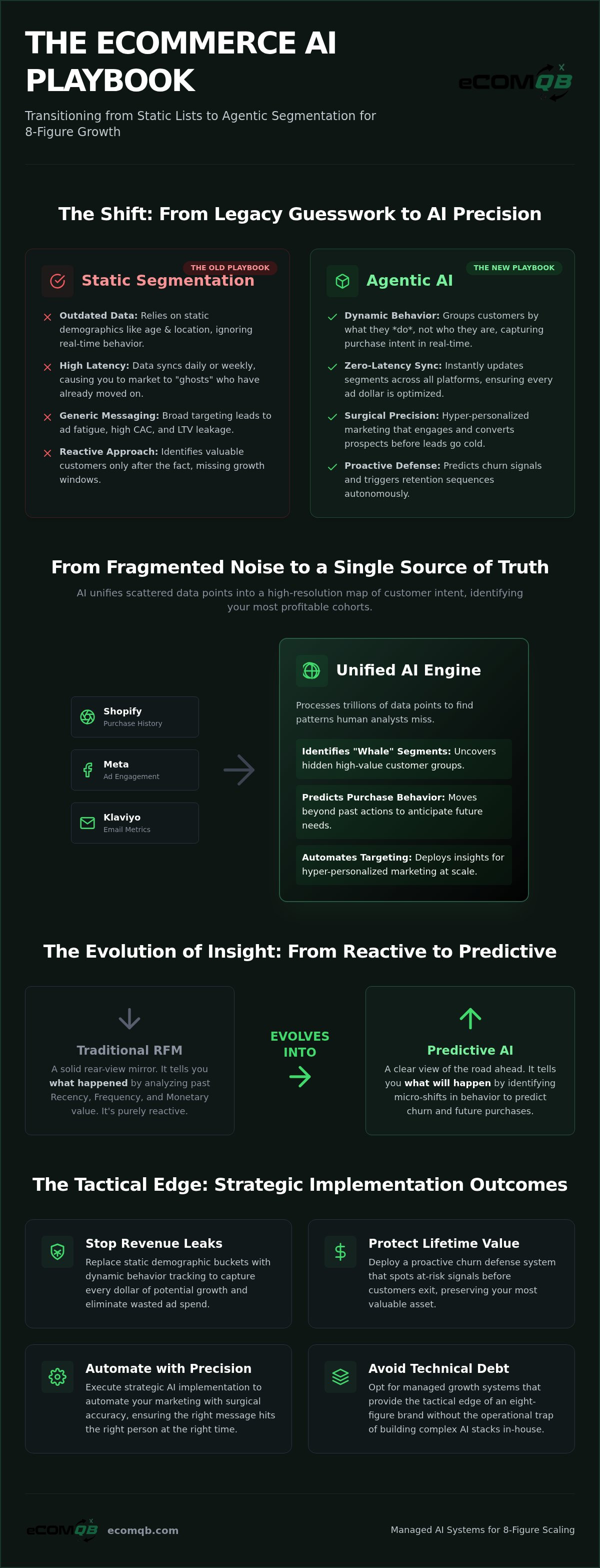
- Unify fragmented data from Shopify, Meta, and Klaviyo into a single source of truth. Use advanced clustering algorithms to identify and prioritize your most profitable "Whale" segments.
- Deploy a proactive churn defense system that spots at-risk signals before customers exit. Leverage predictive insights to protect your lifetime value and maintain high-velocity momentum.
- Execute a strategic implementation of AI for eCommerce customer segmentation to automate your marketing. Audit, clean, and unify your data streams to ensure surgical precision at scale.
- Avoid the operational trap of building complex AI stacks in-house. Opt for managed growth systems that provide the tactical edge of an eight-figure brand without the technical debt.
Beyond Static Buckets: Why Legacy Segmentation is Leaking Revenue
Legacy segmentation is a relic. Relying on age, gender, or location to predict purchase intent is a strategy for a slower era. In 2026, identity is noise; behavior is the only signal that matters. When you group customers by who they are rather than what they do, you miss the intent-driven windows that drive 8-figure growth. Static buckets create a false sense of security while your revenue leaks through the cracks of outdated data.
Latency is the hidden revenue killer in manual segmentation. If your data syncs once a week, or even once a day, you're reacting to ghosts. High-velocity eCommerce requires real-time adjustments. A "browser" becomes a "buyer" in seconds. If your system can't distinguish between the two instantly, you waste impressions on people who have already moved on. This "noise problem" stems from legacy tools that fail to interpret the nuance of a digital footprint. AI for eCommerce customer segmentation solves this by moving beyond grouping by identity to grouping by live, autonomous behavior.
The High Cost of Generic Targeting
Broad targeting is a direct path to ad fatigue and unsustainable CAC. Treating your top 1% of spenders the same as a first-time discount seeker is a strategic failure. This LTV leakage happens when high-value customers feel ignored by generic messaging. The most critical revenue is often captured or lost in the first 48 hours of a customer journey. If your segmentation isn't agentic, you're too slow to capitalize on that momentum. You need systems that identify, tag, and target with surgical precision before the lead goes cold.
Why Traditional RFM is No Longer Enough
Recency, Frequency, and Monetary (RFM) analysis has been the gold standard for decades. It's a solid rear-view mirror, but it can't see the road ahead. Traditional RFM is reactive. It tells you what happened, not what will happen. While it categorizes past performance, it lacks the predictive power required to anticipate future needs. Machine learning evolves this into "Predictive RFM." Instead of waiting for a customer to stop buying to label them as at-risk, AI identifies micro-shifts in behavior that signal churn before it happens. This allows you to pivot from defensive recovery to offensive retention, keeping your growth trajectory on track.
The Mechanics of Agentic Segmentation: Turning Data into Decisive Action
Data is the fuel of the modern enterprise. But raw data is useless without a refinery. AI for eCommerce customer segmentation functions as that refinery, processing Shopify logs, Meta pixels, and Klaviyo engagement metrics into a high-resolution map of customer intent. It's not just about storage. It's about synthesis. Your system must ingest trillions of data points to find the patterns that define your most profitable cohorts.
We use clustering algorithms to move beyond the obvious. These mathematical models identify "Whale" segments; those high-value customers who drive the majority of your profit but often look like average buyers in legacy tools. By analyzing multidimensional variables, AI uncovers hidden commonalities that human analysts would miss. This is how you find the outliers. This is how you protect your margin. Analyze, synthesize, and execute. That's the cadence of a winning brand.
Zero-latency synchronization is the new standard. If your ad platforms and email lists aren't in perfect sync with your segmentation engine, you're bidding on the past. Real-time updates ensure that every dollar spent is optimized for the customer's current state, not their state from six hours ago. To see how these systems integrate with your current stack, you can schedule a strategic briefing with our team.
From Machine Learning to Agentic Execution
Agentic AI is the evolution of automation. It doesn't just categorize; it acts. While traditional machine learning might flag a segment, an agentic system monitors segment drift in real-time. When a loyalist shows micro-signals of becoming a churn risk, the agent triggers a save-sequence immediately. This creates a seamless, autonomous hand-off to agentic media buying, where your ad spend follows the highest probability of conversion without human intervention. It is fast, precise, and relentless.
Predictive Modeling: Forecasting the Next Move
Prediction is the ultimate competitive advantage. AI analyzes historical patterns and live customer sentiment through Natural Language Processing (NLP) to forecast the "Next Best Action" for every individual. Propensity modeling identifies a purchase before the customer even clicks the "add to cart" button. Verified data shows that AI-driven product recommendations can increase revenue by up to 300%. You're no longer reacting to what happened; you're engineering what happens next. This is the playbook for 2026.
Strategic Frameworks: Predicting LTV and Churn with Precision
Strategy is where the game is won. While the mechanics of data ingestion are critical, the frameworks you apply to that data determine your profit margins. AI for eCommerce customer segmentation allows you to move beyond simple observation into the realm of active revenue engineering. You aren't just watching your customers; you're orchestrating their next move. This requires a shift from broad snapshots to high-resolution, predictive models that focus on the levers that actually move the needle: LTV and retention.
Don't ignore the "Goldilocks" segment. This middle tier represents your highest growth potential. These are customers who like your brand but haven't been incentivized to become advocates. AI uses collaborative filtering to map product relationships, identifying exactly which cross-sell offer will bridge the gap between a casual buyer and a loyalist. You're not guessing. You're using math to drive momentum.
The LTV Velocity Framework
Maximizing revenue requires a systematic approach to increasing eCommerce LTV. We utilize a triadic structure to maintain momentum: Identify, Nurture, Retain. First, AI identifies the specific behavioral markers of high-value potential. Second, the system nurtures that potential through personalized discount strategies that protect your margin. Finally, it retains that value through autonomous engagement. This framework ensures that your marketing spend is always allocated to the highest-probability outcomes.
Dynamic vs. Static Comparison
To scale to 8-figures, you must understand the speed of your data. The following table breaks down the evolution of segmentation models based on their "Time to Action."
| Model Type | Methodology | Time to Action |
|---|---|---|
| Static | Manual, Rule-based | Days to Weeks |
| Dynamic | Automated, Behavior-based | Hours |
| Agentic | Autonomous, Workflow-triggered | Milliseconds |
The verdict is clear. Static models are a liability. Dynamic models are the baseline. Agentic models are the only way to dominate in 2026. Companies using AI-driven personalization earn 40% more revenue than those stuck in legacy systems. If you're not moving at the speed of the agent, you're falling behind the competition.
Implementation Playbook: Deploying AI Segmentation for Shopify Brands
Strategy without execution is just a hallucination. The implementation of AI for eCommerce customer segmentation requires a tactical strike, not a slow crawl. You must move with precision to bridge the gap between your raw data and your revenue engine. This isn't about minor tweaks; it's about a fundamental re-engineering of your growth stack. To dominate in 2026, you need a playbook that prioritizes speed, accuracy, and autonomous action.
If you're ready to stop the data leakage and start engineering growth, you can request a technical audit of your current Shopify stack today.
The Shopify Data Edge
Shopify brands have a unique advantage in the post-cookie landscape. By leveraging first-party data directly from the source, you build a moat that competitors can't touch. This data is the foundation for AI personalization experiences that feel intuitive rather than intrusive. To achieve real-time synchronization, your system must utilize the Shopify Admin API and event-driven Webhooks to extract behavioral signals the moment they occur. This ensures your segments are never more than a few milliseconds behind reality.
Connecting Segmentation to Media Buying
Segmentation is only as powerful as the channels it fuels. By feeding your AI-identified "Whale" segments directly into Meta Advantage+ and Google PMax, you provide the platforms with the highest quality training data available. This allows you to create "Value-Based Lookalikes" that target prospects with the highest probability of becoming high-LTV assets. Simultaneously, you must use negative segment targeting to exclude low-intent browsers and chronic returners. This dual-sided approach slashes wasted ad spend and forces your CAC down while pushing your revenue velocity up. It's a tactical win on every front.
The eComQB Advantage: Managed AI Systems for 8-Figure Scaling
Building your own AI infrastructure is a strategic trap. Many ambitious leaders believe that developing a custom stack in-house is the path to total control. In reality, it is a path to technical debt, resource depletion, and missed opportunities. While you're busy recruiting data scientists and debugging API integrations, the market is moving past you. High-velocity growth requires a turnkey solution that delivers results from day one. You don't need to build the engine; you need to win the race.
The eComQB Managed Growth System provides advanced technology without the overhead of a massive internal team. We integrate your brand strategy with our technical execution to ensure peak performance across every channel. Implementing AI for eCommerce customer segmentation shouldn't be an experimental burden on your developers. It should be a precision instrument in your marketing arsenal. We act as your field general, orchestrating the complex mechanics of AI transformation so you can focus on high-level leadership and vision.
Engineering Revenue Velocity
We don't guess. We execute. Our approach to AI transformation for eCommerce brands is rooted in proven playbooks that have already been stress-tested in high-stakes environments. This isn't about tinkering with new tools; it's about deploying a systematic engine designed for 8-figure scaling. Our framework prioritizes three core pillars: Precision, Speed, and Profit. By automating the identification of high-value segments, we ensure your capital is always flowing toward the highest-probability revenue streams.
Your Strategic Tactical Partner
Working with experts provides an aura of high-stakes confidence. You gain access to a fully managed AI technology stack that evolves as quickly as the digital economy. The long-term ROI of this partnership isn't just measured in immediate sales; it's measured in the systemic optimization of your entire business. We remove the friction from AI for eCommerce customer segmentation, allowing your brand to operate with a level of precision that was once reserved for the industry's biggest players. This is the ultimate objective: an 8-figure brand operating on a strategic autopilot, fueled by data and driven by results. It's time to stop building and start scaling.
Dominate the Digital Economy: Your Path to 8-Figure Velocity
The era of guessing is over. You've seen the mechanics of agentic systems and the frameworks required to protect your LTV. Static buckets belong in the past; real-time, autonomous action is the future. By mastering AI for eCommerce customer segmentation, you stop reacting to the market and start engineering it. You move from broad targeting to surgical precision. You transform from a participant into a leader. Analyze, automate, and accelerate.
Scaling to eight figures requires a tactical partner who understands the high-stakes reality of the digital economy. We provide the managed AI transformation, expert Meta and Google advertising execution, and Shopify development excellence needed to maintain your competitive edge. Don't let your data remain a dormant asset. Turn it into a high-velocity revenue engine that operates with relentless efficiency. It's time to play at a higher level.
The next move is yours. Deploy your high-velocity AI growth system with eComQB and secure your position at the top of the leaderboard. Your growth trajectory starts now.
Frequently Asked Questions
What is the difference between AI segmentation and traditional segmentation?
Traditional segmentation relies on rigid, demographic buckets like age, gender, or location. AI for eCommerce customer segmentation shifts the focus to real-time behavioral signals and live intent. It uses clustering algorithms to discover hidden relationships in your data, allowing you to group customers by what they do rather than who they are. This results in dynamic, self-updating cohorts that reflect current market reality.
Does my eCommerce brand need a minimum amount of data for AI segmentation to work?
AI thrives on volume, but data quality is the primary lever for success. Most systems require a learning period of 30 to 60 days to stabilize behavioral models and ensure accuracy. If your brand processes a high volume of daily transactions, the AI will identify profitable patterns and high-value "Whale" segments much faster. Precision requires a clean, unified data stream from the start.
How does AI segmentation directly improve my Meta and Google ad performance?
AI segmentation feeds higher-quality training data into Meta Advantage+ and Google PMax algorithms. By identifying your top 1% of customers, you build value-based lookalike audiences with surgical precision. This reduces wasted ad spend on low-intent browsers. It forces your ROAS higher by focusing your budget on prospects with the highest probability of becoming high-LTV assets.
Can AI customer segmentation help reduce my churn rate?
AI reduces churn by identifying micro-shifts in customer engagement before the exit happens. It spots "At-Risk" signals, such as declining session frequency or changing browsing habits, and triggers autonomous save sequences. This proactive approach allows you to retain high-value revenue that traditional, reactive systems would lose. You shift from defensive recovery to offensive retention.
Is AI customer segmentation compliant with GDPR and privacy laws?
Compliance is a core requirement of modern growth. As of August 2, 2026, Article 50 of the EU AI Act requires transparency when using AI systems for customer interaction. By focusing on first-party data from your own Shopify logs and pixels, you maintain control over your data ecosystem. This ensures you meet regulatory standards in the US and EU while protecting your brand's reputation.
How long does it take to see a ROI from implementing an AI growth system?
You should expect to see measurable efficiency gains within the first 60 days of deployment. The initial phase focuses on data unification and model training to ensure the system is calibrated correctly. Once the models mature, the ROI scales rapidly. Companies using AI-driven personalization earn 40% more revenue than those stuck in legacy, manual systems.
What is an "agentic" workflow in customer segmentation?
An agentic workflow is an autonomous system that acts on data without human intervention. In the context of AI for eCommerce customer segmentation, an agent doesn't just generate a static report. It monitors segment drift in real-time and automatically triggers specific marketing actions. Whether it is shifting ad spend or deploying a personalized SMS, the system executes the move the moment a customer's status changes.
Do I need to hire a data scientist to manage AI segmentation?
You don't need an internal data science team to win this game. Managed growth systems provide the technical infrastructure and strategic execution required for 8-figure scaling. This allows you to function as the field general, focusing on high-level brand strategy while the technical complexities are handled by your tactical partners. You get the power of the tech without the overhead of the team.