Google Shopping Ads Management: Engineering 8-Figure Velocity with Agentic Media Buying

Google Shopping ads drive 76% of retail search ad spend, but the era of manual tweaking is officially over. Most brands are trapped in a cycle of stagnant ROAS and constant product disapprovals, unable to keep pace with the sheer velocity of the modern auction. Effective google shopping ads management in 2026 requires more than just high bids. It demands a total transition from human-led oversight to autonomous, agentic systems. You've likely felt the friction of scaling spend only to watch your margins erode. It's a frustrating, expensive, and unnecessary plateau that separates the market leaders from the also-rans.
We agree that the old playbook is broken. You need predictable revenue growth without the crushing burden of manual management hours. This guide delivers the high-performance playbook for engineering 8-figure velocity through agentic media buying. We'll show you how to dismantle the "black box" of Performance Max, optimize your feed architecture for the 60 billion products indexed by Google, and deploy AI-driven revenue systems that outpace the competition. It's time to stop managing ads and start orchestrating growth.
Key Takeaways
- Eliminate auction latency and capture real-time signals by transitioning from manual bidding to fully autonomous, agentic responses.
- Master the architecture of high-performance product feeds to ensure your data acts as the primary lever for visibility and competitive precision.
- Redefine your google shopping ads management strategy by deploying strategic AI guardrails that prioritize net profit over vanity metrics.
- Scale with surgical precision using the 80/20 rule to identify high-velocity products and drive predictable 8-figure revenue growth.
- Reduce operational friction and management hours by integrating revenue-generating AI tools into your brand’s core growth engine.
The Paradigm Shift: Why Manual Google Shopping Management is Obsolete in 2026
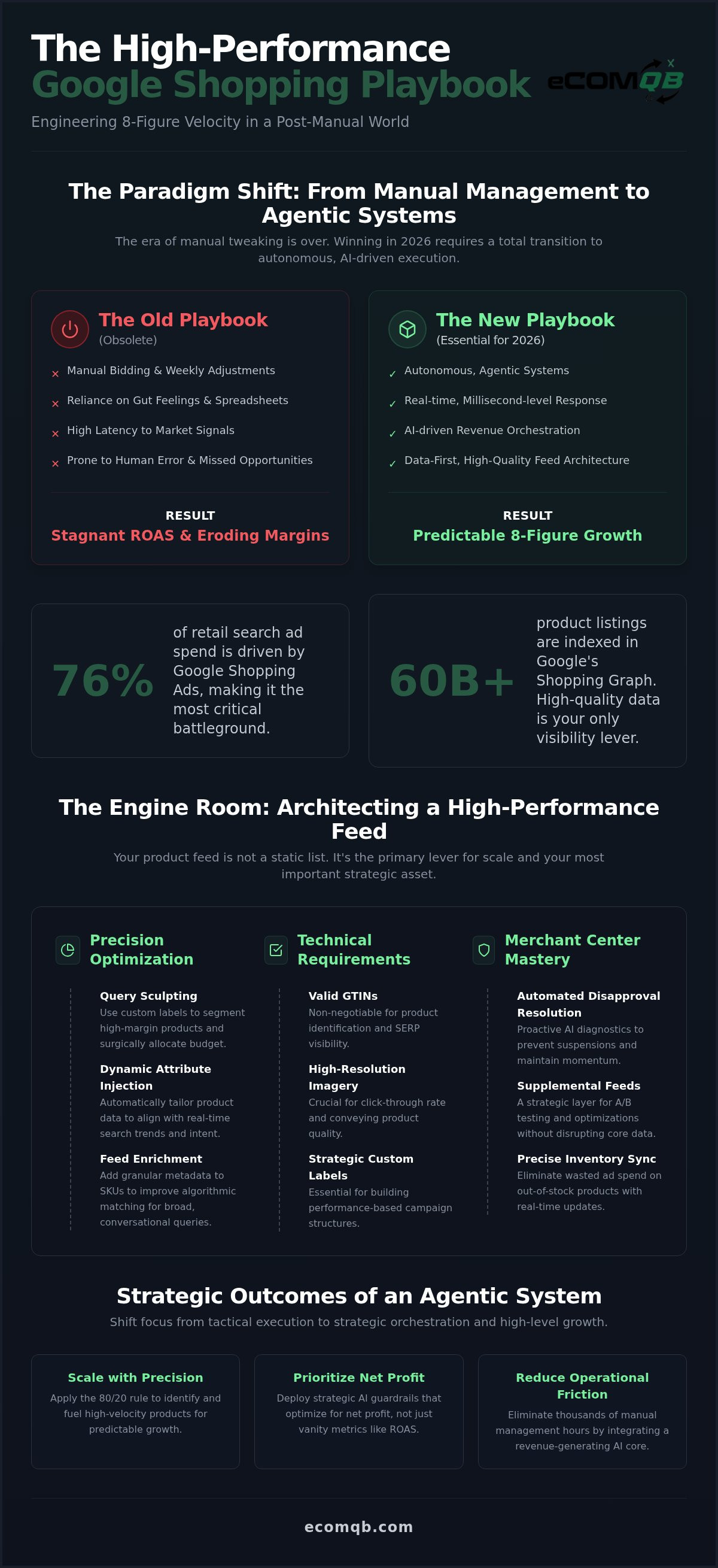
The manual bid is dead. In an auction environment where Google processes millions of signals per millisecond, human intervention has become a liability. Legacy google shopping ads management relied on weekly adjustments, gut feelings, and rigid spreadsheets. Today, that approach is a recipe for stagnation. The digital economy moves at the speed of light; your ad account must do the same. If you're still waiting for a weekly report to adjust your bids, you aren't competing. You're just donating your margin to more agile competitors who have embraced autonomous execution.
Transitioning to a high-performance growth system is no longer optional for brands targeting 8-figure revenue. The cost of legacy management is steep. It manifests as latency, human error, and missed opportunities. When a product begins to trend, an agentic system captures that momentum instantly. A human manager, hindered by sleep and limited bandwidth, might catch it 48 hours later. By then, the peak has passed. You've lost the lead, the sale, and the data. To win in 2026, you must shift from tactical execution to strategic orchestration.
The Evolution of the Google Shopping Algorithm
Google’s AI has evolved into a sophisticated semantic engine. It no longer just matches keywords; it understands intent. With the Shopping Graph now indexing over 60 billion product listings, the algorithm prioritizes relevance and performance history over simple bid amounts. This shift toward a mature AI ecosystem means that broad match and Smart Bidding are the new baseline. Your management strategy must mirror this technological trajectory. Instead of fighting the algorithm with manual overrides, you must feed it high-quality data. Precision, speed, and scale are the only metrics that matter in this new landscape.
The Strategic Need for Speed and Precision
The Architecture of a High-Performance Shopping Feed
Your product feed is the engine room of your entire ad account. In 2026, data is the primary lever for scale. If your feed is just a basic Shopify sync, you're leaving revenue on the table. High-performance google shopping ads management requires a feed that is enriched, optimized, and dynamic. It's your most important asset because it dictates how Google's AI perceives your brand. Without high-quality data, even the most advanced bidding algorithms will fail to find your ideal customers.
Agentic feed optimization moves beyond manual updates. It automates the enrichment of product titles and descriptions to align with real-time intent. Technical requirements for 2026 are non-negotiable. You must provide valid GTINs, high-resolution imagery, and strategic custom labels. Google has indexed over 60 billion product listings; if your data is incomplete, you simply won't show up. Maintaining Merchant Center compliance through proactive AI diagnostics ensures you stay in the game while others are sidelined by account suspensions.
Precision Feed Optimization Tactics
Query sculpting is where you regain control. Use custom labels to segment high-margin products from the rest of your catalog. This allows for surgical budget allocation. Dynamic attribute injection further refines this by tailoring product data to current search trends. Feed Enrichment is the process of adding granular metadata to SKUs to improve algorithmic matching. This ensures your products surface for the growing trend of conversational, broad-intent queries that now dominate the SERP.
Merchant Center Mastery and Compliance
Compliance is a binary game: you're either active or suspended. Automating the resolution of product disapprovals and warnings is essential for maintaining momentum. Supplemental feeds play a critical role here, serving as a layer for strategic testing without disrupting your core data. Perhaps most importantly, you must synchronize inventory levels with precision. Wasted spend on out-of-stock items is a failure of system architecture. If your current data structure is preventing you from scaling, you should examine your technical foundation to identify hidden bottlenecks.
Agentic Media Buying: The New Standard for High-Velocity Scaling
Scaling to 8-figures is a high-stakes game of math and machine speed. Traditional google shopping ads management often hits a glass ceiling because human teams simply can't process real-time auction data fast enough. Enter agentic media buying. This isn't just basic automation or a "set and forget" script. It's an autonomous system that acts as a tireless digital media buyer, making thousands of micro-adjustments every hour. While standard Performance Max campaigns often feel like a "black box," agentic systems impose strategic guardrails. They ensure your budget flows aggressively toward high-margin SKUs while suppressing underperformers before they drain your treasury. You gain the reach of Google's AI with the precision of a surgical strike.
Recent 2026 updates now allow for first-party audience exclusions and expanded video asset limits, but only agentic systems can leverage these features at scale without human delay. You shift your role from a button-pusher to a Field General. You set the high-level objectives, define the mission parameters, and oversee the strategic results. The AI handles the tactical grind of managing thousands of SKUs simultaneously. These systems identify "winning" products by analyzing subtle patterns across the 60 billion product listings indexed by Google. They analyze subtle patterns, capitalize on trends, and scale aggressively while your competitors are still stuck in a meeting.
Deploying Autonomous Bidding Systems
Bidding shouldn't be a static guess. Agentic systems deploy autonomous bidding that adjusts ROAS targets based on real-time variables like inventory age, seasonal trends, and stock velocity. If a product is gathering dust, the system pivots. If a SKU is flying off the shelves, it pushes harder. This level of responsiveness is impossible for manual managers. By setting profit-based ROAS targets that adjust dynamically, you ensure that every dollar spent is an investment in net profit, not just vanity revenue. It’s about maintaining a bird’s-eye view of your performance while the machine executes the ground game.
Cross-Channel Synchronization
Your data shouldn't live in a silo. High-performance google shopping ads management uses search intent signals to fuel your Meta advertising execution. If a product is surging on the SERP, it should immediately trigger a creative push on your social channels. This creates a unified customer journey that follows the user from high-intent search to social discovery and back again. Integrating AI for Shopify personalization ensures that when they land on your storefront, the experience is tailored to the specific query that brought them there. This synergy maximizes ad ROI by eliminating the friction between the click and the purchase. It's about building a revenue machine that works 24/7 without increasing your team's overhead.
Strategic Scaling: Precision Tactics for Maximizing ROAS
Scaling isn't a linear path. It's a series of strategic maneuvers designed to capture market share without sacrificing profitability. In the high-velocity game of google shopping ads management, ROAS is often a distraction. It's a vanity metric that masks the reality of your bottom line. We focus on Net Profit. If your spend is increasing but your bank account isn't reflecting that growth, you aren't scaling. You're just subsidizing Google's infrastructure. Effective google shopping ads management is about more than just setting bids; it's about mastering the math of growth.
Apply the 80/20 rule with surgical intent. Identify the 20% of your catalog generating 80% of your revenue and pour fuel on that fire. Use AI diagnostics to identify leaks in your funnel before they become floods. This proactive approach ensures you're always playing offense. Even in an automated world, negative keyword sculpting remains vital. Protect your brand equity by preventing your ads from appearing for low-intent or irrelevant queries. It's about maintaining a clean, high-performance environment where only the most profitable clicks survive.
The Math of 8-Figure Scaling
Success at scale requires a deep understanding of the Efficiency Frontier. This is the precise point where your ad spend yields the maximum possible return before hitting diminishing results. You must balance your Customer Acquisition Cost (CAC) against the Lifetime Value (LTV) of your buyers. Scaling spend requires a 1:1 correlation with data quality to avoid diminishing returns. If your data is messy, your scaling will be too. We treat every dollar as a tactical asset that must be deployed where it has the highest probability of success.
Advanced Segmentation Strategies
Move beyond catch-all campaigns. Segment your efforts by "New Customer Acquisition" to drive fresh growth and "Remarketing" to capture lost intent. This ensures your budget isn't wasted on users who would have converted anyway. Deploy the "Zombie Product" strategy to revive stagnant SKUs through AI-driven re-testing. Often, a product fails simply because the initial data was insufficient. Re-testing with fresh signals can turn a sleeper into a winner. Use Auction Insights to benchmark your performance against the competition. Don't just watch the leaders. Out-execute them and take their market share. If you're ready to stop guessing and start growing, book a strategic briefing to audit your current trajectory.
Deploying the Revenue Machine: Why eComQB is Your Tactical Partner
eComQB doesn't just manage ads; we engineer growth systems. Most agencies are bogged down by billable hours, junior staff, and bloated headcounts. We operate as a high-performance extension of your leadership team. Our approach to google shopping ads management is built on the foundation of agentic media buying and systemic optimization. We replace manual friction with autonomous precision. By integrating AI transformation for eCommerce brands directly into your ad strategy, we eliminate the latency that kills margins. We find the wins, scale the spend, and secure the market.
We understand the Shopify ecosystem with granular detail. From technical storefront development to aggressive media buying, we execute a single, unified strategic playbook. There are no silos in our methodology. Every technical tweak in your Shopify backend is designed to feed the Google Shopping algorithm better data. Every ad campaign is built to drive higher conversion rates on your agentic landing pages. This is the 8-figure path: a closed-loop system where data flows seamlessly between your store and the SERP. It is fast, methodical, and relentless.
The Managed Growth Advantage
Boutique consulting beats large-agency bureaucracy every time. You don't need a junior account manager learning the ropes on your dime. You need access to a curated AI technology stack without the internal technical debt of building it yourself. Our "Tactical Partner" model is built on a simple premise: we win when you scale. We strip away the corporate fluff to focus on the levers that actually move the needle. Performance, precision, and profit are our only priorities. We function as the field generals of your digital growth, overseeing the technical complexities while you focus on the vision.
To ensure your team has the capacity to handle this strategic shift, you can learn more about practical marketing support that fits your business needs.
Igniting Your Growth Engine
Transitioning to an AI-driven Shopping environment happens with calculated speed. In the first 30 days, we audit your current performance, identify the revenue leaks, and begin the agentic transition. You'll see real-world velocity as our systems begin to out-execute the competition in the auction. Our case studies highlight brands that have achieved 8-figure trajectories by simply removing human bottlenecks from their google shopping ads management. The machine doesn't sleep, it doesn't get tired, and it doesn't miss trends. It's time to stop playing defense and start dominating your category.
Ready to deploy your revenue machine? Contact eComQB today.
Orchestrate Your Path to 8-Figure Dominance
The window for manual google shopping ads management has closed. Success in 2026 requires a decisive shift toward autonomous systems that operate with surgical precision. You've seen how high-performance feed architecture and agentic media buying eliminate the bottlenecks that stall 7-figure brands. By prioritizing net profit over vanity metrics and maintaining absolute data integrity, you position your brand for predictable, 8-figure velocity. The competition is moving fast; you must move faster.
eComQB provides the managed AI systems and Shopify expertise needed to navigate this transition without the technical debt. We function as your tactical partner. We focus on the mechanics of growth while you lead the vision. It's time to stop reacting to the market and start orchestrating it. We provide the performance, precision, and profit your brand deserves.
Engineering 8-Figure Velocity: Deploy Your AI Growth System
The future of eCommerce belongs to those who embrace speed, precision, and scale. Your growth engine is ready for ignition.
Frequently Asked Questions
What is the difference between standard Google Shopping and agentic media buying?
Standard management relies on periodic manual adjustments and basic automation. Agentic media buying utilizes autonomous AI agents that process real-time signals to make thousands of tactical decisions every hour. This eliminates the latency inherent in human-led oversight. While standard campaigns often hit a performance ceiling, agentic systems scale with your data volume, ensuring your google shopping ads management stays ahead of shifting auction dynamics.
How does eComQB handle Google Merchant Center disapprovals?
We deploy proactive AI diagnostics to identify and resolve feed errors before they trigger account-wide suspensions. Our systems monitor Merchant Center alerts 24/7, using supplemental feeds to override technical glitches instantly. This ensures your products remain active and eligible for the auction. We handle the technical friction of misrepresentation or missing GTIN warnings, allowing your catalog to maintain maximum visibility without manual troubleshooting.
Is Google Shopping management still worth it for small Shopify brands?
Yes, especially for specialized retailers. A brand like Hoveroo can use autonomous systems to carve out a dominant position in the niche market for children's hoverboards. By using agentic media buying to optimize for high-intent queries, smaller brands can achieve a level of efficiency and scaling that was previously reserved for enterprise-level budgets.
How long does it take to see results from an AI-driven Shopping strategy?
You can expect to see initial performance shifts within the first 30 days of deploying an agentic strategy. This period focuses on feed enrichment and establishing baseline AI guardrails. True 8-figure velocity typically builds over 90 days as the system ingests more conversion data and refines its bidding logic. The speed of improvement depends on your current traffic volume and the quality of your existing data signals.
Can I use agentic media buying alongside my existing marketing team?
Agentic media buying is designed to augment, not replace, your strategic leadership. We function as a tactical partner, handling the high-velocity execution that overwhelms internal teams. Your marketing leaders can stop clicking buttons and start focusing on brand innovation, creative direction, and market expansion. The AI manages the tactical grind while your humans orchestrate the overarching growth strategy and brand equity.
How does eComQB ensure my Google Shopping ads don’t waste budget on low-margin items?
We use advanced query sculpting and custom labels to segment your products by profitability. Our systems apply profit-based ROAS targets that dynamically adjust based on inventory velocity and margin data. If a product isn't contributing to your net profit, the system suppresses its spend automatically. This ensures your budget is aggressively funneled toward high-velocity winners that actually move the needle for your bank account.
What technical requirements are needed for a high-performance Google Shopping feed in 2026?
High-performance feeds in 2026 require valid GTINs, high-resolution imagery, and enriched semantic metadata. Google's Shopping Graph now indexes over 60 billion listings, making data precision a non-negotiable requirement for visibility. You must also maintain real-time inventory synchronization to prevent wasted spend on out-of-stock items. We ensure your feed architecture meets these technical standards to maximize algorithmic matching and capture conversational search intent.
How does AI-driven SEO and content strategy support my Shopping ads?
AI-driven SEO provides the semantic data that fuels your Shopping performance. By optimizing your product pages for intent-based queries, you create a unified customer journey that lowers your overall CAC. High-quality content strategy ensures that when a user clicks your ad, they land on a high-converting storefront tailored to their specific search. This synergy between paid and organic channels maximizes your total ad ROI and market dominance.