AI for Shopify Conversion Optimization: Engineering High-Velocity Revenue in 2026

AI-referred orders on Shopify grew nearly 13x year-over-year by the start of 2026, yet many brands are still fighting for scraps with static templates. If your conversion rates are stagnant while your customer acquisition costs continue to climb, you are likely feeling the weight of a tech stack that promises much but delivers little. It is an exhausting cycle of high traffic and low yield that keeps 8-figure growth just out of reach.
You know the traditional playbook is broken. You need a system that doesn't just sit there but actually hunts for revenue. This article provides the strategic blueprint to master AI for Shopify conversion optimization, moving you beyond basic apps toward autonomous, agentic systems. We will explore how to build a fully managed conversion machine that turns technical complexity into a precise competitive advantage. From hyper-personalization to agentic storefronts, we are mapping the tactical path to predictable, high-velocity revenue growth.
Key Takeaways
- Move beyond the slow-motion cycle of manual A/B testing by implementing AI for Shopify conversion optimization as a systemic, autonomous revenue engine.
- Understand the mechanics of agentic storefronts that monitor real-time user intent to dynamically reconfigure layouts for maximum impact.
- Analyze the strategic shift from static to agentic CRO and its decisive role in slashing customer acquisition costs while compounding lifetime value.
- Execute a high-stakes 5-step playbook to audit revenue leaks and deploy a curated AI technology stack built for Shopify Plus.
- Discover why a fully managed AI growth system provides the tactical leadership necessary to scale 8-figure brands without operational bloat.
Beyond A/B Testing: The Shift to Agentic Conversion Systems
The digital economy in 2026 doesn't reward patience; it rewards the aggressive application of data. For years, Conversion rate optimization (CRO) was a slow, manual process of guessing, testing, and waiting. That era is over. We define AI for Shopify conversion optimization not as a series of isolated tweaks, but as a systemic revenue engine designed for high-frequency execution. It is a high-stakes game where precision, momentum, and speed determine who captures the margin and who fades into obscurity.
Manual A/B testing has become a bottleneck for ambitious leaders. By the time you gather statistically significant data for a single headline change, your competitors have already pivoted their entire strategy three times. This creates the Velocity Gap. Legacy brands are losing ground because they are trying to solve real-time problems with static, outdated methodologies. Conversion is now a theater of operations requiring rapid-fire tactical adjustments that human teams simply cannot manage at scale.
The Death of the Static Storefront
One-size-fits-all pages are the primary cause of leaked revenue in modern eCommerce. When you present the same layout to a first-time browser as you do to a high-intent repeat buyer, you are leaving money on the table. You are treating every visitor like an average, but averages don't drive 8-figure growth. The shift from reactive to predictive customer experiences is no longer optional; it is the baseline for survival. Agentic CRO is the autonomous optimization of the customer journey.
Velocity as a Competitive Moat
Speed is the ultimate defensive measure. AI shortens the feedback loop from data ingestion to live deployment, turning insights into revenue almost instantly. This rapid iteration cycle is a core pillar for AI transformation eCommerce brands that want to build long-term defensibility. In a market where customer acquisition costs are rising, your ability to convert intent with surgical precision is your only protection.
"Speed to lead" is no longer just a sales term; it applies directly to your on-site conversion. You must identify, engage, and convert visitors within a shrinking window of attention. By automating the mechanical aspects of optimization, you free your leadership to focus on high-level strategy while your agentic systems maintain the offensive. This isn't just about better tools. It's about total tactical dominance.
The Mechanics of High-Velocity Agentic Storefronts
The true power of an agentic system lies in its ability to bridge the gap between media buying and the on-site experience. If your Meta or Google ads promise a specific solution but your storefront delivers a generic welcome, you're bleeding capital. AI agents ensure the narrative remains unbroken, carrying the specific creative intent from the ad directly into the Shopify checkout flow. This level of precision eliminates friction, builds trust, and maximizes the ROI of every dollar spent on acquisition. It's about total alignment from the first impression to the final confirmation.
Dynamic Content Orchestration
Agents serve unique headlines, imagery, and social proof based on whether a visitor arrived from a high-intent search or a top-of-funnel social ad. The impact of AI for Shopify personalization is immediate, often slashing bounce rates by delivering instant relevance. To win in 2026, you must implement zero-latency content delivery that ensures your global audience experiences a tailored journey without the lag that kills conversions. You need to identify, engage, and convert in a single, fluid motion.
Predictive Intent Modeling
We're moving beyond basic "customers who bought this also liked" algorithms that feel like an afterthought. Agentic workflows now predict the Next Best Action (NBA) for every individual visitor by analyzing historical data patterns and current session behavior. This predictive modeling eliminates decision fatigue for the shopper by surfacing the exact solution they need before they have to search for it. It's a methodical, data-driven approach to revenue generation that feels intuitive to the user but is powered by cold, hard data. If you're ready to stop managing fragmented tools and start leading a unified system, it's time to discuss your AI transition strategy.
Static vs. Agentic: A Strategic Comparison for Shopify Brands
Manual CRO is a relic of a slower era. The traditional cycle of hypothesize, test, and analyze is too sluggish to compete in a 2026 market defined by millisecond shifts in consumer behavior. When you rely on human intervention to move the needle, you introduce a ceiling on your growth. AI for Shopify conversion optimization removes this friction, replacing manual guesswork with autonomous systems that optimize, learn, and scale without fatigue. It is the difference between a team that reacts and a system that anticipates.
The strategic impact on your bottom line is decisive. Static storefronts are often the primary cause of inflated Customer Acquisition Cost (CAC) because they fail to convert the diverse intent of modern traffic. Every mismatched landing page is a wasted ad dollar. Conversely, agentic systems drive down CAC by ensuring instant relevance, which simultaneously compounds Lifetime Value (LTV) through hyper-personalized retention. Legacy tech stacks are no longer just inefficient; they are a risk to your market position. AI transformation is the reward for leaders willing to abandon the safety of the status quo for the precision of the future.
The ROI of Autonomous Optimization
Human teams work eight hours a day, but your storefront never sleeps. Autonomous optimization provides 24/7 experimentation, running thousands of micro-tests simultaneously while your competitors are still debating a button color. This is where agentic media buying becomes a force multiplier. It feeds high-quality, intent-rich data directly into the conversion engine, creating a closed-loop system of growth. The opportunity cost of staying with a static Shopify theme is measured in millions of dollars of unrealized revenue and lost momentum.
Data Integrity and Decision Mastery
AI models make better decisions than human "gut feelings" because they are immune to bias and ego. While a manager might favor a specific design, an agentic system only favors what converts. Decision mastery requires clean data to train your conversion agents effectively. You must maintain brand authority by setting the strategic guardrails, allowing the AI to optimize tactical elements within those boundaries. This synergy of human leadership and machine execution is how you achieve 8-figure velocity. You provide the vision; the system provides the performance.
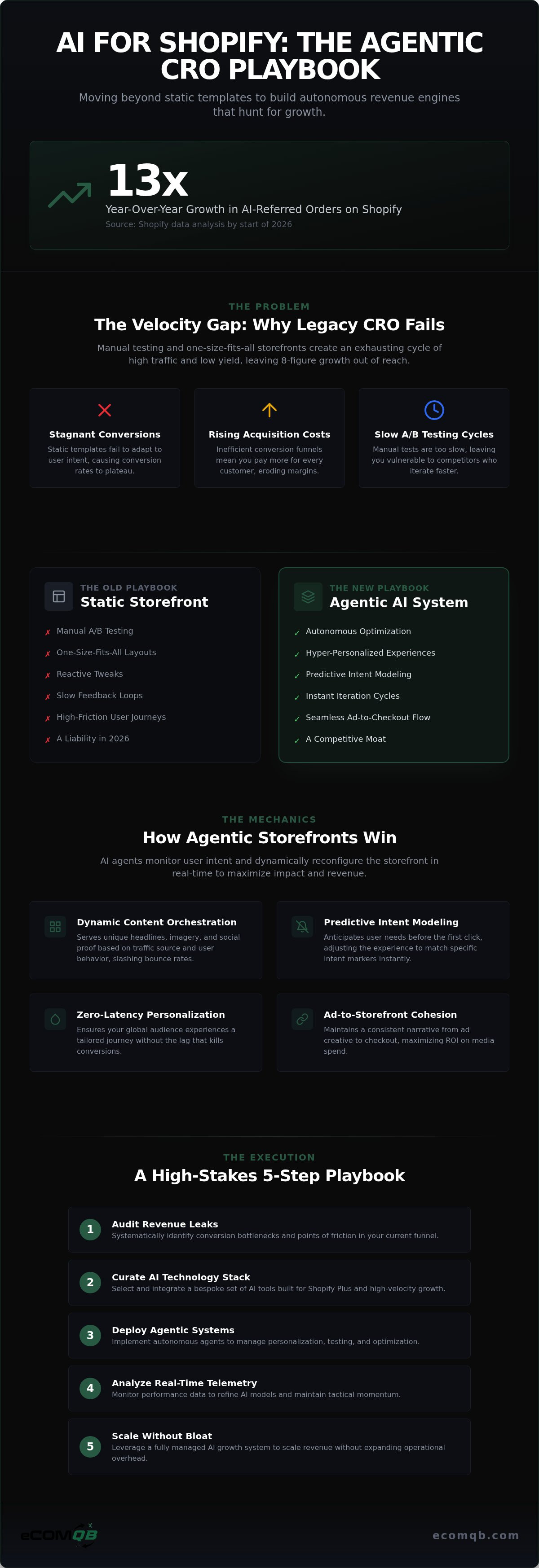
Implementing Your AI Conversion Stack: A 5-Step Playbook
Execution is the only bridge between a vision of 8-figure growth and the reality of a stagnant storefront. To dominate in 2026, you need more than a collection of plugins; you need a tactical roadmap that synchronizes every touchpoint. This 5-step playbook is designed to help you deploy AI for Shopify conversion optimization with surgical precision, ensuring that every dollar spent on acquisition is protected by a high-performance conversion engine. We are moving from fragmented tactics to a unified, systemic offensive.
The transition requires a shift in mindset from "set and forget" to "managed growth." You must audit your current data gaps, select a curated stack that integrates with Shopify Plus, and deploy agentic landing pages for your most aggressive ad sets. This isn't just about technical setup. It's about establishing a continuous optimization loop that captures revenue at every stage of the funnel, including post-visit recovery through agentic email marketing. If you are ready to stop guessing and start executing, it is time to book a strategic briefing with our team.
Phase 1: The Revenue Audit
Identifying "leaky buckets" is your first objective. You cannot optimize what you haven't diagnosed, and most brands are bleeding margin through friction points they don't even see. Setting high-performance KPIs beyond simple conversion rates allows you to measure the true health of your funnel. To perform a comprehensive AI diagnostic, you must track micro-conversion rates, intent-to-buy velocity, and algorithmic attribution accuracy across all device types. This data provides the raw material your agents need to begin the optimization process.
Phase 2: Agentic Deployment
Choosing the right architecture is a critical leadership decision. While off-the-shelf apps offer quick entry, custom-managed AI systems provide the specialized performance required for 8-figure scaling. You must maintain your brand's strategic core while allowing the machine to handle the technical execution. This is where a sophisticated SEO and content strategy for Shopify becomes essential. By driving high-intent traffic through authoritative content, you feed your AI for Shopify conversion optimization tools the qualified data they need to maximize output. High-velocity revenue is the result of clean data meeting autonomous execution.
EComQB: Your Field General for AI Transformation
Victory in the 2026 digital economy isn't won by collecting tools; it's won by deploying a unified offensive. Most brands are currently drowning in unmanaged tech stacks that create more noise than revenue. We function as your field general, orchestrating the transition from fragmented tactics to a cohesive eCommerce AI growth system. This is about leadership, precision, and the relentless pursuit of high-velocity results. We don't just provide software; we provide the strategic command necessary to win.
Unmanaged toolsets leave the burden of execution on your internal team, stretching resources and diluting your focus. A fully managed system removes that operational overhead, allowing you to lead the brand while we handle the technical frontline. By integrating AI for Shopify conversion optimization into a managed framework, we ensure that every lever is pulled at the exact right moment for maximum impact. You don't need more plugins. You need a tactical partner who understands the mechanics of 8-figure growth and possesses the playbook to achieve it.
Precision Strategy, Decisive Execution
Our approach synchronizes agentic media buying with deep storefront optimization to create an unbroken chain of conversion. We don't just build pages; we engineer environments where brand strategy and technological mastery converge to drive performance. This synergy ensures your narrative remains intact while the AI handles the tactical micro-decisions that protect your margins. You can deploy your AI growth system today and begin the shift from defensive management to offensive scaling. It's time to stop playing the game and start winning it.
Scaling to 8-Figures and Beyond
The roadmap to peak performance is paved with data-driven insights and rapid execution cycles. High-velocity revenue generation requires a partner who sees the entire field, identifies the gaps, and executes with certainty. This is the "Locker Room" advantage—a high-stakes environment where ambitious founders gain the strategic mastery needed to dominate their category. We transform your Shopify store from a static asset into an autonomous revenue machine that compounds value 24/7. Secure your competitive advantage with eComQB and claim your position at the top of the market.
Command the Future of eCommerce Growth
The era of passive storefronts has ended. You've seen the blueprint: moving from manual A/B testing to autonomous, agentic systems that optimize in real-time. This shift isn't just a technical upgrade; it's a strategic necessity to protect your margins and outpace the competition. By mastering AI for Shopify conversion optimization, you replace human bottlenecks with high-velocity revenue engines that scale without operational friction.
Success in 2026 requires more than just tools. It demands a curated AI technology stack and managed agentic workflows that align with your brand's unique strategy. We function as your strategic field general, providing the expertise needed to navigate this transition with precision. You have the vision to lead an 8-figure brand; we have the mechanics to engineer its growth. The game is moving faster than ever, but the right playbook ensures you stay ahead of the curve.
Architect your 8-figure revenue machine with eComQB and secure your market dominance today.
Frequently Asked Questions
What is the difference between traditional CRO and AI conversion optimization?
Traditional CRO relies on human intuition and slow manual testing cycles that can take weeks to yield results. AI for Shopify conversion optimization uses autonomous agents to analyze thousands of data points and execute layout changes in real-time. While manual testing is reactive, AI systems are predictive. You move from making guesses about button colors to a system that anticipates shopper needs before they even click.
How much traffic do I need for AI conversion tools to be effective on Shopify?
High-velocity AI tools generally require at least 10,000 monthly sessions to reach peak efficiency. While the system can learn from smaller datasets, higher traffic volume accelerates the feedback loop for autonomous agents. Brands scaling toward 8-figures benefit most because the volume of data allows the AI to identify subtle intent patterns that human analysts would miss. It's about feeding the machine enough data to make decisive tactical moves.
Will AI for Shopify conversion optimization slow down my site speed?
Modern AI conversion systems utilize edge computing and server-side processing to ensure zero-latency delivery. Unlike legacy plugins that bloat your frontend code, agentic systems reconfigure the experience before the page even loads in the browser. When implemented by a strategic partner, these tools actually improve perceived performance by removing irrelevant elements and prioritizing content that matches specific user intent. Speed is a core component of conversion.
Can AI help reduce my customer acquisition cost (CAC)?
AI directly slashes customer acquisition cost by maximizing the yield of every paid visitor. When your storefront dynamically aligns with the creative intent of your Meta or Google ads, bounce rates drop and conversion velocity increases. This efficiency allows you to bid more aggressively for high-intent traffic while maintaining healthy margins. You aren't just buying traffic; you are engineering a system that extracts the highest possible value from it.
How does an agentic storefront differ from a standard Shopify theme?
A standard Shopify theme is a static template that treats every visitor exactly the same. An agentic storefront is a dynamic environment that reconfigures its headlines, imagery, and product sequencing based on real-time user telemetry. It functions as a high-performance salesperson that adapts its pitch to the individual shopper. This shift from one-size-fits-all to hyper-personalized intent matching is the foundation of 8-figure eCommerce growth in 2026.
Is AI-driven personalization safe for brand voice and customer privacy?
Brand integrity is maintained through strategic guardrails that limit AI execution to approved tactical variations. You provide the vision and the system provides the performance within those boundaries. Regarding privacy, modern AI for Shopify conversion optimization focuses on first-party behavioral data rather than intrusive tracking. This ensures you remain compliant with global privacy regulations while delivering the personalized experiences that modern consumers expect and demand.
How long does it take to see ROI from an AI conversion growth system?
You can expect to see an immediate lift in micro-conversions, such as add-to-cart rates, within the first 14 days of deployment. A full return on investment for a managed AI growth system typically materializes within 30 to 90 days as the models refine their predictive accuracy. The compounding effect of improved conversion and reduced CAC creates a momentum that builds over time, leading to predictable and sustainable revenue growth.
Do I need a developer to implement AI for Shopify conversion optimization?
You don't need an in-house developer when you partner with a managed growth system. While implementing these tools requires deep technical expertise, our field general approach handles the entire architecture and execution for you. We bridge the gap between complex AI technology and your strategic business objectives. This allows your leadership team to focus on high-level growth while we manage the technical mechanics of the conversion engine.