Integrating AI Into Your eCommerce Tech Stack: The 2026 Strategic Playbook

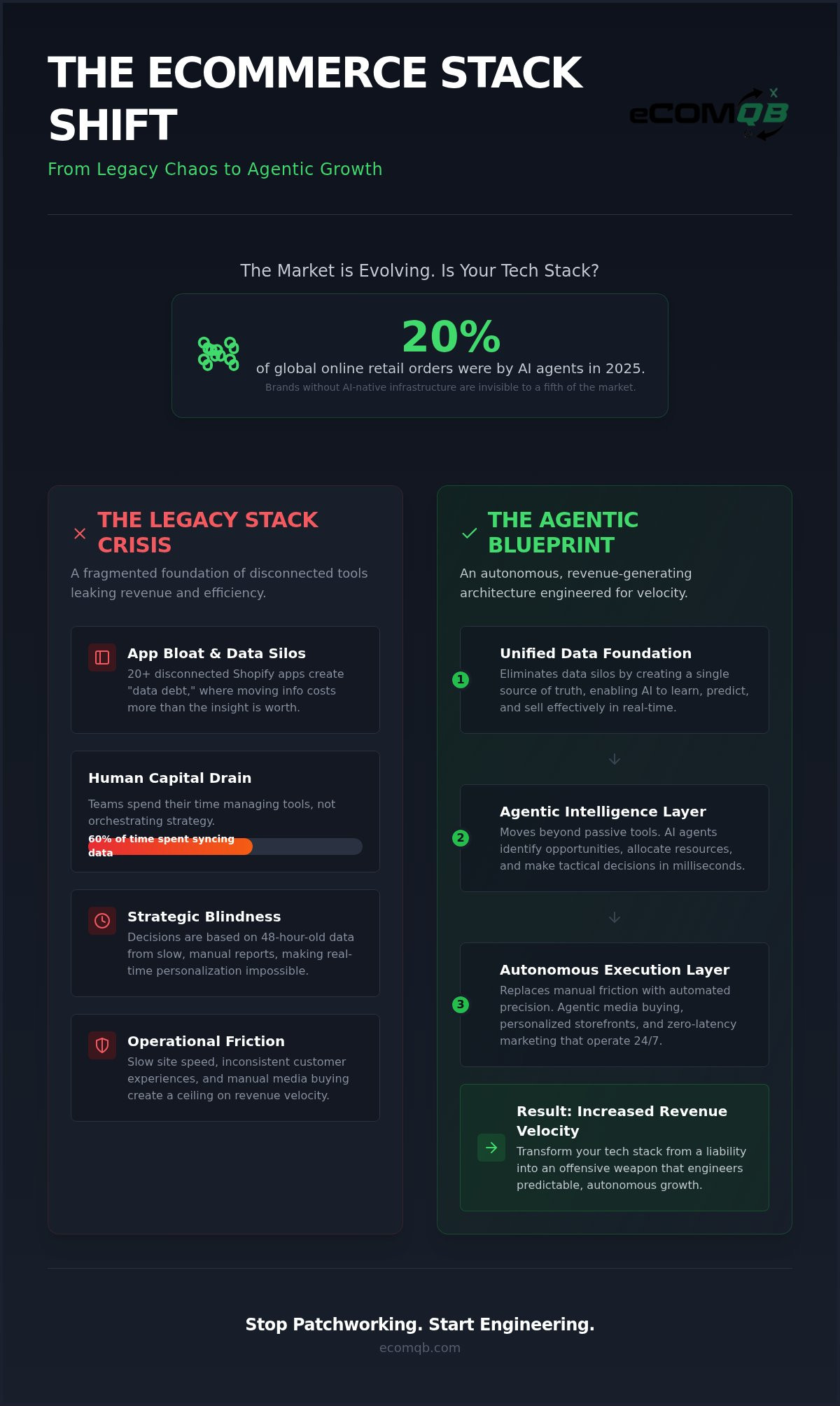
AI agents were responsible for approximately 20% of global online retail orders during the 2025 holiday season. If your infrastructure isn't designed to interact with these autonomous buyers, you're effectively invisible to a fifth of the market. Most brands are currently drowning in fragmented data across 20+ disconnected Shopify apps while watching CAC climb. You know the friction. You feel the overhead. You see the inefficiency. Successfully integrating AI into your ecommerce tech stack is no longer a luxury; it's the baseline for 8-figure survival in 2026.
You've likely realized that adding more SaaS tools only deepens the technical debt. It's time to stop patchworking and start engineering. This strategic playbook is your roadmap to transitioning from legacy software to an agentic, revenue-generating architecture. We'll show you how to build a unified, autonomous system that slashes manual labor and drives predictable growth. We will cover the shift from manual media buying to agentic execution, ensuring your brand operates with precision, speed, and mastery.
Key Takeaways
- Stop the "app bloat" that kills conversion; transition from passive tools to autonomous agents that execute high-level growth workflows without manual intervention.
- Master the strategic process of integrating AI into ecommerce tech stack by replacing fragmented data silos with a unified, agentic architecture.
- Evaluate the ROI gap between low-cost SaaS tools and managed AI systems to avoid the hidden technical debt that stagnates 8-figure scaling.
- Execute a tactical AI Readiness Audit to pinpoint exactly where your current legacy architecture is leaking revenue and where critical data gaps exist.
- Deploy a curated technology stack designed for velocity, focusing on agentic media buying and high-performance storefronts that engineer predictable revenue.
The Legacy Stack Crisis: Why Traditional Architectures Are Leaking Revenue
Most 8-figure brands are built on a foundation of sand. Their tech stacks are a collection of siloed Shopify apps, each promising a fix but delivering a friction point. This is the Legacy Stack Crisis. It's characterized by "data debt," where the cost of moving information between systems exceeds the value of the insight itself. If you're still relying on a patchwork of 20+ disconnected tools, you aren't just inefficient. You're leaking revenue through every crack in your architecture. It's time to stop patchworking and start engineering.
The "App Bloat" trap is real. Every script you add to your Shopify storefront slows down your site speed and nukes your conversion rate. It's a zero-sum game. You add a loyalty app to increase LTV, but the resulting latency drives away 10% of your mobile traffic. Successfully integrating AI into ecommerce tech stack is the only way to break this cycle, moving from a collection of static tools to a unified, agentic system that prioritizes performance over features.
The Anatomy of a Leaking Tech Stack
A leaking stack is easy to spot. It creates a "Data Silo" effect where your CRM, email platform, and analytics suite exist in isolation. This fragmentation makes real-time AI personalization impossible. If your data isn't unified, your AI can't learn, predict, or sell. Your team ends up managing tools instead of orchestrating strategy. They waste hours on manual reports that are already obsolete by the time they hit your inbox. Consider the costs of this architectural friction:
- Human Capital Drain: Your team spends 60% of their time syncing data rather than scaling campaigns.
- Strategic Blindness: Decisions are based on 48-hour-old data because manual reports take too long to generate.
- Inconsistent CX: Customers receive generic emails while your site shows them irrelevant products.
Revenue Velocity vs. Operational Friction
The Agentic Blueprint: Rebuilding Your Stack for Autonomous Growth
The era of "tools that help" is over. In 2026, the standard for 8-figure scaling is "agents that do." Successfully integrating AI into ecommerce tech stack requires a fundamental shift in how you view your software. Most brands treat AI as a fancy feature; elite brands treat it as an autonomous workforce. An AI-native architecture doesn't wait for a human to push "send" or "publish." It identifies opportunities, allocates resources, and executes maneuvers in real-time. It is the difference between having a map and having a driver.
This blueprint consists of three core layers: a unified data foundation, an agentic intelligence layer, and an autonomous execution layer. When these layers align, your marketing becomes an offensive weapon. Agentic media buying on Meta and Google stops being about manual bidding and starts being about goal-oriented optimization. Similarly, agentic email and SMS systems provide zero-latency revenue by triggering perfectly timed, personalized offers that a human team could never coordinate at scale. You aren't just automating tasks; you are automating growth itself.
The Front-End: Agentic Landing Pages and Storefronts
Static storefronts are dead weight. The modern front-end must be a living organism that adapts to every visitor. By integrating AI for Shopify personalization, you transform your site from a catalog into a concierge. Agentic landing pages deliver dynamic content based on real-time user intent, past behavior, and predictive modeling. This shift from static UX to conversational and predictive commerce ensures that every interaction is engineered for maximum conversion velocity. Your storefront should think, learn, and sell.
The Back-End: The AI Growth Engine
Behind the scenes, the AI growth engine handles the heavy lifting. It automates complex workflow sequences across inventory management, marketing, and support. This is where agentic media buying proves its worth by eliminating the manual bidding errors that plague traditional agencies. A managed AI stack ensures that your infrastructure remains lean, fast, and focused on 8-figure momentum. It removes the technical debt that slows down traditional brands. If you are ready to stop managing apps and start leading an autonomous system, you can audit your current architecture with our team to identify your highest-leverage opportunities.
Fragmented SaaS vs. Managed AI Systems: Decoding the ROI Gap
Cheap SaaS is often the most expensive mistake an ambitious brand can make. When you're integrating AI into ecommerce tech stack, the monthly subscription fee is just the tip of the iceberg. You must calculate the total cost of ownership (TCO). This includes the dozens of man-hours your team spends troubleshooting broken Zaps, the revenue lost during data sync delays, and the strategic blindness caused by siloed intelligence. A fragmented stack of "budget" apps creates a fragile ecosystem. It breaks, it lags, and it fails. In the high-stakes game of 8-figure scaling, fragility is a death sentence.
Managed AI transformation offers a superior path to strategic mastery. Instead of your leadership team playing whack-a-mole with API updates, they focus on high-level orchestration. A curated, managed stack mitigates risk by ensuring you aren't locked into a single vendor's ecosystem while providing a unified data layer that engineers velocity. It turns your technology from a monthly expense into a revenue-generating asset that works autonomously to protect your margins.
For brands scaling the sale of interactive digital artifacts, specialized delivery infrastructure is paramount. Utilizing a secure system like Djangify allows you to maintain architectural integrity while ensuring your digital assets are delivered with the same precision and speed as your automated marketing workflows.
The DIY Integration Trap
Most brands fall into the DIY integration trap by trying to stitch together disparate AI APIs without a master plan. They get stuck in the "Chatbot" phase, where AI is merely a reactive widget on a storefront rather than a proactive growth engine. This "Integration Hell" prevents you from achieving true systemic intelligence. Real success requires AI transformation for eCommerce brands at an architectural level. You need a system where every component communicates, learns, and optimizes in unison. Without this cohesion, your AI is just another disconnected tool adding to your technical debt.
Managed Growth Systems: The 8-Figure Advantage
The math of scaling is simple: leverage beats headcount every time. Building an internal AI department requires massive capital, extensive recruiting, and constant retraining. You'd need data scientists, machine learning engineers, and specialized technical managers just to keep the lights on. A managed eCommerce AI growth system provides this entire high-performance infrastructure for a fraction of the cost of a single senior hire. You gain the competitive advantage of elite, field-tested technology without the operational overhead of a bloated payroll. It's about speed, precision, and results. You don't need more employees; you need a more intelligent system.
The Integration Playbook: A Tactical Roadmap for AI Transformation
Precision beats power. When integrating AI into ecommerce tech stack, you don't just flip a switch; you execute a tactical deployment. Most brands fail because they try to automate chaos. If your current processes are broken, AI will only accelerate the failure. Successful transformation requires a methodical approach that identifies high-leverage opportunities, maps them to autonomous workflows, and scales based on measurable revenue velocity. Analyze. Design. Deploy. Scale. This is the sequence of 8-figure mastery.
Properly integrating AI into ecommerce tech stack requires moving through four critical phases. First, the AI Readiness Audit identifies where your legacy architecture is leaking revenue. Second, Architecture Design maps agentic workflows to your specific business objectives. Third, Curated Deployment phases in tools to maintain current momentum. Finally, Optimization and Scaling use agentic insights to drive 10x growth. You aren't just installing software; you're rebuilding your engine for a higher gear.
Auditing for Revenue Leaks
Identify. Quantify. Eliminate. Your audit must pinpoint exactly where manual friction is costing you sales. This means looking at your data through an AI lens to find gaps in the customer journey. For example, evaluating your SEO and content strategy for Shopify often reveals that manual content production is the bottleneck preventing you from capturing long-tail search volume. When you map the customer journey for agentic intervention points, you find hidden friction in everything from site search to post-purchase support. Stop the leaks before you pour in more fuel.
Phased Deployment Strategy
Don't rebuild the whole ship while at sea. Start with high-leverage agents that offer the fastest ROI. We recommend beginning with agentic media buying to stabilize your CAC and improve ROAS through autonomous bidding. Simultaneously, integrating agentic email marketing provides an immediate LTV lift by delivering zero-latency, hyper-personalized messaging. Once these offensive layers are secure, you can scale the system toward full storefront AI transformation. This phased approach ensures you maintain velocity while upgrading your capabilities. If you're ready to stop the guesswork and start the engineering, you should book your tactical AI audit today to secure your competitive advantage.
Engineering Velocity: How eComQB Deploys Revenue-Generating AI Stacks
Our philosophy is rooted in managed execution. We act as your Field General for AI transformation, handling the technical complexities so you can lead the strategic charge. By consolidating fragmented data and deploying agentic workflows, we eliminate the operational bloat that kills 8-figure brands. The result is a lean, autonomous machine that scales without increasing headcount. We prioritize precision, speed, and mastery in every deployment. This isn't about incremental gains; it's about structural superiority.
Your Strategic Partner in AI Growth
Most brands fail because they underestimate the heavy lifting required for true AI integration. We handle the data normalization, API orchestration, and agentic mapping that define a successful transition. As your tactical partner, we understand the mechanics of growth better than any generalist agency. Our clients move from legacy friction to 8-figure velocity by leveraging our field-tested playbook. We've seen brands eliminate the need for manual media buying teams while simultaneously accelerating their revenue velocity through unified data layers. We take the technical debt off your plate so you can focus on the scoreboard. We build the engine; you drive the growth.
Take the Next Move
The window for early-mover advantage is closing fast. By 2027, integrating AI into ecommerce tech stack will be the price of entry. Today, it remains your primary competitive advantage. Stop managing software and start leading a growth machine. Secure your position at the top of the market by deploying a system designed for dominance. It's time to choose between manual operational overhead and engineered revenue velocity. You know the next move. Book Your AI Strategy Call Now to begin your transformation and secure your brand's future.
Secure Your Position in the Agentic Economy
The window for incremental growth has closed. In 2026, market dominance is reserved for leaders who replace legacy friction with agentic flow. You've seen how fragmented data and app bloat act as a ceiling on your brand's potential. Successfully integrating AI into ecommerce tech stack removes that ceiling. It installs a high-performance engine designed for autonomous scale. It's time to stop managing disconnected software and start leading an integrated growth machine.
eComQB serves as your tactical partner in this transition. We provide Managed AI Transformation Services that convert technical complexity into competitive advantage. Our team brings Agentic Media Buying Mastery and Curated Revenue-Generating AI Stacks to the front lines of your operation. We don't just offer tools; we deliver results. You have the playbook, the strategy, and the vision. Now, you need the execution. The digital economy moves fast, but your brand can move faster. Analyze, design, and dominate the new landscape.
Book Your AI Strategy Call to Engineer 8-Figure Velocity. Your brand is ready for the next level. Let's build it together.
Frequently Asked Questions
What is the first step in integrating AI into my existing Shopify tech stack?
The first step is a comprehensive AI Readiness Audit to map your data architecture and identify high-friction revenue leaks. You can't automate chaos. We evaluate your current app ecosystem to see where silos prevent a unified customer view. Integrating AI into ecommerce tech stack begins by cleaning the data foundation so your agents have the fuel they need to sell effectively.
How does agentic media buying differ from traditional automated bidding?
Traditional automated bidding follows "if-then" logic; agentic media buying pursues high-level business objectives autonomously. Agents don't just follow rules; they analyze creative performance, audience shifts, and auction volatility in real-time. This shift from rigid automation to goal-oriented execution allows for a more aggressive, precise offensive on platforms like Meta and Google. It's the difference between a script and a strategist.
Will integrating AI require me to replace my entire current tech stack?
You don't need to rip and replace your entire infrastructure on day one. We favor a phased deployment that prioritizes high-leverage areas like media buying and email retention. Over time, we migrate legacy functions into a unified, agentic architecture. This approach maintains your current revenue velocity while systematically removing the technical debt of your older, disconnected Shopify apps.
How long does a full AI transformation typically take for a mid-market brand?
A full-scale AI transformation for a mid-market brand typically takes 90 to 180 days to reach peak architectural efficiency. However, you'll see tactical wins much sooner. High-leverage agents, such as those for media buying or SMS, can be active within weeks. The timeline depends on your data complexity and the number of legacy silos we need to bridge to create a unified system.
Can AI integration help reduce my Customer Acquisition Cost (CAC)?
Yes, successfully integrating AI into ecommerce tech stack directly attacks rising CAC by eliminating the manual lag in ad optimization. Agents process vast datasets to identify winning creative-audience combinations faster than any human team could. This precision reduces wasted spend and improves ROAS. It allows you to scale your acquisition efforts without the typical efficiency decay seen in manual workflows.
Do I need an internal technical team to manage a managed AI growth system?
You don't need an internal team of data scientists or machine learning engineers to scale. A managed growth system is designed to provide elite technical execution as a service. We function as your outsourced AI department, handling the API orchestration and workflow mapping. This allows your leadership to focus on strategic mastery rather than troubleshooting software integrations or managing technical debt.
What are the most critical KPIs to track during an AI tech stack migration?
Revenue Velocity is the ultimate metric, but you must also monitor ROAS and the reduction in manual operational hours. Watch your site speed and conversion rates as you consolidate apps. The goal is to see a simultaneous increase in performance and a decrease in the human capital required to manage daily marketing and ops tasks. Success is measured by output, not activity.
How does eComQB ensure AI tools actually generate revenue instead of just saving time?
We focus exclusively on offensive AI that directly impacts the bottom line. While many tools prioritize defensive efficiency or "time-saving" features, our curated stacks are built around revenue-generating maneuvers. We deploy agents that actively close sales, optimize bidding, and recover abandoned carts. Every tool in our playbook is vetted for its ability to drive measurable 8-figure scaling through autonomous action.