AI Marketing Automation for Shopify: A 2026 Growth Playbook

Your Shopify store’s next growth lever may not be another marketing app. It may be a connected system that turns customer signals into relevant campaigns and measurable action. That’s the goal of ai marketing automation for shopify. But adding AI to a fragmented stack won’t fix the underlying problem. If customer data, campaign execution, and reporting don’t work together, automation can simply make disconnected work happen faster.
Manual campaign tasks can drain time from strategy, while unclear oversight makes it hard to know what’s improving performance. Start by automating repeatable workflows, keep human judgment in the loop, and measure results against clear business goals.
This playbook explains which Shopify marketing workflows to prioritize, how to connect customer behavior with email, SMS, advertising, personalization, and measurement, and where to set practical guardrails. eComQB brings Shopify development, AI-driven personalization, advertising, and agentic email and SMS into managed eCommerce growth systems, helping brands coordinate their technology and marketing execution.
Key Takeaways
- Build automation around a clear loop: customer signal, decision, campaign action, and performance feedback.
- Prioritize workflows by business impact, data readiness, implementation effort, and the level of human review they need.
- Use ai marketing automation for shopify to coordinate customer signals and campaigns, not just generate content or run a standalone chatbot.
- Roll out one workflow at a time, establish baseline metrics, and track a primary outcome alongside guardrail metrics.
- Connect strategy, curated AI workflows, channel execution, and ongoing optimization to make automation a managed growth system.
What Is AI Marketing Automation for Shopify, and What Should It Actually Do?
AI marketing automation for Shopify connects store and campaign data to AI-assisted decisions, automated marketing actions, and performance feedback. It can use customer behavior to inform audience segments, select a relevant next step, and coordinate activity across acquisition, conversion, and retention. Measurement closes the loop: teams assess what happened after an action and use the findings to refine the workflow.
That’s more than a chatbot answering questions, an app sending a reminder, or generative AI drafting a product description. Those tools can be useful, but they don’t create a marketing operating model on their own. The broader field of Artificial Intelligence in Marketing includes automation, personalization, and data analysis. The practical challenge is connecting those capabilities to Shopify customer signals and business goals.
How Shopify marketing automation differs from isolated AI tools
An isolated automation completes one task. A shopper’s cart activity, for example, could trigger a follow-up message. A connected workflow goes further: it evaluates the signal, applies decision logic, delivers an appropriate action, and tracks a relevant downstream result. That result might be a recovered purchase or a later repeat order, not simply a message sent.
Human oversight still matters. Set the strategy, establish the rules, and review brand voice before campaigns go live. AI can help interpret signals and carry out repeatable steps, but people should guide positioning, handle exceptions, and make decisions that could affect customer trust.
Which business outcomes should the system support?
Start with the business outcome, then work backward to the workflow. An acquisition program might aim to improve traffic quality. A conversion workflow could focus on completed purchases. Retention activity might support repeat purchase or customer value. For each goal, define the customer signal, action, and measurement before automating execution.
Separate outcome measures from activity counts. Messages delivered and campaigns launched show that work happened, not whether it helped the business. Pair activity measures with a primary outcome, such as conversion or repeat purchase, and relevant guardrails, such as unsubscribes or campaign cost. This gives the team a clearer basis for deciding what to refine, expand, or pause.
This is the operating logic behind an eCommerce AI growth system: connected workflows, coordinated channel execution, and measurement tied to business priorities. The related article, “The eCommerce AI Growth System: Engineering 8-Figure Velocity in 2026,” explores that broader system-level perspective. The next step is to map how store signals, decisions, campaigns, and results connect in practice.
How a Shopify AI Marketing System Connects Data, Decisions, and Campaigns
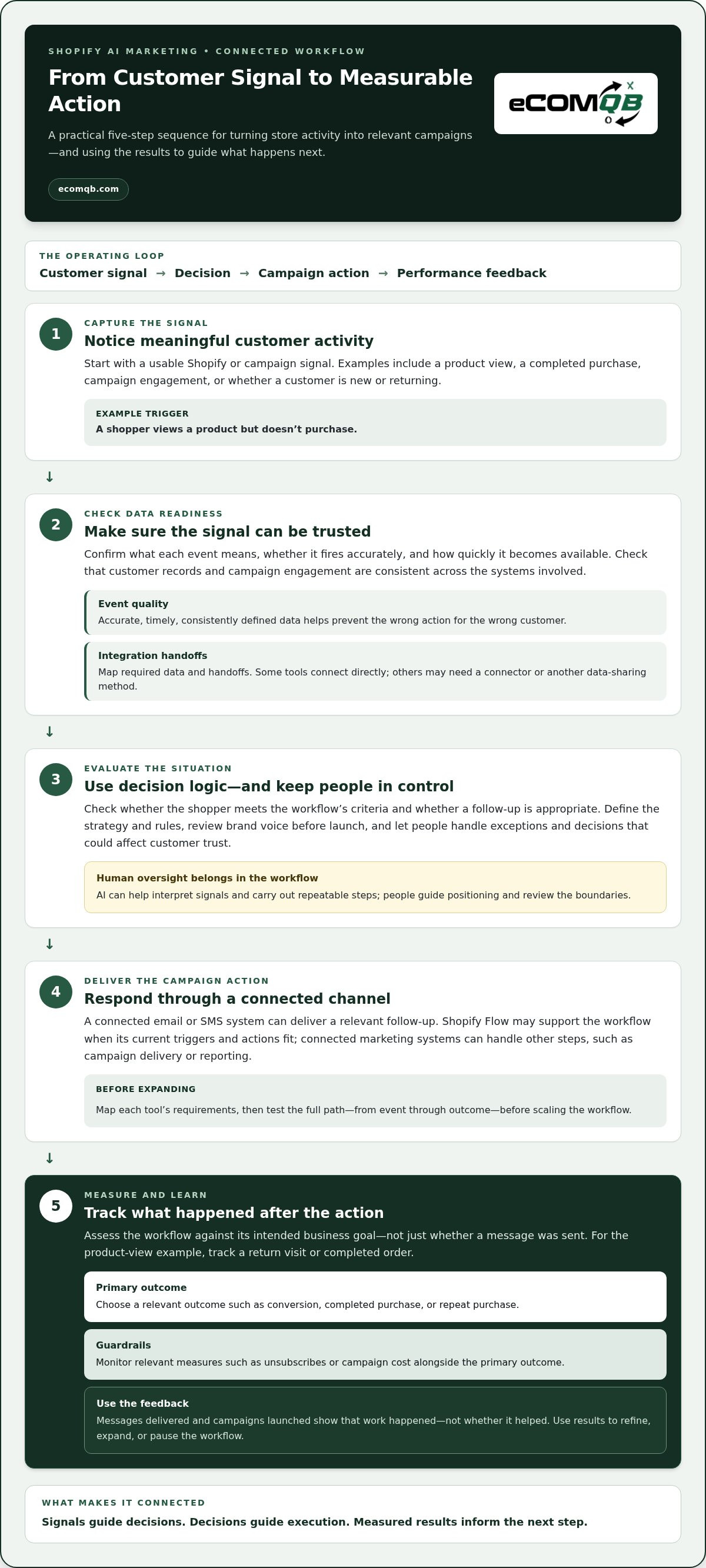
A connected system follows a clear sequence: a customer or campaign signal enters, decision logic determines what it means, a marketing action responds, and measurement shows what happened next. Shopify activity can inform segments and workflow triggers, but only when the data is accurate, timely, and usable by the systems involved.
Clean, consistently defined data is the foundation of dependable automation. If an event is missing, delayed, or interpreted differently across tools, even sound decision logic can trigger the wrong action for the wrong customer.
What data and signals can guide automated marketing?
Useful signals can include a completed purchase, product browsing, campaign engagement, or whether a customer is new or returning. Each signal can help shape segmentation. For example, recent interest in a product may support a relevant follow-up, while purchase history may inform a post-purchase message or retention journey.
Before scaling, check what each event means, whether it fires accurately, and how quickly it becomes available to the workflow. Confirm that customer records and campaign engagement are consistent across the systems you plan to use. Treat integrations as a design decision: some tools may connect directly, while others may require a connector or another data-sharing method. Map the required data and handoffs rather than assuming every platform integrates natively.
How workflows move from trigger to measurable action
Consider a shopper who views a product but doesn’t purchase. The event becomes a trigger. Decision logic checks whether the shopper meets the workflow’s criteria and whether a follow-up is appropriate. A connected email or SMS system can then deliver a relevant message. Measurement tracks what follows, such as a return visit or completed order, so the team can assess the workflow against its intended goal.
Shopify Flow may fit into this design when its current triggers and actions support the workflow. Connected marketing systems can handle other steps, such as campaign delivery or reporting. Map the requirements for each tool, then test the complete path from event through outcome before expanding the workflow.
This is the operational core of ai marketing automation for shopify: signals inform decisions, decisions guide execution, and results shape what happens next. For a broader view of how strategy and technology work together, explore AI transformation for ecommerce brands. eComQB helps brands plan connected workflows across Shopify and marketing channels through its managed growth systems.
Which Shopify Marketing Automations Should You Prioritize, and Which Need Human Control?
Automation isn’t a substitute for marketing strategy. It’s an execution layer that can make repeatable work more responsive when the goal, customer data, and review rules are sound. Prioritize workflows by four factors: business impact, data readiness, implementation effort, and the level of human oversight they need.
Start with tasks that happen often, follow clear rules, and benefit from customer context. Lifecycle messages can respond to customer status or behavior. Personalization can adapt content or recommendations. Advertising systems can assist with optimization, and reporting can surface patterns for a marketer to interpret. Each use case still depends on accurate inputs, deliberate execution, and meaningful measurement. Automation alone doesn’t guarantee better performance.
Compare workflows before you automate
| Workflow | Potential impact | Readiness and effort | Human review |
|---|---|---|---|
| Lifecycle email and SMS | Relevant customer communication and retention | Needs reliable customer status, triggers, and segmentation | Review message logic, timing, frequency, and brand voice |
| Personalization | More relevant storefront or campaign experiences | Needs usable behavior and product data; setup varies by experience | Set boundaries for recommendations and review customer-facing content |
| Paid media | Support acquisition and campaign optimization | Needs clear objectives and trustworthy campaign measurement | Approve budget rules, audience logic, and significant changes |
| Reporting | Improve visibility into trends and workflow outcomes | Needs consistent metric definitions and dependable data | Interpret results and decide what action to take |
Keep people in control of the high-impact calls
Automate repeatable steps, not accountability. Marketers should retain control over strategy, sensitive messaging, creative direction, and unusual customer situations. Define approval rules before launch, especially for budget changes, audience logic, and high-impact campaign edits. Start with a contained workflow, review its behavior and outcomes, then expand when the process is dependable.
For lifecycle programs, agentic email marketing can help frame how AI-supported execution fits into a governed strategy. The same principle applies across channels: give automation clear boundaries, then use human judgment to set direction and handle exceptions. That balance makes ai marketing automation for shopify more than a collection of tasks. It creates a system the team can oversee, evaluate, and refine.
How to Implement Shopify AI Marketing Automation in Measured Stages
Build the system in controlled stages, not with a storewide launch. A focused pilot helps validate the data, workflow, approvals, and measurement before adding more automation. Keep the scope tight enough to learn from, but important enough to matter to the customer journey.
- Choose one goal. Select a clear business objective, such as supporting first-purchase conversion or encouraging repeat purchase. Define the customer journey the workflow should improve and name one primary outcome.
- Set a baseline. Record how the chosen journey performs before launch. Use consistent reporting and attribution definitions so you can compare results meaningfully. Choose guardrail metrics too, such as unsubscribes, deliverability, or operational workload where relevant.
- Audit data and access. Check that the required customer events, segments, and campaign signals are accurate and available to the systems involved. Confirm who needs access, what data each tool uses, and how information moves between systems.
- Map the workflow. Document the trigger, audience logic, action, exclusions, and owner. For example, specify which customer behavior starts a message, who should be excluded, and who reviews its content. Set escalation steps for missing data, unexpected behavior, or customer situations that need human attention.
- Pilot with review. Test the workflow with a controlled scope before expanding it. Review message content for brand voice, confirm the trigger and exclusions behave as intended, and make sure the team knows who can pause or adjust the automation.
- Measure and refine. Compare outcomes with the baseline using the same definitions. Look at the primary business result alongside guardrails, then adjust the audience logic, content, timing, or workflow rules. Expand only when the pilot is understood and manageable.
Choose a pilot that is narrow enough to measure
One well-defined workflow beats several launches with no clear read on performance. Avoid changing multiple automations at once; otherwise, it becomes harder to identify what influenced the result. Keep a simple record of the version tested, changes made, and findings. That creates a useful learning loop for the next workflow.
Measure performance and improve the workflow
Measurement should connect customer outcomes to operational quality. A campaign may meet its engagement target while creating too many unsubscribes, or a workflow may support conversions but require excessive manual correction. Review the full picture before deciding whether to refine, scale, or pause. That discipline turns ai marketing automation for shopify into an accountable operating process.
eComQB helps connect workflow design, channel execution, and measurement as part of a managed growth system. Details of the approach are available through its strategy call information.
Turn Shopify Marketing Automation Into a Managed Growth System
Automation creates leverage when it’s connected to a clear growth plan. Strategy sets the priorities. Curated AI workflows support repeatable decisions and actions. Channel execution brings those actions to customers, while ongoing optimization uses performance signals to guide the next move. Without that coordination, a Shopify team can end up managing more tools without gaining a clearer view of what’s working.
eComQB brings these moving parts together through managed eCommerce growth systems. Meta and Google advertising execution can align acquisition activity with the store experience, while agentic email and SMS support customer communication across the lifecycle. Shopify development and AI-driven personalization can strengthen the storefront when they fit the brand’s growth priorities. The system is tailored to the operation, not built around automation for its own sake.
What managed execution changes for a Shopify team
A managed approach gives the team a strategic and technical partner to coordinate workflows, channels, and measurement. It can reduce the internal burden of stitching together tools and campaign tasks, while keeping ownership of priorities and decisions clear. Teams can connect campaign activity to storefront experiences and customer signals, then use shared performance measures to guide optimization.
This broader perspective is explored in The High-Performance Growth System for Shopify. The key is alignment: the customer experience, marketing execution, and performance feedback should reinforce the same business objective. A campaign may bring a shopper to the store, but the storefront and follow-up journey also shape what happens next.
Define the next move for your store
Start with three questions: Which workflow creates the most friction for your team? What growth goal should it support? Where does measurement break down today? Clear answers help determine whether the next move is workflow design, Shopify development, personalization, channel execution, or better performance visibility.
eComQB tailors managed AI transformation and growth systems to a brand’s priorities and existing operation, connecting strategy, technology, and execution. The aim is a coordinated system the team can oversee and improve, not a promise of guaranteed results.
To map the highest-value opportunity for your store, book a call to discuss your Shopify growth system.
Make Your Next Shopify Growth Move Count
Strong ai marketing automation for shopify is built as a connected system, not a pile of disconnected tools. Start with a workflow tied to a clear business goal, make sure its data and decision rules are dependable, then measure customer outcomes alongside guardrails. Keep people responsible for strategy, brand voice, and high-impact decisions.
That disciplined approach helps turn automation into a repeatable growth capability. eComQB delivers managed AI transformation and growth systems using curated technology stacks, connecting Shopify development with Meta and Google advertising execution and agentic email and SMS. The focus is coordination: align the store experience, campaign activity, and performance signals around your priorities.
Ready to identify the right workflow and map a system around your operation? Book a call to map your Shopify growth system. Start with a clear goal and a practical plan, then build on what you learn.
Frequently Asked Questions
What is AI marketing automation for Shopify?
AI marketing automation for Shopify connects store and campaign data with AI-assisted decisions, automated actions, and performance measurement. For example, a customer’s purchase history or browsing activity could inform a segment, which then receives a relevant marketing message. The system goes beyond a chatbot or one content-generation task: it links customer signals to workflows and evaluates outcomes so your team can refine what happens next.
Can AI automate marketing campaigns for a Shopify store?
Yes. AI can support campaign workflows such as segmenting audiences, personalizing messages, triggering lifecycle communications, and assisting with advertising optimization. The specific actions depend on your connected tools, data, and campaign rules. Set the goal and approval boundaries first, then test a focused workflow. Keep people responsible for strategy, brand voice, sensitive messages, and significant changes to budgets or audience logic.
Which Shopify marketing tasks should I automate first?
Start with a repetitive task tied to a clear customer journey and business goal. Lifecycle email or SMS can be a practical pilot if customer status and trigger data are reliable. Compare each candidate by likely business impact, data readiness, implementation effort, and review needs. Document its audience, exclusions, action, and owner, then measure a customer outcome rather than relying only on messages sent.
Do I need Shopify Flow for AI marketing automation?
No. Shopify Flow may support parts of a workflow when its available triggers and actions fit your needs, but it isn’t a requirement for every AI marketing system. Some workflows may use other connected marketing tools or integrations. Map the customer signal, decision, action, and measurement first. Then confirm how each system exchanges the necessary data and test the complete workflow before scaling it.
How do I measure whether Shopify marketing automation is working?
Set a baseline before launch and choose one primary outcome tied to the workflow, such as conversion or repeat purchase. Compare results using consistent reporting and attribution definitions. Track relevant guardrails too, such as unsubscribes, deliverability, or the amount of manual correction needed. Opens, clicks, and messages sent can help explain activity, but they don’t prove the workflow achieved its business objective.
Does AI marketing automation replace a Shopify marketing team?
No. Automation can reduce repetitive execution and help teams respond to customer signals, but it doesn’t replace strategic direction or accountability. People should set goals, approve brand messaging, review sensitive scenarios, and decide how to act on results. A team can use AI to increase its operating leverage while retaining control of creative direction, customer experience, and high-impact campaign decisions.
Can Shopify AI marketing automation work across email, SMS, and paid ads?
Yes, a system can coordinate email, SMS, and paid advertising when the relevant platforms, data, and integrations support the required workflows. A shared customer signal or campaign objective can inform channel actions, while measurement helps assess how each contributes. Don’t assume every tool connects natively or shares identical data. Map the handoffs, verify access and event accuracy, and define channel-specific review rules before launch.