Choosing an eCommerce Growth Partner: A 2026 Decision Guide

A longer agency service menu won’t guarantee stronger growth. The real advantage comes from choosing an eCommerce growth partner that connects strategy, technology, and execution to your brand’s most important constraint.
If you’re comparing agencies and consultants, overlapping services can make it hard to tell who will own the work and how it will support your goals. Marketing, storefront improvements, and retention can become separate workstreams, each with its own priorities and reporting. You need more than completed tasks. Look for a focused growth plan, clear accountability, and progress measured against business objectives, without adding unnecessary operational complexity.
This guide offers a practical framework for making that choice. You’ll learn how to identify the constraint that matters most, assess whether a partner’s capabilities fit, and evaluate how channels, technology, and measurement should work together. You’ll also find questions to bring to an initial conversation, so you can distinguish connected execution from a polished list of services and decide on a sensible next step.
Key Takeaways
- Pinpoint your biggest growth constraint, then define the business outcome a partner should help influence.
- When choosing an eCommerce growth partner, look beyond service breadth to see whether strategy, implementation, and accountability connect.
- Use consistent criteria to assess strategic diagnosis, channel coordination, data use, and communication.
- Match partner capabilities to your bottleneck, whether it sits in acquisition, conversion, retention, or technology.
- Understand how the engagement will move from setting priorities to measuring results and refining the work.
Choosing an eCommerce Growth Partner Starts With the Growth Problem
Choosing an eCommerce growth partner starts with diagnosing what’s holding the business back, not comparing service menus. A brand struggling to turn traffic into sales needs a different response from one with solid conversion but weak repeat purchasing. The right partner’s capabilities should fit the constraint, the company’s stage, and the capacity of its internal team.
An eCommerce growth partner connects business priorities to strategy, technology, execution, and measurable outcomes, then helps move the work forward. That’s the difference between shared accountability and a list of deliverables. A single channel agency may execute advertising. A software vendor supplies a tool. A development firm completes a defined build. An integrated partner connects the relevant work and keeps it aligned with the growth objective.
That coordination matters in a broad field shaped by digital transactions and technologies, as outlined in this overview of e-commerce. But no platform or channel creates a growth plan on its own. The plan needs to connect customer acquisition, the storefront experience, retention, and the systems that support execution.
What should an eCommerce growth partner actually do?
A capable partner turns business priorities into an operating plan. If conversion is the constraint, that could mean using customer insights to prioritize storefront or landing page improvements, then defining how to evaluate the changes. If repeat purchasing is the issue, it could mean connecting email and SMS activity with customer lifecycle needs. Recommendations are only the starting point. The scope should make clear who implements the work, who measures progress, and who uses the findings to refine it.
There’s no universal service bundle. Scope should follow the business priority, whether that calls for focused channel execution or coordinated work across marketing, technology, and development. Managed AI systems and agentic workflows can support connected execution without adding unnecessary operational overhead. The principle is straightforward: strategy sets the direction, execution puts it into practice, and measurement informs the next decision.
When does a brand need a growth partner?
Look for recurring friction: paid media, storefront, and retention teams working to different priorities; no clear owner for cross-channel results; or initiatives that stall between recommendations and implementation. These can signal a coordination or capability gap. A partner can help connect the work, clarify ownership, and build a focused plan, including through an eCommerce AI growth system.
But not every slowdown calls for outside support. If your team has the skills and tools but decisions are delayed, responsibilities are unclear, or approval processes are cumbersome, the primary issue may be internal operations. Diagnose that distinction first. Bring in a partner to address a genuine strategy or execution gap, rather than adding another layer to a process that needs clearer ownership.
Which eCommerce Growth Partner Capabilities Matter Most?
Capability fit depends on the brand’s growth constraint, not the length of a partner’s service list. The right capabilities are the ones that address your current bottleneck and connect the next move to a measurable business outcome. A partner may cover acquisition, conversion, retention, and operational leverage, but coverage creates value only when priorities, data, and ownership line up.
Use this map to focus your evaluation:
- Acquisition: Meta and Google campaigns should have distinct roles, coordinated around the customer and business objective. Review performance against outcomes that reflect the goal, not activity alone.
- Conversion: Shopify development and landing pages should support the customer journey from ad or search intent through product discovery and purchase. Check that the page experience delivers on the message that brought the visitor there.
- Retention: Email and SMS, including agentic workflows, should respond to customer needs and lifecycle moments rather than generate messages for their own sake.
- Operational leverage: AI should improve a defined workflow, decision, or customer experience. A technology stack without a clear use case can add complexity instead of reducing it.
As the U.S. Chamber of Commerce notes in its guidance on how to vet a business partner, fit matters beyond capability. For eCommerce, translate that principle into clear working ownership: who connects channel insights, implements changes, and uses results to set the next priority?
Evaluate strategy, media, and retention execution
Meta and Google aren’t interchangeable levers. Their roles should reflect the brand’s acquisition strategy, and campaign insights should inform decisions beyond media. A useful agentic media buying playbook connects campaign execution to the wider growth plan. Likewise, agentic email and SMS should support lifecycle marketing, using customer context to make retention activity more relevant. An agentic email marketing playbook can help clarify where automation supports the customer relationship and where human judgment still matters.
Assess storefront, personalization, and AI capabilities
Storefront work should match the intended customer journey. If a landing page is built for a specific campaign or audience, its message, offer, and path to purchase should reinforce that intent. Shopify development should make the experience coherent, not simply deliver a technical change. Personalization earns its place when it supports a relevant customer interaction or a defined objective. Explore the principles behind AI personalization for Shopify, then assess how the workflow would fit your customer experience, data, and measurement.
Use these capabilities to sharpen your partner brief, then bring your priority and bottleneck into a focused growth conversation.
How to Compare eCommerce Growth Partners Without Buying the Pitch
Broad capability doesn’t guarantee clear ownership or measurable execution. A partner can talk about growth, AI, and full-funnel coverage, but your decision should come down to how the proposed work addresses your objective and how progress will be managed. Compare the operating model, not the agency label.
Use the same criteria for each candidate. Look for evidence in the proposed scope, workflow, reporting approach, or examples of past work. Ask for specifics you can evaluate, such as which decisions the work will inform and who is responsible for acting on them.
- Strategic diagnosis: Look for a clear explanation of the growth constraint, the observations behind it, and the priorities that follow. This helps show whether the plan is built around your business or a standard package.
- Implementation ownership: Check that responsibilities for recommendations, execution, approvals, and follow-through are defined. Clear ownership reduces the risk of work stalling between advice and delivery.
- Channel coordination: Look for a plan connecting marketing, storefront, and retention activity to a shared objective. Coordination can reduce fragmented work and conflicting priorities.
- Data use: Ask which measures will be used, what baseline they’ll be compared with, and how findings will inform decisions. This makes performance reviews more useful than a report of activity alone.
- Communication cadence: Confirm that check-ins, decision owners, and a process for raising blockers or changing priorities are part of the proposed workflow. A clear rhythm helps execution adapt as new evidence emerges.
What evidence shows a partner can execute?
Look for a coherent sequence: diagnose the problem, set priorities, implement the agreed work, then review results and refine the plan. Check whether channel and storefront activities connect to the same business objective. For example, a campaign plan should account for the landing page it sends customers to, rather than treating media and site work as unrelated deliverables. Case studies can show relevant experience, but they’re context, not a forecast for your brand.
Claims about AI or performance become more meaningful when tied to a specific workflow, owner, and decision. Ask what will change in practice, who will act on the output, and how the team will assess whether it supported the objective.
Which metrics and accountability signals should align?
Agree on the objective, baseline, measures, and reporting cadence before work begins. If conversion is the priority, define the conversion measure and how it will be interpreted alongside relevant context, such as the campaign or page experience involved. If retention is the focus, connect lifecycle activity to an agreed customer or revenue outcome. Clarify who owns decisions, what your brand must provide, and how priorities may shift when the evidence changes.
When choosing an eCommerce growth partner, treat guaranteed outcomes and isolated vanity metrics with caution. Favor a transparent measurement model, clear responsibilities, and a practical rhythm for learning and action.
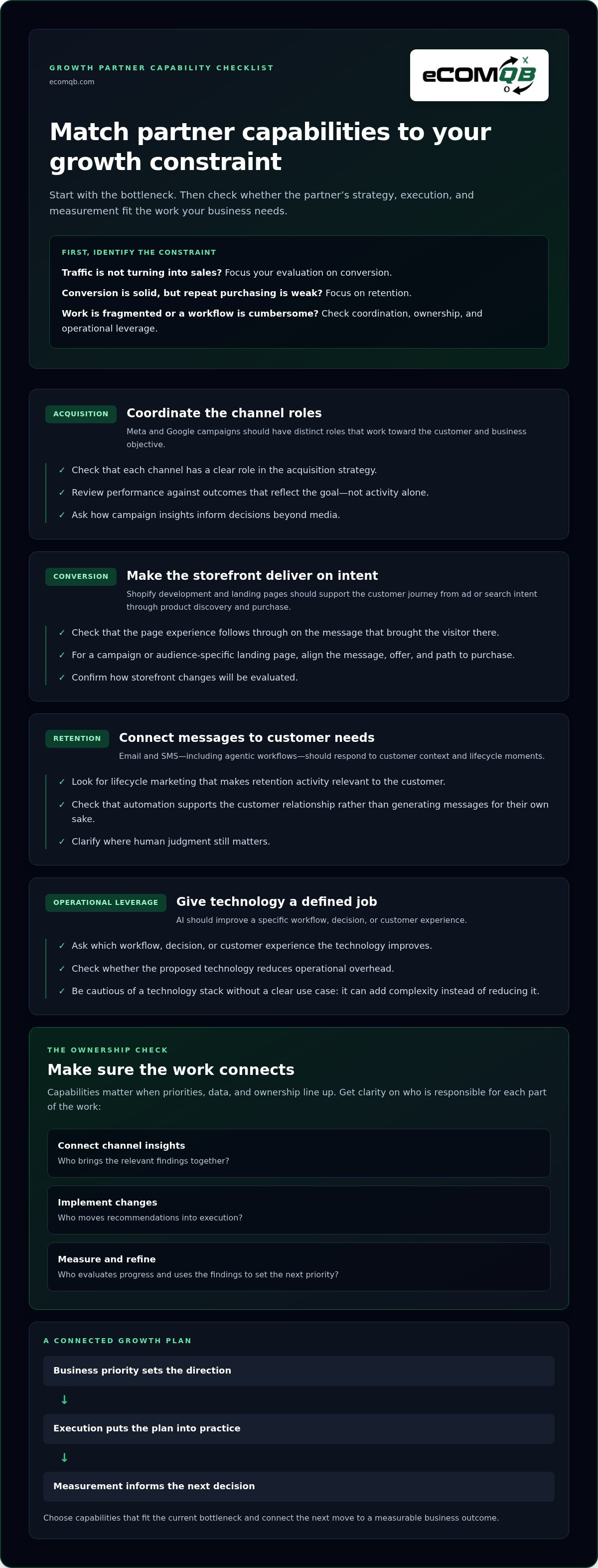
Match the eCommerce Growth Partner to Your Stage and Bottleneck
The right partner scope changes with the problem. A brand needs different support when customer acquisition is weak than when traffic arrives but the storefront fails to convert. Before comparing proposals, turn the bottleneck into a clear decision brief:
- 1. Define the constraint. Identify where growth is slowing: acquisition, conversion, retention, or the technology and workflows supporting them.
- 2. Set the outcome. Name the business result you want to influence and decide how you’ll assess progress.
- 3. Map the capabilities. Select the strategy, execution, and technology needed to address that constraint. Separate essential work from useful but less urgent additions.
- 4. Assign ownership. Clarify what your team owns, what the partner manages, and where approvals or inputs are needed.
- 5. Review the fit. Check that the scope suits your growth stage, internal capacity, and ability to act on the work.
This sequence keeps choosing an eCommerce growth partner tied to your operating reality. If your team can execute but needs direction, strategic support may be the priority. If internal capacity is tight, managed execution can help address the gap. If the constraint is a storefront or systems issue, development may need to lead. Don’t pay for breadth that your current bottleneck doesn’t require.
Which partner capabilities fit each growth bottleneck?
- Acquisition: Paid media strategy and execution across Meta and Google can align channel roles, campaign decisions, and measurement with the acquisition objective.
- Conversion: Shopify storefront development, landing pages, and personalization can connect customer intent with the page experience and path to purchase.
- Retention: Lifecycle email and SMS strategy, including agentic workflows, can connect relevant customer moments with repeat engagement.
- Technology or workflow: eCommerce development and managed AI systems can address a specific system or process constraint without adding needless complexity.
How should AI and managed execution fit the brand?
Start with a repetitive workflow or decision that connects to a defined objective, such as coordinating campaign tasks or supporting relevant lifecycle communications. Then determine where automation can help and where human review remains essential. A managed system should reduce operational load while keeping decision rights, oversight, and performance review clear. For broader organizational change, use an AI transformation playbook to think through how people, processes, and technology need to work together.
Bring your constraint, desired outcome, and internal capacity into a focused growth conversation to clarify a partner scope that fits.
What to Expect From an eCommerce Growth Partner Engagement
A strong engagement turns a growth objective into a working plan, then uses evidence to sharpen the next move. The sequence should be clear from the start:
- 1. Diagnose: Review the business context, current performance, and constraint the work needs to address.
- 2. Prioritize: Agree on the outcome, the highest priority work, and what can wait.
- 3. Implement: Assign owners, inputs, and decision points for the agreed strategy, technology, and execution.
- 4. Measure: Review progress against the objective and a shared baseline using relevant data.
- 5. Refine: Keep what’s working, adjust what isn’t, and revisit priorities as the evidence changes.
This isn’t a one-way handoff. Your team and partner need shared objectives, access to relevant data, timely decisions, and regular performance reviews. Agree on who owns approvals, what information the work depends on, and how findings will shape the next round of activity. That operating rhythm helps keep execution focused without creating unnecessary complexity.
What happens in a focused growth conversation?
Bring your growth objective, the bottleneck you see, and the operating context around it. That might include current channel priorities, storefront concerns, retention goals, internal capacity, or how AI fits your plans. The discussion should clarify which issues deserve attention first across strategy, media, lifecycle marketing, development, and AI. The practical outcome is sharper focus: which capabilities matter, how they connect to your priority, and what a possible path forward could involve.
How does eComQB connect strategy with execution?
eComQB brings strategic consulting together with managed AI systems and hands-on eCommerce execution. Curated AI technology stacks and agentic workflows can support growth activities while keeping them tied to business priorities. Meta and Google advertising can work alongside email and SMS marketing, AI-driven personalization, and Shopify design and development when those capabilities serve the agreed plan. The point isn’t to activate every channel. It’s to connect the right work, owners, and measurement around the constraint that matters.
For brands choosing an eCommerce growth partner, the first call should be a focused working conversation, not a pitch built around a menu. Use it to surface the constraint, test the priority, and clarify a practical next move. Book a focused growth call.
Turn Your Growth Priority Into the Next Move
Choosing an eCommerce growth partner starts with a clear view of the constraint, the outcome you want, and the work your team can realistically own. Compare partners by how they connect diagnosis, implementation, and measurement, not by the size of their service menu. The strongest fit is the one whose scope targets your current bottleneck and makes accountability clear.
eComQB brings strategic consulting together with hands-on marketing and technology execution. Managed AI growth systems use curated technology stacks and agentic workflows. Depending on the priority, execution can connect Meta and Google advertising with email and SMS, personalization, and Shopify development. The goal is a coordinated growth agenda, not disconnected activity.
Bring your objective, current constraint, and operating context into a focused first conversation. Identify the priority, clarify where strategy and execution need to connect, and map a practical path forward. Book a focused growth call.
Frequently Asked Questions
What does an eCommerce growth partner do?
An eCommerce growth partner helps a brand set priorities and connect strategy to execution. Depending on the objective, work may include paid media, lifecycle marketing, storefront development, personalization, or AI-enabled workflows. The service mix matters less than how the work is managed. Look for shared objectives, clear owners for decisions and delivery, and measures that show whether progress supports the business goal.
How do I choose an eCommerce growth partner?
Start by naming the business constraint you need to address. Then compare partners on strategic diagnosis, relevant execution capabilities, measurement, ownership, and communication. Ask how the proposed work supports your objective and what evidence will indicate progress. A useful partner explains responsibilities and priorities before expanding the scope. Choosing an eCommerce growth partner becomes more straightforward when you compare the operating plan, not just promises or service lists.
What should I look for in an eCommerce growth agency?
Look for a clear connection between your growth goal, the proposed work, and how results will be reviewed. Assess whether the agency has capabilities relevant to your bottleneck and can coordinate the channels or technology the plan requires. Clarify who owns execution, decisions, and reporting. Strong positioning alone doesn’t prove fit. The proposed operating model should make sense for your brand, internal capacity, and priorities.
Is an eCommerce growth partner different from a marketing agency?
The roles can overlap, but a growth partner typically takes a broader view of the business objective and how execution connects across channels, technology, and customer experience. A marketing agency may focus on a defined channel or campaign scope. Neither label tells you enough by itself. Compare what work is owned, which decisions the partner supports, and how success is measured against the agreed business objective.
Can one partner manage paid media, email, and Shopify development?
Yes, a growth engagement can coordinate paid media, lifecycle marketing, and Shopify development when those capabilities fit the brand’s priorities. eComQB connects Meta and Google advertising execution with email and SMS marketing, personalization, and Shopify development. A broad scope still needs clear owners for each workstream. Assess how the activities support shared goals and how results from one area inform the next priority.
How should I measure an eCommerce growth partner’s performance?
Set measures that reflect the engagement objective, establish a relevant baseline, and agree on a review cadence. Depending on the scope, track acquisition, conversion, retention, or operational measures. Interpret results in context rather than relying on one metric. Useful reporting explains what changed, what may have influenced it, and what action follows. Clear ownership ensures findings lead to decisions, not just dashboards.
When is the right time to hire an eCommerce growth partner?
Consider a partner when a priority growth constraint exceeds your team’s current capacity or requires coordinated expertise. Signals may include fragmented channel execution, unclear priorities, a storefront challenge, or workflows that could benefit from automation. First define the outcome you want and what your team can own. That groundwork helps shape a focused scope, clarify responsibilities, and make the partnership discussion more productive.
Ready to define your growth priority and the support it needs? Book a focused growth call with eComQB.