AI Personalization Experiences: A Practical eCommerce Growth Guide

What if your store could make each next step feel more relevant without making customers wonder what you know about them? That’s the challenge behind effective ai personalization experiences. Generic recommendations and messages can miss what different customers need, but adding AI without a clear goal can create more complexity without improving the shopping experience.
AI can help improve product discovery, recommendations, and marketing messages while preserving customer trust. The key is a disciplined approach: respond to useful signals, address a clear customer need, and measure whether the change helps.
This guide explains how AI personalization differs from segmentation and fixed rules, where it can help across the shopping journey, and which outcomes your team can track. You’ll also learn how to use customer data thoughtfully, set privacy-conscious guardrails, and improve experiences over time. The result is a more relevant shopping journey and a growth system your team can evaluate and refine.
Key Takeaways
- Separate customer-facing personalization from back-end automation so each AI initiative has a clear role in the shopping journey.
- Use customer signals with intent: distinguish information shoppers share directly from behavior that may need more context.
- Compare generic experiences, segments, fixed rules, and ai personalization experiences to choose the right balance of relevance and control.
- Start with one high-value friction point, form a testable hypothesis, and review results before expanding personalization.
- Coordinate strategy, storefront execution, and marketing workflows to make personalization a measurable growth capability.
What Are AI Personalization Experiences in eCommerce?
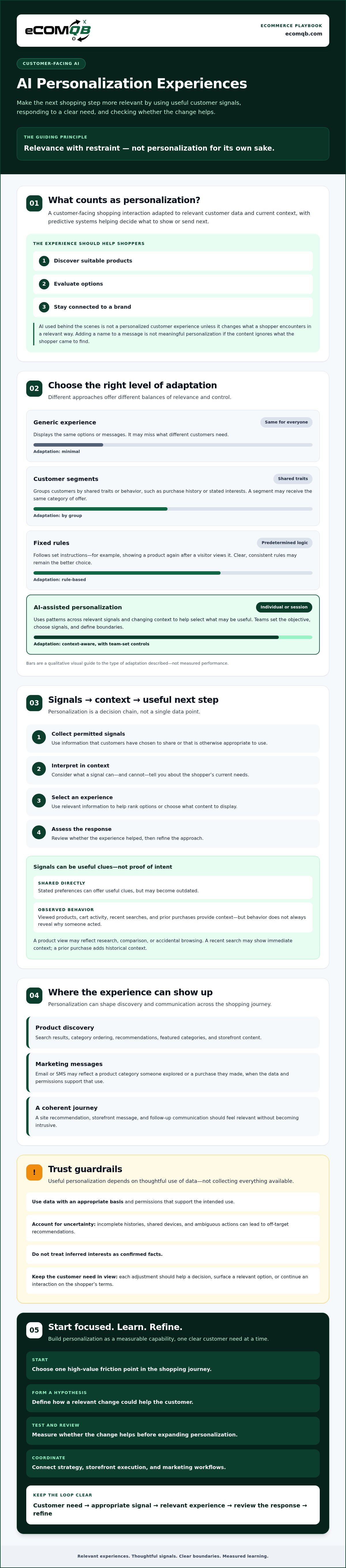
AI personalization experiences are customer-facing shopping interactions adapted to relevant customer data and current context, with predictive systems helping decide what to show or send next. Their purpose is practical: help shoppers discover suitable products, evaluate options, and stay connected to a brand.
This differs from using AI behind the scenes to forecast demand, automate internal workflows, or generate general marketing copy. Those capabilities may support an eCommerce business, but they are not personalized customer experiences unless they change what a shopper encounters in a relevant way. Likewise, adding a customer’s name to a message is not meaningful personalization if the content ignores what they came to find.
How personalization differs from segmentation and static rules
Segmentation groups customers by shared traits or behavior, such as purchase history or stated interests. Personalization uses relevant information to adapt an experience for an individual or a particular session. A segment might receive the same category of offer, while a personalized storefront could change product ordering based on what a shopper has viewed.
Fixed rules follow predetermined instructions. For example, if a visitor views a product, the store might show that product again. AI-assisted systems can use patterns across signals and changing context to help select what may be relevant. AI does not have to make every decision on its own: teams set the objective, choose appropriate signals, and define boundaries for how an experience can change. When the logic is clear and consistent, rules may remain the better choice.
Where customers encounter personalized shopping experiences
Personalization can shape product discovery through search results, category ordering, and recommendations. Recommender systems, for example, help identify items a shopper may want to consider based on relevant information. A storefront might adapt featured categories or content to reflect a shopper’s interests instead of displaying the same options to everyone.
Email and SMS offer other opportunities to make the next interaction more useful. A message might reflect a product category someone explored or a purchase they made, when the data and permissions support that use. Each adjustment should help the customer make a decision, find a relevant option, or continue an interaction on their terms.
Strong ai personalization experiences connect these touchpoints into a coherent journey. A recommendation on the site, a storefront message, and a follow-up communication should feel relevant without becoming intrusive. That takes more than a personalization feature. It requires a clear customer need, useful signals, and deliberate control over how those signals shape the experience.
How AI Personalization Experiences Turn Customer Signals into Relevant Actions
Personalization works through a decision chain, not a single data point. A system can collect permitted signals, interpret them in context, select an experience, and assess how the customer responds. The details vary by technology and business, but the operating principle is consistent: use relevant information to make a useful next step more likely, then review whether it helped.
For example, a shopper who views several items in one category may show an interest in that category. A recent search provides immediate browsing context, while a prior purchase adds historical context. None of these signals proves what the shopper wants now. Interpreted carefully, they may help a system rank options or choose which content to display. This is one way AI can support the broader shift toward intelligent experience engines, where customer interactions inform what happens next.
Which customer signals can inform personalization?
Start with first-party interactions that customers have chosen to share or that are otherwise appropriate to use, such as viewed products, cart activity, and stated preferences. Explicit preferences can offer useful clues about a shopper’s needs, but they may become outdated. Behavioral signals show what someone did, not always why. A product view could reflect research, comparison, or accidental browsing.
Signal quality matters. Incomplete histories, shared devices, and ambiguous actions can all lead to recommendations that feel off target. Use data only when there is an appropriate basis for doing so, and avoid treating inferred interests as confirmed facts. The goal is relevance with restraint, not collecting everything available.
How AI selects and delivers a relevant experience
A recommendation system can rank products or content using available signals and the current shopping context. A storefront might change product order after a category search. An email could feature items related to a previous interaction, while an SMS message may call for a separate, timely decision and suitable permission. Each channel has its own context, constraints, and customer expectations.
A model’s output is a hypothesis, not a verdict. Test whether the selected experience helps shoppers find, compare, or choose products, and watch for irrelevant repetition or poor matches. Review results and adjust the inputs, rules, or experience as needed. If your team needs help connecting customer signals to storefront and marketing decisions, discuss your personalization approach.
AI Personalization vs. Generic Experiences: Balancing Relevance, Control, and Trust
More tailored is not always better. AI personalization can make product discovery more relevant, but it can also feel intrusive when a brand uses data in ways shoppers don’t expect. The right approach depends on the decision you need to improve, the signals you can appropriately use, and how much control your team needs. AI can support customer experiences in different ways, but it is not an automatic upgrade for every store.
| Approach | Adaptability | Data needs | Operational control | Suitable use cases |
|---|---|---|---|---|
| Generic experience | Low; same experience for everyone | Minimal | High; simple to manage | Clear, consistent brand or policy information |
| Segmentation | Moderate; adapts by group | Enough information to define useful groups | High; teams set segments and content | Different messages for broad customer groups |
| Rules-based personalization | Moderate; responds to predefined conditions | Signals tied to clear rules | High; logic is explicit | Stable scenarios, such as showing a viewed category |
| AI-assisted personalization | Potentially higher; can evaluate patterns and context | Relevant, reliable signals and suitable setup | Shared; teams set goals and boundaries, systems help select experiences | Complex choices where patterns warrant evaluation |
When AI personalization adds value, and when simpler rules are enough
Choose an approach based on audience size, decision complexity, and the quality of available data, rather than a fixed threshold. If a condition is clear and stable, a rule may be easier to understand and maintain. AI may be worth testing when the best option depends on interacting signals or changing context. In either case, run a controlled test, assess whether the experience helps, and expand only when results justify the added complexity.
How to protect trust while improving relevance
Make data practices transparent and give customers clear choices suited to your business and the jurisdictions where you operate. Avoid sensitive inferences, recommendations with no understandable rationale, and repeated or contradictory messages across channels. A product suggestion based on a recent browse may feel useful. An unexpected inference about a personal circumstance may undermine confidence.
Where applicable, GDPR is a relevant privacy framework, but the right requirements depend on the business and audience. Confirm current legal guidance for each operating jurisdiction before implementation. Strong ai personalization experiences balance relevance with restraint: use appropriate signals, keep decisions reviewable, and let customer trust set the boundaries for optimization.
How to Plan, Test, and Measure AI Personalization Experiences
Don’t personalize every touchpoint at once. Choose one customer journey where a relevant change could reduce friction, then build a test around a clear business question. A focused pilot is easier to measure, govern, and improve.
Use this five-step framework to plan a useful test:
- Choose a friction point. Find a specific moment where shoppers struggle, such as locating suitable products or receiving a useful follow-up after browsing.
- Define a falsifiable hypothesis. State which signal will inform which experience and what change you expect. For example: “Showing category recommendations based on a shopper’s current browsing context will increase product engagement.”
- Select appropriate signals. Use only data that is relevant and appropriate for the intended experience. Document what you’ll use, what you’ll exclude, and any eligibility limits.
- Set the test and guardrails. Record the baseline, comparison method, duration criteria, and decision rules before launch. Define checks for customer experience, data use, and operational impact.
- Review and decide. Compare results with the baseline and decide whether to refine, expand, or stop. Don’t scale based on an early signal alone.
Choose a starting use case and define the test
Match the test design to the hypothesis. A storefront discovery test might compare product engagement or conversion with a suitable control experience. A follow-up test could examine email or SMS engagement alongside repeat purchase. Select measures in advance, and avoid treating a change in one metric as proof that personalization caused a business outcome.
Separate experience metrics, such as recommendation engagement or message interaction, from business outcomes, such as conversion, revenue per visitor, or repeat purchase. Both matter. Engagement may rise without improving the shopping outcome, while a business outcome can shift for reasons unrelated to personalization.
Build a measurement and iteration loop
Review quality and performance together. Check for unintended effects, including irrelevant recommendations, excessive message frequency, or contradictory experiences across channels. Use what you learn to adjust eligibility, content, or timing. If the test misses its decision criteria or creates a trust concern, pause or stop it.
For Shopify-specific implementation detail, explore the AI for Shopify personalization playbook. If you’re ready to define a measurable pilot for your store, talk with eComQB about your personalization strategy.
How eComQB Can Help Operationalize AI Personalization Experiences
Personalization creates more value when it is treated as a coordinated growth capability, not a software feature running on its own. Strategy identifies the customer problem. Technology supports decisions. Storefront and marketing execution bring those decisions to shoppers. Measurement shows what to refine.
eComQB works with eCommerce brands on managed AI transformation and growth systems, including AI personalization, Shopify development, agentic email and SMS, and advertising execution across Meta and Google. The right workstream depends on the use case. It could connect storefront experiences with relevant email or SMS workflows, or align personalization priorities with broader marketing execution. Specific platforms, integrations, and implementation requirements should be confirmed for each project.
What an end-to-end personalization workstream can include
A focused workstream starts by identifying friction in the customer journey and defining an experience worth testing. Teams can then evaluate the technology needed, plan storefront execution, and decide how relevant marketing workflows should respond. Measurement belongs in the plan from the start, not as a reporting task added after launch.
This coordinated approach helps teams consider the full system: customer experience, data use, implementation, and ongoing review. For a broader view of how managed growth capabilities can fit together, explore the eCommerce AI growth system.
Prepare for a focused AI personalization discussion
Bring a clear starting point. Identify the customer friction you want to address, how you currently measure that journey, and what would count as a useful improvement. It also helps to map the data sources you may use, customer consent considerations for your operating jurisdictions, and practical constraints across your team and technology.
That context supports a strategic conversation about priorities, not a promise of a particular outcome or an assumed solution. The aim is to determine whether AI personalization experiences fit the customer need, what execution may involve, and how progress could be assessed. Book a conversation about your personalization strategy to discuss your use case and implementation priorities.
Make Relevance a Measurable Growth Capability
Strong ai personalization experiences start with a real customer need, not a push to use more AI. Choose one journey where relevance could reduce friction, use appropriate signals, and set clear measures before testing. Then assess both the business outcome and the quality of the customer experience. If a recommendation feels intrusive or adds noise, refine it or stop.
That discipline turns personalization into a system your team can learn from and improve. Strategy, storefront execution, and marketing workflows should work together, with customer trust built into every decision.
eComQB provides managed AI transformation and growth systems for eCommerce brands, with capabilities spanning personalization, Shopify development, email and SMS, and Meta and Google advertising execution. Start with a specific customer journey, a clear measurement approach, and realistic implementation priorities.
Book a conversation with eComQB about AI personalization to discuss your use case and next steps.
Frequently Asked Questions
What are AI personalization experiences?
AI personalization experiences are customer interactions adapted using relevant information and context, with AI helping select what a shopper sees or receives. In eCommerce, this can include product recommendations, search results, storefront content, and email or SMS messages. The goal is to make a shopping decision more relevant. Generic AI-generated copy isn’t personalization by itself; the customer-facing experience must reflect information relevant to that shopper or session.
How does AI personalization work in eCommerce?
AI personalization uses appropriate customer signals, such as viewed products or stated preferences, to help choose a relevant experience. A decision system interprets those signals in context, then ranks or selects products, content, or messages for a storefront or marketing channel. The team defines the objectives and boundaries. Testing matters because a model’s selection isn’t automatically useful; review customer response and business outcomes before refining or expanding it.
What is the difference between AI personalization and customer segmentation?
Customer segmentation groups shoppers who share characteristics or behaviors, then targets each group with a relevant message or experience. AI personalization can adapt what an individual shopper or session sees based on available signals and context. The approaches can work together: a team might first define a broad audience, then tailor product ordering within that group. Choose the method based on the decision, available data, and the level of control your team needs.
Can AI personalization improve the customer experience?
AI personalization can help shoppers discover relevant products, navigate choices, and receive more useful follow-up. The benefit depends on whether the experience fits the customer’s needs and uses appropriate signals. Poor matches, repetitive messages, or unexpected inferences can instead create friction. Measure both experience signals, such as recommendation engagement, and business outcomes, such as conversion or repeat purchase. Compare results with a suitable baseline before deciding whether to continue.
Is AI personalization safe for customer privacy?
AI personalization isn’t automatically safe for privacy; responsible use depends on the data, purpose, transparency, and customer choices involved. Use only information that’s appropriate for the intended experience, explain relevant data practices clearly, and provide choices where applicable. Avoid sensitive inferences and unnecessary collection. Privacy requirements differ by jurisdiction, so review current legal guidance for each market and confirm how consent and data use should be handled before launch.
What data is needed for eCommerce personalization?
Personalization can use relevant first-party signals such as viewed products, search activity, cart interactions, purchase history, and preferences customers choose to share. The right inputs depend on the experience you want to improve. Data should be accurate, current, and interpreted carefully: a product view doesn’t prove purchase intent. Avoid collecting information that isn’t needed, and don’t use sensitive data or inferred traits without a clear, appropriate basis.
How do you measure AI personalization performance?
Start with a defined hypothesis and record a baseline before launch. Compare the personalized experience with a suitable control, then track experience measures, such as recommendation engagement, alongside business outcomes, such as conversion, revenue per visitor, or repeat purchase. Add guardrails for problems like irrelevant suggestions or excessive messaging. Review the full picture, not one metric alone, and decide in advance what would justify refining, expanding, or stopping the test.
Does a small eCommerce brand need AI personalization?
Not necessarily. Simple rules may be enough when a customer situation is clear and stable, such as showing a relevant category after a shopper browses it. Operational readiness means having a specific customer friction point, appropriate signals, a way to measure the experience, and capacity to review results. Start with one use case and test it. Consider AI when decision complexity or changing context makes fixed rules less suitable.