AI-Powered Dynamic Content for eCommerce: Engineering 8-Figure Revenue Velocity in 2026

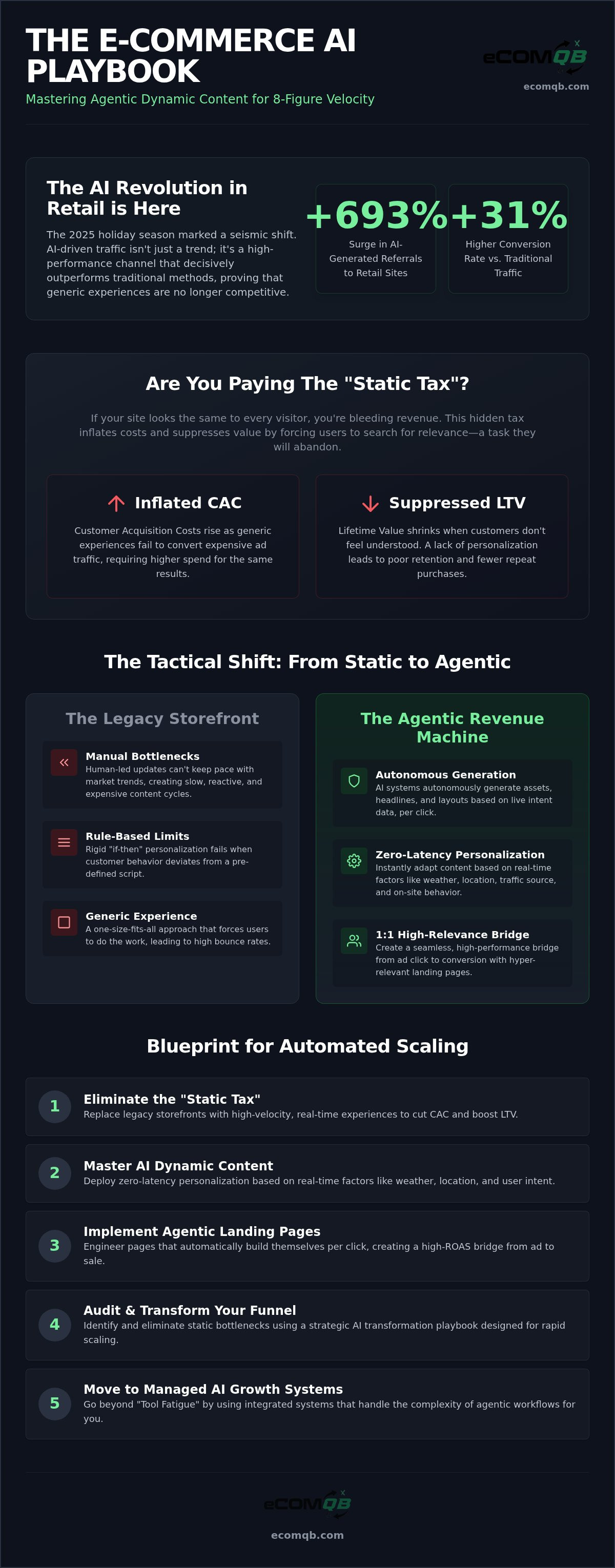
AI-generated referrals to retail sites surged by 693% during the 2025 holiday season and converted 31% better than traditional traffic. You've likely noticed that your standard Shopify storefront is no longer enough to offset rising acquisition costs on Meta and Google. Generic experiences are high-friction traps that bleed revenue. To hit 8-figure velocity in 2026, you must pivot. Strategic deployment of ai powered dynamic content for ecommerce isn't just a minor optimization; it's a tactical necessity for survival.
We understand the frustration of manual landing page bottlenecks and the crushing weight of rising CAC. This guide will show you how to master agentic dynamic content to eliminate conversion friction and accelerate your brand's scaling trajectory. You'll learn the exact blueprint to engineer zero-latency personalization, automate your revenue growth, and secure a decisive competitive advantage. It's time to build, optimize, and dominate.
Key Takeaways
- Eliminate the "Static Tax" that inflates CAC and suppresses LTV by replacing legacy storefronts with high-velocity, real-time experiences.
- Master the deployment of ai powered dynamic content for ecommerce to deliver zero-latency personalization based on real-time factors like weather, location, and intent.
- Implement agentic landing pages that automatically build themselves per click, creating a high-performance bridge between ad traffic and 8-figure revenue velocity.
- Audit your conversion funnel for static bottlenecks and deploy a strategic AI transformation playbook designed for rapid, automated scaling.
- Optimize your operations by moving beyond "Tool Fatigue" toward managed AI growth systems that handle the technical complexity of agentic workflows.
The End of the Static Storefront: Why Legacy Content is Leaking Revenue
The static storefront is dead. It's a relic of a slower era, a museum piece in a high-velocity market. In 2026, your digital presence must function as a real-time, data-driven evolution of the traditional shop floor. AI-powered dynamic content for ecommerce isn't a feature; it's the engine of your revenue machine. It moves beyond simple "if-then" logic to create a living storefront that adapts, evolves, and converts. You're no longer just displaying products; you're orchestrating a sequence of high-intent interactions.
If your site looks the same to every visitor, you're paying the "Static Tax." This hidden levy inflates your Customer Acquisition Cost (CAC) and suppresses your Lifetime Value (LTV). Generic experiences force users to do the work of finding relevance. They won't. They'll bounce. You're left with high ad spend and low retention. Transitioning from rule-based personalization to agentic content generation allows you to move at the speed of the digital economy, capturing revenue that previously leaked through the cracks of a rigid interface.
The High Stakes of Generic Experiences
Modern consumers interpret generic as irrelevant. It's that simple. In a world of instant gratification, even a 250ms latency in relevance can tank your conversion probability. The top 1% of brands aren't just selling better products. They're delivering superior speed, precision, and context. They've eliminated the friction that stalls growth for the rest of the market. If you aren't personalizing at the point of impact, you're losing the game before it starts.
Static vs. Dynamic: A Tactical Comparison
Manual content management is your primary growth bottleneck. It's slow, expensive, and reactive. You can't scale an 8-figure brand on the back of manual updates. AI diagnostics now identify revenue-leaking touchpoints in real-time. Implementing ai powered dynamic content for ecommerce allows your site to anticipate what the user needs before they even click. Consider the tactical shift required to win:
- Manual Bottlenecks: Human-led updates that can't keep pace with shifting market trends.
- Rule-Based Limits: Rigid personalization that fails when customer behavior deviates from the script.
- Agentic Content: Systems that autonomously generate assets, headlines, and layouts based on live intent data.
This isn't about minor tweaks. It's about a fundamental shift in how you deploy your brand. You need a system that learns, reacts, and wins. The 2026 standard demands a storefront that is as agile as your media buying. It's time to stop managing content and start engineering growth.
The Anatomy of AI-Powered Dynamic Content: Precision at Every Touchpoint
Precision is the dividing line between a conversion and a bounce. To implement ai powered dynamic content for ecommerce, you must build an architecture that moves as fast as your customers. This starts with a headless CMS. By decoupling your content from the presentation layer, you gain the agility to push real-time updates across every touchpoint without the friction of traditional backend constraints. Your storefront becomes a fluid asset, capable of shifting its form based on the specific signals each visitor broadcasts.
High-velocity brands leverage real-time data to drive this evolution. Your site should ingest and act on weather, location, and behavioral intent immediately. If a visitor arrives from a rain-soaked city, your hero section should pivot to highlight waterproof gear. If they show high-intent behavior for a specific category, the layout should reorganize to shorten the path to purchase. This isn't just personalization; it's tactical orchestration. You're using data to eliminate every possible micro-friction point in the buyer's journey.
The Technology Stack of High-Velocity Brands
Your stack is either a catalyst or a bottleneck. High-performance Shopify builds require agentic landing page frameworks that process data with zero latency. If your site lags while attempting to personalize, you've already lost the lead. Many ambitious leaders discover that their current eCommerce technology stack is their biggest liability, acting as a brake on a car trying to hit 8-figure speeds. You need a system that is agile, intelligent, and relentless.
Generative Precision: Visuals and Copy
Generative AI serves as the tactical execution arm of your content strategy. It doesn't just create; it optimizes. Dynamic hero sections must adapt instantly to specific ad-referral triggers. Whether a user clicks a Meta ad for "professional-grade tools" or a specific 7-panel hat from The Mad Hatter Co, they should land on a page that mirrors that specific language and imagery. Automated product descriptions should pivot based on search intent, highlighting the technical specs for the researcher or the lifestyle benefits for the emotional buyer.
Maintaining brand consistency is non-negotiable. Agentic brand-voice guardrails ensure that every AI-generated asset adheres to your specific "coach-to-leader" tone. You scale your output without diluting your authority. To see how these systems integrate into your specific growth model, you can book a tactical consultation to audit your current deployment. Precision at scale is no longer an option; it is the 2026 standard for market dominance.
Agentic Landing Pages: The Tactical Bridge to High ROAS
Standard landing pages are a primary point of failure for high-growth brands. You pay for high-intent traffic on Meta and Google, only to dump that capital into a static bucket. If your landing page doesn't mirror the specific promise of your ad creative, you're creating immediate friction. AI-powered dynamic content for ecommerce solves this by deploying agentic landing pages. These aren't just templates; they are real-time constructions that build themselves per click to ensure the message matches the moment.
To win in 2026, you must close the loop between your acquisition and your storefront. This requires a seamless integration with agentic media buying. When your media buying agents and your landing page agents speak the same language, bounce rates plummet. You're no longer hoping for relevance; you're engineering it. This tactical bridge ensures that every dollar spent on traffic is met with a high-velocity, context-aware experience that drives the user toward the checkout.
From Ad Click to Conversion: The Zero-Friction Path
Precision wins the click; relevance wins the sale. Agentic pages automatically match hero images and headlines to the specific ad creative that triggered the visit. If a user clicks an ad highlighting "durability," the landing page prioritizes technical specs and torture-test videos. We also deploy dynamic social proof, surfacing the exact reviews and testimonials that resonate with the user's specific demographic or intent. This is the "Field General" strategy for optimization: identify the objective, deploy the right assets, and secure the conversion.
The ROI of Relevance
Relevance is the ultimate lever for lowering Customer Acquisition Cost (CAC). Data from the 2025 holiday season showed that AI-generated referrals converted 31% better than other traffic sources. By utilizing ai powered dynamic content for ecommerce, you maximize the efficiency of every ad dollar. You aren't just buying traffic; you're buying high-probability outcomes. Scaling to 8-figures requires this level of velocity. It’s about moving beyond manual A/B testing into a state of continuous, automated improvement. You don't just compete; you dominate the auction through superior conversion math.
Implementing the Revenue Machine: A Blueprint for Scaling
Scaling to 8 figures is an engineering challenge, not a creative one. You need a blueprint that removes human friction and installs a self-optimizing engine. Implementing ai powered dynamic content for ecommerce requires a systematic approach to identify, deploy, and refine your digital assets. This is where you move from manual management to automated dominance. You build, you optimize, and you win.
Your blueprint begins with the removal of static bottlenecks. If a human has to approve a headline change or a hero image update, you've already lost the lead. Agentic workflows handle content generation at scale, ensuring your brand remains relevant every second of the day. This is how you maintain 8-figure revenue velocity in a market that never sleeps. It's about moving at the speed of intent, not the speed of your creative team. For companies and personal brands looking to bridge this gap, mediabrains.ai serves as a specialized AI-driven content and growth studio.
Step 1: The AI Diagnostic Phase
Static content is a revenue leak. You must identify high-impact zones where generic experiences are suppressing your conversion rates. Focus on your product pages and homepages first. These are the primary battlegrounds for customer attention. While 89% of retailers have adopted AI in some form, only 7% have successfully scaled its implementation. You secure your advantage by mapping the customer journey for dynamic intervention and setting aggressive performance benchmarks for 2026.
Step 2: Building the Agentic Tech Stack
Precision infrastructure is non-negotiable. You need a data layer that supports real-time decisioning across every channel. This involves selecting the right AI for Shopify personalization platforms that can ingest intent data and output assets instantly. Your stack must integrate agentic email and SMS to ensure cross-channel consistency. When your storefront and your messaging move in unison, you create a frictionless path to purchase.
Optimization is a continuous loop, not a final destination. Deploy AI-driven diagnostic loops to monitor every interaction. When the system detects a drop in velocity, it triggers an autonomous content pivot. This is the "Field General" approach to eCommerce: constant surveillance, rapid adjustment, and decisive execution. To begin engineering your own high-velocity storefront, schedule your tactical blueprint session today.
Managed AI Growth: Scaling without Operational Overhead
Buying more software is a distraction. Most brands are currently drowning in "Tool Fatigue," stacking subscription after subscription without the operational capacity to drive results. Tools don't scale brands; systems do. To leverage ai powered dynamic content for ecommerce at an 8-figure level, you need more than a login. You need an execution partner that functions as your tactical engine. eComQB eliminates the operational overhead by providing a fully managed growth system, allowing you to focus on high-level strategy while we handle the technical precision.
We position ourselves as your tactical partner for AI transformation. This isn't about adding another layer of complexity to your internal team. It's about installing a finished product that works from day one. Our managed growth systems eliminate the need for expensive internal AI specialists or data scientists. We provide the expertise, the agents, and the infrastructure. You provide the vision. Together, we build, optimize, and dominate.
The Managed Service Advantage
The eCommerce AI growth system is designed to decouple growth from headcount. You focus on brand strategy while we execute the technical maneuvers required to win in 2026. We take a "Field General" approach to the landscape, ensuring your storefront remains agile and your content remains relevant. The next generation of market leaders won't be built on bloated internal departments; they'll be built on specialized managed services that deliver zero-latency speed and high-precision results.
Your Next Move in the High-Stakes Game of Growth
Evaluate your brand's readiness for transformation. The competitive risk of remaining on a legacy manual playbook is no longer just a slow leak; it's a total structural failure. In a market where AI-powered recommendations drive 25-35% of total revenue, staying static is a choice to lose market share. AI-powered dynamic content for ecommerce is the baseline for survival in a high-velocity economy. You have the choice to lead the charge or be sidelined by those who did. Secure your strategic advantage and move your brand into the elite 7% of retailers who have fully scaled their AI implementation. The playbook is ready. It's time to execute.
Dominate the 2026 Digital Economy
The window for legacy storefronts is closing. To secure 8-figure revenue velocity in 2026, you must replace rigid, high-friction interfaces with a self-optimizing engine. We've established that decoupling content through headless architecture and integrating agentic landing pages eliminates the "Static Tax" on your ad spend. Mastery of ai powered dynamic content for ecommerce is no longer a luxury; it's the tactical baseline for brands that intend to lead rather than follow.
eComQB stands ready as your tactical partner. We bring Shopify excellence, agentic workflow mastery, and proven 8-figure growth strategies to your operation. You don't need more software; you need a managed system that executes at the speed of intent. It's time to stop managing bottlenecks and start engineering a revenue machine. The future of commerce belongs to the agile. Take the field with a playbook designed for dominance and watch your brand scale with precision.
Deploy Your Revenue Machine with eComQB
Frequently Asked Questions
What exactly is AI-powered dynamic content for eCommerce?
AI-powered dynamic content for ecommerce is a real-time, data-driven evolution of the digital storefront that adapts to visitor intent instantly. It moves beyond static templates by using agentic workflows to generate headlines, images, and layouts based on live data signals. This system ensures every touchpoint remains relevant to the specific user. It's a tactical shift from managing pages to orchestrating high-velocity revenue machines that eliminate conversion friction at scale.
How does dynamic content improve my Shopify store conversion rate?
Dynamic content improves conversion rates by delivering the exact message a visitor needs to see to take action. By matching landing page hero sections to specific ad-referral triggers, you remove the cognitive load of finding relevance. This zero-friction path directly addresses customer needs in real-time. Brands utilizing these systems often see a massive lift in performance because the storefront anticipates intent rather than reacting to it through outdated, static rules.
Will AI-generated content negatively impact my SEO?
Yes, through the implementation of agentic brand-voice guardrails. These systems are fine-tuned to your specific tone profile, ensuring every generated asset adheres to your established leadership voice. You don't sacrifice authority for speed. Instead, you scale your brand's personality across thousands of unique interactions. This allows you to maintain a consistent, high-stakes persona while the underlying technology handles the heavy lifting of real-time content optimization and deployment across your storefront.
What is the difference between personalization and agentic content?
Traditional personalization relies on rigid "if-then" rules that often fail when customer behavior shifts. Agentic content is autonomous and predictive. It doesn't just swap a product recommendation; it builds the entire experience from scratch based on live intent modeling. While personalization is a feature, agentic content is a growth system. It acts as a digital field general, making real-time tactical decisions to secure the conversion without manual human intervention or constant oversight.
How much technical expertise is required to manage dynamic content?
Managing these systems internally requires significant expertise in data infrastructure and agentic workflows. However, our managed service model removes this operational overhead entirely. eComQB functions as your tactical partner, handling the technical execution while you focus on brand strategy. You get the benefits of a high-velocity ai powered dynamic content for ecommerce stack without the need to hire internal specialists. We install the system, monitor the diagnostics, and drive the growth.
How does dynamic content help reduce Customer Acquisition Cost (CAC)?
Dynamic content reduces CAC by maximizing the efficiency of every ad click. When your landing pages automatically match the creative promise of your Meta or Google ads, your bounce rates plummet. Higher conversion probability means you get more revenue from the same ad spend. By closing the loop between media buying and the storefront, you stop paying the "Static Tax" that currently suppresses your profit margins and stalls your brand's scaling trajectory.
Is dynamic content only for enterprise-level brands?
Dynamic content is the new standard for any brand aiming for 8-figure revenue velocity. While enterprise retailers have historically dominated this space, the democratization of agentic tools allows ambitious mid-market brands to compete. If you are scaling on Shopify and facing rising acquisition costs, these systems are a tactical necessity. You don't need an enterprise budget to deploy a high-performance revenue machine; you just need a strategic partner who understands the mechanics of growth.